
Table of Contents
ToggleWhat Is PPPoE Subscription Billing?
PPPoE subscription billing is a system used by internet service providers to manage customers who connect to an internet network through Point-to-Point Protocol over Ethernet (PPPoE). Instead of manually creating users, recording payments and disconnecting customers whose subscriptions have expired, an automated billing platform can connect customer accounts, internet packages, payment records and network access.
For an ISP, this creates a direct relationship between a customer’s subscription and their internet connection. A customer selects a package, pays for the service, and the billing system can activate the appropriate PPPoE account. When the subscription expires, the system can prevent continued access until the customer renews.
This approach is particularly useful for Kenyan internet providers operating residential fiber, estate WiFi, apartment internet, small ISP networks, reseller networks and other subscription-based connectivity businesses.
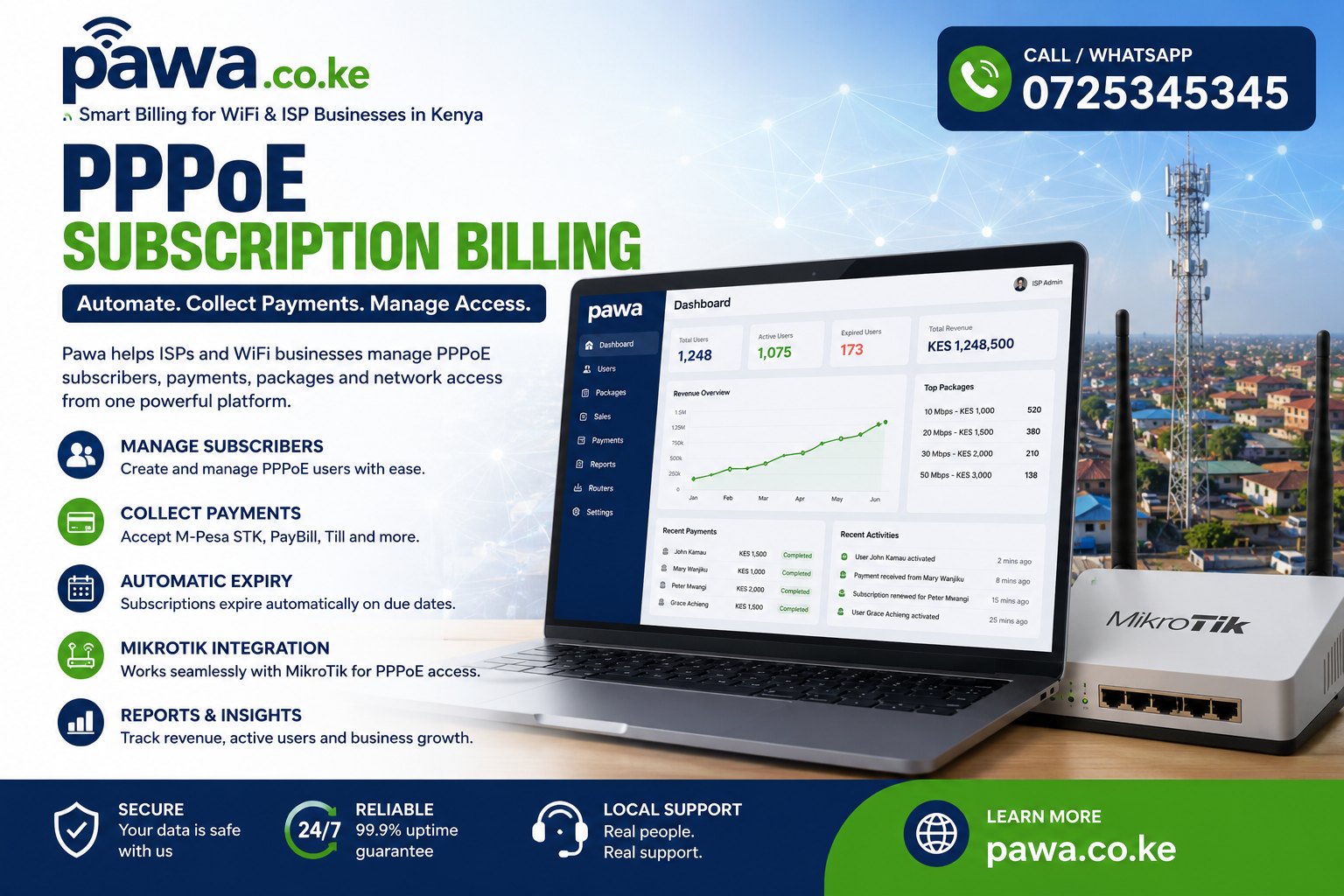
Pawa WiFi is designed around this type of internet billing workflow, supporting both Hotspot and PPPoE management through MikroTik-powered networks.
How PPPoE Billing Works
A typical PPPoE billing setup has several connected components. The ISP has an upstream internet connection, a MikroTik router or compatible network infrastructure, customer accounts, internet packages and a billing platform.
The customer is assigned a PPPoE username and password or another authentication mechanism supported by the network. Their account is associated with a specific subscription package. The package can define factors such as connection speed, price and subscription duration.
When the customer pays, the billing system records the transaction and updates the subscription. The network authentication process then determines whether the subscriber should be allowed to connect.
For example, an ISP could offer a monthly package at KES 2,000. A customer pays KES 2,000 through the available payment channel. Instead of the operator manually checking the transaction and changing the customer’s account, the billing workflow can connect the payment to the subscriber’s account and activate or extend the service.
When the subscription reaches its expiry date, the customer’s access can be suspended according to the ISP’s configuration.
This is the fundamental value of PPPoE subscription billing: connecting the commercial side of the ISP business with the technical side of network access.
Why ISPs Need PPPoE Subscription Billing
Running an ISP manually becomes increasingly difficult as the subscriber base grows.
Imagine an operator with 50 customers. Manually checking payments and updating accounts may still be manageable. At 300 customers, the same process consumes significantly more time. At 1,000 or 3,000 subscribers, manually managing every payment, activation, expiry and renewal can create serious operational problems.
A billing platform gives the ISP a central place to manage customers and subscriptions.
Instead of asking, “Has this customer paid?” the operator can check the subscriber’s account and see the relevant billing information. Instead of manually remembering which accounts should expire at the end of the month, the system can maintain subscription dates.
This reduces repetitive administrative work and makes it easier to identify unpaid or expired accounts.
Pawa’s ISP billing solution specifically focuses on packages, customers, M-Pesa payments, vouchers, router records, invoices and access management for growing internet providers.
PPPoE Subscription Billing for Kenyan ISPs
Kenyan ISPs have a particularly strong reason to automate their billing operations because many customers expect convenient mobile payment options.
M-Pesa can become part of the billing workflow, allowing subscribers to pay for their internet packages without visiting an office. A billing system can then associate payments with customer subscriptions and maintain payment records.
For example, suppose a small estate ISP has 200 subscribers paying KES 1,500 per month.
If all 200 customers pay:
200 × KES 1,500 = KES 300,000 monthly revenue
The challenge is not simply collecting the KES 300,000. The operator also needs to know which customers have paid, which subscriptions are active, which accounts have expired and which customers need follow-up.
A properly configured PPPoE subscription billing platform makes these processes easier to monitor from one dashboard.
PPPoE Billing and MikroTik
MikroTik is commonly used in ISP and WiFi network environments because it provides networking features that can be integrated into automated access-control workflows.
Pawa’s support documentation states that MikroTik is required for its automatic Hotspot or PPPoE access-control workflow, while ordinary home routers cannot run the complete billing automation on their own.
The billing platform can therefore sit between the commercial operation and network infrastructure.
The operator manages the customer and package from the billing platform, while the MikroTik router handles the network-side connection.
This means an ISP can build a workflow where customer information, package selection, payment and network access are connected rather than managed as separate processes.
PPPoE Subscription Billing vs Manual Billing
Manual billing typically involves spreadsheets, notebooks, payment screenshots, SMS messages, WhatsApp conversations and router configuration.
This can work when the ISP is very small, but it becomes increasingly difficult to control as subscriber numbers increase.
Consider an ISP with 500 subscribers.
If each subscriber requires only three minutes of manual billing-related attention every month, that is:
500 × 3 minutes = 1,500 minutes.
That equals 25 hours of administrative work every month.
And that is only three minutes per customer. It does not include customer support, failed payments, reconnections, package changes, payment disputes or technical problems.
Automation can reduce the amount of repetitive work involved in these processes.
The operator can focus more on network performance, customer acquisition and service quality instead of repeatedly updating customer accounts.
PPPoE subscription billing Expiry
Subscription expiry is one of the most important features of a good PPPoE subscription billing system.
Without automation, an ISP may have to maintain a list of customers whose subscriptions expire on different dates.
Customer A might expire on August 5.
Customer B might expire on August 12.
Customer C might expire on August 18.
Customer D might expire on August 25.
With hundreds of customers, tracking these dates manually becomes difficult.
An automated system can associate an expiry date with each subscription and use that information when determining whether the customer should continue receiving service.
Pawa highlights customer expiry records as part of its ISP billing functionality.
M-Pesa and PPPoE Subscription Billing
Payment collection is another major part of ISP billing in Kenya.
A customer should ideally be able to pay for an internet package without requiring the operator to manually confirm every transaction.
Pawa supports M-Pesa-related workflows, including STK payments, while also allowing operators to use their own PayBill or Till according to the selected collection arrangement.
This gives an ISP flexibility in designing its payment process.
For instance, an ISP charging KES 1,000 per month to 500 customers would have potential monthly subscription revenue of:
500 × KES 1,000 = KES 500,000
The billing platform does not create that revenue by itself. The actual business result depends on subscriber acquisition, pricing, network capacity, customer retention and operating costs.
What automation does is make it easier to manage the transactions and subscriptions behind that revenue.
PPPoE subscription billing Packages and Internet Speeds
A billing system can also help an ISP organize different internet packages.
An operator might offer:
- 10 Mbps monthly package
- 20 Mbps monthly package
- 30 Mbps monthly package
- 50 Mbps monthly package
- 100 Mbps premium package
Each package can have its own price and service configuration.
For example, an ISP could sell a 10 Mbps package for KES 1,000 and a 20 Mbps package for KES 1,500.
If 100 customers subscribe to the KES 1,000 package and 50 customers choose the KES 1,500 package:
100 × KES 1,000 = KES 100,000
50 × KES 1,500 = KES 75,000
Total = KES 175,000 per month
The billing system helps the operator distinguish between these subscriptions rather than treating every customer as an identical account.
Managing PPPoE subscription billing Customers
Customer management is another important function of PPPoE subscription billing.
An ISP needs to know who its subscribers are, which package they have, when their subscription expires and whether their account is active.
A customer record might include the subscriber’s name, phone number, account credentials, package, payment history and subscription status.
This information can help customer support teams respond faster.
If a subscriber says, “I paid but my internet is not working,” the operator can check the account and investigate the payment and subscription status rather than starting from scratch.
This is particularly important when an ISP has many customers distributed across different estates or locations.
PPPoE Subscription Billing for Estate Internet
Estate and apartment internet providers are strong candidates for PPPoE billing automation.
An operator may provide internet to 100, 300 or 1,000 apartments through a centralized network.
Each tenant can have an individual subscription.
Suppose an apartment network has 300 subscribers paying KES 1,200 per month.
Potential monthly subscription revenue would be:
300 × KES 1,200 = KES 360,000
The operator needs a reliable way to manage 300 separate subscriptions.
PPPoE billing can help create individual customer accounts while connecting those accounts to the network’s authentication and access-control process.
This can be much easier to manage than maintaining a spreadsheet and manually modifying router accounts.
PPPoE Billing for Small ISPs
You do not need thousands of subscribers before billing automation becomes useful.
A small ISP with 50 or 100 customers can also benefit from establishing proper billing processes early.
Starting with structured billing makes it easier to scale later.
If the ISP reaches 500 subscribers, the operator does not have to completely redesign the billing workflow.
Instead, the same basic system can continue handling customers, packages, payments and expiry records.
This is one reason small internet providers should think about billing infrastructure as part of their business foundation rather than something to install only after the network becomes large.
Multi-Location PPPoE subscription billing
Growing ISPs may operate across several locations.
For example, an operator might have:
- Location A with 150 customers
- Location B with 250 customers
- Location C with 400 customers
The total subscriber base is:
150 + 250 + 400 = 800 customers
At an average monthly subscription of KES 1,200, the theoretical monthly subscription revenue is:
800 × KES 1,200 = KES 960,000
As the number of locations increases, centralized management becomes more important.
Pawa supports business workspaces and router records for operators growing by location.
Revenue Tracking for Internet Providers
A good billing operation should not only activate customers. It should also help the business understand its revenue.
An ISP should be able to determine how much was collected, how many customers are active, which packages are popular and where revenue is coming from.
For example, if an ISP has 600 customers paying an average of KES 1,250 per month:
600 × KES 1,250 = KES 750,000
If 40 customers fail to renew, the number of active paying subscribers falls to 560.
560 × KES 1,250 = KES 700,000
That difference represents KES 50,000 in monthly subscription revenue.
A billing dashboard can make changes in subscriber numbers easier to identify and investigate.
Reducing Revenue Leakage
Revenue leakage is a major problem for growing ISPs.
It can happen when a customer continues receiving service after their subscription expires, when payments are not correctly recorded, when an account is incorrectly activated, or when an operator loses track of manual transactions.
Automation does not eliminate every possible billing problem, but it can create stronger controls.
A subscription can have an expiry date. A payment can have a transaction record. A customer can have an identifiable account.
These records make it easier to reconcile what customers purchased with what the network is providing.
Pawa specifically positions its billing platform around reducing manual payment chasing and connecting payments with automated access.
What to Look for in PPPoE Subscription Billing Software
When choosing PPPoE subscription billing software, an ISP should not focus only on the price.
The first consideration should be network compatibility.
If the ISP uses MikroTik, the billing platform should provide a reliable way to communicate with the router and manage the intended access workflow.
The second consideration is customer management.
The system should make it easy to create subscribers, assign packages, monitor status and handle renewals.
The third consideration is payment integration.
For Kenyan operators, M-Pesa support can be especially important because it gives customers a familiar payment method.
The fourth consideration is reporting.
The operator needs to understand sales, active users, expired subscriptions and other important business information.
The fifth consideration is scalability.
A billing platform should make sense for the ISP today without preventing the business from growing tomorrow.
How Pawa Helps With PPPoE Billing
Pawa is built for PPPoE subscription billing that need to connect internet packages, customer payments, MikroTik routers and access management.
Its platform supports both Hotspot and PPPoE workflows and includes functionality around customer packages, M-Pesa payments, expiry records, router management and revenue tracking.
This makes it relevant to businesses selling internet through estates, apartments, hotspots, venues and growing ISP networks.
Pawa’s current pricing information lists a Starter plan at KES 1,500 per month and a Silver plan at KES 3,500 per month, with the applicable plan depending on the operator’s workspace size. Pawa also states that its own payment collection option adds 5% of net WiFi sales, while operators using their own PayBill or Till do not pay that 5% collection fee.
Hardware, internet connectivity and installation are separate costs, so an ISP should calculate its complete network operating budget rather than looking only at billing software costs.
Is PPPoE Subscription Billing Worth It?
For an ISP managing more than a small number of subscribers, PPPoE subscription billing can be worth implementing because it replaces many repetitive manual tasks with a structured workflow.
The financial value depends on the ISP’s subscriber count, average package price, payment collection costs, bandwidth costs, equipment, support expenses and customer retention.
For example, an ISP with 1,000 customers paying KES 1,500 per month has potential gross subscription revenue of:
1,000 × KES 1,500 = KES 1,500,000 per month.
That KES 1.5 million is not profit. The ISP still needs to pay for upstream bandwidth, infrastructure, power, staff, maintenance, support, premises, taxes and other expenses.
However, when managing this scale of revenue, having a reliable billing and subscription-management process becomes increasingly important.
Advanced PPPoE Subscription Billing for Growing ISPs in Kenya
How PPPoE Subscription Billing Changes ISP Operations
As an internet business grows, the number of tasks involved in serving each subscriber also increases. An ISP does not only provide bandwidth. It must create customer accounts, assign internet packages, collect subscription fees, monitor active accounts, handle renewals, respond to payment problems and manage network access.
This is where PPPoE subscription billing becomes important. Instead of treating billing and network management as two completely separate activities, an ISP can create a connected workflow where the customer’s subscription determines their internet access.
For example, consider an ISP serving 400 residential customers. If the provider charges KES 1,500 per month, the potential monthly subscription value is KES 600,000. If every customer has a different payment date, manually monitoring those accounts becomes difficult. A billing platform can organize those subscriptions so the operator knows which accounts are active, pending renewal or expired.
The benefit is not simply saving time. Better organization can also reduce billing errors and make customer support more efficient.
PPPoE Billing for Recurring Internet Subscriptions
Internet access is naturally suited to recurring subscriptions. Customers generally pay for a defined period of service rather than making a one-time purchase.
An ISP might offer weekly, monthly or longer-term packages depending on its business model.
A monthly package could cost KES 1,000, while a faster package could cost KES 2,000. Business customers might have packages costing KES 5,000 or more depending on bandwidth requirements and service agreements.
A PPPoE subscription billing platform helps the ISP associate each customer with a specific package and subscription period.
When the customer renews, the billing record can be updated. When the subscription reaches its expiry date, the operator can identify the account that requires renewal.
This creates a predictable billing process instead of relying on notebooks, spreadsheets or manually maintained lists.
Managing Different PPPoE Internet Packages
One of the advantages of automated billing is the ability to organize different internet packages.
A growing ISP rarely wants to sell exactly the same package to every customer. Residential customers may require affordable plans, while businesses may need higher speeds and more consistent service.
For example, an ISP could structure its packages around:
Basic Package: KES 1,000 per month.
Standard Package: KES 1,500 per month.
Premium Package: KES 2,500 per month.
Business Package: KES 5,000 per month.
The ISP can then monitor how many customers subscribe to each package.
Suppose 200 customers use the KES 1,000 plan, 150 use the KES 1,500 plan and 50 use the KES 2,500 plan.
The monthly subscription value would be:
200 × KES 1,000 = KES 200,000.
150 × KES 1,500 = KES 225,000.
50 × KES 2,500 = KES 125,000.
Total = KES 550,000 per month.
This kind of breakdown helps an ISP understand which packages are generating revenue and where there may be opportunities to improve pricing or customer acquisition.
PPPoE Customer Activation
Customer activation is another area where billing automation can improve operations.
Traditionally, an ISP employee may need to receive a payment confirmation, locate the customer in a spreadsheet, create or modify the PPPoE account, assign the appropriate package and then inform the customer that the service is active.
Every additional manual step creates another opportunity for an error.
With a connected billing workflow, the customer account, payment and subscription can be associated with each other.
For example, a new customer chooses a KES 1,500 monthly package and completes payment. Once the payment is confirmed, the subscription can be processed according to the ISP’s configured workflow.
The result is a smoother customer onboarding experience.
PPPoE Subscription Renewal
Renewals are critical for an ISP because recurring customers are the foundation of predictable revenue.
Consider an ISP with 1,000 customers paying KES 1,500 monthly. If 950 customers renew, the provider receives:
950 × KES 1,500 = KES 1,425,000.
If only 900 customers renew:
900 × KES 1,500 = KES 1,350,000.
The difference is KES 75,000.
This demonstrates why monitoring subscription renewals matters. An ISP needs to know not only how many customers it has, but also how many customers actually continue paying.
A good PPPoE subscription billing process makes renewal activity easier to track and can help the operator identify customers who have not renewed.
Payment Confirmation and Subscriber Accounts
Payment confirmation can become complicated when an ISP accepts payments through multiple channels.
A customer may pay through M-Pesa, another may use a Till, while a business customer could make a bank transfer.
Without centralized records, staff may have to search through different payment sources to determine whether an account should be activated.
Centralized billing records can make this process easier.
The customer account becomes the reference point. The ISP can associate payments with the subscriber and update the subscription accordingly.
This is especially useful when customer numbers increase.
PPPoE Billing and Customer Support
Billing software can also improve technical support.
Suppose a customer calls and says:
“I paid for internet this morning, but I am still offline.”
The support agent can first check the customer’s account.
The agent can determine whether the subscription is active, whether the payment has been recorded, whether the package is assigned correctly and whether the customer’s account has expired.
If the billing information is correct, the support team can then investigate the network connection.
This creates a logical troubleshooting process:
Payment → Subscription → Account → PPPoE Access → Network Connection.
Without organized billing information, the support team may waste time troubleshooting the router when the actual issue is that the customer’s subscription has not been renewed.
PPPoE Billing for Business Internet Customers
Business customers can be particularly valuable to an ISP because they may purchase higher-value packages.
A residential subscriber might pay KES 1,500 per month, while a business customer may pay KES 5,000, KES 10,000 or more depending on the service.
Suppose an ISP has 50 business customers paying KES 5,000 each.
50 × KES 5,000 = KES 250,000 monthly revenue.
The provider therefore needs accurate records for these accounts.
Business customers may also require invoices, payment histories and clearly defined subscription periods.
A professional PPPoE subscription billing system can help the ISP maintain better records while reducing dependence on manual processes.
PPPoE Billing for Resellers
Some internet businesses do not sell directly to every end user. They may work with resellers, agents or local network operators.
A reseller could purchase connectivity from a larger ISP and distribute it to customers within a particular estate or neighborhood.
As the number of resellers grows, billing becomes more complicated because the upstream provider needs to track accounts and payments separately.
A structured billing platform can provide a foundation for managing these relationships and keeping customer subscriptions organized.
This can be particularly useful for ISPs expanding into multiple neighborhoods without directly managing every customer from a central office.
Scaling From 100 to 1,000 PPPoE Customers
A major advantage of implementing billing automation early is scalability.
An ISP with 100 customers may initially feel that manual billing is easy.
However, growth changes the workload.
At 100 customers, an operator might have 100 subscription records.
At 500 customers, that becomes five times as many accounts.
At 1,000 customers, the operator has to manage 1,000 customer relationships, payment records and subscription statuses.
If the business continues growing, manual processes can become a bottleneck.
A billing system provides a structured foundation that can grow alongside the subscriber base.
Reducing Human Error in ISP Billing
Manual data entry creates the possibility of mistakes.
An employee could enter the wrong customer number, assign the wrong package or record an incorrect expiry date.
Even a small error can affect a customer’s internet service.
For example, if a customer paying KES 2,500 is accidentally assigned a KES 1,000 package, the ISP may provide the wrong service configuration. If the expiry date is entered incorrectly, the customer could lose access earlier than expected.
Automation reduces the number of repetitive manual actions required.
It does not remove the need for proper configuration and monitoring, but it can create a more consistent process.
Using PPPoE Billing Data to Understand Your ISP
Billing data can also help an ISP make better business decisions.
An operator can examine which packages customers prefer, how many subscribers renew each month and how subscriber numbers change over time.
Suppose an ISP has 800 customers.
After reviewing its billing data, the operator discovers that 500 customers are on a KES 1,000 package, 250 are on a KES 1,500 package and 50 are on a KES 3,000 package.
The monthly subscription value is:
500 × KES 1,000 = KES 500,000.
250 × KES 1,500 = KES 375,000.
50 × KES 3,000 = KES 150,000.
Total = KES 1,025,000.
The operator now has a clearer picture of the business than simply knowing that there are 800 subscribers.
PPPoE Billing and Customer Retention
Customer retention is another important consideration.
Acquiring a new subscriber costs money. The ISP may spend money on advertising, installation, customer support and network expansion.
Keeping an existing customer paying every month can therefore be valuable.
Billing records can help identify customers who frequently fail to renew.
If an ISP notices that a group of customers consistently stops renewing after three months, it can investigate possible causes.
The problem might be pricing, network reliability, package suitability or customer service.
Billing data does not automatically solve retention problems, but it gives the ISP information that can support better decisions.
Automating ISP Billing With Pawa
For Kenyan ISPs looking for a structured approach to PPPoE subscription billing, Pawa provides tools for managing internet subscriptions, customer accounts, payment workflows and MikroTik-based access management.
The platform is positioned for WiFi businesses and ISPs that need to manage Hotspot and PPPoE users. Its ISP billing offering includes customer management, packages, M-Pesa payments, router management, expiry tracking and revenue-related functionality. Explore Pawa ISP Billing Software
The key advantage for an ISP is having these processes connected instead of maintaining separate systems for customers, payments and network access.
Building a Reliable PPPoE Billing Workflow
An ISP should approach billing as a complete business process.
The first stage is customer registration.
The second stage is package selection.
The third stage is payment.
The fourth stage is subscription activation.
The fifth stage is network authentication.
The sixth stage is monitoring.
The final stage is renewal or expiry.
When these stages are connected, the ISP can create a much more organized customer journey.
For example:
Customer registers → Selects package → Pays → Subscription activates → PPPoE access is provided → Subscription approaches expiry → Customer renews → Access continues.
This is much easier to scale than manually handling every stage.
PPPoE subscription billing is more than a tool for collecting monthly internet payments. It connects subscribers, packages, payment records, expiry dates and network access into a single operational workflow.
For Kenyan ISPs, estate internet providers, apartment WiFi businesses and growing connectivity operators, this can reduce manual administration and make customer management more systematic.
With MikroTik-based infrastructure and a billing platform such as Pawa, an operator can build a workflow in which customers select internet packages, make payments, receive access and renew subscriptions through a structured process. Pawa supports both Hotspot and PPPoE access management and is specifically positioned for Kenyan WiFi operators and growing ISPs.
If you are building or expanding an ISP business and need to automate PPPoE subscription billing, explore Pawa’s ISP Billing Software or start with the platform’s setup and pricing information.
Frequently Asked Questions
1. What is PPPoE subscription billing?
PPPoE subscription billing is a system that manages internet subscribers, packages, payments, expiry dates and PPPoE network access from a centralized billing workflow.
2. Can PPPoE billing work with MikroTik?
Yes. MikroTik can be used as the network gateway for automated PPPoE access management. Pawa specifically supports MikroTik-based Hotspot and PPPoE workflows.
3. Can customers pay for PPPoE subscriptions using M-Pesa?
Yes. Pawa supports M-Pesa payment workflows, including STK payments, for supported billing setups.
4. Can PPPoE billing automatically handle expired subscriptions?
An appropriately configured billing system can associate customer access with subscription status and expiry, helping operators control access when subscriptions expire.
5. Is PPPoE billing suitable for a small ISP?
Yes. It can be useful even for smaller operators because establishing automated billing early can make it easier to manage customers as the ISP grows.