
Table of Contents
ToggleWhat Is an ISP Billing System With Zero Downtime?
An ISP Billing system with zero downtime is a billing and subscriber-management solution designed to keep critical billing operations available even when individual components experience interruptions. For an internet service provider, billing is not simply an accounting function. It is closely connected to customer subscriptions, payment confirmation, package activation, account expiry and network access.
When an ISP depends on manual billing or disconnected systems, a problem with one part of the operation can quickly affect customers. A payment may not be confirmed, a subscription may fail to renew, or support staff may be unable to determine whether a customer has an active package.
Modern ISP billing therefore needs to be designed around reliability, monitoring, backup procedures and efficient network infrastructure.
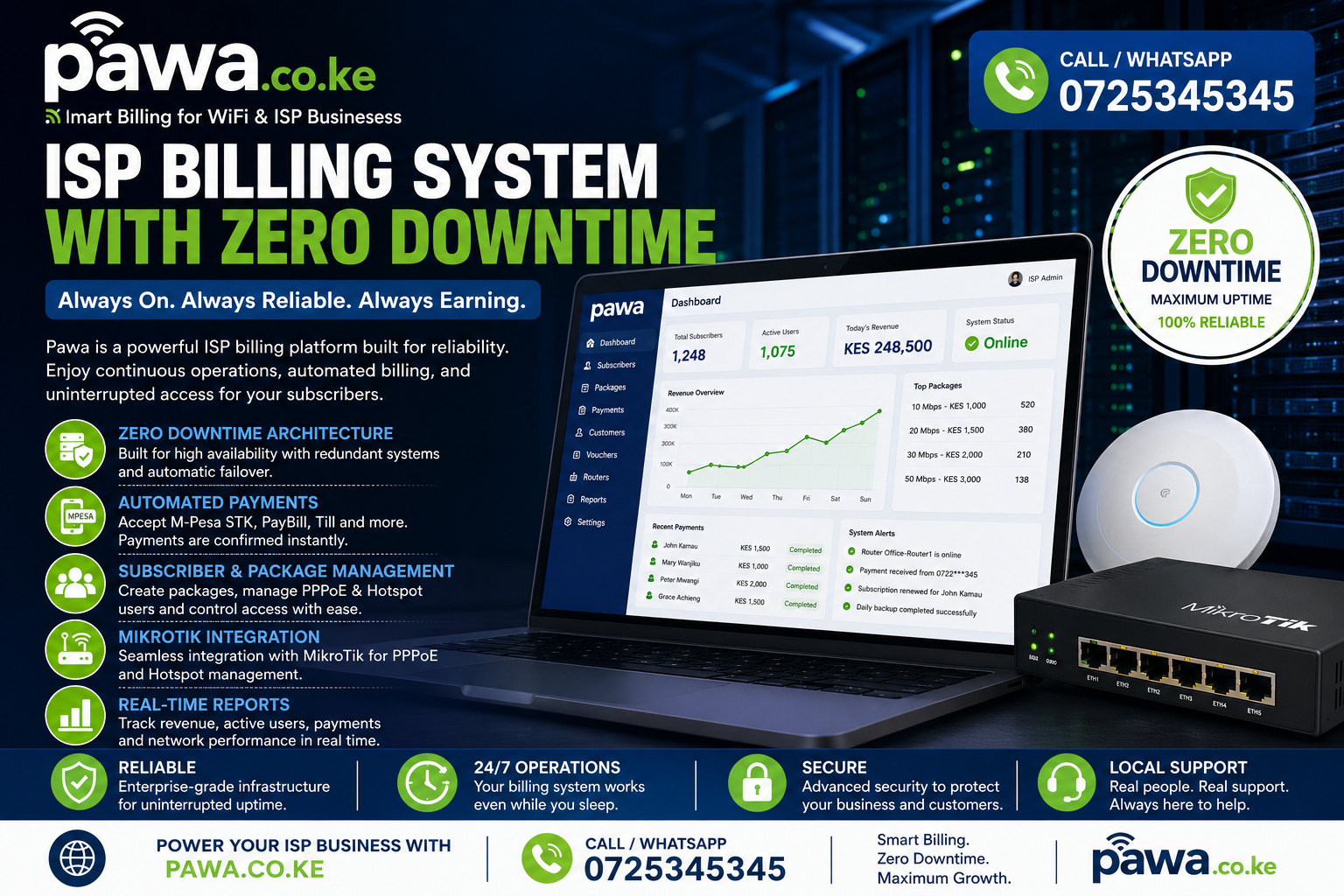
For Kenyan operators, Pawa provides billing tools that connect customer packages, M-Pesa payments, MikroTik-based access management, router records and revenue tracking.
Why Zero Downtime Matters for an ISP
Internet customers expect connectivity to be available whenever they need it. If billing problems repeatedly prevent customers from accessing a service they have already paid for, customer satisfaction can suffer.
Consider an ISP with 1,000 subscribers paying an average of KES 1,500 per month. The theoretical monthly subscription value is:
1,000 × KES 1,500 = KES 1,500,000.
When a billing problem affects a significant portion of those subscribers, the financial impact can quickly become meaningful.
For example, if 50 customers paying KES 1,500 experience a billing-related service interruption, the subscription value associated with those accounts is KES 75,000 for that billing period.
This does not mean every billing outage creates exactly KES 75,000 in losses. Actual losses depend on outage duration, customer contracts, refunds, churn and other factors. However, the example demonstrates why reliable billing infrastructure matters.
Can an ISP Really Guarantee Zero Downtime?
It is important to distinguish between a zero-downtime design goal and an absolute guarantee.
No software platform or network can honestly promise that every possible failure will result in zero interruption. Power failures, upstream internet outages, hardware failures, configuration errors, database problems and other incidents can affect an ISP.
Therefore, an ISP Billing system with zero downtime should be understood as a reliability-focused architecture designed to minimize interruptions and recover quickly when failures occur.
The objective is to eliminate unnecessary billing interruptions while creating processes that allow the ISP to detect, isolate and recover from problems.
This distinction is important when choosing ISP billing software.
How Reliable ISP Billing Supports Network Operations
An ISP billing system sits between business operations and network access.
A simplified workflow looks like this:
Customer → Package → Payment → Billing System → MikroTik → Internet Access
A customer selects a package and makes a payment. The billing system records the transaction and determines the subscriber’s status. The network infrastructure then applies the appropriate access configuration.
Pawa’s current platform is built around MikroTik integration, M-Pesa payments, Hotspot and PPPoE management, customer packages and router visibility.
This connected approach reduces the need for operators to manually update several independent systems.
ISP Billing System With Zero Downtime Payment Processing
Payment processing is one of the most important components of ISP billing.
In Kenya, M-Pesa is particularly important because customers are already familiar with mobile payments. An ISP billing platform can connect payment workflows with subscriber accounts so that operators can track transactions and manage subscriptions more efficiently.
Pawa supports M-Pesa workflows including STK, PayBill and Till options, according to its current website.
Imagine an ISP with 500 customers paying KES 2,000 per month.
500 × KES 2,000 = KES 1,000,000 monthly subscription value.
Managing payments for KES 1 million in monthly subscriptions requires more than a simple spreadsheet. The ISP needs reliable records showing which customers have paid, which accounts require renewal and which transactions need investigation.
MikroTik and ISP Billing Reliability
MikroTik can play an important role in an automated ISP billing environment.
Pawa’s setup documentation states that MikroTik is required for its automated Hotspot and PPPoE access-control workflow. A normal home router can provide internet or function as an access point, but it does not provide the full billing-control workflow by itself.
This architecture allows the ISP to separate responsibilities.
The upstream connection provides internet.
The MikroTik gateway manages network access.
The billing platform manages customers, packages and payment-related workflows.
The customer receives access according to the configured subscription.
This makes it easier to establish a structured ISP operation.
PPPoE Billing and High-Reliability ISP Operations
PPPoE is particularly useful for fixed internet subscribers such as homes, apartments and businesses.
Instead of treating every customer as an anonymous WiFi user, PPPoE allows the ISP to associate a subscriber with an account and authentication credentials.
This makes it easier to manage packages and subscription periods.
A customer might have a 10 Mbps package for KES 1,500 per month. Another customer may have a 30 Mbps package for KES 3,000.
The billing system can associate each account with its relevant subscription.
Pawa supports both PPPoE and Hotspot management from its platform, allowing operators to select the access method that fits their network.
Automatic Subscription Renewal
Subscription renewal is another important part of reliable ISP billing.
A customer should not have to call an ISP every month simply to confirm that a payment has been received and their subscription has been renewed.
A properly designed workflow can connect payment confirmation to subscription status.
For example, a customer whose monthly package costs KES 2,000 can make a payment through the configured payment channel. Once the payment is correctly recognized, the subscription can be updated according to the billing configuration.
This reduces unnecessary manual intervention.
It also allows the ISP support team to concentrate on genuine technical issues instead of repeatedly checking payment screenshots.
Preventing Billing-Related Service Interruptions
Many internet interruptions are not caused by the physical network.
A customer may have excellent signal strength, a working router and sufficient bandwidth but still be unable to browse because their subscription has expired or their payment has not been matched correctly.
An effective billing system should therefore make it easier to identify the difference between:
- Network outage
- Expired subscription
- Failed payment
- Incorrect package
- Authentication problem
- Router connectivity issue
- Customer device problem
Pawa’s support workflow specifically addresses situations where a customer has paid but cannot browse and provides steps for reconnecting or checking payment information.
ISP Billing Monitoring
Monitoring is essential for any provider targeting high availability.
An ISP should know whether its routers are reachable, whether customers are online, whether payments are being processed and whether unusual changes are occurring.
For example, if an ISP normally receives 300 M-Pesa transactions per day but suddenly receives only 40, that could require investigation.
The problem might be a payment integration issue, a marketing change, a network outage or another operational problem.
The important point is that monitoring allows the operator to identify abnormal behavior rather than waiting for customers to complain.
Pawa provides router visibility and billing-related dashboard information as part of its platform.
Backup Internet Connections
An ISP Billing system with zero downtime should be considered alongside the wider network architecture.
Billing software cannot keep customers online when the ISP’s only upstream internet connection fails.
For this reason, growing providers may consider network redundancy.
A basic architecture could include:
Primary Fiber → MikroTik → Customer Network
with:
Backup Connection → Failover → MikroTik → Customer Network
If the primary connection fails, a properly configured failover system can redirect traffic through the backup connection.
The exact setup depends on the ISP’s equipment, providers, routing requirements and budget.
Pawa’s own published guidance recommends internet redundancy for reliability-focused WiFi operations, including a primary connection and a backup connection with automatic failover.
Power Backup for ISP Billing and Network Equipment
Power is another major factor in uptime.
A billing platform can be available online while the physical router, switch or access point at the ISP site is powered off.
This means reliability requires more than software.
An ISP may need:
- UPS systems
- Backup batteries
- Inverters
- Generators where appropriate
- Surge protection
- Proper power distribution
For a small network, a UPS may provide enough short-term protection to bridge brief power interruptions.
For a larger ISP, a combination of UPS, battery backup and alternative power sources may be more appropriate.
Cloud-Based ISP Billing
Cloud-based billing can provide useful operational advantages because administrators do not necessarily need to be physically present at the ISP office to review billing information.
An operator can monitor customers, payments and other business information remotely, depending on the platform’s capabilities and connectivity.
This is particularly useful when an ISP operates multiple locations.
For example, a company might have:
Estate A: 200 customers
Estate B: 300 customers
Estate C: 500 customers
That is a total of 1,000 subscribers.
A centralized billing environment can make it easier to manage those operations rather than maintaining completely separate records.
Pawa supports business workspaces and router records for operators managing different locations and network environments.
Disaster Recovery for ISP Billing
A reliable ISP should also think about what happens when something goes wrong.
Disaster recovery can include:
- Database backups
- Configuration backups
- Router backups
- Recovery procedures
- Alternative payment procedures
- Documented administrator access
- Monitoring and alerts
- Spare networking equipment
The objective is to reduce the time between identifying a failure and restoring normal operations.
For example, if a router configuration is accidentally changed, having a known-good backup can make recovery significantly easier than rebuilding the configuration from memory.
ISP Billing System With Zero Downtime and Customer Experience
Reliability directly affects the customer experience.
Imagine a subscriber paying for a monthly package and receiving internet access within seconds. That is a much better experience than paying, waiting several hours and then calling customer support.
Pawa describes its payment-to-access workflow as customer payment followed by payment confirmation and MikroTik activation.
For an ISP, every unnecessary manual step represents another potential delay.
Automation therefore helps create a more predictable customer journey.
Reducing Manual Billing Errors
Manual billing can create several problems.
An employee might enter the wrong phone number, record an incorrect amount or forget to update an expiry date.
Suppose an ISP has 800 customers and only 2% of accounts experience a manual billing error during a particular cycle.
That would represent:
800 × 2% = 16 accounts.
Sixteen customers requiring billing correction can create a significant support workload.
Automation cannot eliminate all errors, but it can reduce repetitive data entry and establish consistent workflows.
Reliable Billing for Growing ISPs
An ISP should choose billing software according to its current needs while considering future growth.
A business with 100 subscribers may eventually reach 500.
An ISP with 500 customers may later reach 2,000.
The billing platform should therefore be able to support the operator’s expansion strategy.
Pawa currently lists a Starter plan at KES 1,500 per month and a Silver plan at KES 3,500 per month, with plan limits and payment-collection charges depending on the selected setup.
The ISP should also budget separately for MikroTik hardware, access points, cabling, installation and internet connectivity because these are not necessarily included in the software subscription.
How Much Can an ISP Save Through Billing Automation?
The savings depend on the ISP’s size and existing workflow.
Consider an ISP with 600 subscribers.
If manual billing activities require an average of four minutes per customer per month, the total administrative time is:
600 × 4 minutes = 2,400 minutes.
That equals 40 hours per month.
At 1,000 customers, the same process would require:
1,000 × 4 minutes = 4,000 minutes.
That is approximately 66.7 hours per month.
These calculations do not mean that every ISP will save exactly those hours by implementing software. They demonstrate why repetitive billing administration becomes increasingly expensive as subscriber numbers increase.
Choosing an ISP Billing System With High Availability in Mind
Before choosing billing software, an ISP should ask several questions.
Does the platform support the network equipment being used?
Can it manage PPPoE and/or Hotspot users?
Can customers pay using the preferred payment methods?
How are customer expiry dates managed?
How are routers monitored?
What happens if a payment is delayed?
How are backups handled?
How can the operator access support?
Can the system support multiple locations?
These questions are more useful than choosing software based solely on the cheapest monthly price.
Reliable ISP Billing for 24/7 Internet Businesses
An internet service provider operates differently from an ordinary business because customers expect the service to be available throughout the day and night. A customer may need internet access early in the morning, during business hours or late at night. This makes reliability a core part of the ISP business model.
An ISP Billing system with zero downtime helps operators build a billing environment where subscriber accounts, payments and service access can be managed consistently. Instead of depending on manual spreadsheets and physical records, the ISP can use an automated platform to organize customer subscriptions and billing activity.
For a business selling hundreds or thousands of subscriptions every month, this organization can make a substantial difference.
The Connection Between Billing and Internet Availability
Billing and network availability are closely connected in a subscription-based ISP.
When a customer pays for internet, the payment should be associated with the correct account. The account should have the correct package and subscription period. The network should then recognize the customer’s active status.
A breakdown anywhere in this process can create a customer complaint.
For example, a customer could successfully send KES 2,000 through M-Pesa but remain disconnected because the payment was not properly associated with the account. From the customer’s perspective, the internet is not working even though the physical network may be completely operational.
An automated ISP billing workflow can reduce these unnecessary interruptions by connecting payment records and subscriber status.
High Availability Starts With Good ISP Infrastructure
Software alone cannot create a zero-downtime ISP.
A reliable billing operation needs reliable infrastructure around it.
An ISP should consider the availability of its:
- Billing platform
- MikroTik router
- Internet upstream connection
- Core switches
- Access points
- Power supply
- Payment integrations
- Database or customer records
- Monitoring systems
- Backup configurations
If the ISP’s router loses power, customers may go offline regardless of how reliable the billing software is.
Similarly, if the upstream internet provider experiences an outage, the billing platform cannot restore the physical internet connection.
This is why an ISP Billing system with zero downtime should form part of a wider business continuity strategy.
ISP Billing and Automatic Failover
Internet redundancy is an important consideration for ISPs that want to minimize downtime.
A small provider might begin with one fiber connection. As the subscriber base grows, depending entirely on one provider creates a single point of failure.
An ISP could introduce a second connection from another provider.
For example:
Primary Internet: Fiber connection
Secondary Internet: Wireless or alternative fiber connection
A properly configured MikroTik router can be used to implement failover according to the ISP’s network design.
If the primary connection fails, traffic can be redirected through the secondary connection.
The billing platform and customer database still need their own reliability measures, but network redundancy helps protect the actual internet service.
Why Payment Automation Matters for ISP Uptime
Payment automation can indirectly improve service availability.
Imagine an ISP with 700 customers. Every month, hundreds of payments must be processed and matched to customer accounts.
If staff members manually verify each payment, there can be delays.
A customer might pay at 9:00 AM but remain disconnected until an employee checks the transaction later.
That creates an avoidable service interruption.
With automated payment workflows, the time between payment and subscription processing can be reduced.
For Kenyan ISPs, M-Pesa integration is particularly useful because mobile payments are already widely used for internet subscriptions.
Pawa supports M-Pesa payment workflows as part of its ISP billing platform. Pawa ISP Billing Platform
ISP Billing System for Apartment Internet
Apartment internet businesses can benefit significantly from reliable billing automation.
A provider may have a central network serving several residential buildings. Each tenant can have an individual subscription.
Suppose a provider serves 600 apartments at KES 1,500 per month.
The potential monthly subscription value is:
600 × KES 1,500 = KES 900,000.
Managing 600 individual subscriptions manually can become difficult.
A centralized ISP billing system can help the provider organize customers according to their accounts and packages.
When a tenant renews, the subscription record can be updated. When the subscription expires, the account status can be identified.
This gives the ISP greater visibility over its subscriber base.
Zero-Downtime Billing for Estate WiFi
Estate WiFi operators often have customers with different payment dates.
One customer may subscribe on the first of the month while another joins on the 15th.
Without automated subscription management, the operator may have to maintain hundreds of different expiry dates.
An ISP Billing system with zero downtime can help organize these customer lifecycles.
The operator can see which customers are active and which accounts require attention.
This becomes especially important when an estate has several hundred tenants using the same network infrastructure.
Reliable Subscriber Management for Modern ISPs
An ISP Billing system with zero downtime should make subscriber management easier from the moment a customer signs up. Instead of maintaining customer information in separate spreadsheets, notebooks and payment records, an ISP Billing system with zero downtime can provide a structured environment where customer details, packages, payments and subscription status are connected.
For a growing provider, an ISP Billing system with zero downtime can reduce the administrative workload associated with hundreds or thousands of subscribers. The operator can organize customers according to their packages, locations, account status and subscription periods.
A properly configured ISP Billing system with zero downtime also gives customer support teams a clearer picture of each subscriber’s account. When a customer reports a connection problem, staff can first verify whether the account is active and whether the latest payment has been recorded.
Continuous Billing Operations for Growing Networks
An ISP Billing system with zero downtime is especially useful for businesses that operate subscription-based internet services throughout the day. Customers can make payments at different times, including evenings, weekends and public holidays.
An ISP Billing system with zero downtime should therefore be designed around availability rather than depending entirely on an employee being physically present in the office.
When an ISP uses an ISP Billing system with zero downtime, subscription information can be maintained consistently even when the business is managing customers remotely.
For a Kenyan ISP serving several estates, an ISP Billing system with zero downtime can help centralize billing operations while the actual network infrastructure remains distributed across different locations.
Better Payment-to-Internet Access Workflows
The connection between payment and internet access is one of the most important parts of ISP automation.
An ISP Billing system with zero downtime can help create a workflow where customers pay for their selected packages and their subscription status is updated according to the configured billing rules.
With an ISP Billing system with zero downtime, the operator can reduce the number of manual steps between receiving a payment and updating a subscriber’s account.
A reliable ISP Billing system with zero downtime can also help reduce situations where a customer has already paid but still appears on an outdated customer list.
This makes an ISP Billing system with zero downtime particularly valuable for providers that receive large numbers of daily mobile-money transactions.
Supporting M-Pesa-Based Internet Businesses
Kenyan internet businesses frequently rely on mobile payments because customers want convenient ways to renew their subscriptions.
An ISP Billing system with zero downtime can help an operator organize payment information and associate transactions with subscriber accounts.
For an ISP receiving hundreds of payments every month, an ISP Billing system with zero downtime can make it easier to identify successful transactions, pending subscriptions and accounts requiring attention.
A provider can also use an ISP Billing system with zero downtime as part of a broader strategy for improving payment reconciliation and customer service.
The goal of an ISP Billing system with zero downtime is not simply to collect money. It is to make the complete subscription lifecycle easier to manage.
Managing PPPoE and Hotspot Customers
Different internet businesses use different access technologies.
Some providers use PPPoE for residential and business subscribers, while others operate Hotspot networks in apartments, campuses, restaurants, shopping centers and public spaces.
An ISP Billing system with zero downtime can be valuable when an operator needs to manage different subscriber access models.
For PPPoE customers, an ISP Billing system with zero downtime can connect subscription information with authentication and access-control workflows.
For Hotspot customers, an ISP Billing system with zero downtime can support package-based access where customers purchase a defined amount of internet access.
This flexibility makes an ISP Billing system with zero downtime relevant to more than traditional fiber ISPs.
Protecting ISP Revenue
Every active customer represents potential recurring revenue for an ISP.
Suppose a provider has 750 customers paying an average of KES 1,400 per month.
750 × KES 1,400 = KES 1,050,000 per month in potential subscription revenue.
An ISP Billing system with zero downtime can help the provider maintain better visibility over this customer base.
When an ISP Billing system with zero downtime is combined with accurate payment records, operators can more easily identify accounts that have renewed and accounts that require follow-up.
The purpose of an ISP Billing system with zero downtime is therefore closely connected to revenue protection as well as customer management.
Avoiding Unnecessary Customer Disconnections
One of the most frustrating experiences for an internet customer is being disconnected despite having paid.
An ISP Billing system with zero downtime can help reduce billing-related disconnections by keeping subscription information and payment records organized.
A customer who pays KES 2,000 for a monthly package should have their account correctly associated with that subscription.
An ISP Billing system with zero downtime helps create a clearer process for handling that transaction.
When properly configured, an ISP Billing system with zero downtime can distinguish between a genuinely expired subscription and a customer whose payment has already been received.
This can reduce unnecessary calls to customer support.
Better ISP Customer Experience
Customers judge internet providers on more than connection speed.
They also consider how easy it is to pay, how quickly payments are recognized and how efficiently problems are resolved.
An ISP Billing system with zero downtime can contribute to a better customer experience by reducing billing friction.
For example, a customer can pay for their package without needing to send a screenshot to an employee every month.
An ISP Billing system with zero downtime can help the ISP establish a more predictable renewal process.
The result is a more professional experience for subscribers and fewer repetitive administrative tasks for staff.
Scaling an ISP Without Scaling Administrative Work
A major advantage of an ISP Billing system with zero downtime is the ability to support business growth without increasing manual billing work at the same rate.
If an ISP grows from 200 to 1,000 customers, its customer base increases by 800 accounts.
Without automation, the administrative workload can increase dramatically.
With an ISP Billing system with zero downtime, many repetitive processes can be structured around software instead of individual manual actions.
This means an ISP Billing system with zero downtime can become an important part of an ISP’s growth strategy.
Reliable Billing Across Multiple Locations
A provider operating in several estates or neighborhoods needs centralized visibility.
For example, an ISP could have 300 customers in one estate, 250 in another and 450 in a third location.
That creates a total of 1,000 subscribers.
An ISP Billing system with zero downtime can help the operator manage these customers from a central billing environment.
With an ISP Billing system with zero downtime, the provider can organize subscriber records while maintaining visibility into different routers and network locations.
This approach can make an ISP Billing system with zero downtime particularly useful for companies expanding beyond a single neighborhood.
Reporting and Business Intelligence
Billing data can provide valuable information about an ISP’s performance.
An ISP Billing system with zero downtime can help operators understand subscriber numbers, package distribution, payments and account activity.
For example, if 600 customers are on a KES 1,000 package and 200 customers are on a KES 2,000 package, the operator can calculate the potential subscription value.
600 × KES 1,000 = KES 600,000.
200 × KES 2,000 = KES 400,000.
Total = KES 1,000,000.
An ISP Billing system with zero downtime can make this type of information easier to organize and analyze.
The information generated through an ISP Billing system with zero downtime can also help an operator evaluate which packages are performing well.
Monitoring Subscription Expiry
Subscription expiry should be handled carefully because it directly affects both customer access and revenue.
An ISP Billing system with zero downtime can organize expiry information so operators can identify customers whose subscriptions are approaching their renewal dates.
Instead of checking hundreds of records manually, an ISP Billing system with zero downtime can provide a more structured approach to monitoring account status.
This makes an ISP Billing system with zero downtime useful for businesses with daily, weekly or monthly internet packages.
Reducing Dependence on Spreadsheets
Spreadsheets can be useful during the early stages of an ISP business, but they become increasingly difficult to manage as customer numbers increase.
An ISP Billing system with zero downtime provides a more purpose-built approach to subscription management.
Rather than maintaining one spreadsheet for customers and another for payments, an ISP Billing system with zero downtime can bring important information into a centralized workflow.
This can reduce duplication and make it easier for different members of an ISP team to access the information they need.
Building a More Professional ISP Business
An ISP Billing system with zero downtime can also contribute to the professional image of an internet business.
Customers expect modern providers to offer convenient payments, predictable renewals and quick account updates.
When an ISP uses an ISP Billing system with zero downtime, many of these processes can be standardized.
For a provider competing against other ISPs in Kenya, an ISP Billing system with zero downtime can therefore become part of the operational infrastructure supporting customer acquisition and retention.
Why Choose Pawa for ISP Billing?
Pawa is designed to help Kenyan WiFi businesses and ISPs manage internet subscriptions, payments and network access.
For businesses searching for an ISP Billing system with zero downtime, Pawa provides a platform focused on ISP and WiFi billing workflows, including customer management, packages, M-Pesa payment options, MikroTik integration and Hotspot and PPPoE management.
The objective of an ISP Billing system with zero downtime should be to minimize unnecessary interruptions while giving the operator better control over customers and payments.
An ISP Billing system with zero downtime should also be combined with reliable network hardware, backup power, internet redundancy and appropriate monitoring.
Zero Downtime Is a Complete ISP Strategy
It is important to understand that an ISP Billing system with zero downtime is only one component of a highly available ISP operation.
The billing platform cannot prevent an upstream fiber cut.
It cannot repair a failed MikroTik router.
It cannot restore electricity after a major power failure.
Instead, an ISP Billing system with zero downtime should form part of a larger reliability strategy.
That strategy can include backup internet connections, UPS systems, redundant equipment, configuration backups and clear recovery procedures.
When these components work together, the ISP can reduce the risk of prolonged interruptions.
The Future of Reliable ISP Billing in Kenya
The Kenyan internet market continues to create opportunities for smaller ISPs, estate WiFi providers, apartment networks and specialized connectivity businesses.
As these businesses grow, billing automation will become increasingly important.
Customers expect fast payment confirmation, reliable service and convenient subscription management.
ISPs therefore need systems that can support these expectations without creating unnecessary administrative work.
An ISP Billing system with zero downtime represents a broader move toward reliable, automated and scalable internet business operations.
The objective is not simply to collect money. It is to create a system where payments, subscriptions and internet access work together as efficiently as possible.
Why Pawa Is a Practical Option for Kenyan ISP Operators
Pawa is designed for Kenyan WiFi operators and growing ISPs that want to manage payments, packages, customers and network access from one platform.
Its current ISP billing offering includes M-Pesa STK collection, customer expiry records, vouchers, router connection testing, Hotspot deployment and payout tracking.
Its main platform also supports MikroTik connectivity, M-Pesa payments and both Hotspot and PPPoE operations.
For an ISP focused on reliable operations, these capabilities can provide a foundation for connecting billing administration with network access.
Building a Zero-Downtime Mindset
The best way to approach an ISP Billing system with zero downtime is to think beyond the billing software itself.
Reliability is a combination of:
Reliable billing software + reliable MikroTik configuration + backup power + internet redundancy + monitoring + backups + good support procedures.
If any one component becomes a major single point of failure, the overall service can still experience downtime.
An ISP therefore needs to design the complete operation around resilience.
Remarks on ISP Billing System With Zero Downtime
An ISP Billing system with zero downtime is ultimately about creating a billing operation that remains dependable, minimizes service interruptions and allows the ISP to recover quickly when problems occur.
For Kenyan ISPs, automated billing can connect M-Pesa payments, customer subscriptions, PPPoE or Hotspot access, MikroTik infrastructure and revenue tracking into a more organized workflow.
Pawa provides a platform specifically designed around these requirements, with MikroTik integration, M-Pesa payment workflows, Hotspot and PPPoE support, customer management and router visibility.
However, true network reliability requires more than software. ISPs should also consider backup internet connections, power protection, monitoring, configuration backups and appropriate network redundancy.
If you are building a new ISP, expanding an estate WiFi network or trying to replace manual billing, you can explore Pawa’s ISP Billing Software and review its current setup and pricing information. Pawa lists +254 725 345 345 as its support phone number.
Frequently Asked Questions
What is an ISP Billing system with zero downtime?
It is a reliability-focused billing system designed to keep subscriber management, payment processing and access-control operations available with minimal interruption. Zero downtime should be treated as a design objective rather than an absolute guarantee.
Can Pawa manage PPPoE subscribers?
Yes. Pawa supports PPPoE and Hotspot management through MikroTik-based infrastructure.
Does Pawa support M-Pesa payments?
Yes. Pawa currently supports M-Pesa workflows including STK, PayBill and Till options, depending on the selected payment setup.
Does an ISP billing system prevent internet outages?
No. Billing software does not by itself prevent physical network or upstream internet outages. An ISP needs appropriate redundancy, backup power, monitoring and network infrastructure to improve overall availability.
How can I make my ISP billing more reliable?
Use automated billing, reliable payment integration, MikroTik-based access control, monitoring, backups, documented recovery procedures, backup power and redundant internet connectivity where appropriate.