
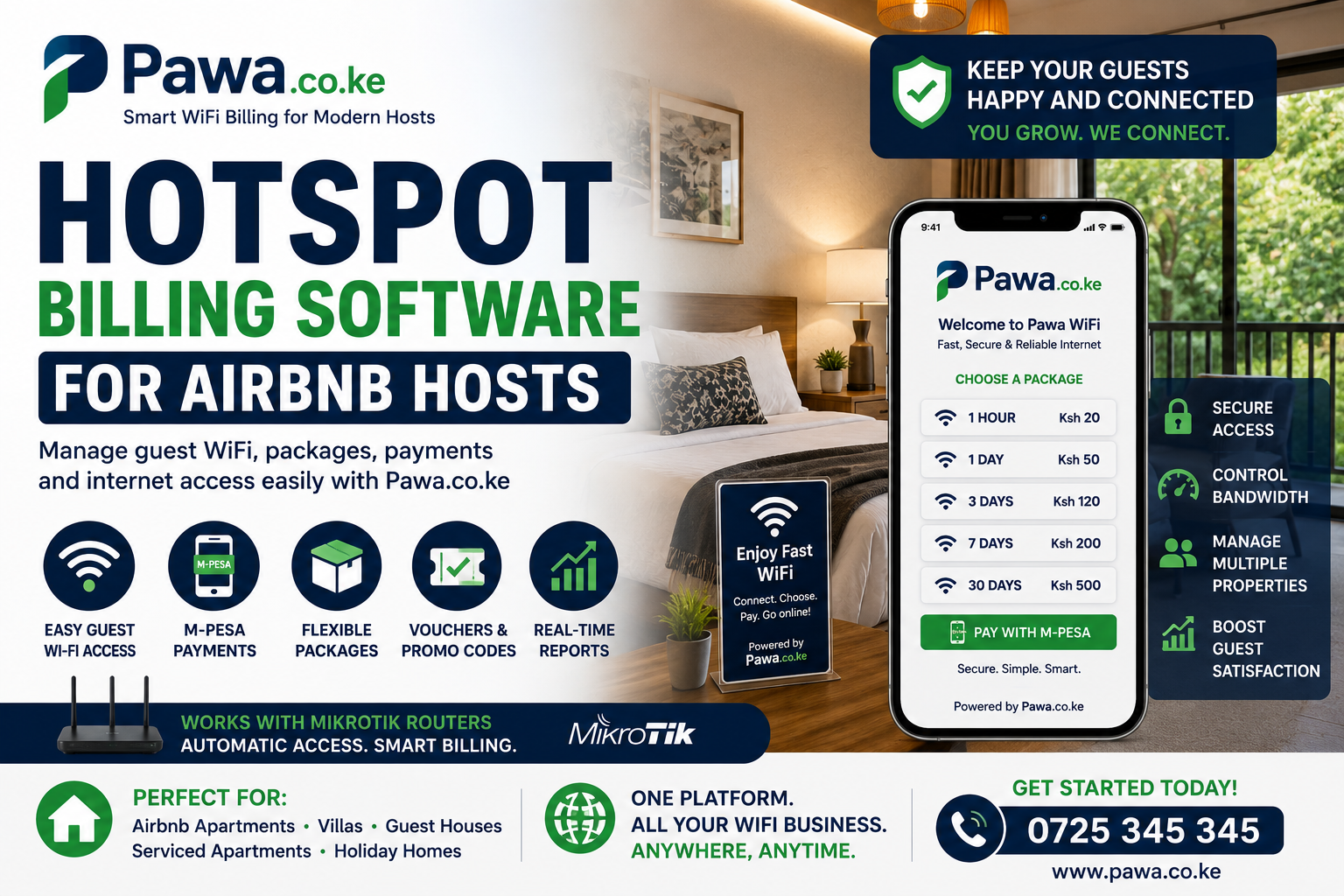
Hotspot Billing Software for Airbnb Hosts in Kenya
Running an Airbnb property means managing much more than bookings, cleaning, check-ins and guest communication. Reliable internet has become an important part of the guest experience, particularly for business travelers, remote workers, international visitors and guests staying for several days.
For Airbnb hosts who want to provide paid, prepaid or managed WiFi access, hotspot billing software for Airbnb hosts can provide a structured way to manage internet packages, payments, customer access and network usage.
Instead of relying on a shared WiFi password, an Airbnb host can create a managed hotspot where guests connect to the network, select an available package where applicable, make a payment and receive internet access according to the package rules.
Pawa.co.ke provides a WiFi billing platform built around MikroTik routers, hotspot packages, M-Pesa payments, customer management, vouchers and automated internet access. Pawa currently describes a workflow in which customers select a package, pay through M-Pesa and have access activated through MikroTik. (Pawa WiFi)
Hotspot Billing Software for Airbnb Hosts in Kenya
Airbnb properties have different internet requirements from ordinary public hotspots.
A guest may need WiFi for a few hours, an entire day, several days or throughout their stay. Some guests may only require basic browsing, while others may work remotely, attend online meetings, stream content or use multiple connected devices.
This makes flexibility important.
A hotspot billing system can allow a host or property operator to create different access packages instead of giving every guest the same unrestricted password.
For example, a host could create hourly, daily, weekly or longer packages depending on the property’s business model. Pawa supports configurable hotspot packages and describes common hourly, daily, weekly and monthly package structures. (Pawa WiFi)
The exact pricing should be determined by the host’s property, internet costs, guest expectations and business model rather than copied from another Airbnb.
Hotspot Billing Software for Airbnb Hosts Who Want Automated WiFi
Managing WiFi manually can become inconvenient when a host operates several properties.
Imagine an operator managing five Airbnb apartments. Every property has its own guests, router, WiFi network and internet connection. If the operator relies on one shared password at every location, it becomes difficult to determine who is connected, when access should expire and how much bandwidth each user consumes.
A managed hotspot system introduces more structure.
The guest connects to the WiFi network and can be directed to a captive portal. The portal can present available packages and payment options. After successful payment, the billing system can communicate with the MikroTik router to activate the customer’s access.
Pawa’s documented workflow connects package selection, M-Pesa payment confirmation and MikroTik access activation. (Pawa WiFi)
This can reduce the amount of manual work required from the host.
Hotspot Billing Software for Airbnb Hosts Using M-Pesa
M-Pesa is particularly useful for Kenyan Airbnb operators because guests can make payments from their phones without requiring cash.
Pawa’s M-Pesa WiFi billing workflow supports STK Push as well as operator-owned PayBill or Till arrangements. Payments can be linked to customers, plans, transactions and access records. (Pawa WiFi)
A typical customer journey can work like this:
The guest connects to the property’s WiFi.
The guest is presented with the hotspot portal.
The guest chooses an internet package.
The guest initiates an M-Pesa payment.
The payment is confirmed.
The guest receives the appropriate internet access.
The package eventually expires according to its configured duration.
This is significantly more organized than manually confirming screenshots and changing passwords.
Hotspot Billing Software for Airbnb Hosts With Multiple Properties
Managing one Airbnb apartment is relatively simple.
Managing ten properties is different.
When a host expands, internet administration can become another operational responsibility. Different apartments may have different routers, internet providers, network capacities and customer volumes.
A centralized billing platform can help organize these operations.
Pawa’s ISP billing platform is designed to support multiple routers and locations, with router records, customer information, packages, vouchers and payment-related information managed through the platform. (Pawa WiFi)
For example, an Airbnb operator could have:
Apartment A with one MikroTik router.
Apartment B with another router.
Apartment C with a different internet connection.
A larger property with multiple access points.
Rather than treating every network as a completely separate manual operation, the host can structure the locations within a managed WiFi environment.
Hotspot Billing Software for Airbnb Hosts Who Need Guest Access Control
Guest WiFi security is another important consideration.
A shared password can easily be forwarded to other people. A previous guest may still know the password weeks after checking out. A guest may also connect multiple devices without the host having a clear way to manage those connections.
A hotspot billing system can provide more controlled authentication.
Instead of relying exclusively on a permanent password, customers can receive access according to a defined package or account.
Pawa’s hotspot workflow is designed around MikroTik access control, customer packages, expiry management and hotspot users. (Pawa WiFi)
This gives the host greater visibility into the access system.
Hotspot Billing Software for Airbnb Hosts and Short-Term Rentals
Short-term accommodation is especially suitable for flexible internet packages because guests do not necessarily have long-term internet requirements.
Consider a guest staying for two nights.
The host could provide WiFi access for the duration of the stay as part of the accommodation package.
Alternatively, a property operating as a broader paid WiFi venue could offer guests additional packages for higher speeds or longer access.
The business model depends on how the host wants to position the internet service.
For many Airbnb properties, WiFi will simply remain an included amenity. In other accommodation businesses, however, controlled paid access may be appropriate.
The important point is to design the billing model around the property’s actual guest experience.
Hotspot Billing Software for Airbnb Hosts Who Want to Sell Internet Packages
A host operating paid WiFi can create different packages based on duration or service characteristics.
For example, an operator might test:
A one-hour package.
A six-hour package.
A one-day package.
A three-day package.
A seven-day package.
A premium package.
These examples are not recommended universal prices. They demonstrate how packages can be structured.
A host should analyze guest behavior before setting prices.
If most guests stay for two nights, a three-day package may be more relevant than a seven-day package.
If most guests are business travelers who need internet during working hours, a short high-speed package could be more useful.
The objective is to make the packages understandable and commercially practical.
Hotspot Billing Software for Airbnb Hosts Who Need Bandwidth Management
Not every Airbnb guest uses the internet in the same way.
One guest might use WhatsApp and email.
Another might stream high-definition video.
Another might work remotely and participate in video conferences.
Another might connect a laptop, phone, tablet and smart television simultaneously.
Without bandwidth management, heavy usage from one customer can affect everyone else.
Pawa’s MikroTik-based approach can be used to manage hotspot profiles and access rules, allowing operators to structure different package profiles and rate limits. (Pawa WiFi)
For Airbnb hosts, bandwidth management can help maintain a more predictable experience.
A property with ten guests using one connection needs different network planning from a property with two guests.
Hotspot Billing Software for Airbnb Hosts and Guest Experience
Internet quality can influence how guests perceive an accommodation property.
A guest working remotely may consider reliable internet essential.
A family may need WiFi for entertainment.
An international traveler may depend on internet connectivity for maps, communication and travel arrangements.
A student or digital nomad may require internet throughout the day.
This means the WiFi experience should be considered part of the overall property operation.
A billing platform cannot fix a weak internet connection by itself. The host still needs an appropriately sized internet service, suitable networking equipment and good WiFi coverage.
However, billing software can help organize the commercial and access-control side of the network.
Hotspot Billing Software for Airbnb Hosts Using MikroTik
Pawa requires a compatible MikroTik router for its automated hotspot and PPPoE access-control workflows. (Pawa WiFi)
MikroTik can act as the network gateway between the internet connection and guest devices.
A simplified structure can look like this:
Internet connection → MikroTik router → access points → guest devices → Pawa billing and authentication workflow
The router controls network access while the billing platform manages packages, customer information and payment workflows.
This setup is particularly useful for hosts who want more control than a standard consumer WiFi router provides.
Hotspot Billing Software for Airbnb Hosts With Captive Portals
A captive portal gives guests a dedicated page before they receive internet access.
Instead of simply entering a permanent WiFi password, the customer can be presented with a branded login or purchasing experience.
A portal can display:
Property or business name.
Available packages.
Payment instructions.
Login information.
Terms of use.
Customer support details.
Access status.
Expiry information.
Pawa supports hotspot portal deployment as part of its WiFi billing workflow. (Pawa WiFi)
For an Airbnb operator, this creates a more professional guest-facing experience.
Hotspot Billing Software for Airbnb Hosts Who Manage Vouchers
Some accommodation operators may prefer voucher-based access.
For example, a property manager could generate WiFi vouchers for guests during check-in.
The guest receives a voucher and uses it to access the network.
This approach can be useful when the host does not want every guest to make an M-Pesa payment.
Pawa supports voucher-style access alongside M-Pesa hotspot purchases. Its MikroTik voucher system supports package profiles, voucher sales and synchronization of package settings with RouterOS profiles. (Pawa WiFi)
This gives operators flexibility in how they provide internet access.
Hotspot Billing Software for Airbnb Hosts and Property Managers
An Airbnb host may eventually manage several units or properties.
At that point, the business starts to resemble a small accommodation operation rather than a single-property hosting business.
The operator may have to manage:
Guest bookings.
Cleaning schedules.
Property maintenance.
Internet connections.
Router equipment.
WiFi complaints.
Payments.
Access credentials.
Internet usage.
Customer support.
Automating WiFi billing can remove some repetitive administrative tasks.
Instead of manually creating access for every guest, the operator can establish package rules and allow the billing system to handle the access workflow.
Hotspot Billing Software for Airbnb Hosts Who Want Better Revenue Tracking
If WiFi is being sold separately, revenue tracking becomes important.
Suppose a property generates KES 500 in WiFi sales on Monday, KES 800 on Tuesday and KES 1,200 on Wednesday.
The operator needs to know whether the revenue is growing, falling or remaining stable.
Pawa provides revenue and transaction visibility within its operator dashboard, with customer, package and M-Pesa information connected to the broader billing workflow. (Pawa WiFi)
This can help an operator answer questions such as:
Which package sells most?
Which property generates the most WiFi revenue?
What are the busiest periods?
How many active users are there?
How much money is being collected?
Which customers have expired packages?
These insights are more useful than manually checking payment messages.
Hotspot Billing Software for Airbnb Hosts and Internet Costs
WiFi billing should never be separated from the underlying internet cost.
Suppose an Airbnb property spends KES 5,000 per month on internet and generates KES 12,000 in paid WiFi sales.
The difference is KES 7,000 before other costs.
If the operator spends another KES 2,000 on electricity and network-related expenses, the remaining amount becomes KES 5,000 before other business costs.
This demonstrates why revenue is not the same as profit.
An Airbnb host should calculate:
Internet subscription.
Billing software.
Electricity.
Router equipment.
Access points.
Maintenance.
Installation.
Payment-related costs.
Property agreements.
Technical support.
Equipment replacement.
Only after accounting for these expenses can the operator determine whether paid WiFi makes financial sense.
Hotspot Billing Software for Airbnb Hosts and WiFi Pricing
Pricing should reflect the property and target customer.
A luxury apartment serving business travelers may have different internet expectations from a budget room serving short-term visitors.
A host should consider whether WiFi will be:
Included in the accommodation price.
Included up to a specific usage limit.
Sold as an optional package.
Available as a premium high-speed service.
Provided through vouchers.
The simplest model is often to include reliable WiFi in the accommodation price.
However, operators running dedicated paid hotspot networks may use billing software to manage additional packages.
The correct model depends on the property.
Hotspot Billing Software for Airbnb Hosts Who Want Premium WiFi
Premium internet can be useful when the property attracts guests who depend heavily on connectivity.
A host could potentially structure different service levels.
A standard package might provide ordinary browsing.
A premium package could provide higher bandwidth.
A longer package could support extended stays.
Again, the network must actually have enough capacity to deliver the promised experience.
There is little value in selling a premium package if the upstream connection cannot support it.
The host should test network performance during peak usage before making performance claims.
Hotspot Billing Software for Airbnb Hosts and Remote Workers
Remote workers represent an important potential customer segment for short-term accommodation.
A guest working from an Airbnb may need:
Video conferencing.
Cloud applications.
Email.
VPN connections.
File transfers.
Web applications.
Online collaboration tools.
A stable connection can therefore be a major property selling point.
For hosts targeting remote workers, network design should prioritize stability rather than simply advertising a large theoretical internet speed.
Multiple access points may be necessary in larger properties.
The router should have enough capacity.
The upstream connection should be reliable.
Power interruptions should be considered.
A billing platform can manage access, but the physical network remains fundamental.
Hotspot Billing Software for Airbnb Hosts and Network Security
Security should be considered when providing WiFi to temporary guests.
The host should avoid exposing router administration interfaces to ordinary guest users.
Administrative passwords should be protected.
Guest traffic should be appropriately separated from management systems.
Networking equipment should be kept physically secure.
Firmware and configurations should be maintained.
Pawa’s support documentation explains that its setup uses MikroTik for automatic Hotspot or PPPoE access control and can use WireGuard-backed management where needed rather than unnecessarily exposing router management publicly. (Pawa WiFi)
A properly configured network helps reduce unnecessary security risks.
Hotspot Billing Software for Airbnb Hosts and Multiple Access Points
One access point may be enough for a small apartment.
It may not be enough for a multi-floor Airbnb property.
Concrete walls, furniture, neighboring wireless networks and physical distance can weaken WiFi signals.
A property manager should therefore conduct a site assessment before installing equipment.
The objective is to determine where access points should be positioned.
A good deployment should provide sufficient coverage in:
Bedrooms.
Living rooms.
Work areas.
Common spaces.
Outdoor areas where WiFi is advertised.
The number of access points should be based on the physical environment and expected device density rather than an arbitrary number.
Hotspot Billing Software for Airbnb Hosts and Customer Support
WiFi support remains important even when billing is automated.
Guests may report:
“I have paid but cannot connect.”
“The WiFi disappeared.”
“The internet is slow.”
“My phone connects but my laptop does not.”
“My package expired.”
“I cannot open the payment page.”
A structured billing system can make troubleshooting easier because the operator can distinguish payment issues from network issues.
Pawa’s support documentation provides a customer troubleshooting flow for cases where a customer has already paid but cannot browse, including reconnecting to WiFi and using the relevant payment or username details. (Pawa WiFi)
This can help hosts avoid manually troubleshooting every customer from scratch.
Hotspot Billing Software for Airbnb Hosts and Automated Expiry
Guest access should not necessarily remain active forever.
If a customer purchases a one-day package, access should expire according to the package configuration.
Automatic expiry prevents old accounts from remaining active indefinitely.
It also helps the operator manage bandwidth.
Pawa’s WiFi billing workflow includes customer expiry records and package-based access management. (Pawa WiFi)
For accommodation operators, automated expiry is particularly useful when dealing with a large number of temporary users.
Hotspot Billing Software for Airbnb Hosts and Different Guest Devices
Guests frequently travel with several devices.
A business traveler might have:
A smartphone.
A laptop.
A tablet.
A smartwatch.
A streaming device.
If the billing model is based on individual devices, the host needs to communicate the rules clearly.
If the model allows multiple devices, the network configuration should reflect that requirement.
Pawa’s hotspot system supports configurable package and user-management workflows, while the exact device and shared-user configuration should be planned according to the property’s network requirements. (Pawa WiFi)
Clear rules help prevent misunderstandings.
Hotspot Billing Software for Airbnb Hosts and Network Capacity
Before purchasing billing software, an Airbnb host should determine the expected number of simultaneous users.
A property with four guests does not have the same capacity requirements as an Airbnb complex with 50 rooms.
Consider a simple example.
If 10 guests each have an average of three connected devices, the network may need to support approximately 30 connected devices.
If 30 guests each connect three devices, the figure becomes approximately 90 devices.
Not every device will consume maximum bandwidth simultaneously, but device density still affects access-point capacity.
This is why network planning should come before equipment purchases.
Hotspot Billing Software for Airbnb Hosts and Reliable Internet
Billing automation does not compensate for poor connectivity.
If the upstream internet connection frequently fails, guests will still experience outages.
The host should therefore choose an internet provider based on:
Availability.
Reliability.
Speed.
Installation cost.
Monthly cost.
Support.
Commercial-use terms.
Expected traffic.
Backup options.
The host should also confirm that the intended WiFi business model is compatible with the provider’s terms.
Do not assume that every consumer internet package permits commercial resale or paid redistribution.
Hotspot Billing Software for Airbnb Hosts and Backup Internet
For high-value Airbnb properties, backup connectivity can be worth considering.
A backup connection could be provided through another fixed connection, mobile broadband or another suitable service.
The backup does not necessarily have to provide the same capacity as the primary connection.
Its role could be to maintain essential connectivity while the primary service is unavailable.
The financial justification depends on the property’s guest expectations and the cost of downtime.
If a premium property heavily markets reliable internet to business travelers, maintaining some form of connectivity during outages may be more valuable than it would be for a budget property.
Hotspot Billing Software for Airbnb Hosts and WiFi Business Models
There are several ways an Airbnb operator can use hotspot billing.
The first is included WiFi.
Guests receive access as part of their accommodation.
The second is premium WiFi.
Basic access is included, while higher-speed or extended access requires an additional payment.
The third is fully paid WiFi.
Guests purchase internet access according to available packages.
The fourth is voucher-based access.
The property issues vouchers to guests.
The fifth is multi-property WiFi management.
An operator manages networks across several Airbnb units.
Each model requires different pricing and operational decisions.
Hotspot Billing Software for Airbnb Hosts and Guest Privacy
Hosts should also think carefully about guest information.
A billing system may process payment information, phone numbers, usernames, access records and other operational information.
Only information necessary for providing and managing the service should be collected.
Access to administrative systems should be restricted.
Guest information should be handled responsibly.
Hosts should also provide clear information about relevant WiFi terms where appropriate.
Technology should make operations easier without encouraging careless handling of customer information.
Hotspot Billing Software for Airbnb Hosts and Pawa
Pawa is designed around paid WiFi operations using MikroTik routers.
Its platform combines hotspot packages, M-Pesa payment workflows, customer management, voucher functionality, router visibility and revenue tracking. (Pawa WiFi)
For an Airbnb host, the value is the ability to bring several WiFi management tasks into one environment.
Instead of separately maintaining:
M-Pesa messages.
Spreadsheets.
Router users.
Package lists.
Voucher records.
Payment confirmations.
The host can use a centralized billing workflow.
Pawa currently lists a Starter subscription at KES 1,500 per month for small hotspots and cafes, with up to two MikroTik routers and up to 2,000 users. Its pricing information also states that Pawa collection adds 5% of net WiFi sales, while operators using their own PayBill or Till do not incur that 5% collection fee. (Pawa WiFi)
Hosts should confirm current pricing and suitability with Pawa before making a purchasing decision.
Hotspot Billing Software for Airbnb Hosts and Startup Requirements
An Airbnb host planning a managed WiFi system should generally begin with:
A suitable internet connection.
A compatible MikroTik router.
Appropriate WiFi access points.
Network cabling where necessary.
Power protection where required.
A Pawa billing account.
Configured hotspot packages.
An M-Pesa payment route where applicable.
A guest support process.
Pawa’s setup documentation states that the onboarding process checks the MikroTik router, API access, hotspot server, profiles and network assumptions. It also explains that the operator provides package prices, durations and M-Pesa business details for setup. (Pawa WiFi)
Hotspot Billing Software for Airbnb Hosts and Installation
Installation should begin with a network assessment rather than immediately mounting equipment.
The installer should determine:
Where the internet connection enters the property.
Where the MikroTik router will be installed.
Where access points should be placed.
How cables will be routed.
Where power is available.
Which areas require coverage.
How many users are expected.
Where equipment can be secured.
This reduces the likelihood of expensive redesign work later.
Hotspot Billing Software for Airbnb Hosts and Scaling
A good Airbnb WiFi system should be able to grow with the property.
A host may start with one apartment and eventually acquire several units.
The operator may then need more routers, access points, customer records and packages.
Pawa’s platform is structured for operators who grow by location and need router records and centralized billing workflows. (Pawa WiFi)
Starting with an organized system can therefore make future expansion easier.
However, scaling should follow actual demand.
There is no need to purchase expensive enterprise infrastructure for a small property with only a few users.
Hotspot Billing Software for Airbnb Hosts and Financial Planning
The financial side should be calculated before deployment.
Imagine an Airbnb operator invests KES 30,000 in networking equipment and setup.
Suppose monthly internet and operational costs total KES 8,000.
If paid WiFi generates KES 15,000 per month, the operating difference is KES 7,000 before additional expenses and equipment replacement.
If the same property only generates KES 5,000 in monthly WiFi sales, the operator would not cover KES 8,000 in recurring costs.
This illustrates an important point.
The technology may work perfectly while the business model fails.
Hosts should therefore determine whether WiFi will be a direct revenue stream or an accommodation amenity.
Hotspot Billing Software for Airbnb Hosts and Free WiFi
Not every Airbnb host needs to charge guests for WiFi.
In many properties, free internet can be an important feature used to attract bookings and improve guest satisfaction.
In this case, billing software can still be useful if the host operates a wider WiFi business or wants controlled access.
For example, an Airbnb complex could offer standard WiFi to guests while selling premium access to guests who require higher performance.
The host should choose the model that improves the overall economics of the property.
Hotspot Billing Software for Airbnb Hosts and Premium Accommodation
Premium accommodation providers may have stronger reasons to invest in professionally managed WiFi.
Business travelers and long-stay guests can have high connectivity expectations.
A professional network can provide:
Better coverage.
Controlled bandwidth.
Automated access.
Payment automation.
Guest authentication.
Usage visibility.
Package management.
Centralized administration.
The billing system becomes one component of the property’s digital infrastructure.
Hotspot Billing Software for Airbnb Hosts and Long-Stay Guests
Long-stay guests can have different requirements from overnight visitors.
A guest staying for one month may need continuous internet for work, communication and entertainment.
A host can create longer-duration packages if the business model requires them.
Pawa supports daily, weekly and monthly package structures alongside shorter-duration packages. (Pawa WiFi)
The host can therefore build packages around actual stay patterns.
Hotspot Billing Software for Airbnb Hosts and Property Branding
The captive portal can also become a branding point.
Instead of displaying a generic router login page, the operator can create a branded experience that communicates the property or WiFi business identity.
The page can include:
Property name.
WiFi instructions.
Available packages.
Payment information.
Support contacts.
Terms.
This can make the WiFi experience feel more professional.
Hotspot Billing Software for Airbnb Hosts and Operational Efficiency
The biggest benefit of automation is not simply collecting payments.
It is reducing repetitive administrative work.
An operator should not need to manually activate every guest, check every payment message and remove every expired user.
Automated billing connects these activities.
Pawa’s documented customer flow is built around package selection, M-Pesa payment confirmation and automatic MikroTik activation. (Pawa WiFi)
That makes the workflow easier to scale.
Hotspot Billing Software for Airbnb Hosts and Better WiFi Management
A managed hotspot gives hosts greater control over their network.
The operator can organize:
Customers.
Packages.
Vouchers.
Routers.
Payments.
Access.
Expiry.
Revenue.
Network operations.
This can be especially valuable for hosts operating multiple accommodation units.
Instead of viewing WiFi as simply “the password written on a piece of paper,” the operator can treat connectivity as a managed service.
Hotspot Billing Software for Airbnb Hosts and Business Growth
Airbnb hosts who build multiple properties eventually face a choice.
Continue managing everything manually or introduce systems.
WiFi is one area where automation can make a meaningful difference.
With a centralized hotspot billing system, the operator can standardize packages across properties while still maintaining individual router and location records.
The host can also analyze which properties generate the strongest WiFi demand.
This information can influence future network investment.
Hotspot Billing Software for Airbnb Hosts in Kenya With Pawa
For Kenyan Airbnb hosts looking to manage paid or controlled WiFi, Pawa offers a platform centered on the combination of MikroTik networking, hotspot billing and M-Pesa payments.
Its documented system supports:
M-Pesa STK payments.
PayBill and Till workflows.
Hotspot packages.
Voucher management.
Customer records.
Expiry tracking.
MikroTik integration.
Router monitoring.
Revenue tracking.
Hotspot portal deployment. (Pawa WiFi)
This combination can help an Airbnb operator create a more structured WiFi operation.
Start your WiFi business with Pawa
Hotspot Billing Software for Airbnb Hosts and the Best Way to Start
The best approach is to start with the property rather than the software.
First determine how many guests need WiFi.
Then evaluate the internet connection.
Next determine the expected number of devices.
Assess the building and WiFi coverage.
Choose the appropriate MikroTik router and access points.
Determine whether WiFi will be free, included, premium or paid.
Create simple packages if payment is required.
Connect the payment workflow.
Test the system before guests begin using it.
Finally, monitor customer feedback and network performance.
This approach prevents hosts from purchasing equipment without understanding the actual requirement.
Hotspot Billing Software for Airbnb Hosts
Hotspot billing software for Airbnb hosts can be useful when an accommodation operator wants greater control over guest internet access, package management, payments and network administration.
The technology is particularly relevant for Airbnb operators managing multiple units, premium accommodation, long-stay guests, paid WiFi services or properties where controlled internet access is part of the business model.
However, billing software should not be viewed as a replacement for good internet infrastructure.
A successful Airbnb WiFi setup requires reliable upstream connectivity, appropriate network equipment, good coverage, sensible bandwidth management, clear guest communication and responsible financial planning.
For Kenyan operators using MikroTik routers, Pawa brings together hotspot billing, M-Pesa payments, customer management, packages, vouchers and network access workflows in one platform. (Pawa WiFi)
If you are planning to deploy managed WiFi across an Airbnb apartment, holiday rental, serviced apartment or multiple short-term rental properties, you can explore the Pawa platform and its current setup options at Pawa.co.ke.
Hotspot Billing Software for Airbnb Hosts Frequently Asked Questions
What is hotspot billing software for Airbnb hosts?
Hotspot billing software for Airbnb hosts is a system that manages guest WiFi access, packages, authentication, payments and expiry. It can allow operators to control how customers connect to a managed WiFi network.
Can Airbnb hosts use M-Pesa for WiFi payments?
Yes. Pawa supports M-Pesa-based WiFi payment workflows, including STK Push and operator-owned PayBill or Till options. (Pawa WiFi)
Does Pawa require a MikroTik router?
Yes. Pawa’s automated Hotspot and PPPoE access-control workflow requires a compatible MikroTik router. A normal home router can distribute internet, but it cannot provide the full Pawa billing automation by itself. (Pawa WiFi)
Can one Pawa account manage multiple Airbnb properties?
Pawa is designed to support operators growing by location, including router records and centralized billing workflows. The appropriate configuration depends on the number of properties and routers involved. (Pawa WiFi)
Can I provide free WiFi and still use a hotspot system?
Yes. A host can use managed WiFi infrastructure without necessarily charging guests directly. The billing features become particularly useful when the operator wants paid packages, premium access, vouchers or another commercial WiFi model.
How much does Pawa cost?
Pawa’s currently published pricing lists the Starter plan at KES 1,500 per month, while its pricing page explains that Pawa-collected WiFi sales carry an additional 5% collection fee and operators using their own PayBill or Till do not pay that 5% collection fee. Pricing and plan suitability should be confirmed directly with Pawa before purchase. (Pawa WiFi)
Can guests receive internet access automatically after payment?
Pawa’s documented workflow connects package selection and M-Pesa payment confirmation to MikroTik access activation, allowing the access process to be automated rather than manually creating users after every payment. (Pawa WiFi)
Is hotspot billing software necessary for every Airbnb?
No. A single small Airbnb that provides free WiFi may not need a dedicated billing platform. It becomes more useful when the host needs controlled access, paid packages, vouchers, M-Pesa payments, multiple routers or multiple properties.
Can hotspot billing software improve Airbnb guest experience?
It can improve the management and access process, but guest experience ultimately depends on the entire network. Reliable internet, adequate coverage, appropriate bandwidth and good equipment remain essential.
What should I do before installing a hotspot billing system?
Assess the property, determine expected users and devices, verify internet availability, choose appropriate networking equipment, decide whether WiFi will be free or paid, create packages if necessary and then configure the billing and authentication workflow.
SEO Title:
Hotspot Billing Software for Airbnb Hosts in Kenya | Powerful & Reliable
Meta Description:
Hotspot billing software for Airbnb hosts in Kenya helps manage guest WiFi, M-Pesa payments, packages, vouchers and MikroTik access with Pawa.
Focus Keyword:
hotspot billing software for Airbnb hosts