
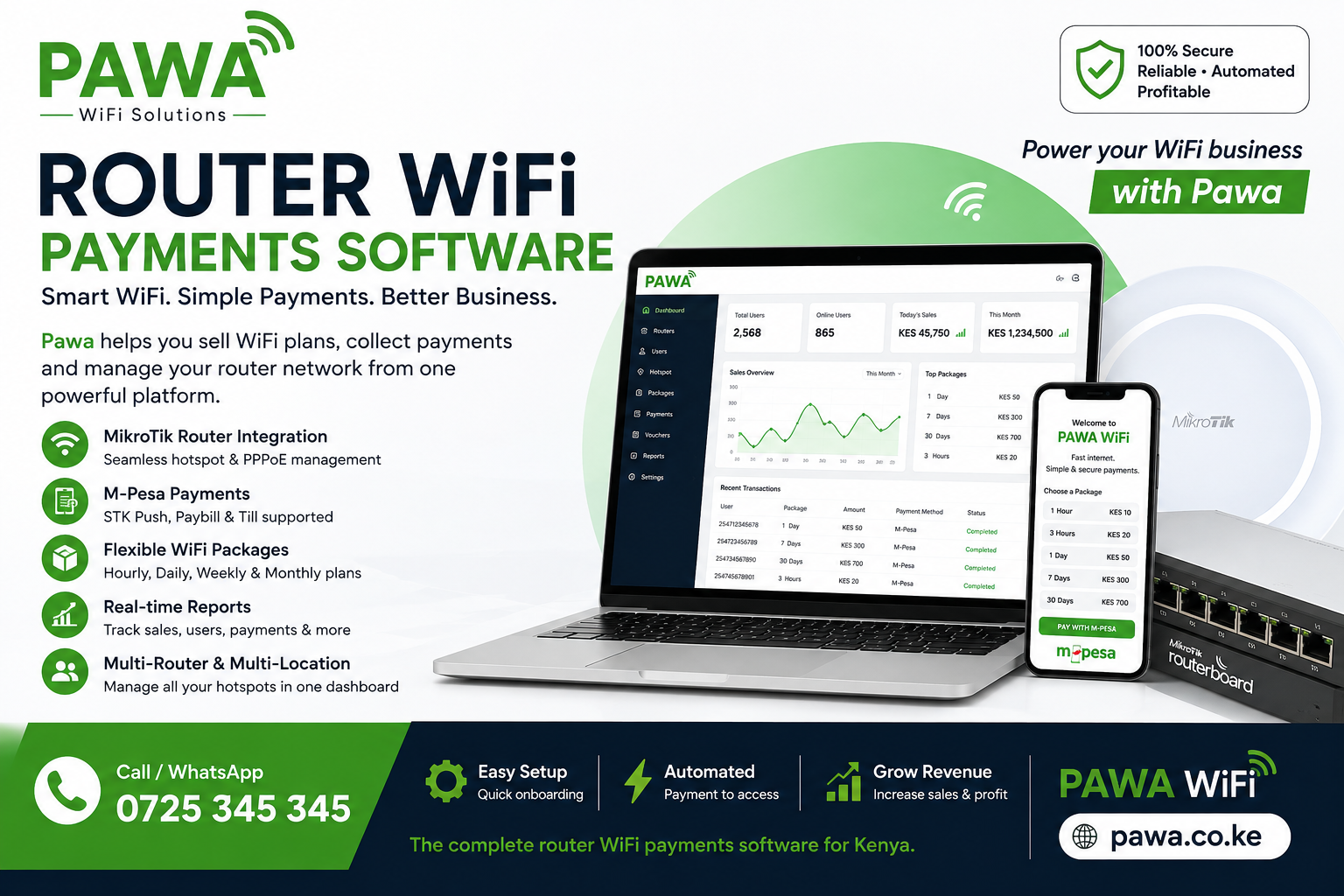
Router WiFi Payments Software:
Looking for router WiFi payments software to turn your internet connection into a managed and profitable WiFi service? A modern WiFi billing platform can help operators sell internet packages, collect customer payments, activate access automatically and monitor connected users from one dashboard.
For Kenyan WiFi operators, payment integration is particularly important. Pawa WiFi connects WiFi package sales with M-Pesa payments and MikroTik router automation, allowing customers to choose a package, pay and receive internet access without the operator manually activating every account. (Pawa WiFi)
This makes router payment software useful for apartment WiFi, estates, hotels, cyber cafés, shops, venues, public hotspots, events and small ISPs.
What Is Router WiFi Payments Software?
Router WiFi payments software is a system that connects an internet network with billing and payment functions.
Instead of simply providing an open WiFi connection, an operator can create paid internet packages such as:
- Hourly WiFi.
- Daily WiFi.
- Weekly WiFi.
- Monthly WiFi.
- Voucher packages.
- Speed-based packages.
- Customer-specific plans.
The software manages the relationship between the customer’s payment and their internet access.
For example, a customer can connect to a captive portal, select a package, make an M-Pesa payment and have their internet access activated after the payment is confirmed.
Businesses using digital management platforms such as Vega can also benefit from integrating reliable connectivity and payment workflows into their broader operations.
Why Businesses Need Router WiFi Payments Software
Manually managing WiFi customers can become difficult as the number of users increases.
An operator may otherwise have to:
- Receive a payment notification.
- Confirm the payment.
- Identify the customer.
- Create or update their account.
- Activate internet access.
- Record the transaction.
- Monitor expiry.
- Disconnect expired users.
A billing platform can automate much of this process.
Pawa’s published workflow allows customers to select a package, pay through M-Pesa, have the payment confirmed and then have MikroTik activate their internet access. (Pawa WiFi)
For businesses using software such as Prim, automated internet access can complement other digital business-management processes.
Router WiFi Payments Software for Apartment WiFi
Apartment WiFi is one of the practical applications for router billing software.
A property owner or WiFi operator can provide residents with different internet packages instead of giving every tenant unrestricted access.
For example, an operator could offer:
- 1-day access.
- 3-day access.
- 7-day access.
- 30-day access.
Customers can select the package they need and make payment electronically.
Pawa identifies estate WiFi and apartment WiFi operators among the use cases for its M-Pesa billing solution. (Pawa WiFi)
For properties that also manage deliveries, Dexa can provide complementary courier and dispatch-management functionality.
Router WiFi Payments Software for Hotels
Hotels and guest houses can use WiFi billing software to manage guest internet access.
A hotel could provide:
- Free basic WiFi.
- Paid premium packages.
- Time-based access.
- Voucher access.
- Guest-specific internet packages.
The system can reduce the need for hotel staff to manually create accounts.
Pawa’s published WiFi billing use cases include hotels, venues and paid public WiFi environments. (Pawa WiFi)
Hotels that coordinate transport for guests can also use platforms such as Dereva to connect customers with professional drivers and riders.
Router WiFi Payments Software for Cyber Cafés
Cyber cafés often have multiple customers connecting throughout the day.
A WiFi billing system can help an operator sell access according to time or package.
A cyber café could create:
- 1-hour packages.
- 3-hour packages.
- Daily packages.
- Weekly packages.
- Voucher access.
Pawa supports voucher-style access alongside M-Pesa hotspot purchases and identifies cyber cafés, shops and public hotspots among suitable use cases. (Pawa WiFi)
Operators can therefore provide customers with flexible payment options while maintaining better control over network access.
How Router WiFi Payments Software Connects to a Router
The router is an important part of a paid WiFi system.
Pawa’s system is designed around MikroTik RouterOS, with the software communicating with the router to manage hotspot and PPPoE access. (Pawa WiFi)
A typical setup can include:
Internet source → MikroTik router → WiFi access points → Customers
The billing platform sits alongside this infrastructure and manages:
- Customer packages.
- Payments.
- User access.
- Expiry.
- Router records.
- Revenue information.
For larger networks, additional access points can be installed to provide better WiFi coverage.
Businesses planning connectivity infrastructure can also explore SpaceKits for Starlink and network-related solutions.
Router WiFi Payments Software With M-Pesa
For Kenyan WiFi businesses, M-Pesa is an important payment channel.
Pawa supports M-Pesa payment workflows including STK Push, PayBill and Till, depending on the operator’s selected collection arrangement. (Pawa WiFi)
The customer experience can be simple:
Step 1: Choose a Package
The customer selects the desired internet package.
Step 2: Make Payment
The customer pays using M-Pesa.
Step 3: Payment Is Confirmed
The system verifies the transaction.
Step 4: Internet Is Activated
The customer’s MikroTik access is activated.
Step 5: Package Expires
The customer’s access follows the selected package period.
This payment-to-access workflow reduces manual intervention.
Businesses developing broader digital workflows can also explore solutions from ZamaCore.
Router WiFi Payments Software for Rental Properties
Rental properties increasingly require digital services for both tenants and property managers.
A landlord can provide paid or controlled WiFi while managing other property operations through digital systems.
Internet billing software can help with:
- Tenant access.
- Package sales.
- Payment records.
- Expiry tracking.
- User management.
- Network monitoring.
For property businesses using KayaPro360, WiFi billing can become another digital service integrated into the property’s operational model.
Router WiFi Payments Software for Events
Temporary events can also benefit from paid or controlled WiFi.
Event organizers may need to provide connectivity at:
- Conferences.
- Exhibitions.
- Weddings.
- Corporate events.
- Training sessions.
- Outdoor events.
A WiFi operator can create temporary packages for visitors or exhibitors.
Pawa’s published use cases include temporary events and venue WiFi. (Pawa WiFi)
When combined with event-management systems such as Wito, organizers can manage attendance and connectivity as separate but complementary digital services.
Router WiFi Payments Software for Farms and Rural Businesses
Farm businesses increasingly use internet connectivity for digital operations.
A farm, agricultural training centre or rural business may want to provide controlled WiFi to:
- Employees.
- Visitors.
- Customers.
- Tenants.
- Students.
- Contractors.
A paid WiFi system can help the operator control access and track payments.
Agricultural businesses using FAMA can manage farm-related activities digitally while using suitable internet infrastructure for their operations.
This is particularly useful where the farm has a central office, accommodation facilities or customer-facing areas.
Router WiFi Payments Software for Residential Estates
Residential estates can use managed WiFi as an additional service for residents.
Instead of relying on manual payment verification, an operator can establish packages and automate customer access.
Pawa specifically describes its billing system as suitable for estates, hotspots and reseller-style operations. (Pawa WiFi)
An estate WiFi operator can therefore manage:
- Customers.
- Packages.
- Payments.
- Expiry dates.
- Routers.
- Active users.
- Revenue.
Property-management platforms such as RentalDesk can complement these operations by helping manage rental-related activities.
Router WiFi Payments Software for WiFi Entrepreneurs
Starting a paid WiFi business can be easier when billing, payment and access management are handled from one system.
A new operator can begin with a relatively small hotspot and expand as the customer base grows.
Potential locations include:
- Apartment blocks.
- Student residences.
- Shopping areas.
- Cafés.
- Small estates.
- Markets.
- Hotels.
- Events.
- Cyber cafés.
Pawa offers different plans based on network size. Its published pricing currently lists Starter at KES 1,500 per month and Silver at KES 3,500 per month, while Pawa collection adds 5% of net WiFi sales when payments are collected through its gateway; operators using their own PayBill/Till do not pay that 5% collection fee. (Pawa WiFi)
Router hardware, installation, cabling, access points and internet are separate costs. (Pawa WiFi)
Router WiFi Payments Software for MikroTik Networks
MikroTik routers are commonly used in managed WiFi environments because they provide network-management functionality that can work with billing systems.
Pawa supports MikroTik hotspot and PPPoE workflows. (Pawa WiFi)
This allows operators to manage different types of users.
Hotspot Users
Hotspot access is useful for customers who connect through a captive portal and purchase packages.
PPPoE Users
PPPoE can be useful for fixed broadband customers who require subscriber-based access.
Pawa supports both Hotspot and PPPoE management from its platform. (Pawa WiFi)
Router WiFi Payments Software With Automatic Access
One of the biggest advantages of automated WiFi billing is reducing manual work.
Instead of an operator manually activating every customer, the system can connect the payment record with the access profile.
Pawa describes a workflow where payment confirmation leads to MikroTik activation, while the dashboard keeps records of payments, users, packages and router status. (Pawa WiFi)
This can make it easier to manage a growing network.
For example, if 100 customers purchase internet packages throughout the day, an automated system can process the transactions without requiring the operator to manually configure each customer.
Router WiFi Payments Software and Network Monitoring
Payment collection is only one part of operating a WiFi business.
An operator also needs to know whether routers and customers are online.
Pawa provides router visibility and monitoring features through its dashboard, including router status and network-related information. (Pawa WiFi)
This can help operators identify issues such as:
- Router downtime.
- Customer access problems.
- Expired packages.
- Network interruptions.
- Payment discrepancies.
For larger technical environments, connectivity can be integrated into broader ICT and infrastructure systems. ZES provides services in areas including ICT, engineering and security infrastructure.
Router WiFi Payments Software for Online WiFi Businesses
A WiFi business also needs customers to find and understand its services.
An operator can create a website explaining:
- Available packages.
- Prices.
- Coverage areas.
- Payment methods.
- Customer support.
- Frequently asked questions.
A professionally optimized website can help attract people searching for WiFi services in a particular location.
Kenya Website Experts provides website development and SEO services that can help businesses establish an online presence.
Benefits of Router WiFi Payments Software
A properly configured system can provide several benefits.
Automated Payments
Customers can pay digitally instead of relying entirely on cash.
Automatic Access
Payment confirmation can trigger internet activation.
Package Management
Operators can create different plans for different customers.
Expiry Tracking
The system can keep track of package periods.
Customer Management
Operators can maintain records of users and their packages.
Router Management
MikroTik router information can be monitored through the dashboard.
Revenue Visibility
Operators can review sales and payment records.
Pawa’s platform combines customer management, payments, router visibility, packages and hotspot access within its WiFi billing workflow. (Pawa WiFi)
What You Need for Router WiFi Payments Software
A typical managed WiFi setup may require:
- Internet connection
- MikroTik router
- WiFi access points
- Network cabling
- Power supply
- WiFi billing software
- Payment method
- Customer portal
Pawa states that a MikroTik router is required for its automated Hotspot or PPPoE access-control workflow and that ordinary home routers cannot run the complete billing automation by themselves. (Pawa WiFi)
The exact hardware depends on the number of customers, coverage area and network design.
Router WiFi Payments Software Pricing Considerations
When planning a WiFi business, operators should calculate the complete project cost rather than looking only at the software subscription.
Potential expenses include:
- Billing software.
- Router.
- Access points.
- Cabling.
- Installation.
- Internet service.
- Power backup.
- Network maintenance.
Pawa’s published pricing separates its software and setup costs from router hardware, cabling, installation, access points, power backup and internet service. (Pawa WiFi)
This makes it easier for an operator to prepare a realistic budget.
Who Should Use Router WiFi Payments Software?
Router WiFi payment software can be useful for:
- WiFi hotspot operators.
- Apartment WiFi providers.
- Estate WiFi businesses.
- Hotels.
- Cyber cafés.
- Shops.
- Event organizers.
- Small ISPs.
- WiFi resellers.
- Public hotspot operators.
Pawa’s published MikroTik billing solution specifically lists apartment WiFi operators, estate WiFi providers, retail hotspots, cyber cafés and small ISPs among its target users. (Pawa WiFi)
More Content on Router WiFi Payments Software
Automate Customer WiFi Access With Router WiFi Payments Software
Managing a growing WiFi network becomes easier when payments and internet access are connected through one automated system. Instead of asking customers to send payment screenshots or waiting for an administrator to activate accounts manually, a WiFi billing platform can create a smoother customer journey.
With Pawa, a WiFi operator can create internet packages, receive payments and manage customer access through a compatible MikroTik network. This approach is useful for businesses that want to reduce repetitive administrative work while giving customers a convenient way to purchase internet.
A typical customer journey can be:
Connect to WiFi → Open the login portal → Select a package → Pay → Payment is confirmed → Internet access is activated.
This model can work particularly well for apartment WiFi providers, estates, hotels, cafés, cyber cafés and public hotspots.
Router WiFi Payments Software for Growing WiFi Businesses
A small hotspot may initially be manageable with manual payment verification. However, as more customers join the network, manual administration can consume significant time.
A growing operator may need to keep track of:
- Active customers.
- Expired packages.
- Daily sales.
- Payment transactions.
- Internet packages.
- Connected devices.
- Router status.
- Customer accounts.
Automated billing software provides a central place to manage these activities.
For operators that also run delivery businesses, Dexa can provide a separate digital solution for managing courier and dispatch activities, while Pawa focuses on WiFi billing and access management.
Router WiFi Payments Software for Estate Internet
Estate WiFi is an increasingly practical application for managed internet billing.
A property owner can establish a network covering apartments, residential units or shared spaces and offer residents different packages.
For example:
| Package | Example Use |
|---|---|
| Daily | Short-term users |
| Weekly | Temporary residents |
| Monthly | Long-term tenants |
| Premium | Higher-speed users |
The operator can adjust packages according to the network’s capacity and business model.
For property owners using RentalDesk for rental operations, managed WiFi can become an additional digital service offered to tenants.
Router WiFi Payments Software for Rural Connectivity
WiFi billing software is not limited to urban businesses. Rural enterprises, farms and community WiFi projects may also need controlled internet access.
A farm could provide WiFi to workers, visitors or accommodation facilities. An agricultural training centre could provide paid connectivity to participants. A rural business could establish a hotspot for customers and the surrounding community.
When combined with agricultural management systems such as FAMA, reliable connectivity can support both farm administration and online communication.
The network operator can manage internet packages separately from the farm’s other digital systems.
Choosing the Right Router WiFi Payments Software
Before selecting a WiFi billing platform, operators should consider several factors.
Payment Integration
For Kenyan businesses, M-Pesa integration can make it easier for customers to purchase internet packages.
Router Compatibility
The billing system should work with the network hardware being used. Pawa’s automated access-control system is designed around MikroTik routers.
Package Management
Operators should be able to create packages suitable for their customers.
Customer Management
A good platform should make it easier to identify users and manage their access.
Reporting
Sales and payment records can help the operator understand how the WiFi business is performing.
Scalability
The system should be capable of supporting the network as the customer base grows.
Router WiFi Payments Software and Customer Experience
The customer experience can influence whether people continue using a WiFi service.
Customers generally want a straightforward process:
Connect → Choose → Pay → Browse.
Complicated registration processes or delayed account activation can discourage users.
Automated payment confirmation can make the experience more convenient while reducing the number of support requests handled manually.
Operators can also create different packages for different customer requirements, allowing users to choose an option that suits their budget and intended usage.
For businesses building broader digital customer experiences, Zivo and other technology platforms can complement their operational systems.
Router WiFi Payments Software for WiFi Resellers
WiFi resellers can purchase internet capacity and distribute it to customers through managed networks.
The reseller may operate:
- A residential hotspot.
- A commercial hotspot.
- An estate network.
- A hotel network.
- A small ISP.
- A community WiFi service.
Billing software helps transform the network into a structured commercial service.
Instead of relying on handwritten records, the operator can use digital customer and payment records to understand sales and usage.
Businesses using ZamaCore or other digital business tools can similarly benefit from keeping their technology operations organized.
Router WiFi Payments Software and Network Infrastructure
Billing software is only one component of a successful WiFi network.
The operator also needs suitable internet connectivity and network equipment.
A typical setup may include:
Internet connection → MikroTik router → Network switch → WiFi access points → Customers
For larger premises, additional access points may be required.
If the internet source is satellite-based, such as Starlink, the operator can also require appropriate networking equipment between the Starlink system and the customer WiFi network.
SpaceKits provides Starlink-related installation and connectivity services in Kenya, making it relevant for operators considering satellite connectivity as part of their network infrastructure.
Router WiFi Payments Software for Events and Temporary Hotspots
Temporary WiFi businesses can use billing software to provide controlled internet access during events.
An event organizer may want to sell:
- One-hour access.
- Half-day access.
- Full-day access.
- Premium access.
This can create an additional service or revenue stream while giving attendees an organized way to connect.
Events using Wito for RSVP and attendance management can combine event registration with a separate WiFi service.
The operator should plan bandwidth and network capacity based on the expected number of attendees.
Expand Your Router WiFi Payments Software Business Online
A WiFi operator can also attract customers through online marketing.
A dedicated website can display:
- WiFi packages.
- Prices.
- Coverage locations.
- Payment instructions.
- Contact information.
- Frequently asked questions.
- Customer support details.
SEO can help the business appear when people search for phrases such as:
- WiFi billing software Kenya.
- M-Pesa WiFi billing.
- Router payment software.
- MikroTik hotspot billing.
- Apartment WiFi software.
- Paid WiFi management system.
- WiFi hotspot billing Kenya.
Kenya Website Experts can support businesses with website development and SEO services.
Router WiFi Payments Software for Secure Network Management
WiFi operators should also consider network security.
A managed WiFi network should separate customers from administrative systems where appropriate.
Operators should consider:
- Strong administrator passwords.
- Secure router configuration.
- Customer isolation.
- Appropriate access permissions.
- Regular software updates.
- Monitoring unusual activity.
For larger installations, networking can form part of a wider ICT and security infrastructure strategy. ZES provides services covering ICT, engineering and security-related infrastructure.
Build a Better WiFi Business With Router WiFi Payments Software
A successful paid WiFi service requires more than an internet connection. It requires a combination of connectivity, network equipment, billing, payments, customer management and support.
With the right setup, an operator can reduce manual payment processing and make it easier for customers to purchase internet access.
Frequently Asked Questions About Router WiFi Payments Software
What is router WiFi payments software?
It is software that connects customer payments and internet access, allowing an operator to sell WiFi packages and manage users through a router-based network.
Can customers pay for WiFi using M-Pesa?
Yes. Pawa supports M-Pesa STK, PayBill and Till payment workflows. (Pawa WiFi)
Does router payment software activate WiFi automatically?
With a compatible MikroTik setup, Pawa can connect payment confirmation to automatic internet activation. (Pawa WiFi)
Can I sell daily and monthly WiFi packages?
Yes. Pawa supports different package durations, including daily, weekly and monthly packages. (Pawa WiFi)
Can I use my own PayBill or Till?
Yes. Pawa states that operators can use their own PayBill or Till, with no 5% Pawa collection fee, although the monthly subscription still applies. (Pawa WiFi)
Do I need a MikroTik router?
For Pawa’s automated Hotspot and PPPoE billing workflow, yes. Pawa states that ordinary home routers cannot run the complete billing automation by themselves. (Pawa WiFi)
Can router WiFi software work for an apartment?
Yes. Apartment and estate WiFi are specifically listed among Pawa’s supported use cases. (Pawa WiFi)
Can I use vouchers?
Yes. Pawa supports voucher-style access alongside M-Pesa hotspot purchases. (Pawa WiFi)
Start Using Router WiFi Payments Software in Kenya
If you operate a WiFi hotspot, apartment network, hotel, cyber café, estate network, event WiFi service or small ISP, router WiFi payments software can help turn a basic internet connection into a structured service.
Instead of manually checking payments and activating customers, an automated billing system can connect:
Customer → WiFi Package → M-Pesa Payment → Payment Confirmation → MikroTik Router → Internet Access
Pawa is built around this workflow, combining WiFi package sales, M-Pesa collection, customer management, MikroTik access control and router visibility in one platform. (Pawa WiFi)
The wider digital ecosystem can also support different parts of the business, including Vega, Prim, Dexa, Dereva, Zama, SpaceKits, ZamaCore, KayaPro360, Wito, FAMA, RentalDesk, Pawa, Zivo, ZES and Kenya Website Experts.
For Kenyan operators looking for router WiFi payments software, Pawa provides a dedicated platform for M-Pesa billing, WiFi packages, customer access and MikroTik network management. (Pawa WiFi)