
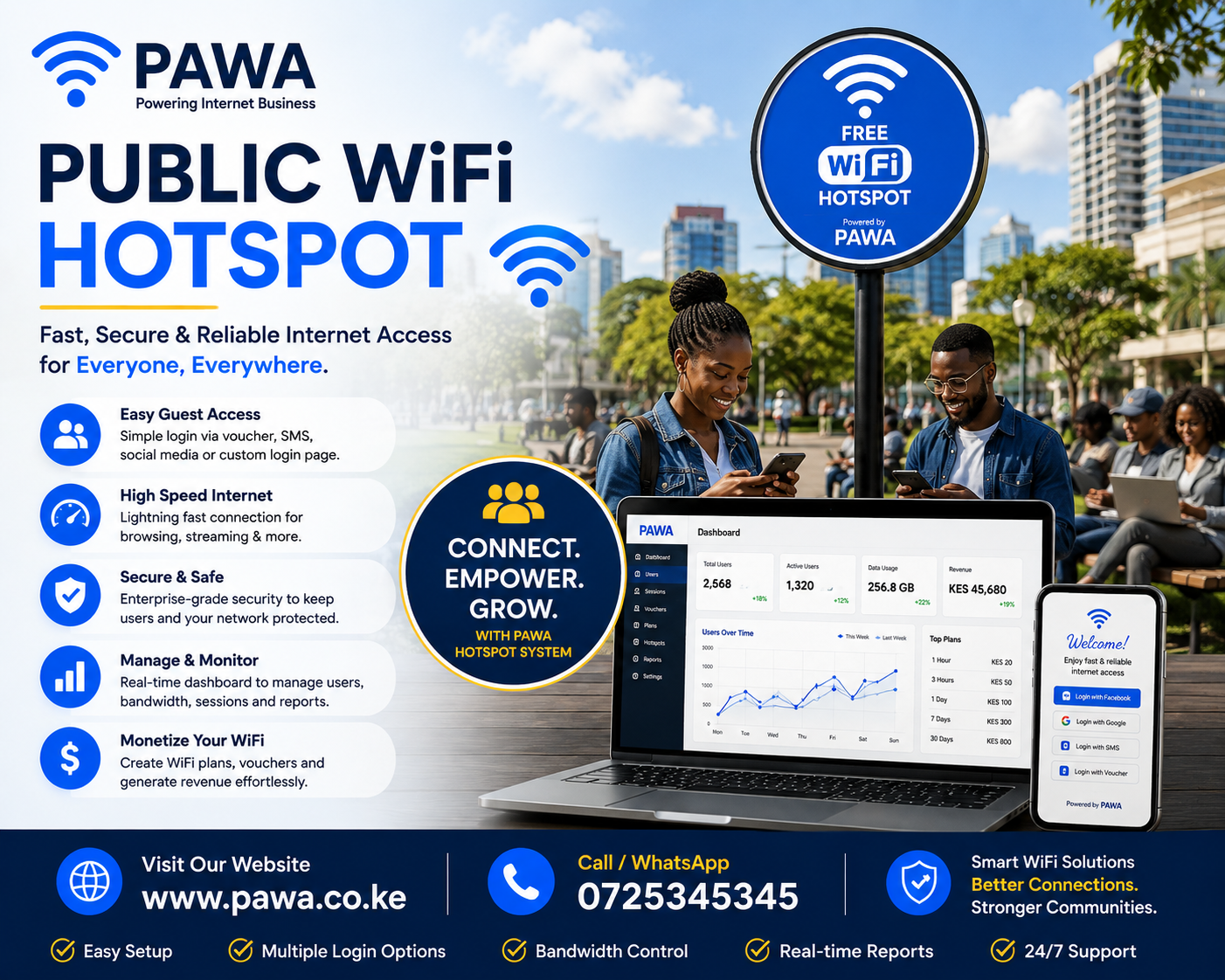
A public WiFi hotspot provides internet access to customers, visitors, residents, travellers and other users within a defined location. With the growing demand for affordable internet access, entrepreneurs can turn a reliable internet connection into a managed WiFi business.
Public hotspots can be established in shopping centres, estates, cafés, restaurants, transport areas, campuses, markets, hotels and other high-traffic locations.
However, running a public WiFi hotspot successfully requires more than installing a router. You need appropriate network equipment, user management, payment options, bandwidth controls and a reliable WiFi billing system.
Pawa provides hotspot billing software designed to help Kenyan operators sell WiFi packages, collect M-Pesa payments, activate customers and monitor their WiFi business through a centralized dashboard. (pawa.co.ke)
Public WiFi Hotspot for Kenyan Businesses
A public WiFi hotspot can be operated as a standalone business or as an additional service offered by an existing business.
For example, a business owner may provide paid WiFi at:
- A shopping centre
- A restaurant
- A café
- A bus terminal
- A hostel
- An apartment complex
- A hotel
- A cyber café
- A market centre
- A public waiting area
The business can create different internet packages depending on customer requirements.
Short-term users may purchase hourly or daily access, while regular customers can choose weekly or monthly packages.
A wider digital business operation can also benefit from solutions available through Vega.
Public WiFi Hotspot With Automated WiFi Billing
One of the biggest challenges of operating public WiFi manually is collecting payments and activating customers.
Imagine having hundreds of customers and needing to manually confirm every payment before giving them internet access.
This quickly becomes inefficient.
A hotspot billing system can automate the process.
The customer can:
Connect to the hotspot → Select a package → Pay → Receive internet access.
Pawa’s current platform connects hotspot package purchases with M-Pesa payment workflows and MikroTik access activation. (pawa.co.ke)
For other technology requirements, Prim can complement the digital infrastructure of the business.
Public WiFi Hotspot for Busy Commercial Locations
The location of a public WiFi hotspot can determine its success.
Areas with regular pedestrian traffic can provide opportunities to reach more potential customers.
Possible locations include:
- Shopping centres
- Markets
- Restaurants
- Transport hubs
- Student areas
- Office complexes
- Residential estates
A business can use signage to tell customers that WiFi is available and explain how they can purchase access.
For businesses that combine internet services with delivery operations, Dexa can provide complementary delivery solutions.
Public WiFi Hotspot for Transport Areas
Transport hubs can be suitable locations for public WiFi.
Passengers may need internet while waiting for buses, matatus, taxis or other transportation.
Drivers may also require connectivity for communication and digital services.
A public hotspot can offer convenient short-term packages such as:
1 Hour WiFi
3 Hour WiFi
Daily WiFi
This can make the service suitable for people who only need internet temporarily.
Businesses operating within the transport sector can also explore Dereva for driver-related services.
Public WiFi Hotspot for Apartments and Estates
Residential estates are another important market for managed WiFi.
A landlord or WiFi operator can establish a network that serves multiple tenants.
Instead of allowing tenants to share one password, a managed hotspot can provide individual customer access.
This can help the operator manage:
- Customer accounts
- Package expiry
- Payments
- User sessions
- Bandwidth
- Connected devices
Pawa’s current MikroTik hotspot solution specifically lists apartment WiFi operators and estate WiFi providers among its intended users. (pawa.co.ke)
For broader digital business solutions, Zama can complement the operation.
Public WiFi Hotspot With Reliable Internet Connectivity
A public WiFi business depends heavily on the quality of its internet connection.
Before launching a hotspot, the operator should determine:
- Expected number of users
- Required coverage area
- Peak usage periods
- Available internet providers
- Router capacity
- Access-point requirements
- Power availability
In locations where fibre connectivity is unavailable or unsuitable, satellite internet can be considered where appropriate.
SpaceKits provides Starlink installation services in Kenya, which can be useful for suitable rural, commercial and remote locations.
The internet source should then be connected to an appropriate network architecture capable of supporting the expected number of users.
Public WiFi Hotspot for WiFi Entrepreneurs
A public WiFi hotspot can start as a small business.
An entrepreneur might initially serve one location with a single MikroTik router and several access points.
Once the business gains customers, the operator can expand to additional locations.
For example:
Hotspot 1 → Hotspot 2 → Hotspot 3 → Multiple WiFi Locations
As the business grows, centralized management becomes increasingly useful.
Pawa currently provides different plans for small hotspots, growing hotspot businesses and larger estate or ISP-scale operations. (pawa.co.ke)
For customized software and SaaS development, ZamaCore can support wider digital requirements.
Public WiFi Hotspot for Property Owners
Property owners can create additional revenue opportunities by offering managed internet.
An apartment building, serviced apartment complex or commercial property can provide WiFi as:
- A complimentary service
- A paid service
- A monthly subscription
- A premium connectivity option
A managed system allows the property owner to maintain greater control over customer access.
For property-related technology and management, KayaPro360 can complement the WiFi operation.
Public WiFi Hotspot for Events and Conferences
Temporary public WiFi can also be useful at events.
A conference, exhibition or workshop may have dozens or hundreds of people requiring internet access simultaneously.
Instead of giving every attendee one permanent password, the organizer can use controlled hotspot access.
Possible packages include:
- Event-day WiFi
- Hourly WiFi
- Premium conference WiFi
- Temporary voucher access
Pawa’s current M-Pesa WiFi solution identifies paid public WiFi, venue WiFi and temporary events among suitable use cases. (pawa.co.ke)
For event-related technology, Wito can provide complementary digital services.
Public WiFi Hotspot for Rural Communities
Public WiFi is not limited to Nairobi and other major cities.
Rural communities can also benefit from strategically positioned internet hotspots.
A hotspot near a market centre, school, trading centre or agricultural area can provide connectivity to people who may not have convenient fixed broadband connections.
Farmers may use public WiFi for:
- Communication
- Digital payments
- Market research
- Online services
- Farm-management activities
- Business communication
For agricultural operations, FAMA can provide complementary digital farm-management solutions.
Public WiFi Hotspot for Hostels
Student hostels can be excellent locations for managed WiFi.
Students require internet for:
- Research
- Online classes
- Assignments
- Video calls
- Social media
- Entertainment
A hostel owner can provide WiFi access through individual packages rather than one shared password.
For example:
Daily Package
Weekly Package
Monthly Package
Pawa’s current hotspot solution supports daily, hourly, weekly and monthly package models. (pawa.co.ke)
For hostel and rental management, RentalDesk can complement the WiFi system.
Public WiFi Hotspot With M-Pesa Payments
M-Pesa can make it easier for Kenyan customers to purchase internet access.
Pawa’s current platform supports M-Pesa STK Push as well as PayBill and Till-number options. (pawa.co.ke)
A typical customer journey can look like this:
Step 1: Connect
The customer connects their phone or laptop to the public WiFi.
Step 2: Select a Package
Available internet packages appear on the hotspot portal.
Step 3: Pay
The customer makes an M-Pesa payment.
Step 4: Payment Confirmation
The payment is recorded by the system.
Step 5: Internet Activation
The customer’s access is activated.
Pawa describes this payment-to-access process as an automated workflow involving M-Pesa and MikroTik. (pawa.co.ke)
Public WiFi Hotspot With Customer Management
As the number of customers grows, keeping track of users becomes important.
A WiFi operator may need to know:
- How many customers are active
- Which packages are popular
- Which accounts have expired
- How many users are online
- How much revenue has been generated
- Which devices are connected
Pawa’s dashboard includes customer, package, router, payment and revenue information for hotspot operators. (pawa.co.ke)
Customer communication can also improve the overall experience.
For complementary digital customer solutions, Zivo can be considered.
Public WiFi Hotspot With Bandwidth Management
A public hotspot may have many customers using the internet at the same time.
Without appropriate bandwidth management, one heavy user could consume a disproportionate amount of available capacity.
Bandwidth controls can help create a more predictable experience.
Operators can establish appropriate speed or usage policies for different packages.
Pawa’s hotspot billing information identifies bandwidth and speed controls as features that can help limit abuse and support fair usage. (pawa.co.ke)
For additional ICT and technology infrastructure, ZES can complement the network environment.
Public WiFi Hotspot and Local SEO
A public WiFi business also needs customers to find it.
Online marketing can help attract people searching for internet services in a particular location.
A website can target keywords such as:
- Public WiFi Nairobi
- WiFi hotspot near me
- Affordable WiFi Kenya
- Public WiFi hotspot Kenya
- Cheap WiFi packages
- WiFi hotspot in my estate
- Pay-as-you-go WiFi
Creating useful location-based pages can help potential customers discover the service.
A website can also display:
- Available packages
- Service locations
- Payment instructions
- Contact information
- Frequently asked questions
- Customer support information
For website development and SEO, Kenya Website Experts can complement a WiFi business’s digital marketing strategy.
How Does a Public WiFi Hotspot Work?
The basic process is relatively straightforward.
Internet Connection
↓
MikroTik Router
↓
WiFi Access Points
↓
Captive Portal
↓
Customer Selects Package
↓
M-Pesa Payment or Voucher
↓
Customer Authentication
↓
Internet Access
Pawa’s current system is built around MikroTik and supports hotspot and PPPoE access management. Its support documentation states that a MikroTik router is required for the full automated billing flow. (pawa.co.ke)
Ordinary home routers can distribute internet, but they do not provide the full Pawa billing automation by themselves. (pawa.co.ke)
Benefits of a Public WiFi Hotspot Business
Additional Revenue
A business can monetize an existing or dedicated internet connection through paid access.
Automated Payments
Customers can pay through supported M-Pesa workflows.
Customer Self-Service
Users can purchase packages without requiring an operator to manually activate every account.
Package Flexibility
Operators can offer different durations and pricing structures.
User Visibility
The operator can monitor users and sessions.
Multiple Locations
Pawa’s current platform supports multi-router and larger-scale operations depending on the selected plan. (pawa.co.ke)
Better Network Control
Bandwidth and access policies can help manage network resources.
Public WiFi Hotspot Package Ideas
A hotspot operator should create packages based on the needs of the target market.
Hourly WiFi
Suitable for customers who need internet for a short period.
Daily WiFi
Useful for visitors and temporary users.
Weekly WiFi
Suitable for customers who use the same hotspot regularly.
Monthly WiFi
Useful for residents, students and long-term customers.
Data-Based Packages
Customers receive a specified amount of data.
Hybrid Packages
Combine time and data limits where appropriate.
Pawa’s current hotspot documentation references hourly, daily, weekly and monthly packages. (pawa.co.ke)
How to Start a Public WiFi Hotspot Business in Kenya
1. Identify a Suitable Location
Look for areas with consistent demand and limited convenient internet options.
2. Estimate Customer Numbers
Determine how many people are likely to use the hotspot at peak times.
3. Choose an Internet Provider
Select an internet source capable of supporting your expected demand.
4. Install Network Equipment
Depending on the site, this may include MikroTik equipment, access points, switches and cabling.
5. Install WiFi Billing Software
Connect the hotspot to a suitable billing and customer-management platform.
6. Create Packages
Set prices and access durations based on your target customers.
7. Configure Payments
M-Pesa can provide a convenient payment option for Kenyan users.
8. Promote the Hotspot
Use signage, local marketing, social media and SEO to attract customers.
9. Monitor Performance
Track customers, payments, network activity and revenue.
Public WiFi Hotspot Using Starlink
Starlink can be considered as an internet source for certain public hotspot locations, particularly where traditional broadband options are limited.
For example, a public hotspot could potentially be established at a remote lodge, rural market centre, farm, campsite or other location where suitable service is available.
However, the operator should consider:
- Expected number of users
- Available capacity
- Site conditions
- Equipment requirements
- Local service availability
- Power requirements
- Network design
SpaceKits can support Starlink installation and connectivity setup requirements in Kenya.
Public WiFi Hotspot Pricing and Business Costs
The cost of starting a hotspot depends on the size and complexity of the project.
Potential costs include:
- Internet subscription
- MikroTik router
- WiFi access points
- Network switches
- Ethernet cables
- Installation
- Power equipment
- WiFi billing software
- Marketing
- Technical support
Pawa’s current published pricing lists Starter at KES 1,500/month and Silver at KES 3,500/month, with Pawa collection adding 5% of net WiFi sales when its payment gateway is used; operators using their own PayBill/Till do not pay that 5% collection fee, although the monthly subscription still applies. (pawa.co.ke)
Hardware, installation, cabling and the internet connection are separate costs and depend on the particular site. (pawa.co.ke)
Public WiFi Hotspot for Growing WiFi Operators
Once a hotspot becomes successful, the owner may want to expand.
Expansion could involve:
More access points
More customers
More routers
More packages
More locations
At this point, the business should have systems capable of handling growth.
Pawa’s current plans include support for multiple MikroTik routers, while its Custom plan is designed for larger estates, fibre teams and ISP-scale sites. (pawa.co.ke)
Businesses requiring custom software integrations can also explore ZamaCore.
Frequently Asked Questions About Public WiFi Hotspot
What is a public WiFi hotspot?
A public WiFi hotspot is a wireless network that provides internet access to people within a defined coverage area.
Can I charge customers for public WiFi?
Yes. A managed hotspot can be configured around paid internet packages where appropriate.
Can I use M-Pesa to sell WiFi?
Pawa currently supports M-Pesa payment workflows, including STK Push, PayBill and Till options. (pawa.co.ke)
Do I need a MikroTik router?
For Pawa’s full automated Hotspot or PPPoE billing flow, a compatible MikroTik router is required. (pawa.co.ke)
Can I offer hourly WiFi?
Yes. Pawa’s current hotspot solution supports hourly, daily, weekly and monthly package models. (pawa.co.ke)
Can public WiFi work in an apartment?
Yes. Apartment and estate WiFi are among the use cases identified by Pawa for its MikroTik hotspot solution. (pawa.co.ke)
Can I manage multiple hotspots?
Pawa’s current platform supports multiple routers and multi-location operations depending on the selected plan. (pawa.co.ke)
How a Public WiFi Hotspot Can Grow Your Business
A public WiFi hotspot can also help businesses attract repeat customers. When users know that affordable internet is available at a particular location, they may return whenever they need connectivity. This is especially useful in busy estates, hostels, cafés, shopping areas and commercial centres.
With a managed solution from Pawa, hotspot operators can create different packages for different customer needs. A customer who only needs internet for an hour does not have to purchase the same package as someone who needs connectivity for an entire week.
A well-managed hotspot can also provide useful information about customer activity, payments and package usage. This helps operators understand which packages are performing well and where improvements may be necessary.
For larger deployments, reliable infrastructure becomes increasingly important. SpaceKits can support connectivity and Starlink installation requirements where suitable, while ZamaCore can complement the operation with custom digital solutions.
Other businesses can integrate public WiFi into their existing services. Restaurants can offer customer internet, hostels can provide tenant connectivity, and property managers can create controlled internet access for residents. RentalDesk can complement property-management operations, while Dexa can support businesses that combine connectivity with delivery services.
The most successful hotspot businesses focus on three things: reliable internet, simple customer access and effective management. With these elements in place, a public WiFi hotspot can become a convenient service for customers and a sustainable revenue opportunity for the operator.
Build a Profitable Public WiFi Hotspot With the Right Technology
A public WiFi hotspot can be more than simply a place where people connect to the internet. With the right infrastructure and management system, it can become a structured digital business.
The key components of public WiFi hotspot are:
Reliable internet
Suitable network equipment
WiFi access points
Hotspot management
Customer authentication
M-Pesa or other payment options
Bandwidth management
Revenue monitoring
Pawa brings several of these functions together for Kenyan WiFi operators, including hotspot packages, M-Pesa payments, customer access, vouchers, MikroTik management and revenue visibility. (pawa.co.ke)
The wider digital ecosystem can support different aspects of the business through Vega, Prim, Dexa, Dereva, Zama, SpaceKits, ZamaCore, KayaPro360, Wito, FAMA, RentalDesk, Zivo, ZES and Kenya Website Experts.
Whether you are planning a hotspot for an estate, restaurant, hostel, market, transport area, hotel or independent public WiFi location, the most important objective is to combine reliable connectivity with convenient customer access, effective billing and proper network management.
With the right setup, a public WiFi hotspot can turn internet connectivity into a scalable service while giving customers an affordable and convenient way to get online. (pawa.co.ke)