
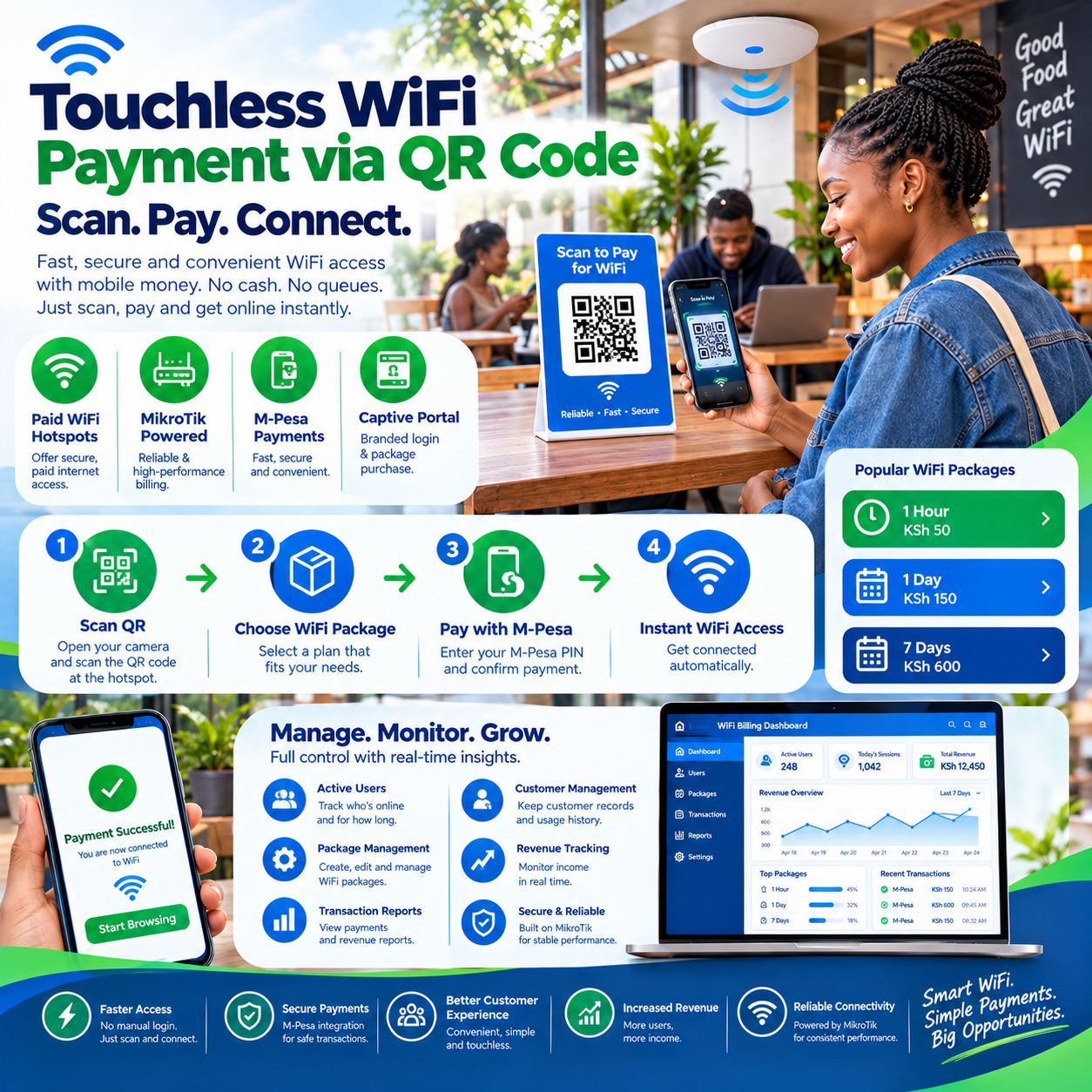
Touchless WiFi payment via QR code is the quiet upgrade transforming how businesses sell internet — replacing passwords, vouchers, and counter queues with a single scan that takes a customer from standing to browsing in seconds.
A sticker on the wall. A card on the table. A poster at the gate.
The customer points their phone camera, taps the link that appears, pays from the page, and the internet opens — no app download, no typed password, no human standing in the middle.
It sounds almost too simple to be a business upgrade, yet operators everywhere describe it the same way: the single change that made selling WiFi effortless.
This article explores why touchless WiFi payment via QR code systems have spread so fast, how the technology actually works, and what it delivers for the businesses and the customers on both sides of the scan.
Because the story of this small square pattern is really the story of friction ending — and revenue beginning.
What Touchless WiFi Payment via QR Code Actually Is
Strip away the terminology and the concept is beautifully physical.
A business prints a QR code — the familiar square of black and white blocks — and places it where customers can see it: the café table, the reception desk, the hostel door, the matatu seat-back.
A customer scans it with their phone camera, and a page opens instantly: the WiFi packages, the prices, and a payment button.
The customer pays through mobile money, and their device connects — the entire touchless WiFi payment via QR code journey completed without a single word exchanged.
No passwords written on walls. No vouchers sold behind counters. No staff interrupted mid-task to sell access.
The QR code is simply a doorway: it carries the network’s address, so any phone that scans it lands exactly where the purchase happens.
What makes it “touchless” is everything it removes — no shared surfaces touched, no cash passed, no devices handled by staff, no typing on a public keyboard.
In a world where customers already scan menus, pay merchants, and board planes by QR code, a touchless WiFi payment via QR code system feels less like new technology and more like the natural next step.
That familiarity is its superpower — the customer already knows exactly what to do.
Why Touchless Changed Everything
The shift to touchless did not arrive as a fashion; it arrived as a correction of everything awkward about the old ways.
Consider how WiFi access used to be sold.
A password shouted across a counter. A card handed from staff to customer, then passed between friends. A voucher scratched, folded, lost, and reprinted.
Every step involved contact, confusion, or waiting — and every one of those frictions leaked sales.
A touchless WiFi payment via QR code system removes the entire friction chain at once.
The customer never waits for attention, never asks a stranger for a password, and never fumbles with cash while a queue grows behind them.
Hygiene accelerated the shift permanently.
The global moment when shared surfaces became suspect taught customers to prefer scanning over touching — and businesses discovered that touchless WiFi payment via QR code access was not just safer but genuinely faster.
Speed sealed the verdict.
A scan-to-pay flow completes in under thirty seconds; a staffed transaction takes minutes and depends on someone being free.
Multiply that difference across a busy lunch rush, and the arithmetic explains why venues that adopted touchless WiFi payment via QR code systems never volunteered to go back.
The old ways were not wrong so much as heavy — and touchless made them weightless.
How the Technology Actually Works
The elegance of a touchless WiFi payment via QR code system hides in how little the customer needs to know.
Behind the single scan, a clean sequence unfolds.
The QR code encodes a link — usually to the venue’s payment portal or a direct connection page.
The phone’s camera reads it, and the browser opens on the landing page: branded, mobile-friendly, showing the available packages and prices.
The customer picks a package, and the payment prompt arrives on their own phone — an M-Pesa push carrying the exact amount.
They enter their PIN, the payment confirms, and the system connects their device or delivers their access credentials automatically.
The whole touchless WiFi payment via QR code loop — scan, choose, pay, connect — completes without the customer ever speaking to staff or touching anything shared.
On the business side, the machinery is equally tidy.
The billing platform records the payment, timestamps the session, and logs everything to a dashboard the owner reads from anywhere.
The QR code itself can be printed once and serve for years — or updated remotely whenever prices, packages, or promotions change.
That combination — a printed doorway and a living system behind it — is what makes touchless WiFi payment via QR code deployments so durable: the oldest part of the setup is a sticker, and the newest part is whatever the platform evolves into next.
The Psychology of the Scan
The deepest reason touchless WiFi payment via QR code systems convert so well is behavioral, and it is worth understanding.
Scanning has become muscle memory.
Kenyan customers scan QR codes to pay merchants, view menus, register for events, and verify goods — the gesture is as automatic as answering a call.
When a customer sees a QR code promising WiFi, no explanation is needed; their thumb is already moving.
This native familiarity means a touchless WiFi payment via QR code launch needs no training campaign, no staff demonstrations, and no customer education — the market taught itself years ago.
The second psychological force is ownership.
Scanning feels like the customer initiating — their phone, their camera, their choice — rather than being sold to.
That framing matters: purchases that feel self-directed complete more readily than purchases that feel pressed upon.
The third force is visibility.
The QR code sits where the need lives — at the table where the laptop opened, at the seat where the wait began — meeting the customer at the exact moment of wanting.
Marketing calls this point-of-need presence, and it is why touchless WiFi payment via QR code placements consistently outperform counter-only sales.
The customer who wanted internet found the offer before the wanting faded — which is the whole secret of conversion, hiding inside a square of printed blocks.
Where Touchless WiFi Payment via QR Code Shines
Some venues suit this model so perfectly they adopt it almost on sight.
Cafés and restaurants lead the list: every table becomes a point of sale, and the customer browsing the menu scans their way online without anyone leaving the kitchen.
Hotels and guesthouses follow: the code sits on the bedside card, guests choose their package, and the front desk never touches the transaction.
Matatus and transport stages put codes on seat-backs, turning every journey into a purchase opportunity for passengers with minutes to fill.
Event venues print codes on tickets, wristbands, and banners — hundreds of attendees connecting themselves while organizers watch the revenue on a dashboard.
Hostels and student housing mount codes on doors, ending the age of passwords traded through WhatsApp groups.
Salons, clinics, and waiting rooms place codes at every seat, converting waiting time into browsing time and browsing time into revenue.
In every setting, the pattern repeats: the touchless WiFi payment via QR code model works wherever people, phones, and idle minutes gather.
And the flexibility stretches further than most owners expect.
One code at the gate can serve an entire compound; separate codes per floor can segment a building; a rotating code per event can run a conference.
Wherever the operator can place a sticker, a touchless WiFi payment via QR code business can live.
What the Business Gains: The Operator’s Side
The operator’s gains from a touchless WiFi payment via QR code system stack up in four quiet categories.
The first is staffing freedom.
Nobody sells, nobody takes payment, nobody distributes vouchers — the sticker sells around the clock, including the hours nobody is at the counter.
The second is leak-free revenue.
Every transaction flows through the system: recorded, receipted, reconciled, and visible.
The quiet losses of the voucher era — uncounted change, off-book sales, forgotten sessions — simply have nowhere to hide in a touchless WiFi payment via QR code operation.
The third is reach.
The code sells to customers staff never meet: the midnight guest, the self-serve regular, the visitor who would never ask but happily scans.
Collections expand from business hours to all hours, which operators consistently describe as the moment their WiFi income stepped up a level.
The fourth is intelligence.
Every scan, view, and purchase lands in the dashboard: which hours sell, which packages win, how many people scanned but didn’t buy.
That data turns pricing from guesswork into adjustment — and the operators who read their touchless WiFi payment via QR code reports weekly keep finding money the old system never revealed.
Four gains, one sticker — a return-on-investment story that explains the model’s rapid spread better than any pitch.
What the Customer Gains: The Other Side of the Scan
The customer’s experience explains why touchless WiFi payment via QR code adoption sticks — because the gains are just as real on their side.
Speed first: from noticing the code to browsing takes under a minute, which fits the attention span of a person who wanted internet now.
Privacy second: no conversation with a stranger, no cash counted in public, no explaining a budget — the transaction stays between the customer and their phone.
Fairness third: the portal shows every package and price openly, so the customer chooses exactly what fits — the ten-minute checker pays little, the day worker pays for a day, and nobody subsidizes anybody.
Control fourth: their session, their expiry, their choice to extend — all visible on screen, all managed without asking anyone.
That dignity layer is repeatedly cited by customers themselves: paying by scan feels like topping up, not being sold to.
There is a trust dividend too.
Because the payment happens through the customer’s own mobile money prompt — their PIN entered on their own phone — the touchless WiFi payment via QR code flow carries the same security feeling as every other M-Pesa transaction they make daily.
Businesses that switched report the same customer verdict, phrased in a dozen ways: “I just scanned and it worked.”
In the service economy, that sentence is worth more than any advertisement the venue could buy.
Dynamic Codes: One Sticker, Endless Flexibility
Here is where a touchless WiFi payment via QR code setup pulls ahead of every printed alternative: the code can be dynamic.
A static code is frozen — printed once, pointing at one destination forever.
A dynamic code is a pointer that the business can redirect anytime: today it shows the standard packages, this weekend it shows the event special, next month it shows the new pricing.
The sticker on the wall never changes; the destination behind it changes as often as the business does.
This transforms the economics of promotions entirely.
A weekend offer that once required reprinting posters now requires a dashboard update — and every existing touchless WiFi payment via QR code placement in the building becomes the promotion’s distribution channel instantly.
Menu changes, price tests, and seasonal packages all follow the same pattern: the physical code stays, the digital offer flows.
Dynamic codes also solve the relocation problem.
The café that moves premises prints nothing new; the code redirects, and the touchless WiFi payment via QR code system follows the business wherever it goes.
For operators managing multiple venues, dynamic codes mean one print run serving many changing offers — with each location’s code pointing to its own pricing and packages.
The sticker, in other words, stopped being stationery and became a remote control — one of the quietest but most valuable upgrades the model ever received.
Integration With Billing Platforms
A QR code on its own is just a link; the business lives in the platform behind it — and the depth of that integration defines how much a touchless WiFi payment via QR code deployment can actually do.
A fully integrated platform handles the entire journey automatically.
It presents the packages, collects the mobile money payment, connects the device, enforces the session limits, counts down the time, and cuts off cleanly when the purchase ends.
It reconciles stray payments, issues receipts, and logs every transaction with timestamps both parties can trust.
And it reports the whole operation back to the owner in plain numbers: revenue by day, scans by hour, conversions by package.
When the platform also manages the network itself — sessions, speeds, and device binding — the touchless WiFi payment via QR code system becomes a complete point of sale rather than a payment button.
That completeness matters at the moments that test it.
The customer who pays at 11 p.m. expects connection at 11 p.m. — and only an integrated system delivers that without a human waking up.
The customer whose payment hiccups needs a clear retry path, not a blank screen — and integrated platforms handle failures gracefully by design.
Operators evaluating platforms for their touchless WiFi payment via QR code launch should test the full loop with their own phone and their own money before signing anything.
The platform that completes the scan-to-browse journey smoothly at midnight is the one that will quietly earn every day after.
Security: Trust Built Into the Scan
Money and connectivity flow through every touchless WiFi payment via QR code system, and the good ones earn trust through architecture rather than promises.
The payment rule comes first and stays absolute: customers enter their M-Pesa PIN only on their own phone, inside the payment provider’s own prompt — never on a web form, never on a shared screen.
Any QR destination that asks for payment credentials directly should be walked away from on sight.
The landing page carries the second layer: served over secure HTTPS, branded with the business’s real identity, and displaying honest prices before any payment begins.
Customers quickly learn what a legitimate touchless WiFi payment via QR code page looks like — and businesses protect that recognition by keeping their codes where customers expect them and their pages looking like themselves.
Code tampering is the third concern, and the fix is placement discipline.
Codes posted in monitored areas, checked regularly, and replaced when worn stay trustworthy; a sticker slapped over the real one is the classic attack, and it fails wherever staff glance at the walls.
Data discipline completes the picture: platforms built for touchless WiFi payment via QR code operations collect only what the transaction needs, state their purpose plainly, and keep records secure.
Trust, in this model, compounds: every clean scan-and-pay experience makes the next customer’s thumb move faster — and that accumulated confidence is itself a business asset worth protecting.
The Marketing Layer Hiding Behind the Code
The scan moment is the single highest-attention interaction the business owns — and touchless WiFi payment via QR code systems turn it into a marketing channel almost as a side effect.
Every customer who scans lands on a page the business controls completely.
That page can carry the day’s specials, the loyalty program invitation, the upcoming event, or the new menu line — delivered to an audience that is physically present and actively engaged.
No poster commands attention like the page standing between a customer and their internet.
The impressions are guaranteed by architecture, targeted by location, and refreshed with every new scan.
With consent, the page can also capture a phone number for the venue’s own promotions — turning anonymous foot traffic into a reachable audience over time.
Venues running their touchless WiFi payment via QR code pages deliberately report the same discovery operators everywhere make: the login page outsells the wall posters, the tent cards, and the boosted posts combined.
And the sponsorship opportunity reaches further.
A neighboring business can sponsor the free first session, its name attached to the customer’s moment of generosity — “your first fifteen minutes are on us, courtesy of the pharmacy next door.”
That placement converts advertising into gratitude, which is the strongest emotional position any ad ever occupies.
The blank page, treated as marketing real estate, becomes the venue’s best-performing screen — and the QR code becomes its front door.
The Mistakes That Weaken QR Deployments
The predictable errors repeat across deployments, and naming them is cheaper than making them.
The first is the unreadable code: printed too small, placed too high, or laminated into glare — a doorway customers can see but never open.
Test every placement with a real phone from a real standing position; the two-minute check saves months of invisible lost sales.
The second is the dead end: a code pointing to a page that loads slowly on cheap phones or buries the prices below the fold.
Speed is the entire promise of touchless WiFi payment via QR code — a page that hesitates breaks the spell the scan created.
The third is the silent launch: stickers appear overnight with no explanation, and customers who would love the system never learn it exists.
One week of signage, staff mentions, and a visible “scan to connect” line fixes what silence would have wasted.
The fourth is stale destinations: pages still advertising last season’s prices because nobody updated the link.
Dynamic codes exist precisely to prevent this — and the operators who review their touchless WiFi payment via QR code destinations monthly keep every sticker honest.
The fifth is ignoring the analytics: scans without purchases are a pricing message, not a mystery — and the dashboard says so plainly to anyone who reads it.
None of these mistakes is fatal; all of them are invisible until revenue quietly underperforms, which is why the operators who test, launch loudly, and read their numbers keep the model working exactly as designed.
The Payoff: What the Little Square Actually Delivers
Ask businesses a year after adopting a touchless WiFi payment via QR code system what changed, and the answers gather into a remarkably consistent list.
Revenue rose — not because prices went up, but because selling stopped depending on someone being available, and the sticker collected during every hour the counter was empty.
Labor lightened — staff returned to their actual jobs, and the owner’s WiFi involvement shrank to a dashboard glance.
Friction vanished — the password questions, the voucher arguments, and the “did you get my payment” conversations all ended, replaced by records that settle everything in seconds.
And the customer relationship improved — because a service that opens in one scan, prices itself honestly, and respects the customer’s privacy earns the kind of loyalty discounts never buy.
None of it required new bandwidth, new hardware beyond a printed square, or a single new hire.
It required pointing the customer’s existing habits — the camera, the scan, the M-Pesa PIN — at the product they already wanted.
That is the quiet argument inside every successful touchless WiFi payment via QR code deployment: the future of selling internet was never a bigger counter or a louder poster.
It was a small square of printed blocks, placed exactly where the customer was already looking — and the businesses that noticed first are the ones whose WiFi now sells itself, one effortless scan at a time.
Frequently Asked Questions
Do customers need a special app to scan?
No — every modern phone camera scans QR codes natively and opens the link directly.
That zero-install requirement is one of the biggest advantages a touchless WiFi payment via QR code system holds over app-based alternatives.
What happens if a customer pays but doesn’t connect?
An integrated platform confirms the payment and activates the connection automatically; if anything stalls, the transaction’s timestamped record traces and resolves it in seconds.
This automatic pairing of payment and connection is the core promise of a touchless WiFi payment via QR code deployment.
Can one QR code serve an entire building?
Yes — a single code can point every floor’s customers to the same portal, with their purchases connecting their own devices.
Larger venues can also place per-floor or per-zone codes, giving the touchless WiFi payment via QR code system finer visibility without changing the customer experience.
Can the code be updated without reprinting?
Yes — dynamic codes redirect to whatever the platform currently offers, so prices, packages, and promotions change from the dashboard while the printed sticker stays the same.
This flexibility is why operators standardize on dynamic touchless WiFi payment via QR code codes from day one.
Is paying through a QR code safe?
Yes — the payment completes through the customer’s own mobile money prompt, with their PIN entered only on their own phone inside the provider’s secure environment.
That architecture is what makes the touchless WiFi payment via QR code flow as trustworthy as every other M-Pesa payment the customer makes daily.
Does this work for customers without smartphones?
A customer without a camera can still buy through the counter or a staff-assisted payment — the QR flow covers the overwhelming majority while the platform keeps a path for everyone.
Most venues running touchless WiFi payment via QR code systems keep that human fallback precisely for the rare exception.
How long does setup take?
Printing the code takes minutes; configuring the portal, packages, and payments on a modern platform takes an afternoon.
Most businesses complete their touchless WiFi payment via QR code launch within a day and see first purchases the same week.
Can the page show ads or sponsorships?
Yes — the landing page can rotate sponsor banners, promote neighbors, or attach a sponsor’s name to a free first session, turning the scan moment into marketing revenue.
Venues that add this layer to their touchless WiFi payment via QR code setup typically earn twice from the same customer connection.
What if the internet or platform goes down?
Customers simply cannot complete new purchases until service returns — active sessions continue unaffected, and the dashboard shows the gap clearly.
Well-engineered touchless WiFi payment via QR code platforms recover cleanly and keep every record intact through the disruption.
How do I know the system is working?
Two dashboard numbers answer it: scan-to-purchase conversion and revenue per day.
The operators who watch those two figures weekly tune their way to stronger results from the same touchless WiFi payment via QR code sticker — adjusting packages, placement, and page speed against evidence rather than guesswork, and discovering what every successful deployment eventually proves: the little square was never just a link, but the front door of a touchless WiFi payment via QR code business that earns with every scan it welcomes.