
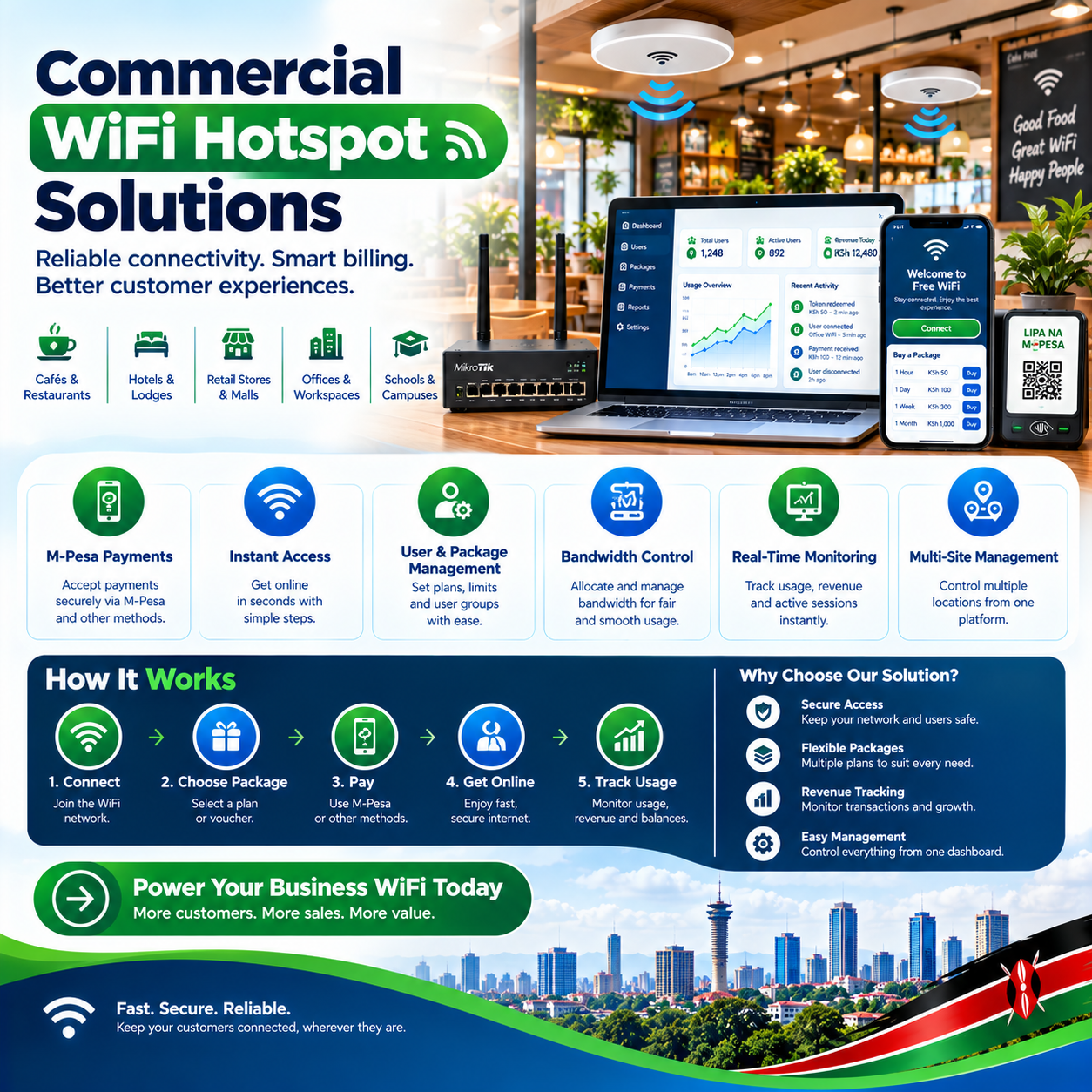
Commercial WiFi hotspot solutions have become one of the most accessible business opportunities of the decade — turning ordinary internet connections, ordinary rooms, and ordinary foot traffic into extraordinary income.
The idea is beautifully simple: wherever people gather with phones in hand and minutes to spare, connectivity has value, and the right system turns that value into revenue.
Cafés collect it from laptop workers. Estates collect it from tenants. Clinics collect it from waiting rooms. Transport stages collect it from departing travelers.
What makes this possible — reliably, automatically, and profitably — is the layer of technology known as commercial WiFi hotspot solutions.
This article explores the complete landscape: what these solutions are, the business models they enable, the venues where they thrive, and how the operators earning daily built their systems the smart way.
Because behind every “WiFi available here” sign that actually makes money, there is a well-chosen commercial WiFi hotspot solution working quietly in the background.
Table of Contents
ToggleWhat Commercial WiFi Hotspot Solutions Actually Are
Strip away the industry language and the concept is refreshingly clear.
A commercial WiFi hotspot solution is the complete system that lets a business sell or monetize internet access — rather than simply give it away and absorb the cost.
The ingredients work together as one machine: a network that carries the signal, a portal that greets every customer, a payment flow that collects money, and enforcement that delivers exactly what was purchased.
A commercial WiFi hotspot solution is what stands between a free WiFi giveaway and an actual business line on the profit-and-loss statement.
The word “commercial” carries the whole distinction.
Home WiFi serves a household. Commercial WiFi serves customers — which means it needs pricing, packages, payments, records, and reliability that a home setup never has to think about.
That is the gap these solutions fill: they take the networking equipment a business already owns and give it a commercial brain.
The result, for thousands of businesses across the market, has been the same: an expense transformed into an asset — the quiet achievement of every well-implemented commercial WiFi hotspot solution.
The Three Business Models the Solutions Enable
Every deployment of commercial WiFi hotspot solutions follows one of three proven models, and choosing between them is the operator’s first strategic decision.
The first is direct sales: customers pay for access — by the hour, the day, or the month — and connectivity becomes a product with a price tag.
This is the classic hotspot model, and it thrives wherever foot traffic is steady and customers already buy internet in small amounts.
The second is monetized free access: connectivity stays complimentary, but the login page earns its keep through advertising, sponsorships, and customer data collected with consent.
Venues with strong branding goals often choose this path, discovering that a commercial WiFi hotspot solution can turn even free WiFi into a marketing asset that pays for itself.
The third is the hybrid — and it is where most successful deployments land: a short free session funded by a sponsor or the venue itself, with paid packages waiting for anyone who wants more.
The hybrid captures both worlds: generosity for the casual visitor, revenue from the committed user, and a complete commercial WiFi hotspot solution income structure from a single connection.
The beauty of modern platforms is that all three models run on the same infrastructure — meaning the operator can start with one and evolve to another without rebuilding anything.
That flexibility is why businesses treat commercial WiFi hotspot solutions as long-term strategy rather than one-time setup.
The Venues Where These Solutions Thrive
The map of successful commercial WiFi hotspot solutions deployments reads like a tour of everyday commercial life.
Cafés and restaurants led the way: laptop workers, lunch meetings, and evening gatherings all convert into paying sessions or loyal regulars.
Hotels and guesthouses followed: per-guest access replaced the handwritten password card, and premium tiers became an upsell at check-in.
Estates and apartment blocks discovered the model independently: tenants buying packages through a portal ended the landlord’s collection rounds forever.
Transport hubs — stages, lounges, and long-distance termini — turned waiting time into revenue through commercial WiFi hotspot solutions built for high-volume, short-session traffic.
Clinics, salons, and service centers converted their waiting rooms: every idle minute with a phone in hand became an opportunity.
Event venues rounded out the list — conferences, weddings, and exhibitions selling day passes to crowds that gather nowhere else on the calendar.
The pattern across all of them is identical: people, phones, and time — the three ingredients every commercial WiFi hotspot solution is designed to monetize.
Wherever those three meet, the model works, which is why the map keeps expanding year after year.
The Technology Stack: What Runs Behind the Scenes
A complete commercial WiFi hotspot solution rests on four layers, and understanding them helps any buyer evaluate what they are actually purchasing.
The first layer is the network itself: routers, access points, and the internet connection — the physical machinery that carries the signal.
The second is the captive portal: the page every customer lands on, which displays packages, takes payments, and doubles as the venue’s highest-attention marketing screen.
The third is the billing engine: the system that processes mobile money, activates sessions, counts down time, and cuts access precisely when purchases end.
The fourth is the management layer: the dashboard where the owner watches revenue, adjusts pricing, and reads the reports that turn operations into strategy.
Modern commercial WiFi hotspot solutions deliver all four as an integrated whole — which is what separates them from the improvised setups of the industry’s early days.
Integration matters most at the seams: when payment confirms, the session must open instantly; when time expires, the cutoff must be automatic.
Those seams are where customer trust is built or broken, and professional commercial WiFi hotspot solutions are engineered to make every transition invisible.
The operator’s experience matches the customer’s: one dashboard, one login, and a business that reports on itself every morning.
Payments: The Heartbeat of the Whole System
No element of commercial WiFi hotspot solutions matters more to daily revenue than how money moves — and in this market, money moves through M-Pesa.
The modern payment flow is fully automated: the customer selects a package on the portal, an STK push lands on their phone, they enter their PIN, and their session opens within seconds.
No counter queue. No cash to count. No vouchers to scratch. No staff involvement at any point.
That automation is what turns a commercial WiFi hotspot solution into a twenty-four-hour business — selling at 6 a.m., at midnight, and through every hour the venue itself is closed.
Reconciliation completes the payment layer: every transaction is matched, receipted, and timestamped, so disputes end before they begin.
Shallow integrations — paybill numbers, typed references, delayed confirmations — are where sales quietly die, which is why payment depth is the first test every serious buyer runs.
The two-minute evaluation is simple: pay for a real package on the candidate platform with your own phone, and time the loop.
Under a minute is the professional standard, and the commercial WiFi hotspot solutions that meet it consistently are the ones whose operators collect while their competitors chase payments.
Designing Packages That Actually Sell
The product menu is where a commercial WiFi hotspot solution meets its market, and the operators who earn most design their packages against one reference: the customer’s alternatives.
The ladder structure is the proven pattern.
A short, affordable session at the bottom catches first-timers and quick checkers.
A mid-tier package — priced as the obvious value — serves the daily mainstream.
A day pass or monthly option at the top converts regulars into predictable, committed revenue.
Speed tiers add a second dimension where the network can honestly deliver: premium packages that genuinely move faster, enforced at network level rather than promised on the page.
The commercial WiFi hotspot solutions that enforce speed tiers reliably turn upgrades into the easiest sale in the building — because the difference is felt, not claimed.
Off-peak pricing is the ladder’s secret rung: discounted packages during quiet hours monetize capacity that otherwise sits idle.
And the dashboard closes the loop: package popularity, sales by hour, and conversion patterns tell the operator exactly which rungs are working.
The operators who tune their commercial WiFi hotspot solution menus against that evidence monthly consistently out-earn those who set prices once and never look back.
The Marketing Machine Hiding in Every Portal
Here is the dimension of commercial WiFi hotspot solutions that even enthusiastic adopters underestimate: the login page is the single highest-attention advertising space the business owns.
Every customer must face it before a single byte of internet flows — no scroll past, no mute button, no walking by.
That guaranteed attention makes the portal a promotional engine: daily specials, upcoming events, loyalty programs, and new offerings delivered to a captive audience already inside the building.
Venues running commercial WiFi hotspot solutions with deliberate portal marketing report the same discovery: the login page outsells every poster, tent card, and boosted post they have ever paid for.
The sponsorship layer extends the opportunity outward.
Neighboring businesses pay to appear on the portal, sponsors attach their names to free sessions, and the venue earns from its audience twice.
With consent, the login flow also builds a contact list — converting anonymous foot traffic into a reachable audience for the venue’s own promotions.
Over a year, that list becomes an asset worth more than the connectivity revenue itself, which is the quiet second income hiding inside every commercial WiFi hotspot solution deployment.
The Mistakes That Weaken Deployments
The recurring failures are well documented across the market, and naming them is cheaper than making them.
The first is the unfinished setup: the network installed, the portal configured, and the payment layer never connected — premium WiFi running as a permanent giveaway.
The second is the silent launch: paid access switched on without telling regulars, then a week spent repairing goodwill that one honest announcement would have preserved.
The third is overselling capacity: more packages sold than the connection can comfortably carry, until the evening peak becomes the hour that loses customers.
The fourth is skipping enforcement: no device binding, no concurrent-login blocks — and a commercial WiFi hotspot solution quietly turned into a donation box by shared credentials.
The fifth is ignoring the dashboard: reports full of pricing evidence that nobody reads, while underperforming packages linger month after month.
The sixth is neglecting the hardware: no power protection, no maintenance routine, and a network that judges every storm by how it survives.
Each mistake is fixable in an afternoon, and the operators who fixed them early are the ones whose commercial WiFi hotspot solutions still run cleanly years later.
Security: The Trust Layer Behind Every Transaction
Money and personal data flow through every commercial WiFi hotspot solution, which makes security a business requirement rather than a technical preference.
The payment rule comes first and stays absolute: customers enter their M-Pesa PIN only on their own phones, inside the payment provider’s own environment.
Any system asking for payment credentials on a web form should be rejected on sight — a standard every professional commercial WiFi hotspot solution already meets.
Network segmentation comes second: guest traffic on its own isolated layer, business systems on another, and never the two touching.
This single structure neutralizes the most common venue-network risk — a visitor’s device wandering where it should never reach.
Access hygiene completes the stack: sessions that expire, accounts that close when customers leave, and admin access limited to named people with records of every change.
The venues that explain this to their customers discover that security is a selling point — because in a market where everyone uploads something sensitive, a trustworthy commercial WiFi hotspot solution earns loyalty that discounts never will.
Scaling: From One Venue to a Portfolio
Growth is where the choice of commercial WiFi hotspot solutions proves itself — because the platform that manages one location gracefully either extends or fragments at the second.
Centralized platforms scale silently: the second venue inherits the same packages, portal, and policies as configuration rather than construction.
The owner watches both locations on one dashboard, with revenue reported per site and the whole portfolio visible from one login.
Multi-site operators describe opening new locations as almost administrative — the commercial WiFi hotspot solution template replicates, the hardware mounts, and the first sales arrive within days.
Consistency compounds with scale: a customer who knows one location’s WiFi knows them all, which quietly builds the brand across the portfolio.
The lesson the scaling operators share is simple: choose the platform for the tenth location, not the first, because retrofitting centralization after fragmentation costs multiples of choosing it correctly upfront.
That foresight is what separates an operator from an owner — and it costs nothing extra on day one with the right commercial WiFi hotspot solution.
Choosing Well: The Evaluation That Works
The selection process that consistently finds the right commercial WiFi hotspot solution takes one week and costs nothing but attention.
Define the requirements honestly first: expected users, target packages, payment flow, and the model — direct sales, monetized free, or hybrid.
Shortlist three candidates whose pricing is transparent: flat fees, no hidden transaction charges, and costs that stay fair at the scale you intend to reach.
Then test with your hands: real hardware, real payments, deliberate power cuts, and the cheapest phone your customers actually carry.
Hand a phone to someone who has never used the system and watch them connect, pay, and browse unaided — the portal test that predicts daily revenue better than any feature list.
Message support with a planted problem and measure the response, because networks do not only break at convenient hours.
The buyer who completes that sequence chooses their commercial WiFi hotspot solution with evidence rather than hope — which is why their choice rarely needs revisiting.
The Payoff: What the Right Solution Delivers
Ask operators a year after deploying well what changed, and the answers gather into four themes.
Revenue: a cost line became an income line — collected around the clock, at hours no staff member worked.
Calm: the voucher books, the password questions, and the payment disputes all ended, replaced by records that settle everything in seconds.
Professionalism: the branded portal, the seamless payment, the honest speeds — small polish points customers mention in reviews without being asked.
And insight: a business that finally reports on itself — peak hours, best sellers, customer patterns — turning every future decision into arithmetic.
None of it required new bandwidth, new premises, or new staff.
It required pointing the right commercial WiFi hotspot solution at an audience the business already had — and the operators who made that move describe the shift the same way: the WiFi stopped being weather and became infrastructure.
That transformation — from expense to asset, from giveaway to growth engine — is what commercial WiFi hotspot solutions deliver when they are chosen well and run with attention.
Frequently Asked Questions
Do I need special hardware to deploy one?
Usually no — modern platforms run on standard routers and access points, and most vendors confirm compatibility before you spend anything.
The strongest commercial WiFi hotspot solutions support a wide range of common equipment, protecting whatever the venue already owns.
Can I charge for WiFi in a market where customers expect it free?
Yes — the hybrid model solves this: a short courtesy session for everyone, with paid packages for anyone wanting more.
Deployed this way, commercial WiFi hotspot solutions preserve goodwill while converting heavy users into revenue.
How much can a venue realistically earn?
It scales with footfall and pricing, but even modest venues typically cover their entire internet cost with a surplus — and busy venues earn multiples of that.
The dashboard on any commercial WiFi hotspot solution shows the venue’s own numbers within the first week.
Do customers actually pay through their phones?
Overwhelmingly yes — the pay-as-you-go habit is already native to the market, and portal purchases feel exactly like buying tokens or airtime.
That familiarity is why commercial WiFi hotspot solutions need no customer training at launch.
What stops one customer from sharing their access?
Device binding and concurrent-login limits tie each purchase to one device at a time, enforced automatically.
This is standard in every professional commercial WiFi hotspot solution and recovers the revenue sharing would otherwise drain.
Can I run different prices at different times?
Yes — off-peak discounts, happy hours, and time-based packages are standard configuration on capable platforms.
Operators using this feature on their commercial WiFi hotspot solution routinely fill dead hours with revenue that previously didn’t exist.
What happens when the power goes out?
With proper protection, sessions persist and service restores automatically; without it, the outage refunds the venue’s reputation daily.
Power backup is listed as core infrastructure in every serious commercial WiFi hotspot solution deployment plan.
Can the portal show my own branding?
Yes — logos, colors, package names, and promotions all carry the venue’s identity, turning every login into a brand moment.
It is the most visible feature of commercial WiFi hotspot solutions and the one customers comment on most.
Is customer data collected at login safe?
Handled properly, yes — reputable platforms collect minimally, state consent plainly, and secure records with the same infrastructure guarding the payments.
Venues that respect data on their commercial WiFi hotspot solution earn trust that compounds into loyalty.
Can one system manage several locations?
Yes — centralized dashboards span multiple sites with per-location reporting, and new venues inherit proven templates as configuration.
Portfolio owners standardize on commercial WiFi hotspot solutions with this architecture precisely because growth becomes repetition rather than rebuilding.
How long does deployment take?
Most venues go live within a day or two: connect the network, configure packages, test payments, and brief the team.
The technical work is hours; the strategic decisions — model, pricing, packages — are a single well-spent meeting before any commercial WiFi hotspot solution goes live.
What is the smartest first step this week?
Count your footfall honestly, list what your customers already pay for internet elsewhere, and price a three-rung package ladder against it.
That single page of notes, tested on a trial commercial WiFi hotspot solution with real payments, has launched more profitable deployments than every sales pitch combined — and the venues that ran it discovered the same closing truth every time: the audience was always there, the demand was always real, and the only thing their WiFi was ever missing was a commercial WiFi hotspot solution to turn it into a business.