
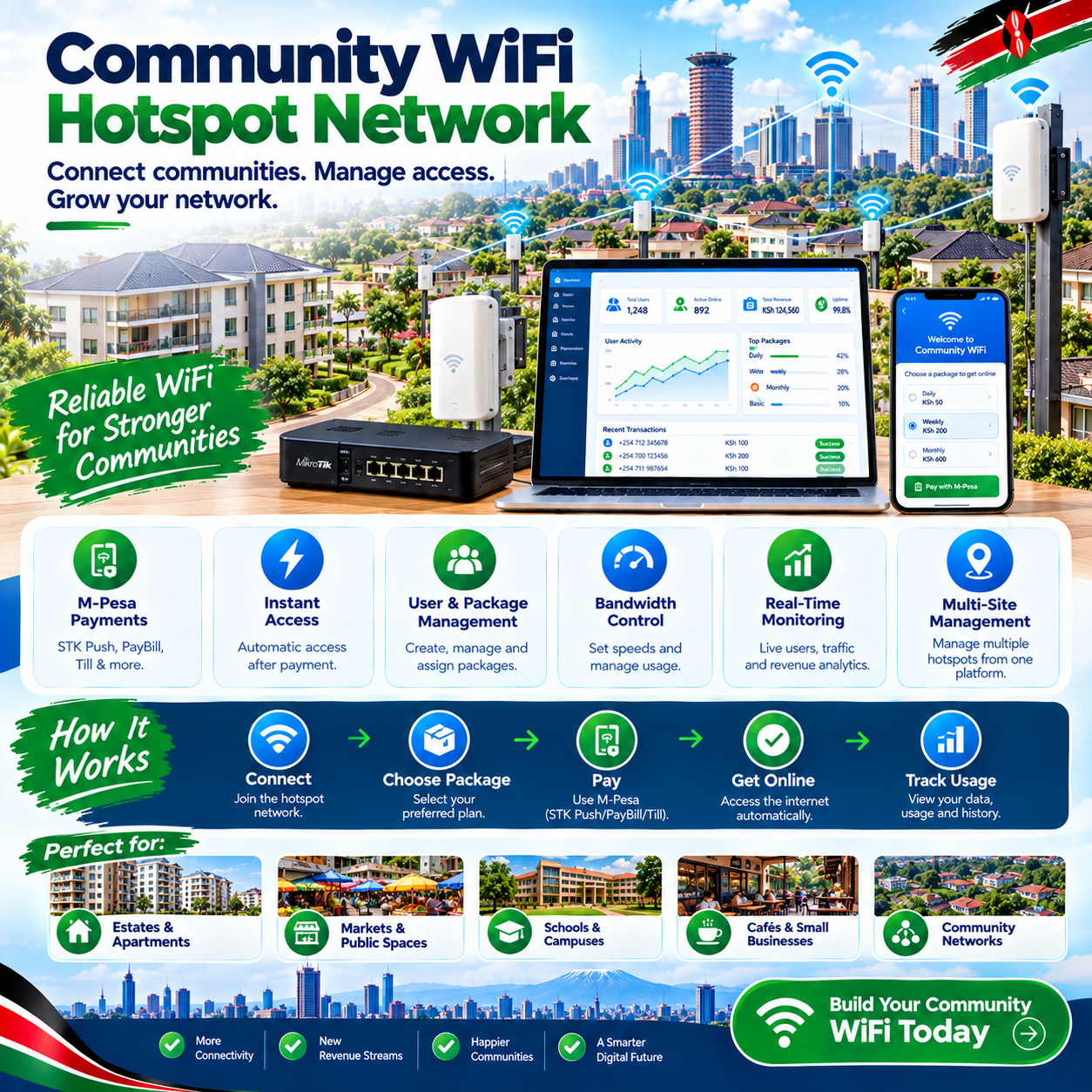
A community WiFi hotspot network is one of the most quietly powerful ideas in connectivity today — neighbors pooling resources, sharing one connection, and building the internet access their area was never prioritized to receive.
In places the big carriers served last and the fiber crews scheduled for “next year,” communities stopped waiting and started building.
A mast on the church roof. A router in the market kiosk. A shared link feeding forty households that split the cost the way they split everything else — together.
The community WiFi hotspot network model has connected villages, estates, and trading centers that official rollouts skipped, and it did so with local money, local labor, and local pride.
This article explores the complete picture: what these networks are, how they work, how they sustain themselves, and why they may be the most important connectivity story of the decade.
Because the community WiFi hotspot network is more than a technical arrangement — it is proof that access is something people can build for themselves.
What a Community WiFi Hotspot Network Actually Is
Strip away the terminology and the concept is wonderfully human.
A community WiFi hotspot network is shared internet infrastructure built, owned, and operated by the people who use it — a neighborhood, a village, a congregation, a school community, or an estate.
One good connection enters the community. Equipment distributes it. A billing or cost-sharing system divides the expense fairly. And everyone who participates gets access at a fraction of what individual subscriptions would cost.
The word “community” is doing real work in that definition.
This is not a carrier’s tower serving passive subscribers — it is a community WiFi hotspot network where the users are also the stakeholders, the decision-makers, and often the technicians.
Ownership takes different forms: an individual champion who runs it as a service, a committee that governs it collectively, a church or school that hosts it, or an informal grouping that simply shares costs.
What all versions share is the same foundation — infrastructure that belongs, in every sense that matters, to the place it serves.
That sense of ownership is not sentimental decoration; it is the operational reason a community WiFi hotspot network survives when commercial models would have walked away.
Why Communities Build Their Own
The origin story of almost every community WiFi hotspot network begins with the same frustration: being told to wait.
Rural areas and low-income neighborhoods sit at the end of every rollout queue — the fiber comes “eventually,” the coverage is thin, and the data prices assume budgets the community does not have.
Yet the need is immediate and real: students with assignments, farmers checking prices, families video-calling relatives abroad, job seekers uploading applications.
A community WiFi hotspot network exists because someone in the community looked at that gap and decided the wait had gone on long enough.
The economics make the decision rational, not just determined.
One bulk connection divided across forty households costs each participant a fraction of an individual bundle — and delivers more reliability than any of them could buy alone.
The community’s collective purchasing power, which was always there, finally gets applied to connectivity.
That is the quiet insight inside every community WiFi hotspot network: the resource was never missing — only the organizing.
And organizing is something communities have done forever, around water points, savings groups, and security arrangements.
Connectivity simply became the newest chapter of an old tradition.
How the Network Actually Works
The anatomy of a community WiFi hotspot network is straightforward, and every part can be understood without an engineering degree.
The backbone is one strong internet connection — fiber where it exists, a high-capacity wireless link where it does not — terminated at a central point: the church, the school, the shop, the champion’s rooftop.
Distribution equipment then spreads the signal: access points mounted where they cover the most homes, and outdoor units reaching the edges of the community.
The management layer is what turns shared infrastructure into a working community WiFi hotspot network: a billing system that registers users, tracks usage, collects payments, and enforces fair access.
Each household or user buys their package through a portal — paid by mobile money, activated instantly — exactly like any commercial hotspot.
The difference lies in where the money goes: into maintaining and growing the community’s own infrastructure rather than into a distant shareholder’s pocket.
That circular flow — payments feeding the network that serves the payers — is the economic engine of every sustainable community WiFi hotspot network.
And because the billing layer automates collection and enforcement, the network runs with the same professionalism as a commercial operation, without needing commercial staffing.
The Billing Layer: Fair Shares and Clean Records
Money is where community projects historically go to die — which is why the billing system is the most important component in a modern community WiFi hotspot network.
The old informal version failed predictably: one person collected cash, kept records in a notebook, and spent their evenings being doubted.
The modern version automates the entire flow: each household pays through M-Pesa, the system records the payment, and access activates without anyone handling cash.
Every transaction in the community WiFi hotspot network carries a timestamped receipt, visible to the payer and the treasurer alike — which ends the suspicion that kills volunteer-run projects.
Fairness becomes structural rather than negotiated: everyone sees the same packages, the same prices, and the same enforcement.
The household that pays stays connected; the one that falls behind disconnects automatically — no door-knocking, no awkwardness, no committee meetings about individuals.
That neutrality is what allows a community WiFi hotspot network to scale past the trust of personal relationships and into genuine community infrastructure.
Transparency completes the loop: monthly revenue, expenses, and surplus are all visible in the dashboard, and the community can see its own money at work.
Networks that share those numbers openly report something remarkable — members pay faster, volunteer more, and defend the project when it needs defending.
The People Who Make It Work
Every successful community WiFi hotspot network traces back to a specific kind of person: the local champion.
The champion is usually not a technician — they are the teacher, the shopkeeper, the youth leader, or the retired engineer who simply decided their community deserved internet.
They organize the initial meeting, negotiate the connection, learn the equipment, and become the network’s first administrator.
The billing platforms behind a community WiFi hotspot network are deliberately designed for exactly this person: no IT background required, everything managed from a phone.
Around the champion, the healthy pattern is a small team rather than a solo act — one person handling payments, another handling equipment, a third handling the inevitable questions.
Committees matter, but lightly: decisions about pricing and expansion belong to the community, while daily operations belong to whoever the system trusts with the dashboard.
The community WiFi hotspot network model works best when governance is clear about that boundary — collective decisions on direction, individual accountability on execution.
Succession is the final people-question, and the networks that planned for it early are the ones still running a decade later.
Documentation, shared passwords, and a second trained administrator are the quiet insurance policies of every mature community WiFi hotspot network.
The Digital Inclusion Payoff
The deepest impact of a community WiFi hotspot network is measured not in revenue but in what access unlocks.
Students in connected villages complete assignments they once traveled hours to type — and the village’s exam results tell the story within a few years.
Farmers check market prices before selling, and the difference in bargaining power is immediate and permanent.
Families hold video calls with relatives abroad that once required expensive trips to town.
Job seekers upload applications the same day opportunities appear, and local businesses — salons, shops, boda operations — come online for the first time.
Researchers studying community connectivity consistently find the same pattern: a community WiFi hotspot network raises the digital participation of an entire area within months of going live.
The inclusion effect is strongest for exactly the people commercial models serve worst — the elderly managing affairs online, the young learning skills, the households that could never justify an individual subscription.
Access stops being a luxury item and becomes what electricity became a generation ago: shared infrastructure everyone draws from.
That transformation — from digital exclusion to digital citizenship — is the real product of every community WiFi hotspot network, and it is why the model attracts support from NGOs, counties, and development partners alike.
The Money Model: How Community Networks Sustain Themselves
Sustainability is the question every community WiFi hotspot network must answer honestly, because donated equipment without a revenue plan becomes a shrine within two years.
The proven model is simple cost-recovery: members pay modest monthly or daily packages, and those payments cover the backbone connection, the electricity, the maintenance, and a reserve for growth.
The pricing philosophy differs from commercial operators: a community WiFi hotspot network prices to sustain, not to maximize — which keeps access affordable while keeping the lights on.
Surplus, when it exists, compounds the mission: the second access point, the extended coverage, the upgraded backbone.
Some networks add revenue layers that commercial operators would recognize — visitor packages, sponsored access days funded by local businesses, or event connectivity.
The financial discipline that makes it all work is the billing automation itself: collections that never forget, records that never argue, and reports the whole community can trust.
Networks running on automated community WiFi hotspot network billing report collection rates that volunteer cash systems never achieved — because paying became as easy as buying airtime.
The sustainability rule that veterans repeat: treat the network as a utility with a budget, not a favor with a donation box.
Partnerships: Scaling Without Losing Ownership
The most successful community WiFi hotspot network deployments grew through partnerships that respected the community’s ownership.
Counties and development organizations provide equipment and training; the community provides the site, the people, and the operation.
Internet providers offer bulk wholesale rates to aggregated community demand — a customer base they could never profitably reach household by household.
Schools and churches contribute the physical anchor: the tower location, the security, and the trust that only long-standing institutions carry.
The pattern in healthy partnerships is consistent — the community WiFi hotspot network remains community-operated, with partners strengthening rather than absorbing it.
Technology partners matter too: billing platforms with local support keep the network running, and equipment vendors with spares keep it repaired.
The networks that articulated their own terms before accepting help are the ones whose partnerships lasted — because ownership was never on the table.
That clarity is what separates a community WiFi hotspot network that grows from one that gets acquired by its own generosity.
Where Community Networks Thrive
The map of thriving community WiFi hotspot network deployments tells you everything about the model’s flexibility.
Villages and rural trading centers are the heartland — places the market underserved and the community organized.
Peri-urban estates use the model to share one strong connection across compounds that individually could not justify the cost.
Church communities extend connectivity from the sanctuary to the surrounding homes, turning ministry infrastructure into community infrastructure.
School networks serve students by day and surrounding households by evening — the same equipment earning twice.
Market associations wire their trading centers, and the vendors’ businesses modernize around the access.
Even urban apartment clusters form informal community WiFi hotspot network arrangements — a shared mast in the courtyard, packages managed through a portal, costs split fairly.
The common ingredient across every setting is the same: a gap the market left, and a community willing to fill it themselves.
The Mistakes That Sink Community Projects
The failure patterns are well known, and every veteran of the model can recite them.
The first is the free-money myth: launching a community WiFi hotspot network with donated equipment and no revenue plan, then watching it die the day the first repair bill arrives.
The second is the single-point-of-failure champion — one person holding every password, every skill, and every relationship, until they move away and the network moves with them.
The third is informal money: cash collections without records, which poison community trust faster than any technical fault.
The fourth is underpricing from kindness — packages so cheap they cannot fund maintenance, guaranteeing the network’s slow decline.
The fifth is skipping the billing automation and running on memory and goodwill, which works for six months and never for six years.
The sixth is ignoring the equipment’s physical needs — no surge protection, no maintenance schedule, and a network that every storm punishes.
Each of these is avoidable, and the networks that avoided them share the same habits: automated community WiFi hotspot network billing, documented operations, priced-for-sustainability packages, and at least two people who can run everything.
The Technology, Kept Simple
The technical stack of a community WiFi hotspot network is deliberately modest, and that modesty is a feature.
The backbone connection — the one significant recurring cost — is chosen for capacity and reliability rather than brand.
Distribution runs on proven wireless equipment: access points for dense areas, outdoor units for reach, mounted high and protected from power events.
The billing platform sits on top, managing users, payments, and enforcement exactly as any commercial hotspot would.
Households at the coverage edge receive outdoor units that capture the signal cleanly — the same customer-premises discipline commercial networks follow.
Power protection is non-negotiable in every serious community WiFi hotspot network: surges, backups, and a maintenance routine that treats the grid as the adversary it is.
The entire stack is learnable: champions routinely go from novices to confident operators within a season, guided by platform support and the community of similar networks that now spans the region.
That knowledge commons is one of the model’s hidden strengths — no community WiFi hotspot network builds alone, because the ones that came first documented everything.
Growth: From One Mast to a Movement
The networks that survive their first year tend to do something remarkable: they multiply.
The village whose community WiFi hotspot network works becomes the region’s training ground, sending champions to help the next community launch.
Multi-site operations emerge — one administrative team, several community nodes, all reporting to dashboards the public can inspect.
The billing platforms support this naturally: multiple locations, one management layer, per-site transparency preserved.
Some networks federate formally, sharing backbone costs and technical staff across villages — the cooperative model applied to bandwidth.
The growth pattern mirrors every successful community institution: prove it locally, document it honestly, and let neighboring communities copy what works.
That ripple effect is why advocates describe the community WiFi hotspot network not as projects but as a movement — one that scales by trust rather than by capital.
The Payoff: What Communities Actually Gain
Ask members of established networks what changed, and the answers stack up in layers.
Access: connectivity that arrived years ahead of any official schedule, at prices individual subscriptions could never match.
Skills: the champions, treasurers, and young technicians who learned real infrastructure by running real infrastructure.
Money that stays home: connectivity spending that once left the community forever now circulates through it — maintaining equipment, paying local hands, funding expansion.
And agency: the profound shift from waiting for service to owning it, which colors how the community approaches every other shared challenge.
That last gain is the one veterans mention most.
A community WiFi hotspot network teaches a community that infrastructure is buildable — and communities that learn that lesson once apply it to water, to energy, to everything.
The network, in the end, was never only carrying internet.
It was carrying proof — and that proof, broadcast mast by mast across the region, is the real legacy of every community WiFi hotspot network that dared to begin.
Frequently Asked Questions
Do community members need technical skills to run one?
No — modern platforms handle the billing, payments, and enforcement automatically, and the equipment skills are learnable in weeks.
The champions running successful community WiFi hotspot network deployments came from every background except formal IT.
How is this different from a commercial hotspot?
Ownership and purpose: a commercial network maximizes profit for an operator, while a community WiFi hotspot network prices to sustain itself and answers to its users.
The technology is nearly identical — the direction of the value is what differs.
How much does it cost to start?
A modest backbone connection, distribution equipment, and the billing platform — costs that a founding group can often share, or a partner can fund with the community operating from day one
Networks that priced their launch honestly reached sustainability within their first months of community WiFi hotspot network collections.
How do households pay?
Through the portal, by mobile money — the same pay-as-you-go flow they already use for tokens and airtime.
Automation is what makes a community WiFi hotspot network administrable by volunteers at all.
What happens when someone doesn’t pay?
Their access suspends automatically until they reconnect — no confrontations, no committee involvement, no exceptions that erode fairness.
This neutrality is the operational backbone of every durable community WiFi hotspot network.
Can the community see where the money goes?
Yes — and they should: revenue, expenses, and surplus visible in reports builds the trust that volunteer projects live on.
Transparency is the culture of every community WiFi hotspot network that lasted.
What if the area has no fiber?
Wireless backhaul solves it: a strong 4G or fixed wireless link feeding the community node, the same way commercial sites connect.
The community WiFi hotspot network model was practically designed for exactly these uncovered areas.
How many households can one network serve?
From a handful of compounds to several hundred households, depending on the backbone and equipment — and growth is incremental, adding access points as membership grows.
The scalable architecture is why a community WiFi hotspot network rarely outgrows its design.
Can schools and churches anchor a network?
They are the classic anchors — trusted locations, existing power and security, and institutional continuity that outlasts individual volunteers.
Most celebrated community WiFi hotspot network stories began in exactly those buildings.
What prevents equipment theft or damage?
Placement discipline, community ownership itself — people protect what is theirs — and basic physical security at the anchor site.
The ownership effect is real: vandalism in community-run community WiFi hotspot network deployments is rare precisely because the community guards its own.
Is this model recognized by regulators and partners?
Yes — community networks are an established category globally, with counties, NGOs, and providers increasingly partnering with them.
Operating transparently from the start is what positions any community WiFi hotspot network for those partnerships.
What is the smartest first step for a community considering this?
Gather the interested households, count them honestly, price the backbone connection, and model what each member would pay for packages that sustain the network.
That one page of arithmetic, discussed in an open meeting, has launched every thriving community WiFi hotspot network in the region — and the communities that took it decided the same thing every time: the wait was over, the tools were ready, and the community WiFi hotspot network they built together became the access they had stopped expecting anyone to bring them.