
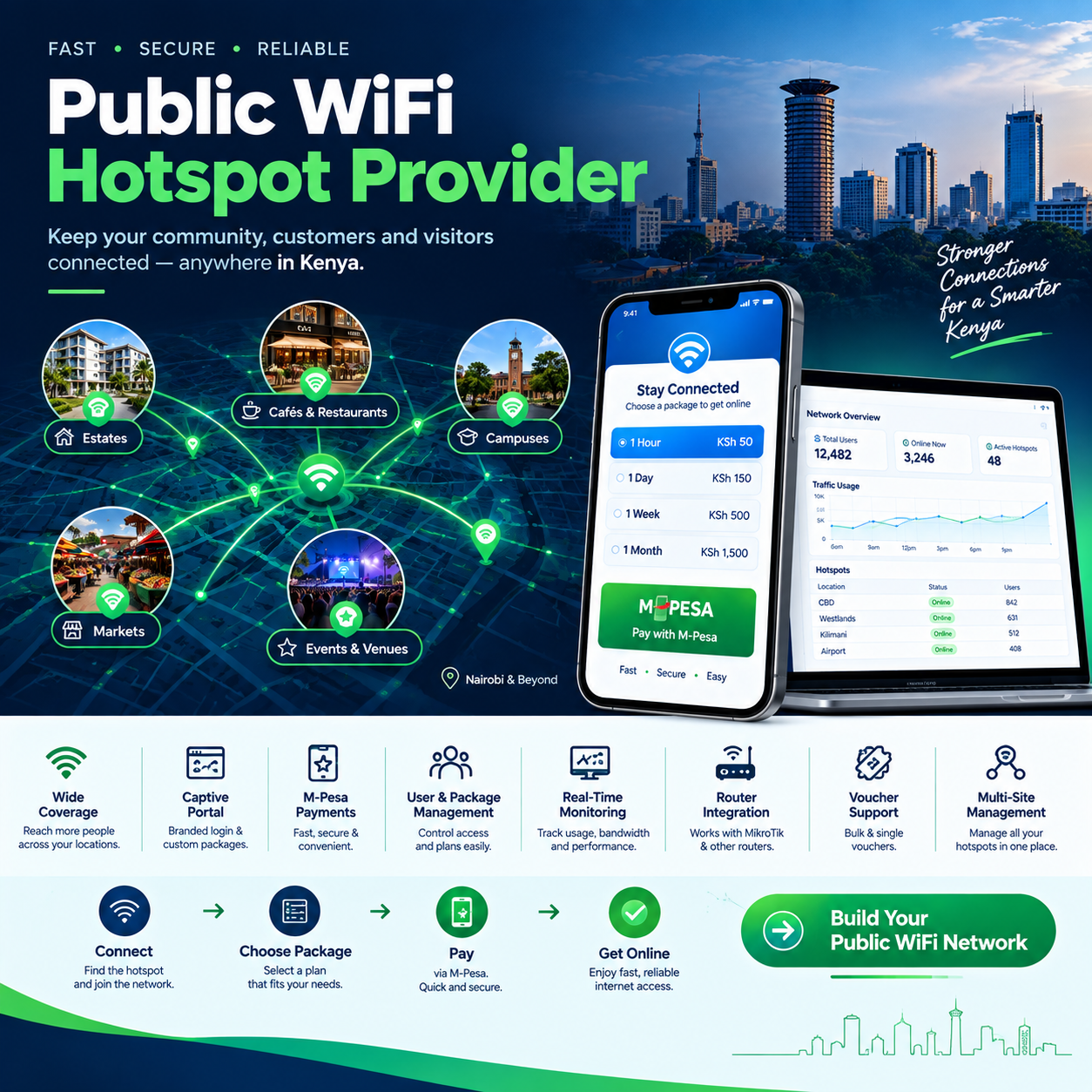
A public WiFi hotspot provider operates one of the most visible businesses in the modern economy — the person or company behind the networks people connect to at markets, stages, campuses, cafés, and waiting rooms every single day.
Wherever crowds gather with phones in hand, someone is selling them internet — and that someone has built a genuinely durable business on a resource most venues waste.
The opportunity rests on three everyday facts: people carry phones, they buy internet in small amounts, and they spend hours in public spaces with time to fill.
A public WiFi hotspot provider simply organizes those facts into a system that sells, collects, and delivers — automatically, around the clock.
This article walks through the complete picture: what the role actually involves, the models that work, the venues that pay best, and the habits that separate thriving providers from struggling ones.
Because behind every network that “just works” in a public space stands a public WiFi hotspot provider who built it deliberately.
What a Public WiFi Hotspot Provider Actually Is
Strip away the industry language and the role is refreshingly concrete.
A public WiFi hotspot provider supplies paid or monetized internet access to people in shared, public-facing spaces — and manages the entire operation: the connection, the equipment, the payments, and the customer experience.
The provider buys connectivity in bulk, distributes it across a venue or neighborhood, and sells it in slices sized for real budgets — an hour here, a day there.
The work spans both worlds: half technician, half businessperson, with the billing platform handling most of the second half automatically.
What distinguishes a public WiFi hotspot provider from someone who merely shares a password is the commercial machinery: packages, payments, enforcement, and records.
That machinery is what turns a shared connection into a service — one that can be priced, measured, improved, and scaled.
The title also describes a responsibility, and the good providers feel it: hundreds of people each day judge the network by whether it delivers.
A public WiFi hotspot provider who takes that responsibility seriously builds something rare in public spaces — a service people trust enough to pay for, again and again.
Why the Business Model Wins
The economics behind a public WiFi hotspot provider reward exactly the discipline this market has always honored: buy wholesale, sell retail, serve a demand that never stops arriving.
The core arbitrage is structural and permanent — bulk bandwidth costs a fraction of what individual bundles cost, and customers happily pay for access priced below their phone’s own data menu.
The demand side is equally durable: every year, more of daily life — work, school, commerce, government — moves online, and every new online need arrives holding a phone in a public space.
Operators studying the public WiFi hotspot provider model consistently highlight its margin profile: after the fixed costs of bandwidth and equipment, every additional session sold rides infrastructure that is already paid for.
That near-zero marginal cost means growth compounds — the same mast, the same portal, the same payment flow, serving more customers at almost no added expense.
There is also a defensive quality to the model: connectivity is not a fashion product, and nobody unsubscribes from the internet.
A public WiFi hotspot provider serves a need that renews itself daily with every new crowd — which is why the business rewards longevity more than novelty.
And the barriers that once protected the industry’s giants have fallen: the tools, the payments, and the knowledge are now accessible to anyone willing to learn the craft.
The Venues Where Providers Thrive
The map of successful public WiFi hotspot provider operations reads like a tour of the busiest places in any town.
Markets and trading centers top the list — dense foot traffic, waiting vendors, and customers who buy connectivity the way they buy everything else: small, instant, local.
Transport stages and long-distance termini follow: crowds with minutes to fill and journeys to plan.
University and college neighborhoods supply the most loyal customers — students with assignments, deadlines, and a daily need for affordable access.
Estates and residential clusters turned the model inward, with providers serving hundreds of households from a single mast.
Hospitals, clinics, and government offices convert waiting rooms into revenue — the public WiFi hotspot provider serving people who literally have nowhere else to be.
Cafés, salons, and event grounds complete the map: smaller crowds, higher willingness to pay for comfort and speed.
The common ingredients across every location are the same three that define the trade — people, phones, and time.
Wherever those meet in volume, a public WiFi hotspot provider can build a business — and the operators who match their equipment to their crowd’s habits win their locations outright.
The Technology Stack Behind the Service
Every professional public WiFi hotspot provider runs on four coordinated layers, and understanding them is the first step to running one well.
The foundation is the connection itself — fiber where it exists, high-capacity wireless where it does not — sized for the evening peak rather than the quiet afternoon.
The distribution layer spreads the signal: access points positioned for coverage, outdoor units reaching the edges, and mounting discipline that survives weather
The billing layer is the business’s engine: the captive portal that greets every user, the payment flow that collects through M-Pesa, and the session management that delivers exactly what was purchased.
The management layer is the provider’s cockpit: one dashboard showing revenue, active users, package performance, and network health at a glance.
Modern platforms integrate all four so tightly that a public WiFi hotspot provider can run the entire operation from a phone — adjusting prices at breakfast, checking the evening rush from home.
Integration matters most at the seams: payment confirming into instant activation, expiry landing as a clean cutoff, records arriving complete for every session.
Those seams are where customer trust forms, and the platforms behind successful public WiFi hotspot provider operations are engineered to make every transition invisible.
Payments: The Heartbeat of the Operation
No part of a public WiFi hotspot provider business matters more to daily revenue than how money moves — and in this market, money moves through M-Pesa.
The professional flow is fully automated: the user selects a package on the portal, an STK push lands on their phone, they enter their PIN, and their session opens within seconds.
No counter, no cash, no vouchers to print or guard — the public WiFi hotspot provider collects at 6 a.m., at midnight, and through every hour between.
Reconciliation completes the payment layer: every transaction matched, receipted, and timestamped, so disputes end before they begin.
Payment depth is also the first test every serious buyer runs on any platform: pay for a real package with a real phone, and time the loop.
Under a minute is the standard, because every second of delay at the moment of decision loses customers who were ready to pay.
Providers who upgraded from manual or shallow payment flows to deeply integrated ones report the same discovery: collections stopped being work and became weather — steady, automatic, and visible on the public WiFi hotspot provider dashboard every morning.
Designing Packages That Fit the Crowd
The package menu is where a public WiFi hotspot provider meets its market, and the operators who earn most build their menu against one reference: the customer’s own data bundle prices.
The ladder structure is the proven pattern.
A short, cheap session at the bottom catches first-timers and quick checkers.
A mid-tier package — priced as the obvious value — serves the daily mainstream.
A day pass or weekly option at the top converts regulars into committed, predictable revenue.
Speed tiers add a second dimension where the network can honestly deliver them: premium packages that genuinely move faster, enforced at network level rather than promised on the page.
The public WiFi hotspot provider whose premium tier is felt rather than claimed turns upgrades into the easiest sale on the street.
Off-peak pricing fills the quiet hours — discounted packages during mornings and late nights monetize capacity that otherwise sits idle.
And the dashboard closes the loop: package popularity, sales by hour, and conversion patterns tell the provider exactly which rungs to keep, fix, or retire.
Providers who tune their menus monthly against public WiFi hotspot provider evidence consistently out-earn those who set prices once at launch and never look again.
The Marketing Layer Most Providers Miss
Here is the dimension of the public WiFi hotspot provider business that even experienced operators underestimate: the login page is the highest-attention advertising space the operation owns.
Every connected user faces it before a single byte of internet flows — no scroll past, no mute button, no walking by.
That guaranteed attention makes the portal a promotional engine: new packages, promotions, and announcements delivered daily to an audience already engaged and already present.
Sponsorship extends the opportunity: neighboring businesses pay to appear on the portal, and sponsors attach their names to free sessions — turning the public WiFi hotspot provider into a small media company as a side effect.
With consent, the login flow builds a contact list of users who opted to hear more — an audience the provider can reach for launches, price changes, and events at zero cost.
Venues and providers who run this layer deliberately report the same finding: the portal outperforms every poster and flyer the operation ever paid for.
The referral effect compounds it further — a public network that works well becomes the neighborhood’s recommendation, passed along in exactly the conversations where new customers are decided.
That is why the savviest public WiFi hotspot provider treats every login screen as both a checkout counter and a billboard, and keeps both sides of it fresh.
The Mistakes That Weaken Provider Operations
The recurring failures are well documented across the industry, and naming them is cheaper than making them.
The first is overselling the mast: packing more users onto the connection than the evening peak can carry, until the network’s reputation collapses one frustrating night at a time.
The second is skipping enforcement: no device binding, no concurrent-login blocks — and a public WiFi hotspot provider quietly converted into a donation box by shared credentials.
The third is the silent launch: switching paid access on without introducing it to the crowd, then misreading the slow first week as rejection.
The fourth is ignoring the dashboard: reports full of pricing and capacity evidence that nobody reads while underperforming packages and congestion warnings linger.
The fifth is neglecting the hardware: no surge protection, no maintenance routine, and a network that every storm and blackout judges publicly.
The sixth is the stale menu: prices and packages frozen in launch-day assumptions while the neighborhood’s habits and competitors moved on.
Each mistake is fixable in an afternoon, and the providers who fixed them early are the ones whose public WiFi hotspot provider operations still run cleanly years later.
Security: The Trust Behind Every Transaction
Money and personal data flow through every public WiFi hotspot provider operation, which makes security a business requirement rather than a technical preference.
The payment rule comes first and stays absolute: users enter their M-Pesa PIN only on their own phones, inside the payment provider’s own environment.
Any system that asks for payment credentials on a web form should be rejected on sight — a standard every professional public WiFi hotspot provider platform already meets.
Network segmentation comes second: public user traffic on its own isolated layer, business and admin systems on another, and never the two touching.
Access hygiene completes the stack: sessions that expire cleanly, records that answer every dispute, and admin access limited to named people with a log of every change.
Providers who explain this to their customers discover that security is a selling point — in a market where everyone uploads something sensitive, a trustworthy public WiFi hotspot provider earns loyalty that discounts never will.
Scaling: From One Site to a Network
Growth is where the choice of platform proves itself, because the system that manages one site gracefully either extends or fragments at the second.
Centralized platforms scale silently: the second location inherits the same packages, portal, and policies as configuration rather than construction.
The provider watches every location on one dashboard, with revenue reported per site and the whole network visible from a single login.
Multi-site operators describe expansion as almost administrative — the public WiFi hotspot provider template replicates, the hardware mounts, the first sales arrive within days.
Site selection repeats the original discipline at scale: count the crowd, test the connection, price against the local alternatives — then deploy the template that already worked once.
The providers who grew to five sites and beyond all share the same history: standards written down, hardware chosen with headroom, and every expansion funded by a site that was already proven profitable.
That is the compounding path of the public WiFi hotspot provider trade — one verified location at a time, each new site inheriting everything the last one learned.
The Payoff, Counted Honestly
Ask providers with a few years behind them what the business delivered, and the answers gather into four themes.
Income that compounds: margin-rich sessions sold on infrastructure already paid for, collected around the clock at hours no staff member worked.
A business with a shape: clean records, known customers, and numbers steady enough to plan against — the difference between a hustle and an enterprise.
Reputation that grows: a network that works in a crowded space becomes the local standard, recommended in the conversations that decide where people spend.
And independence: an operation that runs itself daily, needing the provider’s decisions rather than their constant presence.
None of it required special genius or unusual capital — only the discipline to build the system properly and read the evidence it produced.
That is the case for becoming a public WiFi hotspot provider in one sentence: the crowds were always gathering, the phones were always in hand, and the only thing the opportunity ever needed was someone organized enough to serve it.
Frequently Asked Questions
How much does it cost to become a public WiFi hotspot provider?
A serious single-site launch covers the connection, distribution equipment, power protection, and the billing platform — a budget comparable to other small-business starts.
Providers who sized honestly and launched on proven public WiFi hotspot provider platforms typically recover the investment within the first quarter.
Do I need technical qualifications?
No — modern platforms handle the portal, payments, and enforcement automatically, and the equipment skills are learnable in weeks.
The providers who thrive came from every background except formal IT, guided by platform support and the community of operators who built this industry.
How do users pay?
Through the portal, by mobile money — the same pay-as-you-go flow they already use for tokens and airtime.
That native familiarity is why a public WiFi hotspot provider launch needs almost no customer education at all.
What stops users from sharing one purchase?
Device binding and concurrent-login limits tie each purchase to one device at a time, enforced automatically.
This is standard in every professional public WiFi hotspot provider deployment and recovers the revenue sharing would otherwise drain.
Which locations earn the most?
Waiting-heavy, high-footfall sites: markets, stages, campuses, hospitals, and dense residential clusters.
The formula behind every profitable public WiFi hotspot provider site is always the same — crowd multiplied by time on hand.
Can I run free sessions and paid packages together?
Yes — and the hybrid outperforms either model alone: a short courtesy session welcomes everyone, with paid tiers serving anyone who wants more.
Providers running this structure report goodwill and revenue arriving from the same connection.
What happens during a power cut?
With proper protection, sessions persist and service restores automatically; without it, the outage refunds the provider’s reputation daily.
Power backup is listed as core infrastructure in every serious public WiFi hotspot provider deployment plan.
Can one person manage several sites?
Yes — centralized dashboards span multiple locations with per-site reporting, and new sites inherit proven templates as configuration.
Portfolio providers standardize on public WiFi hotspot provider architecture precisely because growth becomes repetition rather than rebuilding.
How do I price against the big carriers’ bundles?
Price visibly below bundle value per hour and deliver visibly above bundle experience — the structural advantage every public WiFi hotspot provider holds over consumer data pricing.
Customers compare in two taps, and the honest ladder wins that comparison permanently.
What reports should I check weekly?
Revenue by hour, package popularity, active-user peaks, payment success rate, and any congestion warnings.
The providers who read their public WiFi hotspot provider dashboards weekly catch problems while they are small — and find opportunities while they are fresh.
Is the market getting saturated?
No — demand keeps deepening as daily life moves online, and most areas still have fewer serious operators than their foot traffic could support.
The public WiFi hotspot provider opportunities that remain open belong to whoever arrives with the better system, not merely the first.
What is the smartest first step this week?
Choose your best candidate location, count the crowd at two different peak hours, price a three-rung ladder against local bundle math, and test a trial platform with a real payment.
That single page of notes, run honestly, has launched more thriving public WiFi hotspot provider businesses than every other preparation combined — and the operators who ran it discovered the same truth every time: the crowd was already there, the demand was already paying, and the only thing the space was ever missing was a public WiFi hotspot provider organized enough to serve it.