
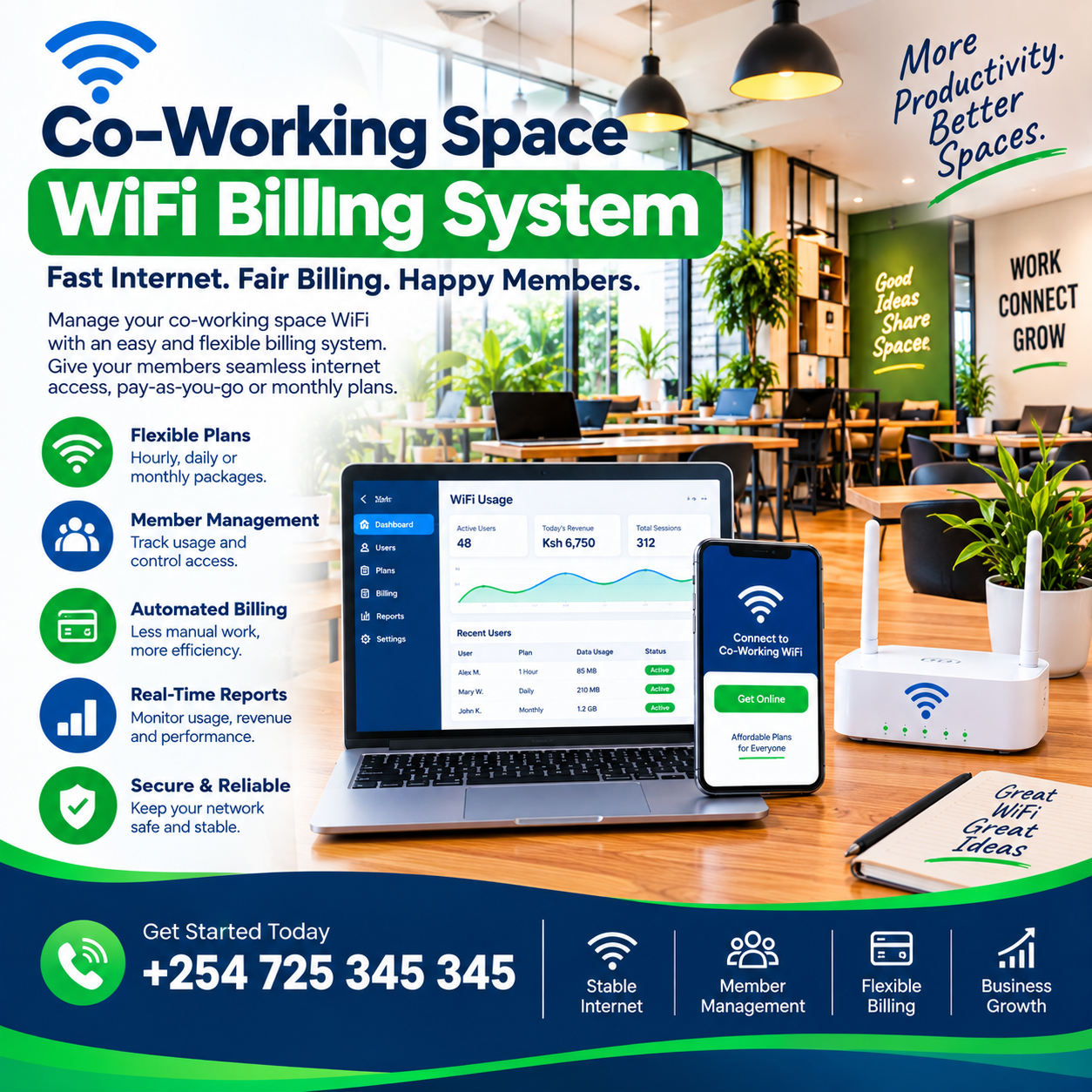
Co-working space WiFi billing system technology is the invisible engine behind every successful shared office — the machinery that turns a room full of desks, a strong connection, and a revolving crowd of professionals into a membership business that runs itself.
Every co-working space lives or dies by the same three realities: members expect flawless internet, drop-ins expect instant access, and the operator expects every shilling of both to be collected without friction.
Managing those expectations manually is impossible — a space serving fifty members, twenty daily drop-ins, and a stream of meeting-room guests cannot track access on paper without losing money and goodwill in equal measure.
That is precisely the gap a co-working space WiFi billing system was built to close, and the operators who deployed one describe the change as hiring their best employee: a system that never forgets a payment, never misses an expiry, and never leaves a paying member stranded at a login screen.
This article walks through the complete picture: what these systems actually do, why co-working is the most demanding WiFi environment in the entire trade, how memberships and day passes work side by side, and the habits that turn a shared office’s internet into its most professional asset.
Because in the co-working economy, connectivity is not an amenity — it is the product, and a co-working space WiFi billing system is what makes selling that product possible at scale.
Table of Contents
ToggleWhat a Co-working Space WiFi Billing System Actually Is
Strip away the jargon and the concept is refreshingly concrete.
A co-working space WiFi billing system is the complete commercial layer of a shared office’s internet: the portal every visitor lands on, the payment machinery that collects from every user type, and the access management that delivers exactly what each person paid for.
The system’s defining challenge is that it serves many customer types simultaneously — and serves each one correctly.
The monthly member needs seamless, always-on access that never asks them to log in again.
The day-pass visitor needs instant self-service access for a few hours, paid by phone without approaching the front desk.
The meeting-room guest needs temporary access scoped to their booking, expiring when their reservation ends.
The event attendee needs full-day coverage sold or sponsored as part of a gathering.
A co-working space WiFi billing system handles all of these flows through one platform, one dashboard, and one consistent experience — which is what no manual arrangement, no matter how diligent the staff, has ever achieved.
The word “system” in the name matters: this is not a router setting or a password rotation schedule but an integrated architecture where payments, access, and records move together.
When a member’s subscription renews, their access continues without interruption.
When a visitor’s day pass expires, their session ends cleanly without a staff member noticing or intervening.
When a question arises about any transaction, the answer lives in a timestamped record rather than in anyone’s memory.
That integration is what distinguishes a genuine co-working space WiFi billing system from the improvised arrangements that still run many spaces — and it is the difference between connectivity as a managed product and connectivity as a daily headache.
Why Co-working Is the Most Demanding WiFi Environment
Of every venue type in the connectivity trade, shared offices place the heaviest demands on their networks — and understanding why clarifies what a co-working space WiFi billing system must deliver.
The first demand is professional criticality.
Co-working members are not browsing casually; they are running businesses, attending client calls, submitting proposals, and hitting deadlines — all through the space’s connection.
A buffering video in a café is an irritation; a frozen video call in a co-working space is a member’s reputation taking damage in front of their client.
The second demand is duration: members occupy the space for full working days, meaning the network carries sustained, heavy load from morning to evening every single day, not just at peak hours.
The third demand is device density: a single member can arrive with a laptop, a phone, a tablet, and a hotspot-tethered console — and a space of fifty members can easily present two hundred active devices.
The fourth demand is fairness under load: when one member’s large upload slows another’s client presentation, the space’s professionalism is on trial, and the members judge it harshly.
The fifth demand is the variety of access types running in parallel — members, drop-ins, guests, and events — each requiring different billing and different treatment.
No other venue combines all five demands at once, which is why the operators who run the most respected spaces treat their co-working space WiFi billing system as the core of their operation rather than an add-on to it.
Members may forgive an uncomfortable chair or a crowded Monday; they do not forgive a network that costs them a client.
The system that guarantees the network performs — and bills for that performance correctly — is therefore the foundation everything else in the space is built on.
The Membership Layer: Recurring Revenue on Autopilot
The financial heart of any shared office is its membership base, and a co-working space WiFi billing system is what turns that base into recurring revenue collected without chasing.
The structure begins with package design: hot desks, dedicated desks, and private offices each carry their own subscription tier, and the system manages all of them from one menu.
Members pay monthly through mobile money — the STK push arrives on their renewal date, their PIN confirms, and their access continues seamlessly into the next cycle.
No renewal reminders composed by staff, no awkward conversations at the front desk, no lapsed memberships discovered when a member cannot connect.
The renewal flow inside a co-working space WiFi billing system runs on automation: reminders before expiry, one-tap payments, instant reactivation, and grace periods that rescue the member whose payday arrived a day late.
Retention follows the same machinery: members who never experience a payment failure, an access gap, or a billing dispute renew at rates that manual operations never achieve.
The system also handles the membership lifecycle cleanly — pauses for members traveling, upgrades when a freelancer becomes a team, and downgrades when budgets tighten — each transition processed from the dashboard without contract renegotiation drama.
The financial reporting completes the picture: monthly recurring revenue visible at a glance, churn flagged as it happens, and upgrade patterns revealing which members are ready for larger plans.
Operators who moved their memberships onto a proper co-working space WiFi billing system describe the same discovery: the membership base stopped being an administrative burden and became a predictable, growing asset they could actually plan against.
That predictability — the whole month’s baseline income known in advance — is what makes expansion, hiring, and second locations financeable rather than hopeful.
Day Passes and Drop-Ins: Serving the Crowd Without a Queue
While memberships anchor the revenue, the daily flow of drop-in visitors supplies the volume — and a co-working space WiFi billing system serves them entirely through self-service.
The visitor connects to the network, lands on the branded portal, and sees the options laid out clearly: an hour pass, a half-day, a full day — each with its price and its terms.
They tap their choice, an M-Pesa prompt lands on their phone, they enter their PIN, and their session opens within seconds.
The entire transaction completes without the visitor approaching the front desk and without a staff member touching anything — which is the defining convenience of a well-deployed co-working space WiFi billing system.
The commercial effects stack up quickly.
Selling hours expand to all twenty-four: the early riser who arrives before reception opens and the evening worker who stays past closing both buy their passes without anyone present.
Conversion improves because the portal displays every option honestly, and the payment completes before hesitation has time to grow.
The queue disappears: on busy days when the front desk would once have become a bottleneck of cash transactions and change-making, visitors now flow through the portal on their own.
Leakage ends: every pass sold is recorded, receipted, and reconciled automatically — the sales that once depended on the honesty of a cash tin now live in the platform’s books.
And the front desk staff return to their actual job: welcoming people, giving tours, and converting visitors into members — the highest-value work in the building.
Operators who automated their drop-in flow report the same pattern: day-pass revenue rose, staff stress fell, and the front desk transformed from a checkout counter into a sales office.
That transformation, repeated daily, is one of the quietest returns a co-working space WiFi billing system delivers.
Meeting Rooms and Booked Access: Billing That Follows the Calendar
Every co-working space runs a second business inside its walls — the meeting rooms, event corners, and private booths rented by the hour — and a co-working space WiFi billing system ties their connectivity directly to their bookings.
The mechanic is elegant: when a client books the meeting room for two hours, the system provisions their WiFi access for exactly that window.
Their guests connect during the reservation, browse freely, and find their sessions ending politely as the booking closes — no staff member issuing passwords, no access lingering after the room empties.
That scoping solves the oldest problem in meeting-room management: the guest whose access outlived their meeting and quietly consumed the space’s bandwidth for the rest of the day.
For corporate clients running day-long strategy sessions, the system provisions full-day access for the whole visiting team — billed as part of the room’s package, receipted automatically, and scoped to the booked date.
For the recurring client — the consultant who books the same room every Thursday — the system remembers the pattern and streamlines every repeat visit.
The billing integration also protects the premium: meeting-room access is sold as part of a higher-priced product, and the co-working space WiFi billing system enforces that distinction automatically, so free-flow floor access never leaks into a paid-room product.
Operators who wired their bookings to their billing describe the guest experience as their best sales moment: visitors experiencing seamless, professional connectivity in a paid meeting are precisely the people most likely to become members.
The meeting room, in other words, doubles as the showroom — and the system ensures the showroom always performs.
Bandwidth Governance: Fairness as a Feature
With members, drop-ins, guests, and events all sharing one connection, the most important technical job of a co-working space WiFi billing system is governed sharing — because unfairness under load is the fastest way to lose members.
The governing principle is simple: everyone who paid receives their floor, and nobody consumes the room.
Per-user speed floors guarantee every member the baseline their subscription promises — enforced at network level, automatically, through the busiest morning and the heaviest afternoon.
Speed ceilings cap the extremes: the member uploading a video library no longer starves the floor while the room waits.
Traffic prioritization keeps the business-critical flows — video calls, cloud applications, file transfers — responsive even when the space is full.
Tiered delivery gives the premium memberships their visible advantage: dedicated-desk and private-office plans carry higher enforced speeds than the hot-desk tier, and the difference is felt rather than claimed.
That felt difference is what justifies the tier pricing — and a co-working space WiFi billing system makes the tiers real instead of aspirational.
Event mode adds the final capability: when the space hosts a gathering, the system can carve out dedicated capacity for the event without degrading the members’ experience — a balancing act no manual arrangement has ever managed gracefully.
Members never see any of this machinery; they simply experience a network that behaves the same way every day, at every hour, under any load.
That consistency is the product — and it is manufactured by the governance layer of the co-working space WiFi billing system running quietly beneath the surface.
The Portal as Front Door: Branding and Member Experience
The captive portal — the page every device meets before internet flows — is the most-viewed screen in the building, and a co-working space WiFi billing system turns it into the space’s digital front door.
For the drop-in visitor, the portal is the first impression: branded with the space’s identity, displaying options cleanly, and completing a purchase in under a minute.
That first impression carries commercial weight — a visitor who connects effortlessly forms a judgment about the space’s professionalism before sitting down.
For the member, the portal is a checkpoint that should almost never appear: subscriptions recognize returning devices and connect them automatically, so the daily experience is walk in, sit down, work.
When the portal does appear for a member — a renewal prompt, a package confirmation — it is quick, branded, and friendly.
The same screen doubles as the space’s noticeboard: announcements about upcoming events, new amenities, community lunches, and partner offers delivered to every connecting device without printing a single flyer.
The sponsorship option extends the surface: partner brands can appear on the visitor portal, adding a revenue line to the co-working space WiFi billing system at zero cost to the operation.
And the data capture, handled with consent, converts anonymous visitors into a reachable audience for membership offers — the pipeline through which day-pass users become monthly members.
Operators who treated their portals deliberately describe them as the space’s highest-performing marketing asset — seen by every visitor, trusted by every member, and refreshed with every campaign.
That front door, always open and always on-brand, is one of the most visible returns a co-working space WiFi billing system provides.
Member Insights: The Data That Grows the Business
Beneath the payments and the access runs a quieter asset: the stream of data a co-working space WiFi billing system collects — and the operators who read it grow faster than the operators who ignore it.
The usage patterns reveal the space’s true rhythm: which hours fill first, which days run quiet, and which corners of the calendar hold unmonetized capacity.
That rhythm shapes everything — staffing levels, event scheduling, discount windows, and the timing of membership drives aimed at filling the quiet hours.
The member patterns reveal the business’s health: renewal rates by plan type, upgrade paths forming among hot-desk regulars, and usage trends that signal which members are outgrowing their current packages.
A member whose usage has climbed for three consecutive months is a dedicated-desk conversation waiting to happen — and the co-working space WiFi billing system surfaces that signal before anyone has to guess.
The drop-in data reveals the pipeline: which visitors convert to members, how many visits a typical conversion takes, and which offers accelerate the journey.
Armed with that, operators run targeted campaigns — a third-visit discount, a membership offer to the regulars — with conversion rates that blanket promotions never achieve.
The capacity data protects the experience: device counts, bandwidth saturation points, and peak loads showing exactly when the network — and the space itself — approaches its ceiling.
Operators who read their dashboards weekly describe the shift plainly: decisions that were once felt became measured, and the business began steering by evidence.
That intelligence layer, accumulating silently with every session, is one of the most underrated returns on a co-working space WiFi billing system.
Integration: One System, Many Tools
The modern co-working operation runs on several systems — booking calendars, membership databases, accounting tools — and a capable co-working space WiFi billing system is built to connect with them rather than compete with them.
The most valuable integration is the booking bridge: meeting-room reservations flowing directly into access provisioning, so the calendar and the network always agree.
The membership integration keeps the subscriber database and the access list synchronized — a member who joins through the website is online before they arrive, and a member who cancels is closed out without a manual step.
The accounting connection turns every transaction into bookkeeping: exports, categorized revenue, and reconciliation files that make month-end a review rather than a reconstruction.
The payment rails run the deepest: M-Pesa integration handling every subscription renewal, day pass, and room booking through the flow the market already trusts.
For operators running multiple spaces, the integration extends across locations: one dashboard, several venues, every member and visitor visible portfolio-wide.
That architecture is what makes the co-working space WiFi billing system the operational hub of the business rather than one tool among many — the center the other systems report to.
The evaluation question for any buyer follows directly: how well does the candidate platform connect to what the space already runs?
The platforms that answer well turn a co-working operation from a collection of disconnected tools into a single managed machine.
That coherence — every system speaking to the one that collects the money — is the structural advantage of a properly integrated co-working space WiFi billing system.
The Visitor Journey: From First Login to Signed Membership
The most profitable path in any co-working business is the journey from anonymous visitor to committed member — and a co-working space WiFi billing system manages every step of that journey automatically.
It begins at the portal: the visitor connects, buys a day pass, and experiences the space’s connectivity at its best — the trial that no sales pitch can match. The system records the visit, so the second and third visits are recognized rather than anonymous.
The patterns build: the visitor who has purchased three day passes in two weeks is signaling exactly what the data is designed to reveal.
The offer arrives at the right moment: a membership invitation priced against their demonstrated spending — “you’re already spending more than our monthly plan costs.” That invitation, triggered by evidence rather than hope, converts at rates that cold outreach never approaches.
The membership begins through the same system: one payment flow, one access provision, one receipt — the visitor becoming a member without friction or paperwork.
And the journey’s beginning is just as managed: the guest at a meeting, the event attendee, the tour visitor — every one of them provisioned cleanly, every one of them a potential member the system now knows about.
Operators who mapped their conversion journeys through their co-working space WiFi billing system report the same discovery: the pipeline was always there — the system simply made it visible and gave it a mechanism. That mechanism, running quietly every day, is how the spaces with the strongest membership growth actually grow.
Events and Community: The Space as a Stage
Every thriving co-working space doubles as a community venue — workshops, pitch nights, training sessions, and networking mornings — and a co-working space WiFi billing system handles the event layer with the same precision it applies to memberships.
For ticketed events, the system provisions attendee access scoped to the event window: guests connect on arrival, browse for the duration, and their sessions close as the gathering ends.
For sponsored events, the sponsor’s name carries the access: every attendee browsing free beneath the sponsor’s branding — a placement the sponsor values far above a banner.
For community events the space hosts itself, access is granted as a benefit: complimentary sessions issued from the dashboard, the generosity deliberate and the cost trivial.
The capacity question — always the event planner’s nightmare — is answered by the system’s governance: event traffic carved from the members’ capacity, so the gathering thrives without the regulars suffering.
The reporting closes the loop: attendance by connection, session counts, and the guest list of devices that becomes the follow-up audience for membership offers.
Events, managed this way, become the space’s best marketing instrument: every attendee experiences the network, the brand, and the community in a single sitting.
Operators who ran regular event calendars on their co-working space WiFi billing system describe the same flywheel: events fill the quiet hours, introduce new audiences, convert attendees to members, and justify the premium memberships that the events themselves made visible.
The space that hosts well becomes the venue the community asks for — and the system is what makes hosting effortless.
The Mistakes That Undermine Shared-Office WiFi
The recurring failures in co-working connectivity are well documented, and naming them is the cheapest protection any operator can buy before deploying a co-working space WiFi billing system.
The first is the undersized backbone: bandwidth chosen for the space’s name rather than its working load, and the network folding precisely during the afternoons that pay the rent. The professional sizing method is concurrency math — members plus drop-ins plus guests, times realistic per-device needs, plus event headroom — calculated before any package is priced.
The second is the member-versus-visitor conflict: day passes sold into the same pool as premium memberships with no governed separation, until a paying member’s call drops behind a visitor’s streaming and the cancellation conversation follows.
The third is the manual remnant: the portal running alongside handwritten passwords and desk-side exceptions — every off-system access a record that does not exist and a dispute waiting to form.
The fourth is the hard expiry: a member’s access cut mid-presentation because their renewal lapsed an hour earlier, with no grace period and no warning — the single fastest way to convert a loyal member into a critic. Grace periods and automatic reminders exist precisely to prevent that moment, and the operators who configured them never live through it.
The fifth is the invisible system: billing deployed but never mentioned, so visitors queue at the desk for a portal that could have served them instantly.
The sixth is the stale menu: packages and prices frozen since opening while the members’ needs, the market’s bundles, and the competitors’ offers all moved on.
Each mistake is avoidable with the same discipline — size honestly, govern the sharing, close the manual remnants, grace the expiry, announce the system, and review the menu quarterly.
The operators who kept those habits watch their co-working space WiFi billing system become the quiet foundation of the space’s reputation — while competitors wonder why their members keep leaving.
Scaling: One Space Becomes a Brand
The deepest business value of a co-working space WiFi billing system reveals itself at the second location — because everything that made the first space run professionally is now a template.
The package structure transfers: the membership tiers, the day-pass ladder, the meeting-room products — replicated to the new venue as configuration rather than reinvention.
The operational playbook transfers: the governance rules, the portal branding, the conversion journeys — proven once, applied everywhere.
The dashboard extends across the portfolio: members, drop-ins, and revenue visible per location and in total, with the whole business reviewed in one sitting.
Members gain portability: a subscription recognized across every branch turns a single-space membership into a brand-wide product — a benefit that justifies premium pricing and deepens loyalty.
The data compounds across locations: conversion patterns, pricing lessons, and capacity insights from every venue informing the next opening.
Financing follows the records: clean, automated revenue history from location one is precisely what banks and partners evaluate when location two needs capital.
Operators who scaled on this architecture describe opening new spaces as almost administrative — the co-working space WiFi billing system template deploys, the equipment mounts, and the first members enroll into a system that already works.
hat is how the strongest co-working brands in the market grew: one proven system, cloned deliberately, until the brand outgrew its first room.
The Payoff, Counted Honestly
Ask operators a year after deploying a co-working space WiFi billing system what changed, and the answers gather into five themes.
Revenue: memberships renewing on autopilot, day passes selling around the clock, and meeting rooms billing their own connectivity — every income stream flowing through one clean system.
Time: the front desk returned to sales, the reconciliations ended, and the operator’s week shifting from chasing payments to reading dashboards.
Experience: members connected seamlessly, visitors served instantly, and guests scoped precisely — the connectivity performing at the standard the space’s rent implies.
Insight: a business that finally reports on itself — conversion paths, renewal health, and capacity ceilings all visible before they become problems.
And reputation: the space known for flawless internet becoming the one professionals recommend — in a market where the network is the product, that reputation is the brand.
None of it required unusual capital or exotic technology. It required treating connectivity as the core product it is, and deploying the system built to sell it properly.
That is the complete case for a co-working space WiFi billing system: the members were always going to demand the network, the visitors were always going to arrive, and the only thing the space was ever missing was the machinery that sells, serves, and scales it.
Frequently Asked Questions
Can one system really handle members, drop-ins, and guests at once?
Yes — that multi-flow capability is its defining feature: subscriptions run on autopilot, day passes sell through the portal, and booked guests receive scoped access automatically. Operators running all three through a co-working space WiFi billing system describe it as the only way the math of a shared office actually works.
How do day-pass visitors pay without approaching the desk?
Entirely through the portal: they connect, choose a package, pay by M-Pesa, and browse within seconds. That self-service flow is the headline convenience of a co-working space WiFi billing system and the reason selling hours expand to all twenty-four.
What happens when a member’s subscription expires?
Reminders arrive before expiry, renewal is one tap, and a grace period covers the gap — with access pausing only if the renewal genuinely does not arrive. That gentle lifecycle is standard in every mature co-working space WiFi billing system and is what protects members from mid-work cutoffs.
Can meeting-room guests get access tied to their booking?
Yes — the system provisions access for exactly the reserved window, closing it politely when the booking ends. That booking-linked scoping is one of the most valued features of a co-working space WiFi billing system among corporate clients.
How do I stop one member from slowing down the whole space?
Through per-user floors and ceilings enforced at network level, plus prioritization for business-critical traffic — configured once and applied automatically. That governance is the core machinery of every co-working space WiFi billing system that holds under full load.
Can premium memberships offer genuinely faster speeds?
Yes — tiered delivery enforces higher speeds for dedicated-desk and private-office plans, and the difference is felt rather than claimed. That enforceable tiering is what lets premium pricing hold in a co-working space WiFi billing system across any room size.
Does the system work across multiple branches?
Yes — additional locations inherit the packages and portal as configuration, with portfolio-wide reporting in one dashboard. Multi-site operators standardize on this architecture because it lets a co-working space WiFi billing system scale as the brand grows.
Can the portal display our branding and announcements?
Yes — logos, colors, and messages all carry the space’s identity, and the same screen promotes events and offers to every connecting device. The branded portal is the most visible feature of a co-working space WiFi billing system and the one visitors comment on most.
How does the system help convert visitors into members?
By recording every visit and revealing the patterns: the regulars receive evidence-based membership offers priced against their demonstrated spending. That conversion mechanism is the growth engine behind every successful co-working space WiFi billing system deployment.
What about events held in the space?
Attendee access is provisioned for the event window, sponsors can carry the branding, and member capacity is protected throughout. The event layer is one of the most profitable capabilities of a co-working space WiFi billing system in community-active spaces.
What should I check before choosing a platform?
Payment depth in local rails, access types supported, integration with your booking tools, and a live demonstration on your own hardware. The operators who tested candidates hands-on before choosing their co-working space WiFi billing system report the smoothest deployments by far.
How is member data and payment security handled?
Payments complete through the customer’s own mobile money prompt, records are timestamped and encrypted, and admin access stays limited to named people. That security architecture is standard in every professional co-working space WiFi billing system and is worth verifying in every demo.
What is the smartest first step this week?
Count your real demand — members, drop-ins, and guest-hours per week — and trial a platform that handles all three flows on your actual network.
That honest audit, plus one hands-on trial, is how every smooth deployment of a co-working space WiFi billing system began — and the operators who ran it discovered the same truth every time: the members were already paying for excellence, the visitors were already arriving ready to buy, and the co-working space WiFi billing system simply gave the space the machinery to serve them all — one renewal, one day pass, and one seamlessly connected working day at a time.