
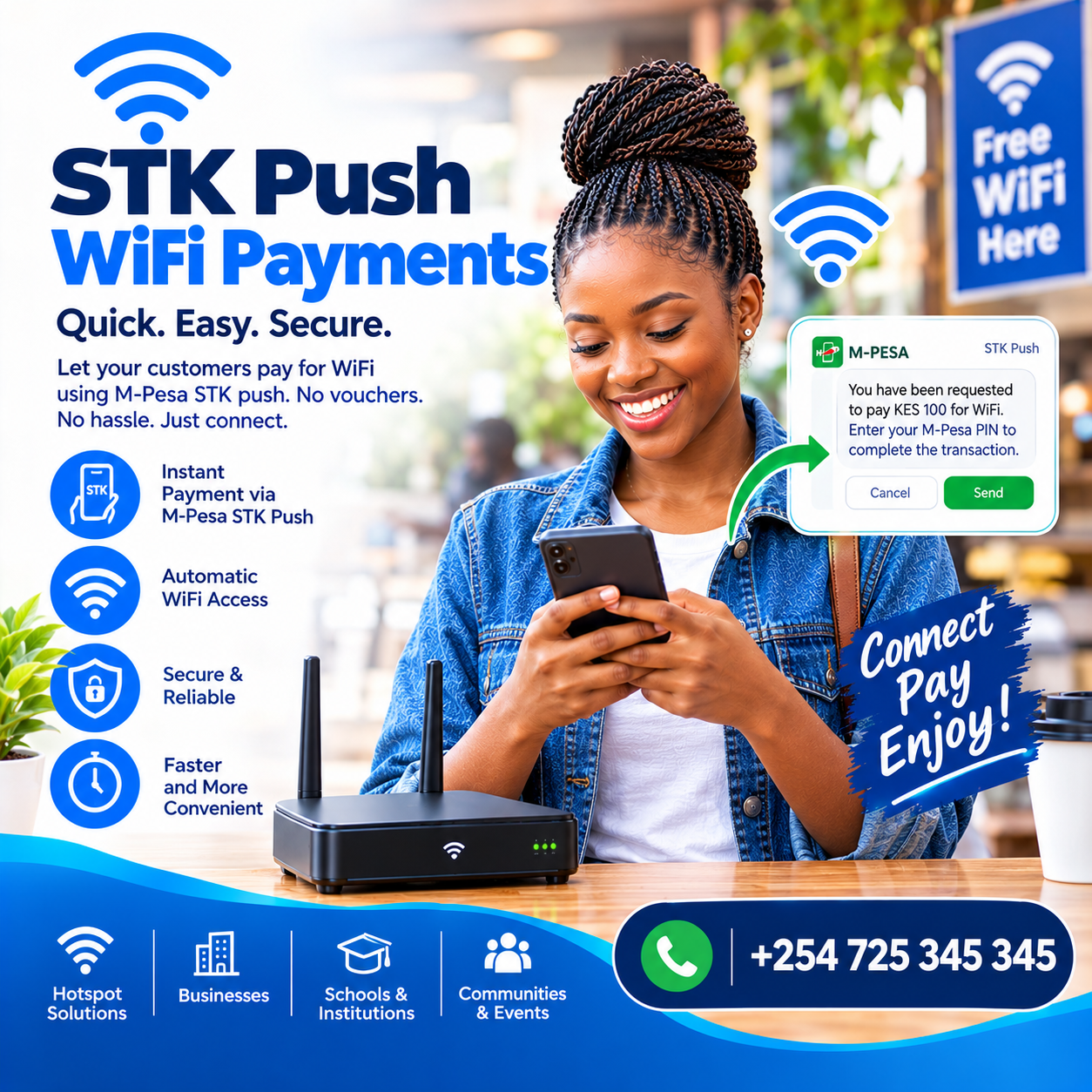
STK push WiFi payments are the technology that turned selling internet from a conversation into a tap — the payment prompt that lands directly on a customer’s phone the moment they select a package, waits only for their PIN, and converts a willing buyer into a connected customer within seconds.
Every operator in the trade knows the two worlds from the inside.
In the older world, the customer selected a package and then faced the friction: a paybill number to memorize, an account field to fill, a confirmation to wait for — and sometimes, a sale that simply never completed because the journey between wanting and paying lost them along the way.
In the modern world, the entire journey lives inside one seamless motion: tap the package, receive the prompt on your own phone, enter your PIN, and browse. No numbers to copy, no fields to mistype, no waiting, no doubt.
That motion is what STK push WiFi payments deliver — and it is why the networks running them convert visitors into customers at rates the older arrangements never approached.
This article walks through the complete picture: what the STK push actually is, how the flow works moment by moment, why speed decides revenue, how the technology handles every edge case, and what the whole engine delivers to the operator who runs it well.
Because the customer’s willingness to pay was never the problem — the friction between their willingness and their payment was, and STK push WiFi payments are simply the technology that removed it.
Table of Contents
ToggleWhat STK Push WiFi Payments Actually Are
Strip away the acronyms and the concept is refreshingly simple.
STK stands for SIM Toolkit — the technology that lets a network’s systems place a message directly onto a customer’s phone screen, right where they can act on it instantly.
Applied to WiFi selling, STK push WiFi payments work like this: the customer connects to the network, lands on the portal, taps a package — and a payment prompt appears on their phone screen, pre-filled with the exact amount and the seller’s identity.
They enter their PIN. The payment confirms. The portal responds — their session opening, their countdown starting, their access live. The entire journey, from first tap to browsing, completes inside a minute.
What makes the technology remarkable is what it eliminates rather than what it adds.
It eliminates the paybill number the customer would otherwise memorize or copy — because the prompt arrives with everything pre-filled.
It eliminates the account field where a single typo strands money in limbo — because there is nothing to type.
It eliminates the waiting and wondering — because the confirmation flows automatically to the network the moment the PIN is entered.
And it eliminates the human requirement — because no attendant, no operator, and no middleman stands anywhere in the chain.
The customer experiences the flow as identical to every other purchase they make through their phone daily: the same prompt, the same PIN, the same confirmation they have completed hundreds of times for airtime, shop goods, and everything else.
That familiarity is the technology’s deepest advantage — STK push WiFi payments require no education, no persuasion, and no trust-building, because the market has been fluent in the motion for years.
The operator experiences the flow as automation: every payment arriving confirmed, every session opening automatically, and every transaction recorded with a timestamp on both sides.
That combination — familiar to the customer, automatic for the operator — is what makes the STK push the payment standard of the entire connectivity trade.
Why the STK Push Transformed the Trade
The value of STK push WiFi payments is easiest to see against the payment methods it replaced — because the contrast explains why conversion rates changed so dramatically.
The pre-push era of WiFi selling had three structural frictions, and each one leaked sales.
The first friction was the copy journey: the customer selected a package, then had to write down or memorize a paybill number, navigate to their payment menu, and re-enter the details manually — a journey long enough for hesitation to return and end the sale.
The second friction was the typo risk: the account field where the customer’s meter or username had to be typed exactly right, with every mistake stranding their money and starting a support conversation.
The third friction was the confirmation gap: the payment sent, the waiting begun, and the customer staring at a login screen without knowing whether anything happened — while the network wondered the same thing in reverse.
Each friction individually cost sales; together, they made the moment of payment the most fragile point in the entire business.
STK push WiFi payments dissolved all three structurally: nothing to copy because everything arrives pre-filled, nothing to mistype because the amount and recipient are carried automatically, and nothing to wonder about because the confirmation flows the instant the PIN lands.
The conversion evidence followed immediately: operators who moved from manual payment flows to push-based ones reported abandoned purchases falling sharply — with collections rising in the same month, from the same traffic, at the same prices.
The reason is behavioral: the customer’s decision to buy is made at the moment they tap the package, and every second between that tap and the payment is a second in which hesitation can return.
The push collapses that gap to nearly zero — the prompt arrives before doubt does, and the sale completes while the decision is still fresh.
That is the behavioral engine inside STK push WiFi payments: not a new customer, but the same customer, protected from their own reconsideration by the speed of the flow.
And it is why the operators who understood that psychology early built the highest-converting networks in the trade on push-based payments — while the ones who kept the old flows kept losing buyers they never even knew they had.
The Flow, Moment by Moment
The elegance of STK push WiFi payments is best appreciated by walking through one complete purchase — second by second, exactly as the customer experiences it.
Second one: the customer connects to the network and lands on the portal, where the packages are displayed with honest prices and large, obvious buttons.
Second ten: they tap their choice — an hour, a day, a week — and the billing platform sends the payment request across the mobile money network.
Second fifteen: the prompt appears on the customer’s screen, carrying the exact amount, the recipient’s identity, and a request for their PIN — everything pre-filled, nothing left to guess.
Second thirty: they enter their PIN, and the payment confirms — the money moving through rails the customer has trusted for years, verified by the same security they use for every other purchase.
Second thirty-five: the confirmation flows automatically to the billing platform, which verifies the amount against the selected package and triggers the access controller.
Second forty: the customer’s session opens, their countdown begins, and their internet is live — with the receipt landing on their phone in the same moment.
The entire journey from stranger to browsing completes inside a minute, and the remarkable part is the absence between the steps: no attendant to find, no number to copy, no field to fill, no queue to join, and no moment of doubt about whether anything happened.
Every step answered the previous one automatically — which is the defining promise of STK push WiFi payments, and the reason customers describe the experience with the sentence every network wants: “I just tapped and it worked.”
The flow’s consistency matters as much as its speed: the same motion serves every package on the menu, from the twenty-shilling hour to the monthly subscription, so the customer never learns a second behavior to buy anything the network offers.
That consistency extends across every device: the prompt works on the newest smartphone and the most basic handset alike, because the technology lives in the SIM and the network, not in the phone’s sophistication.
Shallow imitations of the flow betray it in familiar ways — the fallback to manual payment details, the confirmation that lags, the activation that needs a nudge — each gap a measurable share of buyers lost at the moment that decides the sale.
Deep integration closes every gap: the prompt fires the instant the package is tapped, the confirmation triggers activation instantly, and the receipt lands before the customer has finished sitting down.
That seamlessness is what separates a professional STK push WiFi payments deployment from an improvised one — and it is verifiable in a single live test, timed on the cheapest phone the market carries.
Speed: Where Revenue Lives or Leaks
Speed is the metric that decides the commercial success of STK push WiFi payments, because the customer mid-purchase is a transaction in progress — and every second of delay invites hesitation to return.
The arithmetic is unforgiving. The customer who tapped a package has made their decision; the only question is whether the system completes the sale faster than their reconsideration.
The professional standard is under a minute, end to end — with the prompt arriving within seconds of the tap, and the session opening within seconds of the PIN.
Every second beyond that standard is measurable in abandoned purchases: the buyer who stares at a loading screen, wonders whether the network is trustworthy, and returns to the bundle sitting two taps away on their own SIM.
Operators who timed their old manual flows against push-based ones describe the gap honestly: the copy-and-pay journey took minutes of attention and produced doubt at every step, while the push completes in under one — with confidence at every step.
The speed discipline extends beyond the happy path: the failed payment that retries, the delayed confirmation that resolves, and the session that activates after a hiccup — all recovered in seconds rather than support tickets.
Because speed at the happy path wins the sale, and speed at the failure path wins the customer back.
Platforms differ visibly here, which is why the evaluation test is so decisive: one real purchase, timed honestly, on the operator’s own phone and network.
The platforms that complete the loop in under a minute announce their engineering; the ones that stall announce their cost — measured in the customers they will quietly lose every evening.
The speed standard also applies at scale: the platform must deliver the same prompt speed when twenty customers tap packages simultaneously during the evening peak as it does for a single buyer at noon.
Operators who tested that peak-load consistency describe it as the sharpest quality check in the entire evaluation: the STK push WiFi payments that held their speed under load earned the business, and the ones that slowed announced their ceiling.
That is the discipline in one sentence: time the purchase, test the crowd, and let the seconds tell you which engine deserves your customers.
Security: The PIN That Never Leaves the Customer’s Hand
Every payment technology must answer the trust question, and STK push WiFi payments answer it structurally — with one principle that never bends: the customer’s PIN is entered only on their own phone, inside their payment provider’s own secure environment.
The architecture works because the STK prompt is issued by the mobile money system itself, not by the WiFi operator’s website — so the network never touches, sees, or stores the customer’s credentials at any point in the flow.
The customer taps a package, and the prompt arrives from the same trusted source they use for every other purchase — the same familiar screen, the same security, the same confidence.
The business receives only what fulfillment requires: the confirmation that money arrived, matched to the package selected — never the credentials that moved it.
That separation is what makes customers comfortable paying quickly and repeatedly: the payment experience is identical to every other transaction they complete daily, with no new risks and no new behaviors to learn.
Any platform that breaks the principle — asking for PINs on web forms, collecting credentials through the portal, or handling payment details directly — disqualifies itself immediately, because the risk it introduces is never worth any feature it offers.
The security discipline extends to the records as well: the confirmations arrive on the customer’s own device, the operator’s dashboard holds only transaction metadata, and nothing sensitive accumulates anywhere it could be exposed.
Operators who explained this architecture to their customers discovered something valuable: security, stated simply, becomes a selling point — in a market where everyone trusts cautiously and rewards what proves itself.
And the trust compounds: customers who feel safe paying once return to pay again, recommend the network to their circles, and treat the STK push WiFi payments experience as the standard every other service should meet.
That trust, engineered into the payment layer rather than promised on the portal, is among the deepest assets a network can own — built one clean, familiar, secure transaction at a time.
The Records: Every Payment Writing Its Own History
Every transaction under STK push WiFi payments writes its own permanent record — and that automatic trail is among the system’s most valuable outputs, precisely because nobody had to work for it.
The customer’s copy arrives instantly: the payment confirmation on their own phone, showing the amount, the recipient, and the time — the receipt they keep without effort and consult without asking.
The operator’s copy lands in the same moment: the platform’s dashboard entry, matched to the package purchased, bound to the session activated, and timestamped to the second.
Together, the two records change what disputes are even possible. The customer who wonders what they paid scrolls their messages and sees the answer. The operator who wonders whether a payment landed checks the dashboard and finds it matched.
The matching is the quiet achievement: every payment tied to its package, every package tied to its session, every session tied to its moment — so no shilling ever arrives without its purpose and no session ever opens without its payment.
The reconciliation layer extends the protection: the stray payment, the duplicate attempt, the delayed confirmation — all matched automatically to their correct destinations, with nothing stranded and nothing argued over.
Operators who ran records-first deployments describe the effect on disputes precisely: the arguments that once settled by memory simply stopped, because both sides held evidence neither could rewrite.
And the records serve the moments beyond disputes: loan applications that evaluate the business’s history, audits that verify its collections, and the growth plans that price the network on evidence rather than impression.
In every one of those moments, the trail written by STK push WiFi payments is the proof — a complete, timestamped, self-maintained story of everything the business has earned.
That story, accumulating silently with every transaction, is the quietest and most compounding asset the payment layer creates.
The Product Ladder: Selling Everything Through One Motion
The payment flow is not just a cash register — it is the storefront where the network’s entire product ladder meets its market, and STK push WiFi payments carry every rung of that ladder through the identical motion.
The ladder begins with the short session: one or two hours priced for the quick checker and the first-timer, removing every barrier between a stranger and their first purchase.
The middle serves the daily mainstream: half-day and full-day packages priced as the obvious value, producing most of the network’s revenue in every successful deployment.
The top converts the regulars: weekly bundles, monthly subscriptions, and premium speed tiers that turn repeat customers into predictable income — with renewals handled through the same tap, the same prompt, and the same PIN.
Speed tiers deserve special mention, because the push is where they get sold: the premium option sits beside the standard one on the portal, and the customer who upgrades pays through the identical flow, receiving genuinely faster speeds enforced at network level.
The honesty of those tiers is what makes the ladder work: a customer who paid for premium and felt the difference becomes the upgrade path’s best advertisement, while a tier that fails to deliver poisons the whole menu.
Off-peak pricing extends the ladder’s reach: discounted sessions during the quiet hours, sold through the same flow, filling the network’s idle capacity with revenue it would otherwise never see.
Every rung of the ladder collects through the identical motion — tap, prompt, PIN, browsing — which means the customer never learns a new behavior to buy anything the network offers.
That consistency is the commercial elegance of STK push WiFi payments: one payment experience carrying an entire product line, from the smallest hour to the monthly subscription, with the same speed and the same trust at every price point.
And the dashboard completes the picture: sales by package, conversions by tier, and upgrade patterns — the evidence that tells the operator exactly how to tune the ladder as the market evolves.
Operators who read that evidence monthly run living menus — ladders that adapt to their market rather than freezing at launch and hoping.
That living quality is what separates the networks whose menus compound revenue from the ones whose menus quietly expire, and the payment flow is where that difference begins.
The Customer Psychology: Why the Tap Wins
The deepest reason STK push WiFi payments convert so well is behavioral — and understanding the psychology explains why the technology outperforms every alternative arrangement.
The first force is decision freshness: the customer’s choice is made at the moment they tap the package, and the push completes the sale while that decision is still warm — before hesitation, comparison, or distraction can return.
Every payment method that adds steps between the decision and the payment gives hesitation room to work; the push gives it none.
The second force is familiarity: the prompt looks exactly like every other payment the customer completes daily, which means zero learning, zero suspicion, and zero new trust required.
The brain treats the motion as routine — and routine purchases complete without the deliberation that novel ones demand.
The third force is effort symmetry: buying requires one tap and one PIN, while not buying requires switching to a bundle menu and navigating a purchase there — so the network’s offer is literally the path of least resistance.
That asymmetry quietly wins comparisons the customer never consciously runs, and it is why networks on STK push WiFi payments capture purchases their own customers would have taken elsewhere.
The fourth force is certainty: the prompt shows the exact amount before the PIN is entered, so the customer always knows precisely what they are agreeing to — no surprises, no arithmetic, no post-payment doubt.
The fifth force is the receipt’s reassurance: the confirmation landing on their own phone in the same moment gives the customer proof of the purchase before the session even begins.
Together, the five forces explain the conversion difference that operators observe but rarely articulate: the push does not create new demand — it stops the existing demand from leaking away between decision and payment.
That protection of willing buyers is the technology’s true function, and it is why the networks running it out-earn identical networks running older flows at identical prices and identical speeds.
The demand was always there; STK push WiFi payments are simply what stopped it from slipping through the gaps.
Edge Cases: What Happens When Things Wobble
No payment system is flawless, and the mark of a capable STK push WiFi payments platform is not the absence of hiccups but the machinery that recovers them — quickly, visibly, and without drama.
The failures fall into familiar categories, each with a known handling pattern.
The cancelled payment: the customer who tapped a package and abandoned the prompt — no money moved, no session owed, and the portal simply waiting for them to try again.
The delayed confirmation: the PIN entered but the confirmation caught in a moment of network congestion — the platform’s records show the attempt, and the session opens the instant the confirmation completes.
The confirmed-but-inactive payment: the money that landed while the access controller hiccupped — reconciliation catches the payment automatically, activates the session, and the customer continues exactly where they left off.
The duplicate payment: the customer who paid twice in impatience — the platform recognizes both transactions, opens one session, and flags the second for quick resolution.
The wrong-amount edge: the customer whose balance could not cover the selected package — the prompt simply declines cleanly, and the customer chooses a package their balance fits.
What separates engineered platforms from assembled ones is how these cases surface: capable systems detect and resolve most failures before the customer even reports them, while weak ones leave the buyer staring at a login screen and the operator discovering the problem by complaint.
The operator’s protocol for the rare visible failure is simple and fast: the timestamped records trace the case in seconds, the fix follows the evidence, and a small goodwill gesture converts the frustrated customer into an advocate.
That recovery speed is not a courtesy — it is reputation management at the exact moment the network’s reliability is being judged.
Operators who tested failure handling during platform evaluation describe it as the most revealing exercise of the entire process: the platforms that recovered cleanly earned trust, and the ones that handled failures clumsily answered the selection question by themselves.
Because every payment system meets its wobbles eventually — and the STK push WiFi payments machinery that meets them well is the one worth owning.
Automation: The Network That Sells While the Owner Sleeps
The deepest gift of STK push WiFi payments is not any single feature but the automation it produces — the transformation of a network from a business that needs its owner present into one that only needs their decisions.
The selling hours tell the story first. Under the manual era, the network earned while a human stood ready to collect — and the 2 a.m. customer, the 5 a.m. buyer, and the Sunday afternoon rush simply never happened. Under push-based payments, those hours became some of the busiest on the dashboard.
Operators consistently report that a third or more of their revenue arrives in hours their old arrangements could never serve — the recovery of demand that was always there, finally collected by machinery that never sleeps.
The staff hours tell it next: the attendant who once spent the day receiving cash and writing receipts now does the work that actually earns — serving customers, maintaining quality, and growing the business — while the payment layer handles itself.
The owner’s hours complete the picture: mornings that begin with a dashboard glance instead of a reconciliation, pricing decisions made from evidence instead of instinct, and evenings returned from the counter to the family.
The scale effect follows naturally: because the thousandth transaction costs the same as the first — nothing — the network that serves two hundred customers today can serve four hundred tomorrow without the owner working harder.
That asymmetry is what makes automated STK push WiFi payments the foundation of every multi-site operation in the trade: the second mast inherits the same payment engine, and the portfolio grows without the workload growing alongside it.
And the risk profile improves with the automation too: no cash in drawers, no float to reconcile, no human errors at the moment of collection — the entire money layer running on machinery that behaves identically every day.
That is the transformation in full: a business that once required its owner’s presence for every shilling now requires only their judgment — which is the entire difference between operating and owning, delivered by the payment technology alone.
Choosing a Platform: The Tests That Find the Real Engine
The market offers many platforms claiming push-based payments, and the evaluation that finds the genuine ones takes one week and costs nothing but attention — with the tests themselves writing the checklist.
The first test is the live purchase: a real payment on the candidate platform, with the operator’s own phone and money, timed from package selection to open browsing.
Under a minute is the professional standard; anything slower announces the sales that will leak daily.
The second test is the cheap-phone check: the portal and the prompt experience loaded on the most basic device the market carries, over a weak connection — because the customer’s reality, not the demo room’s, is where the platform lives.
The third test is the failure rehearsal: a deliberately cancelled payment, a mid-session interruption, a duplicate attempt — watched closely to see how the platform recovers.
The fourth test is the peak-load check: several purchases in quick succession, mimicking the evening rush, revealing whether the prompt speed holds when the crowd taps together.
The fifth test is the record verification: the receipts on both sides, the dashboard entries, and the completeness of the trail every transaction leaves.
The sixth test is the support question: a planted problem sent during evening hours, measured for response speed and quality — because payment emergencies do not respect business hours.
The seventh is the fee schedule read in full: the all-in monthly cost at the operator’s target scale, in writing, with no transaction charges hiding behind tiers.
The buyers who ran all seven tests on every candidate describe the field clearing quickly: most platforms fail on the first two, and the ones that pass all seven announce their quality within the first day.
That evidence-first discipline is what the market’s most successful operators share: their STK push WiFi payments engines were not the first ones found, but the best ones verified — tested with their own shillings before they were trusted with their customers’.
The Mistakes That Weaken Payment Operations
The recurring failures in payment operations are well documented across the trade, and naming them is the cheapest protection any operator running STK push WiFi payments can receive.
The first is the shallow integration: launching on a platform whose payment flow falls back to manual details, and discovering the abandoned purchases only after the month’s collections disappoint.
The second is the untested launch: going live without making a real purchase first, and learning the flow’s behavior in front of a paying customer instead of during rehearsal.
The third is the ignored dashboard: the payment success rate, the failed transactions, and the reconciliation flags going unread — while the leak they announce compounds into a habit.
The fourth is the security shortcut: any arrangement that touches customer credentials directly, collected for convenience — the mistake that no volume justifies and no recovery repairs.
The fifth is the stale pricing: packages frozen since launch while bundles, competitors, and customer habits all moved on — and conversions drifting down for reasons the operator cannot name.
The sixth is the silent failure response: the customer whose payment hiccupped left waiting without communication, converting a solvable moment into a public grievance.
The seventh is the set-and-forget posture: the payment flow deployed once and never re-tested, while platforms, providers, and networks all updated around it.
Each mistake is avoidable with the same discipline: integrate deeply, rehearse honestly, read the numbers weekly, guard the credentials structurally, price against the market monthly, respond to failures fast, and re-test after every change.
The operators who kept those habits watch their STK push WiFi payments operations run for years with collections that behave like weather — steady, automatic, and visible every morning.
Scaling: One Payment Engine Becomes a Portfolio
The deepest business value of STK push WiFi payments reveals itself at the second site — because the payment engine that ran the first network is now a template that replicates without redesign.
The package structure transfers: the same ladder, the same pricing logic, the same payment flows — configured for the new location in an afternoon.
The enforcement transfers: the same device binding, session management, and reconciliation — proven once, applied everywhere.
The dashboard extends across the portfolio: every location’s collections, success rates, and records visible in one view, with per-site detail preserved.
The operator who managed one network’s payments now manages several with barely more effort — the same dashboard glance covering the whole portfolio, the same weekly rhythm reading every site’s numbers.
The financing follows the records: clean, automated collection history is precisely what banks, partners, and lenders evaluate when the next site needs capital — and the payment layer has been writing that history since day one.
And the data compounds with scale: payment patterns learned at one site tune the pricing at the next, until the whole portfolio runs on evidence rather than instinct.
The operators who scaled this way all followed the same sequence: prove the payment engine completely at one location, document its configuration honestly, then clone it deliberately.
That cloning discipline is what turns STK push WiFi payments from a single-site tool into the foundation of a genuine network business — one verified location at a time, each one inheriting the machinery the first one proved.
The Payoff, Counted Honestly
Ask operators years down the road what their STK push WiFi payments engine ultimately gave them, and the answers gather into five themes.
Collections: more of them, arriving around the clock in hours the counter era never served — with the leakage, the disputes, and the reconciliation evenings simply engineered out.
Speed: the moment of payment transformed from the business’s most fragile point into its most reliable — the customer’s tap answered within seconds, every time.
Trust: the architecture that never touches a PIN, the records that settle every question, and the reputation that compounds with every clean transaction.
Time: the operator’s evenings returned from counters and cash-tin arithmetic, and their role shifted from collecting payments to making decisions.
And scale: a business that grows by replication, with every new mast inheriting the payment engine that made the first one earn.
None of it required more customers, more bandwidth, or more hours.
It required the technology this article has described — integrated deeply, tested honestly, and trusted to do what it was built for.
Because the customers were always willing to pay, and STK push WiFi payments are simply what made paying instant for them and automatic for the business — the technology that turned every willing buyer into a connected customer, every hour of the day.
Frequently Asked Questions
How fast should the payment prompt arrive after a customer taps a package?
The professional standard is seconds: the prompt lands on the customer’s screen almost immediately after the tap, with the full journey from selection to browsing completing in under a minute.
Operators who timed their STK push WiFi payments flows during evaluation consistently chose the platforms that met that standard.
Is it safe for customers to pay through the prompt?
Yes — structurally: the PIN is entered only on the customer’s own phone, inside their payment provider’s own secure environment, and the network never sees or stores those credentials.
That architecture is the security foundation of every professional STK push WiFi payments platform, and it should be verified in every evaluation.
What happens if a customer pays but the WiFi doesn’t activate?
The platform’s timestamped records trace the payment in seconds, reconciliation matches it automatically in most cases, and the session opens the moment the confirmation completes.
The recovery machinery built into capable STK push WiFi payments systems is what turns rare failures from disputes into minor moments.
Do customers need a smartphone for the prompt to work?
No — the technology lives in the SIM and the network, so the prompt works on every handset the market carries, from the newest smartphone to the most basic phone.
That universality is one of the reasons STK push WiFi payments serve the entire audience rather than a segment of it.
What happens if the customer cancels the prompt?
Nothing moves: no money is charged, no session is owed, and the portal simply waits for them to try again whenever they are ready.
The clean handling of cancellations is part of the recovery machinery inside every capable STK push WiFi payments system.
Can subscriptions and renewals run through the same flow?
Yes — reminders issue before renewal, one-tap prompts arrive pre-filled with the exact amount, and the next cycle activates automatically on confirmation.
The subscription engine riding on STK push WiFi payments is what turns regular customers into predictable monthly income.
What should I test before committing to a platform?
A real purchase with your own phone, timed end to end; the experience on the cheapest device available; deliberate failures and their recovery; and the all-in fee schedule at your target scale.
Those four tests separate the genuine STK push WiFi payments engines from the shallow copies within a single day.
How does the flow stop revenue leakage?
Through automation and binding: every sale completes through recorded rails, every session binds to its paying device, and every shilling arrives with a traceable trail.
That structural closure is why operators who moved to STK push WiFi payments report collections rising without a single new customer.
What happens during a network or power interruption mid-payment?
Well-engineered platforms recover automatically: confirmations queue and complete, sessions activate when connectivity returns, and records survive intact through the disruption.
Testing that resilience deliberately is the sharpest quality check available on any STK push WiFi payments candidate.
Can I still offer discounts and free sessions?
Yes — launch offers, courtesy windows, and loyalty credits are all issued from the same dashboard that runs the paid flow, through the identical payment machinery.
The flexibility of a capable STK push WiFi payments platform keeps generosity deliberate while automation handles the routine.
How do the records help if a customer disputes a payment?
Both sides hold the same evidence: the customer’s confirmation message and the operator’s matched dashboard entry, timestamped to the second.
That records-first resolution is why payment arguments nearly vanish on networks running STK push WiFi payments properly.
Can one payment engine serve multiple locations?
Yes — additional sites inherit the same payment flows as configuration, with per-location collections reported into one dashboard.
Portfolio operators standardize on this architecture precisely because STK push WiFi payments scales by replication rather than rebuilding.
How much does the payment layer cost compared to what it earns?
Platform fees are modest and predictable, and the honest comparison is against the manual bill: collection hours, leakage, disputes, and the selling hours the counter era never served.
Most operators find their STK push WiFi payments engine pays for itself within the first weeks of recovered collections alone.
What is the smartest first step this week?
Make one real payment on your candidate platform with your own phone, timed from selection to session — then test one deliberate failure and watch the recovery.
That single hour of hands-on evidence is how every confident choice was made, and the operators who ran it discovered the same truth every time: the customers were always willing to pay, the technology was always ready to collect, and the STK push WiFi payments engine was simply the bridge between the two — instantly, safely, and around the clock, one tap, one PIN, and one quietly compounding month at a time.