
Ubiquiti Kenya:Introduction
Businesses across Kenya are upgrading their networks to support cloud applications, VoIP, CCTV, remote work, guest WiFi, and digital operations. As these requirements grow, Ubiquiti Kenya solutions have become one of the most popular choices for schools, hotels, offices, apartments, warehouses, internet service providers, hospitals, and retail businesses looking for enterprise-grade networking without recurring software licensing costs.Unlike traditional consumer routers, Ubiquiti provides an integrated ecosystem that combines wireless networking, switching, routing, surveillance, access control, and centralized management. Instead of managing several unrelated devices from different manufacturers, organizations can monitor and configure most of their infrastructure through a unified management platform.
Before writing this guide, we reviewed the highest-ranking pages for Ubiquiti Kenya. Two common patterns quickly became clear.
Most websites describe themselves as “leading dealers,” “authorized suppliers,” “offering the best prices,” or “high-performance networking experts.” However, very few explain how businesses should determine which UniFi access point, switch, gateway, or wireless bridge actually fits their environment. They also rarely explain capacity planning, WiFi design, or future scalability.
Another observation is that many websites function mainly as online stores. They list hundreds of products and prices but provide little practical guidance on designing reliable business networks or avoiding costly deployment mistakes.
This guide focuses on practical business decisions instead of marketing slogans. You’ll learn what Ubiquiti Kenya solutions include, where they perform best, realistic deployment scenarios, and how to choose equipment that continues supporting your business as it grows.
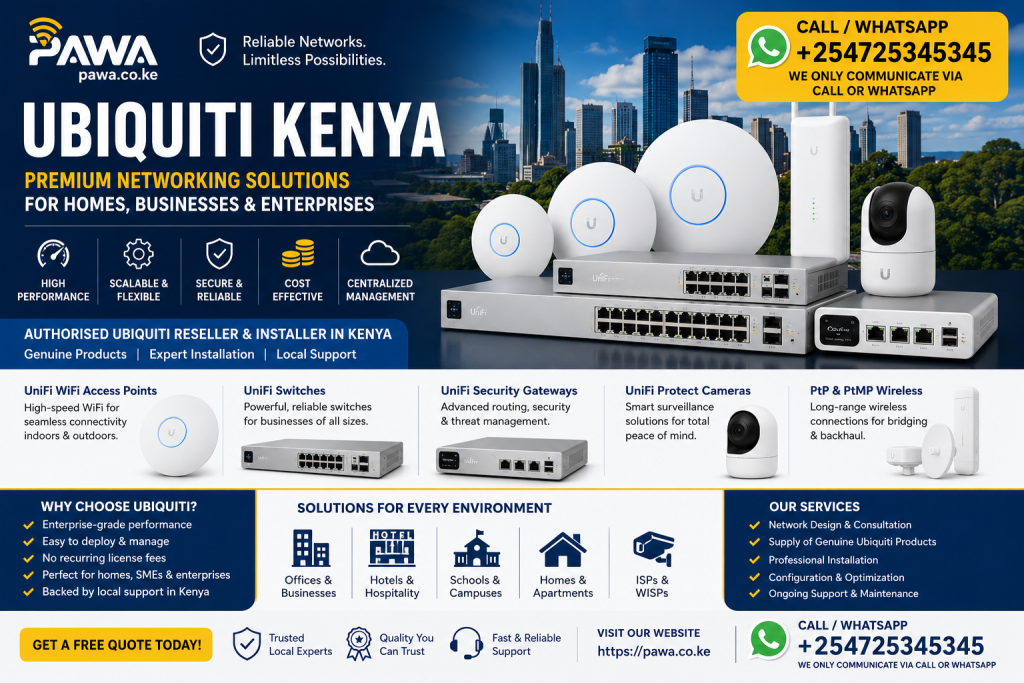
What Is Ubiquiti Kenya?
Ubiquiti Kenya refers to the supply, installation, configuration, and support of networking products from Ubiquiti Inc. across Kenya.
Rather than producing only wireless access points or routers, Ubiquiti has built an ecosystem covering almost every aspect of modern networking.
Its major product families include:
- UniFi WiFi Access Points
- UniFi Switches
- UniFi Gateways
- UniFi Protect CCTV
- UniFi Access
- UniFi Talk
- airMAX wireless radios
- airFiber backhaul solutions
- UISP platforms for ISPs
These systems are used by organizations ranging from small offices with fewer than ten employees to universities, hotels, manufacturing facilities, apartment developments, and wireless internet providers.
Why Ubiquiti Kenya Is Growing Rapidly
The demand for Ubiquiti Kenya continues increasing because modern organizations expect more from their networks than simple internet access.
Businesses now require:
- Reliable office WiFi
- Secure guest networks
- CCTV connectivity
- Cloud application access
- Video conferencing
- VoIP telephony
- Remote management
- Multiple branch connectivity
- Centralized administration
Older networking equipment often struggles when dozens or hundreds of users connect simultaneously.
Ubiquiti addresses this challenge by allowing organizations to build scalable wireless and wired infrastructure managed from a centralized dashboard.
This reduces administration time while simplifying expansion as businesses grow.
Industries Using Ubiquiti Kenya
Professional Ubiquiti Kenya deployments now support almost every industry.
Common sectors include:
- Schools
- Universities
- Hospitals
- Hotels
- Apartment complexes
- Warehouses
- Manufacturing plants
- Government institutions
- Banks
- Restaurants
- Shopping malls
- Retail chains
- Internet Service Providers (ISPs)
- Corporate offices
Each environment has different networking requirements.
A hotel prioritizes guest WiFi and roaming between floors.
A warehouse requires reliable connectivity across large storage areas.
Schools need classroom coverage while supporting hundreds of simultaneous users.
Internet providers often deploy airMAX and airFiber equipment to distribute broadband over long distances.
Understanding these differences allows installers to recommend equipment that matches operational needs instead of selling unnecessary hardware.
Understanding the UniFi Ecosystem
One reason businesses prefer Ubiquiti Kenya solutions is the UniFi ecosystem.
Instead of purchasing separate management software for access points, switches, routers, cameras, and gateways, administrators manage these devices through one centralized interface.
This unified approach simplifies:
- Device monitoring
- Firmware updates
- User management
- Guest portals
- VLAN configuration
- Traffic analysis
- Network troubleshooting
- Security monitoring
For organizations operating multiple branches, centralized administration significantly reduces maintenance effort.
A network administrator in Nairobi can monitor branch offices in Mombasa, Kisumu, Nakuru, Eldoret, or Nyeri without travelling between locations.
UniFi Access Points
Wireless connectivity remains one of the most popular areas of Ubiquiti Kenya deployments.
UniFi access points provide wireless coverage for:
- Offices
- Hotels
- Schools
- Hospitals
- Retail stores
- Restaurants
- Apartment buildings
Popular product families include:
- UniFi U6 Lite
- UniFi U6 Pro
- UniFi U6 Long Range
- UniFi U7 Series
- UniFi Enterprise Access Points
Each model serves different user densities and coverage requirements.
A small accounting office with fifteen employees may require only one or two access points.
A hotel with several floors may require dozens of strategically positioned units to maintain seamless roaming for guests.
Choosing equipment based on expected user numbers generally produces better long-term performance than purchasing the cheapest available device.
Ubiquiti Switching Solutions
Switches form the backbone of every business network.
Professional Ubiquiti Kenya installations commonly include managed PoE switches capable of powering:
- Access points
- CCTV cameras
- VoIP phones
- Access control readers
- Wireless bridges
PoE (Power over Ethernet) simplifies installation because both power and data travel through a single Ethernet cable.
This reduces cable clutter while making future expansion easier.
Switches are available in multiple sizes including:
- 8-port
- 16-port
- 24-port
- 48-port
Many organizations deliberately purchase switches with additional unused ports to accommodate future growth without replacing equipment after only a few years.
airMAX and airFiber Wireless Links
Not every building can be connected using fibre optic cables.
This is where Ubiquiti Kenya airMAX and airFiber solutions become valuable.
Wireless bridges commonly connect:
- Office buildings
- Schools
- Apartment blocks
- Factory buildings
- Warehouse compounds
- Remote branches
These point-to-point and point-to-multipoint systems eliminate the need for expensive trenching while providing reliable connectivity across long distances when installed correctly.
Ubiquiti Kenya for Small Businesses
Small businesses often assume enterprise networking is beyond their budget.
In reality, a properly planned Ubiquiti Kenya deployment allows organizations to start with only the equipment they currently require before expanding gradually.
For example, a growing office may begin with:
- One gateway
- One managed switch
- Two wireless access points
As employee numbers increase, additional access points, switches, surveillance cameras, or access control devices can be integrated into the same management platform without rebuilding the entire network.
This scalability explains why many growing businesses select Ubiquiti over consumer networking equipment.
Why Professional Installation Matters
Buying networking hardware is only part of the project.
Professional Ubiquiti Kenya deployments include:
- Site surveys
- Wireless coverage planning
- Rack installation
- Structured cabling
- VLAN configuration
- Network security
- Controller setup
- User testing
- Documentation
- Staff training
Many online stores advertise attractive hardware pricing but provide limited guidance on deployment planning or network optimization. Businesses generally achieve better long-term performance when installation is planned around operational requirements rather than simply purchasing individual devices.