
WiFi Hotspot Business Model – How to Build a Profitable Internet Business in Kenya
Reliable internet access has become a necessity for homes, businesses, schools, hotels, apartments, and public spaces. As demand for affordable connectivity continues to grow, many entrepreneurs are discovering the potential of the WiFi Hotspot Business Model. By providing paid internet access through strategically placed hotspots, businesses can generate recurring revenue while meeting the increasing demand for fast and reliable internet services.
Unlike traditional businesses that rely on one-time sales, a WiFi Hotspot Business Model creates continuous monthly, weekly, daily, or hourly income through internet subscriptions and voucher sales. Whether you’re starting a neighborhood WiFi business, expanding an Internet Service Provider (ISP), or offering managed connectivity in apartments, shopping centres, hotels, or campuses, a well-designed hotspot business can deliver consistent returns with the right technology.
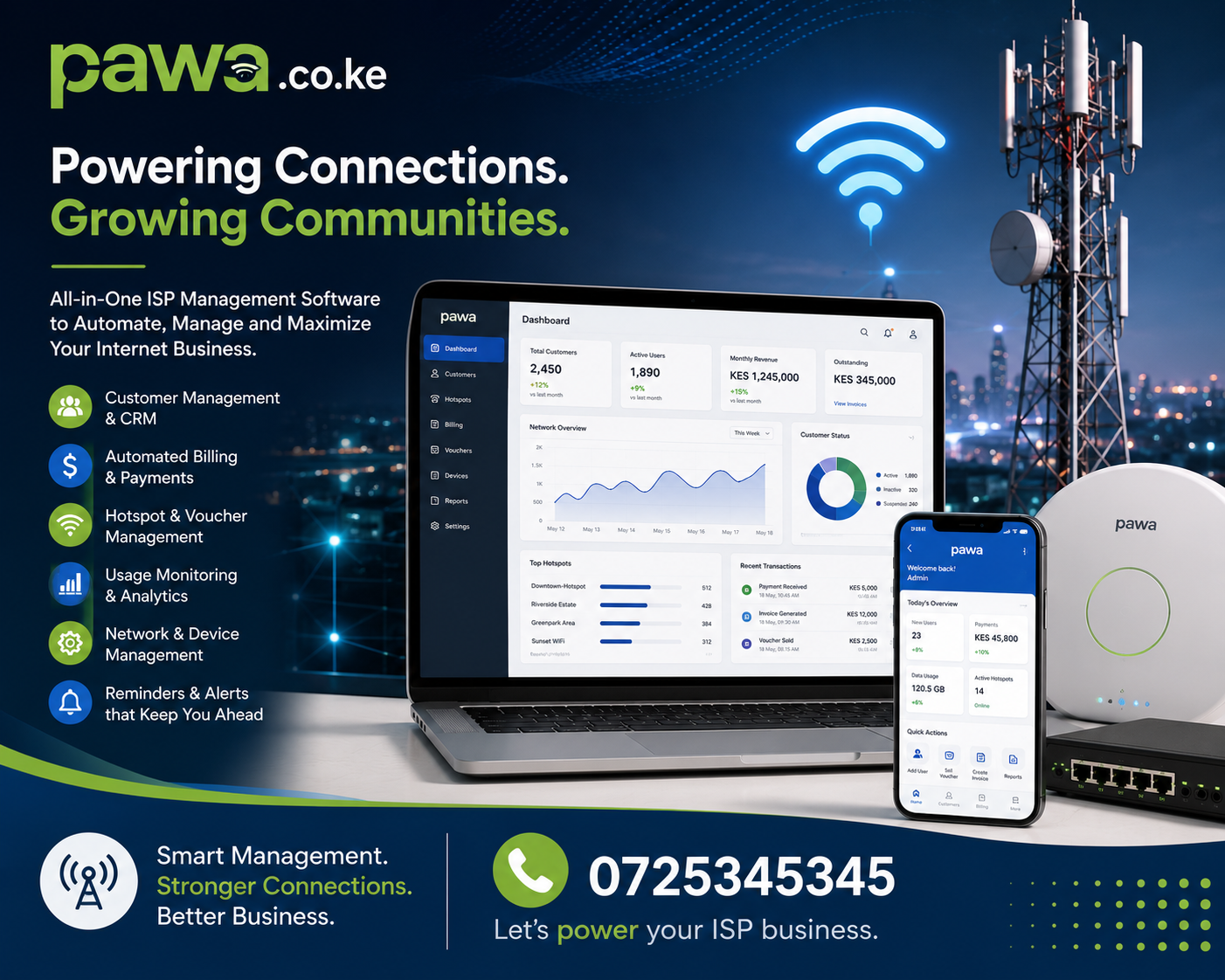
Pawa provides a complete hotspot management and ISP billing platform that enables businesses to automate customer registration, voucher generation, subscription billing, payment collection, bandwidth management, and customer support. With Pawa, entrepreneurs can focus on growing their customer base while the system automates the day-to-day management of their hotspot network.
Understanding the WiFi Hotspot Business Model
A WiFi Hotspot Business Model involves providing internet access to users through wireless hotspots in exchange for payment or subscription. Customers connect their smartphones, laptops, tablets, or other devices to the hotspot and purchase internet access based on predefined pricing plans.
The business owner purchases internet bandwidth from an upstream provider and redistributes it to customers using wireless networking equipment and hotspot management software. Revenue is generated by charging customers for internet usage through vouchers, subscriptions, or recurring billing packages.
Depending on the target market, hotspot businesses can operate in:
- Residential estates.
- Apartment buildings.
- Shopping centres.
- Hotels and lodges.
- Restaurants and cafés.
- Schools and universities.
- Public transport terminals.
- Office complexes.
This flexibility makes the WiFi Hotspot Business Model attractive to entrepreneurs looking for scalable and recurring revenue opportunities.
Why the WiFi Hotspot Business Model is Growing
The increasing demand for internet access has created significant business opportunities across Kenya and other African markets. Remote work, online education, digital banking, video streaming, cloud applications, and social media all require reliable internet connectivity.
Many communities remain underserved by traditional internet providers, creating opportunities for local hotspot operators to bridge the connectivity gap.
A successful WiFi Hotspot Business Model offers several advantages:
- Recurring monthly income.
- Growing market demand.
- Scalable business operations.
- Low operational costs.
- Flexible pricing packages.
- High customer retention.
- Easy service expansion.
- Strong long-term growth potential.
Unlike businesses that depend on seasonal demand, internet services generate continuous customer usage throughout the year.
Essential Components of a WiFi Hotspot Business Model
Launching a successful hotspot business requires more than simply installing wireless routers. Multiple components work together to deliver reliable internet services while ensuring smooth business operations.
Internet Connectivity
Every hotspot business begins with a reliable internet connection from an upstream provider. The quality and capacity of this connection directly affect customer satisfaction and business performance.
Network Infrastructure
The network typically includes:
- Wireless access points.
- MikroTik routers.
- Network switches.
- Outdoor antennas.
- Customer Premises Equipment (CPE).
- Fibre or wireless backhaul.
- Power backup systems.
- Network monitoring equipment.
Proper network design ensures reliable coverage, stable performance, and room for future expansion.
Hotspot Management Software
A professional hotspot management platform is the backbone of every successful WiFi Hotspot Business Model. It automates customer authentication, billing, bandwidth allocation, user management, and reporting.
Pawa enables hotspot operators to manage all these functions from one centralized dashboard, reducing manual work and improving operational efficiency.
Billing and Payment Integration
Automated billing is essential for recurring revenue. Customers should be able to purchase internet packages conveniently using digital payment methods such as M-Pesa.
Pawa supports automated billing workflows that simplify payment collection while minimizing revenue leakage.
Revenue Streams in a WiFi Hotspot Business Model
One of the biggest strengths of the WiFi Hotspot Business Model is its ability to generate multiple sources of income.
Common revenue streams include:
- Daily internet vouchers.
- Weekly subscriptions.
- Monthly internet packages.
- Business internet plans.
- Apartment WiFi services.
- Hotel guest internet.
- School internet packages.
- Enterprise connectivity.
Diversifying service packages enables businesses to serve different customer segments while maximizing profitability.
Benefits of Using Pawa for Your WiFi Hotspot Business
Managing hundreds or even thousands of internet subscribers manually is both time-consuming and inefficient. Pawa automates critical business processes, allowing hotspot operators to scale confidently.
With Pawa, businesses can:
- Automate customer registration.
- Generate internet vouchers.
- Manage recurring subscriptions.
- Integrate M-Pesa payments.
- Monitor bandwidth usage.
- Manage customer accounts.
- Generate business reports.
- Support business growth.
These automation capabilities reduce administrative work while improving customer satisfaction and revenue collection.
Why Choose Pawa?
Pawa is built specifically for ISPs, hotspot operators, apartment internet providers, hotels, schools, and businesses offering managed internet services. The platform combines hotspot authentication, ISP billing, customer management, payment automation, reporting, and bandwidth management into one comprehensive solution.
Whether you are launching your first hotspot or expanding an established ISP, Pawa provides the tools needed to build a profitable and scalable WiFi Hotspot Business Model.
How to Build a Successful WiFi Hotspot Business Model
Starting a hotspot business requires more than purchasing networking equipment and installing internet access points. To create a sustainable WiFi Hotspot Business Model, entrepreneurs need proper planning, reliable technology, excellent customer service, and an efficient management system. Businesses that combine these elements are better positioned to attract subscribers, retain customers, and generate consistent recurring revenue.
The first step is identifying a target market. Different customer groups have varying internet needs, and understanding these requirements helps you design packages that match customer expectations. Residential estates may require affordable monthly subscriptions, while cafés and restaurants may prefer hourly vouchers for their guests. Hotels often provide internet as part of accommodation packages, whereas educational institutions may need controlled access for students and staff.
Once the target market has been identified, businesses should invest in a reliable internet connection, quality networking equipment, and professional hotspot management software such as Pawa. Automation plays a significant role in reducing operational costs while improving customer satisfaction and overall efficiency.
Choosing the Right Location for Your Hotspot Business
Location is one of the most important factors influencing the success of a WiFi Hotspot Business Model. Areas with high internet demand and limited connectivity often present the greatest business opportunities.
Popular locations for hotspot deployment include:
- Apartment complexes.
- Residential estates.
- Universities and colleges.
- Shopping malls.
- Hotels and guest houses.
- Restaurants and cafés.
- Bus stations.
- Markets and business centres.
- Hospitals.
- Office buildings.
Before launching a hotspot, entrepreneurs should assess the area’s population density, internet demand, competition, and available infrastructure. Conducting a simple market survey can provide valuable insights into customer expectations and pricing preferences.
Pricing Strategies That Increase Profitability
An effective pricing strategy is essential for maximizing revenue while remaining competitive. A flexible WiFi Hotspot Business Model allows operators to offer different internet packages that cater to varying customer needs and budgets.
Examples of pricing plans include:
- Hourly internet access.
- Daily vouchers.
- Weekend packages.
- Weekly subscriptions.
- Monthly unlimited plans.
- Business packages.
- Student discounts.
- Premium high-speed packages.
Offering multiple pricing options enables businesses to attract casual users while encouraging frequent customers to subscribe to long-term plans that generate predictable recurring income.
Pawa allows operators to configure customized pricing structures and automatically manage package activation, expiration, and renewals without manual intervention.
Automating Operations with Pawa
Managing a growing hotspot business manually becomes increasingly difficult as the number of subscribers increases. Tasks such as customer registration, voucher generation, payment confirmation, account activation, bandwidth allocation, and reporting can quickly consume valuable time.
Pawa automates these routine processes, enabling operators to focus on expanding their business instead of performing repetitive administrative work.
With Pawa, businesses can automate:
- Customer registration.
- Internet voucher generation.
- Subscription renewals.
- User authentication.
- M-Pesa payment processing.
- Bandwidth allocation.
- Customer account management.
- Financial reporting.
Automation not only improves operational efficiency but also reduces human error, minimizes revenue leakage, and enhances the customer experience.
Managing Subscribers Efficiently
Customer satisfaction is one of the most important drivers of success in a WiFi Hotspot Business Model. Subscribers expect reliable internet, fast support, transparent billing, and uninterrupted service.
Pawa provides centralized subscriber management features that allow operators to:
- Register new customers.
- Monitor active subscribers.
- Track subscription status.
- Suspend inactive accounts.
- Reactivate customers instantly.
- View payment history.
- Manage multiple packages.
- Generate subscriber reports.
Having complete visibility into subscriber activity enables businesses to provide faster support while maintaining accurate customer records.
Maximizing Revenue Through Additional Services
Although internet subscriptions form the primary source of income, operators can increase profitability by offering complementary services alongside their hotspot business.
Additional revenue opportunities include:
- Home internet installations.
- Office connectivity solutions.
- Managed apartment WiFi.
- Router sales.
- Network equipment installation.
- Maintenance contracts.
- Business networking services.
- Technical support packages.
Diversifying services allows hotspot operators to generate income from multiple sources while strengthening customer relationships.
Scaling Your WiFi Hotspot Business
One of the greatest advantages of a WiFi Hotspot Business Model is its scalability. A successful hotspot serving one neighborhood can gradually expand into additional estates, towns, or commercial centres without completely redesigning operations.
Growth strategies include:
- Opening new hotspot locations.
- Expanding into apartment complexes.
- Partnering with landlords.
- Providing internet to schools.
- Serving hotels and hospitality businesses.
- Offering enterprise connectivity.
- Adding fibre internet services.
- Building a regional ISP network.
Because Pawa supports multi-site management, operators can oversee multiple hotspot locations from a single dashboard, simplifying expansion while maintaining consistent service quality.
Common Mistakes to Avoid
Many hotspot businesses struggle because of avoidable operational mistakes. Understanding these challenges can improve long-term success.
Common mistakes include:
- Purchasing low-quality networking equipment.
- Choosing unreliable internet providers.
- Poor hotspot coverage planning.
- Manual billing processes.
- Lack of customer support.
- Inconsistent pricing strategies.
- Ignoring network security.
- Failing to monitor network performance.
Using professional hotspot management software significantly reduces these risks by providing centralized control, automation, and detailed reporting.
Why Pawa is the Best Platform for Your WiFi Hotspot Business Model
Pawa has been developed specifically for ISPs, hotspot operators, apartment internet providers, schools, hotels, and organizations delivering managed internet services. Its comprehensive platform combines customer management, hotspot authentication, automated billing, payment integration, bandwidth management, and business analytics in one solution.
With Pawa, businesses can:
- Automate subscriber management.
- Generate internet vouchers instantly.
- Integrate M-Pesa payments.
- Control bandwidth allocation.
- Manage recurring subscriptions.
- Monitor network performance.
- Generate financial reports.
- Scale operations across multiple locations.
Whether you are launching your first hotspot or managing thousands of subscribers, Pawa provides the technology needed to operate efficiently and grow confidently.
WiFi Hotspot Business Model vs Traditional Internet Distribution
| Feature | Traditional Internet Distribution | WiFi Hotspot Business Model |
|---|---|---|
| Revenue | Primarily fixed subscriptions | Multiple recurring revenue streams |
| Customer Access | Individual installations | Shared hotspot access |
| Payment Collection | Often manual | Automated digital payments |
| Subscriber Management | Limited automation | Centralized management |
| Business Scalability | Slower expansion | Easily scalable |
| Billing | Manual invoicing | Automated billing system |
| Network Monitoring | Basic | Real-time monitoring and analytics |
| Operational Efficiency | More manual processes | Highly automated with Pawa |
Frequently Asked Questions
What is a WiFi Hotspot Business Model?
A WiFi Hotspot Business Model involves providing paid internet access through wireless hotspots, allowing customers to purchase internet packages while generating recurring revenue for the business.
Is a WiFi Hotspot Business profitable?
Yes. With proper planning, reliable infrastructure, strategic pricing, and automated management, a hotspot business can generate predictable recurring income through subscriptions and internet voucher sales.
How does Pawa support a WiFi Hotspot Business Model?
Pawa automates subscriber registration, hotspot authentication, billing, M-Pesa payment collection, bandwidth management, customer account management, and reporting, making hotspot operations more efficient.
Can I manage multiple hotspot locations using Pawa?
Yes. Pawa supports centralized management of multiple hotspot sites, allowing operators to monitor subscribers, payments, and network performance from a single dashboard.
Who can benefit from a WiFi Hotspot Business Model?
Entrepreneurs, Internet Service Providers (ISPs), apartment internet providers, hotels, restaurants, cafés, schools, shopping centres, and businesses offering public internet access can all benefit from implementing a WiFi Hotspot Business Model.
Conclusion
The demand for affordable, reliable internet continues to create new opportunities for entrepreneurs and ISPs across Kenya. A well-planned WiFi Hotspot Business Model enables businesses to generate recurring income while providing valuable connectivity to homes, businesses, educational institutions, and public spaces.
Success depends on combining reliable infrastructure with intelligent automation. Pawa simplifies every aspect of hotspot management, from customer registration and voucher generation to billing, bandwidth management, M-Pesa integration, and reporting. By choosing Pawa, operators can build a scalable, efficient, and profitable WiFi Hotspot Business Model that delivers exceptional customer experiences while supporting long-term business growth.