
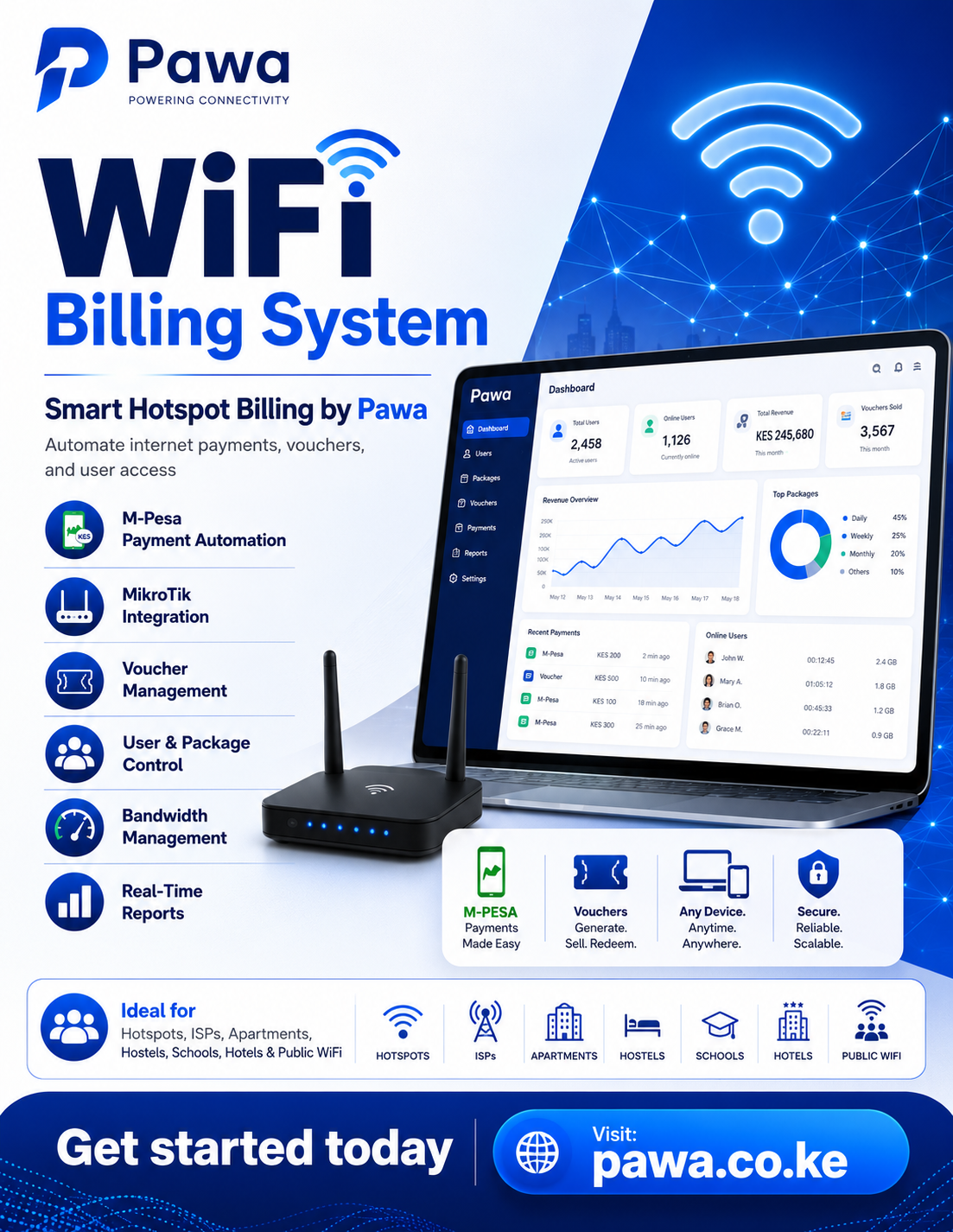
Internet access has become one of the most important services in Kenya and across Africa. Whether you are running a small WiFi hotspot in an estate, managing internet for rental houses, serving customers in a hotel, providing connectivity in a school, or building a growing ISP business, one thing is clear: manual WiFi management is no longer enough.
A WiFi billing system helps you control how users connect, how they pay, how long they stay online, and how much bandwidth they consume. Instead of manually creating users, checking payments, disconnecting expired clients, or replying to every customer asking for reconnection, a proper WiFi billing system automates the entire process.
For businesses using MikroTik routers, a WiFi billing system becomes even more powerful. It can work with hotspot login pages, vouchers, user packages, M-Pesa payments, expiry rules, bandwidth limits, and customer records. This is why hotspot billing platforms commonly focus on features such as vouchers, bandwidth control, user authentication, reports, payment processing, and captive portals.
At Pawa, we understand the real problems faced by WiFi providers in Kenya. Many hotspot owners start small, maybe with one router, one location, and a few customers. But as users increase, problems begin. Payments become hard to track. Customers pay but do not get connected on time. Some users overuse bandwidth. Others share access. Expired accounts remain active. The owner starts losing money without noticing.
That is where Pawa WiFi billing system comes in.
Pawa is built to help hotspot owners, small ISPs, landlords, apartment managers, cyber cafés, schools, churches, offices, and public WiFi providers manage internet users professionally. With the right billing system, you can turn WiFi from a stressful manual service into an automated income-generating platform.
What Is a WiFi Billing System?
A WiFi billing system is software that helps internet providers manage users, payments, access time, internet packages, and router connections from one central platform. It controls who can access the internet, how much they pay, what package they receive, when their access expires, and whether they should remain connected.
In simple terms, a WiFi billing system is the business brain behind your WiFi network.
Without a billing system, you may have to do everything manually. A customer sends money. You check your phone. You open the router. You create a user. You set the speed. You set the time limit. You remove them when the time expires. If many customers pay at the same time, you may delay or make mistakes.
With a WiFi billing system, this process becomes automatic.
A customer connects to your WiFi. They see a login or payment page. They select a package. They pay. The system confirms payment. The router gives access. When the package expires, the system disconnects or redirects them to renew.
This creates a smooth experience for both the business owner and the customer.
A good WiFi billing system can support:
- Hotspot login pages
- M-Pesa payments
- Voucher generation
- Time-based packages
- Data-based packages
- Speed limits
- User accounts
- Router monitoring
- Payment history
- Expiry control
- Customer records
- Revenue reports
- Multi-location management
This is why a WiFi billing system is important for anyone who wants to sell internet access professionally.
Why Your Business Needs a WiFi Billing System
Many WiFi businesses fail not because the internet service is bad, but because the billing and control process is weak. If you cannot control users, payments, expiry, and bandwidth, the business becomes difficult to scale.
A manual WiFi business can work when you have 5 or 10 users. But when you reach 50, 100, 300, or 1,000 users, manual work becomes a serious problem.
You need a WiFi billing system because it helps you:
1. Automate Customer Payments
The biggest advantage of a WiFi billing system is payment automation. Customers should not call you every time they want internet. They should be able to connect, choose a package, pay, and get connected automatically.
In Kenya, this is very important because many customers prefer mobile money payments. Modern WiFi billing platforms in Kenya usually focus on M-Pesa integration, automatic payment confirmation, real-time activation, payment tracking, and daily revenue reporting.
With Pawa, your WiFi business can reduce manual payment checking and improve customer experience.
2. Reduce Human Error
Manual billing creates mistakes. You may forget to disconnect expired users. You may activate the wrong package. You may give one customer more time than they paid for. You may forget who has paid and who has not.
A WiFi billing system reduces these errors by automating package activation and expiry.
3. Save Time
When your WiFi system is automated, you do not need to spend the whole day responding to payment messages. The system handles activations, disconnections, renewals, and records.
This gives you more time to focus on growing the business.
4. Control Internet Abuse
Some users consume too much bandwidth. Others share access with many devices. Some try to bypass payment. A proper WiFi billing system helps control this through speed limits, device limits, session control, and expiry rules.
5. Increase Revenue
When payments are automated and expired users are disconnected on time, you reduce losses. Every customer pays for what they use. This improves your income.
6. Improve Customer Experience
Customers want fast internet access. They do not want to wait for the admin to confirm payment manually. A WiFi billing system gives them instant access after payment, making your service look more professional.
7. Scale to More Locations
Once your system is organized, you can expand to more estates, apartments, shops, hotels, schools, and public areas. Instead of managing everything manually, you monitor all users from one dashboard.
How a WiFi Billing System Works
A WiFi billing system works by connecting your router, payment method, customer login page, and admin dashboard.
Here is a simple example:
- A customer connects to your WiFi.
- The customer is redirected to a captive portal or login page.
- The customer chooses a package, such as 1 hour, 3 hours, 1 day, 1 week, or 1 month.
- The customer pays using the available payment method.
- The system confirms the payment.
- The system activates internet access on the router.
- The customer browses according to the package limits.
- When the package expires, the system disconnects the customer or asks them to renew.
This process can happen automatically without the business owner touching the router.
For MikroTik users, this is especially useful because MikroTik routers are widely used for hotspot and ISP management. Many billing platforms focus on MikroTik hotspot, PPPoE, captive portal login, queues, vouchers, and speed limits because MikroTik is powerful for managing users and bandwidth.
Why MikroTik Works Well with a WiFi Billing System
MikroTik routers are popular among hotspot providers, ISPs, cyber cafés, schools, hotels, and estate WiFi businesses because they are affordable, powerful, and flexible.
A MikroTik-based WiFi billing system can help you manage:
- Hotspot users
- PPPoE users
- Static IP clients
- Bandwidth queues
- Speed limits
- User sessions
- Router access
- Captive portal login
- Voucher access
- Device control
- Package expiry
For example, if you sell a KES 20 package for 1 hour, the billing system can create access on the router and automatically remove or expire the user after the time ends.
If you sell a KES 100 daily package with a certain speed, the system can assign the right speed limit and expiry time.
If you manage monthly customers, the system can track payments and reconnect or disconnect users depending on their subscription status.
This makes MikroTik a strong foundation for building a professional WiFi billing business.
Pawa WiFi Billing System for Kenyan Hotspot Providers
Pawa is designed for people who want to manage WiFi businesses in a practical and professional way. It is suitable for anyone who wants to sell internet access using packages, vouchers, M-Pesa, and router automation.
Pawa can help you serve different types of customers, including:
- Estate WiFi users
- Apartment tenants
- Hostels
- Shops
- Hotels
- Airbnb units
- Cyber cafés
- Schools
- Churches
- Offices
- Public WiFi zones
- Small ISPs
- Rural internet providers
- WiFi resellers
The goal of Pawa is simple: help you earn from WiFi without struggling with manual billing.
Key Features of a Good WiFi Billing System
When choosing a WiFi billing system, do not look only at the price. Look at the features that will help you manage users, protect revenue, and grow your business.
Below are the most important features your system should have.
1. Captive Portal Login Page
A captive portal is the page users see when they connect to your WiFi. Instead of accessing the internet immediately, they are redirected to a login or payment page.
This page can show:
- Your business name
- Available internet packages
- Payment instructions
- Login form
- Voucher input
- Terms of use
- Contact details
- Promotional messages
A good captive portal makes your WiFi business look professional. It also helps users understand how to pay and connect without calling you.
Captive portals are a common part of hotspot billing because they allow access control, login management, package selection, and branding.
For Pawa, the captive portal can become the main customer-facing page where users buy WiFi access.
2. M-Pesa Payment Integration
In Kenya, a WiFi billing system must support mobile payments. Customers want to pay quickly using their phones. A good system should confirm payment and activate internet automatically.
M-Pesa integration helps you:
- Receive payments faster
- Confirm transactions automatically
- Activate packages instantly
- Reduce manual checking
- Track revenue
- Avoid payment disputes
- Improve customer experience
If your WiFi business depends on manual payment confirmation, you will struggle as users increase. A WiFi billing system with payment automation makes the business smoother.
3. Package Management
Different customers need different internet packages. Some want short access. Others want daily, weekly, or monthly plans. A good WiFi billing system should allow you to create flexible packages.
Examples of WiFi packages include:
- KES 10 for 30 minutes
- KES 20 for 1 hour
- KES 50 for 3 hours
- KES 100 for 24 hours
- KES 300 for 1 week
- KES 1,000 for 1 month
- Unlimited monthly package
- Speed-based package
- Device-based package
- Data-limited package
With Pawa, you can create packages that match your market. For example, estate users may prefer daily and weekly plans, while apartment tenants may prefer monthly plans. A cyber café may prefer time-based access. A hotel may prefer guest vouchers.
4. Voucher Generation
A voucher is a code that gives a customer internet access. Vouchers are useful for hotels, schools, events, cyber cafés, shops, and guest WiFi services.
You can print or share vouchers with customers. Each voucher can have:
- Username
- Password
- Time limit
- Speed limit
- Expiry date
- Device limit
- Package value
Voucher-based billing is common in hotspot management systems because it allows prepaid access control and easy offline selling.
For example, a hotel can generate 100 guest vouchers for visitors. A school can create student vouchers. A cyber café can sell time-based vouchers. A landlord can issue monthly vouchers to tenants.
5. Bandwidth Control
Bandwidth control is one of the most important parts of WiFi management. Without bandwidth control, a few users can consume all the internet and make the network slow for everyone.
A good WiFi billing system should allow you to control:
- Upload speed
- Download speed
- Package speed
- User speed
- Device speed
- Fair usage rules
- Heavy user limits
For example:
- KES 20 package: 2 Mbps
- KES 50 package: 5 Mbps
- Monthly package: 10 Mbps
- Premium package: 20 Mbps
This allows you to sell different packages based on value. Customers who want faster internet can pay more. Customers who only need basic browsing can buy cheaper packages.
MikroTik queues are commonly used to enforce per-user speed limits, burst settings, and fair usage policies.
6. User Management
A WiFi billing system should help you see all users in one place. You should know who is connected, who has paid, whose package has expired, and who is consuming more bandwidth.
User management helps you track:
- Active users
- Expired users
- Paid users
- Unpaid users
- Connected devices
- User history
- Package assigned
- Payment status
- Last login time
- Data usage
This gives you better control of your WiFi business.
7. Automatic Expiry and Disconnection
One of the biggest losses in WiFi businesses comes from users who remain connected after their package has expired. If you forget to disconnect them, they continue using internet for free.
A WiFi billing system solves this problem by automatically expiring users when their package ends.
For example:
- A 1-hour package ends after 1 hour.
- A daily package ends after 24 hours.
- A weekly package ends after 7 days.
- A monthly package ends after 30 days.
The system should disconnect or redirect the user to renew.
This protects your revenue.
8. Payment Reports
You cannot grow a WiFi business if you do not understand your numbers. A good WiFi billing system should provide reports that help you know how your business is performing.
Important reports include:
- Daily payments
- Weekly payments
- Monthly payments
- Package sales
- Active customers
- Expired customers
- Most popular packages
- Router performance
- Revenue per location
- Failed payments
- Customer renewal rate
Reports help you make better decisions. For example, if most customers buy daily packages, you can create better weekly offers. If one location performs better than another, you can invest more there.
9. Multi-Router and Multi-Location Support
If your WiFi business grows, you may have more than one router or location. You may serve different estates, buildings, schools, or business premises.
A strong WiFi billing system should help you manage multiple routers and locations from one dashboard.
This is useful for:
- ISPs
- Apartment WiFi providers
- Estate WiFi businesses
- Hotspot operators
- Cyber café owners with branches
- Hotels with multiple areas
- Schools with different blocks
- Franchise WiFi businesses
Instead of logging into every router manually, you manage everything centrally.
10. Customer Self-Service
A modern WiFi billing system should allow customers to help themselves. They should be able to:
- View packages
- Make payment
- Get connected
- Renew access
- Check expiry
- Contact support
- Reconnect after payment
This reduces support calls and improves customer satisfaction.
Customers prefer systems that are simple. If they can connect without calling anyone, they are more likely to keep using your WiFi service.
Who Needs a WiFi Billing System?
A WiFi billing system is useful for many types of businesses and organizations.
WiFi Billing System for Hotspot Owners
Hotspot owners need a billing system to sell internet access in public or semi-public areas. This can include estates, markets, shops, bus stages, hostels, or community areas.
With a WiFi billing system, a hotspot owner can create packages, collect payments, control users, and monitor revenue.
This is one of the fastest-growing uses of WiFi billing because many people want affordable daily or hourly internet.
WiFi Billing System for Small ISPs
Small ISPs need more than just routers. They need a system that manages customers, subscriptions, payments, disconnections, and reports.
A WiFi billing system helps small ISPs automate:
- Monthly billing
- Customer activation
- Package upgrades
- Router access
- Payment tracking
- Expiry control
- Service suspension
- Revenue reports
For a growing ISP, automation is not optional. It is necessary.
WiFi Billing System for Landlords and Apartments
Many landlords now provide WiFi as an extra service to tenants. Some include it in rent, while others sell it separately.
A WiFi billing system helps landlords:
- Sell WiFi packages to tenants
- Control access per room
- Track payments
- Disconnect unpaid tenants
- Offer monthly plans
- Reduce complaints
- Manage shared internet fairly
This can become an additional income stream for property owners.
WiFi Billing System for Hostels
Student hostels need reliable WiFi, but managing many students manually can be difficult. A billing system helps hostels create student packages, vouchers, and access limits.
Students can pay for daily, weekly, or monthly internet access. The hostel owner can monitor usage and prevent abuse.
WiFi Billing System for Hotels and Airbnb
Hotels and Airbnb hosts need controlled guest WiFi. Some provide free access, while others sell premium packages.
A WiFi billing system can help hotels:
- Create guest vouchers
- Limit access duration
- Offer premium speeds
- Brand the login page
- Track guest usage
- Prevent unauthorized access
Hotels commonly use hotspot systems to generate temporary guest vouchers, create premium plans, limit bandwidth, monitor connected devices, and customize captive portals.
For Airbnb hosts, a simple WiFi billing system can also help control guest access and avoid sharing the main password permanently.
WiFi Billing System for Schools and Colleges
Schools need to control internet access for students, teachers, staff, and guests. Without control, students may misuse internet or overload the network.
A WiFi billing system helps schools:
- Create different user groups
- Limit student access
- Give staff priority access
- Manage guest WiFi
- Monitor usage
- Control bandwidth
- Reduce abuse
This makes school internet more secure and organized.
WiFi Billing System for Cyber Cafés
Cyber cafés can use WiFi billing systems to sell wireless access alongside computer services. Customers can buy time-based access and connect using their phones or laptops.
This helps cyber cafés increase income without adding many computers.
WiFi Billing System for Churches and Events
Churches, conferences, training centers, and events often need temporary WiFi access. A billing system allows organizers to create vouchers or time-limited access for attendees.
This prevents the WiFi password from being shared widely and keeps the network under control.
WiFi Billing System for Offices and Co-Working Spaces
Offices and co-working spaces need guest WiFi management. A billing system can help create controlled access for visitors, clients, temporary workers, and paid users.
Co-working spaces can even sell premium WiFi packages to members.
Benefits of Using Pawa WiFi Billing System
Pawa is built with the needs of Kenyan WiFi providers in mind. It focuses on practical automation, customer convenience, and business control.
Here are the main benefits of using Pawa.
1. Faster Customer Activation
Customers do not want to wait. Once they pay, they expect to be connected immediately.
Pawa helps reduce delays by automating the activation process. This improves customer trust and reduces complaints.
2. Better Revenue Control
Every paid package should have a clear expiry time. Every user should pay before accessing internet. Every payment should be recorded.
Pawa helps protect your income by ensuring access is controlled and billing is organized.
3. Less Manual Work
Manual work can become stressful as your customer base grows. Pawa helps automate repetitive tasks such as user activation, expiry, payment tracking, and access control.
This allows you to focus on business growth instead of daily technical work.
4. Professional Customer Experience
A branded login page makes your WiFi service look professional. Customers can see your packages, pay, and connect easily.
This gives your business a better image compared to sharing one password with everyone.
5. Easy Package Selling
Pawa allows you to structure your internet packages based on your market. You can sell hourly, daily, weekly, or monthly access.
This flexibility helps you serve different customers and increase sales.
6. Scalable for Growth
Whether you are starting with one router or planning to manage many locations, a billing system gives you a foundation for growth.
Pawa can help you move from a small hotspot to a more organized internet business.
WiFi Billing System vs Manual WiFi Management
Many people start their WiFi business manually. They give users passwords, receive payments on phone, and adjust router settings manually. This can work at the beginning, but it becomes risky as the business grows.
Here is why a WiFi billing system is better.
Manual WiFi Management
Manual management usually means:
- Sharing passwords manually
- Checking M-Pesa messages manually
- Creating users manually
- Disconnecting users manually
- No proper reports
- High risk of free usage
- Poor customer experience
- Difficult scaling
- More support calls
- More mistakes
WiFi Billing System
A WiFi billing system gives you:
- Automatic payments
- Automatic activation
- Automatic expiry
- Captive portal login
- Package control
- User tracking
- Revenue reports
- Voucher management
- Bandwidth control
- Better customer experience
- Easier business growth
If you want to build a serious WiFi business, a billing system is the better option.
Important WiFi Packages You Can Sell with Pawa
Choosing the right packages can help you make more money. Your packages should match your location, customer needs, and internet cost.
Here are examples.
Hourly WiFi Packages
Hourly packages are good for public hotspots, markets, cyber cafés, bus stops, and shops.
Examples:
- KES 10 for 30 minutes
- KES 20 for 1 hour
- KES 30 for 2 hours
- KES 50 for 3 hours
These packages work well where customers need quick access.
Daily WiFi Packages
Daily packages are popular in estates, apartments, hostels, and public WiFi areas.
Examples:
- KES 50 for 12 hours
- KES 100 for 24 hours
- KES 150 for 24 hours premium speed
Daily packages are easy to sell because many customers prefer paying small amounts.
Weekly WiFi Packages
Weekly packages help improve customer retention.
Examples:
- KES 300 for 7 days
- KES 500 for 7 days premium
- KES 700 for 7 days unlimited
Weekly packages reduce daily payment friction and help you get more stable income.
Monthly WiFi Packages
Monthly packages are best for tenants, homes, offices, and regular customers.
Examples:
- KES 1,000 monthly basic
- KES 1,500 monthly standard
- KES 2,500 monthly premium
- KES 3,500 monthly business package
Monthly packages help you predict income and plan bandwidth better.
Speed-Based WiFi Packages
Speed-based packages allow you to charge more for better internet.
Examples:
- Basic: 2 Mbps
- Standard: 5 Mbps
- Premium: 10 Mbps
- Business: 20 Mbps
This model works well for apartments, offices, and small ISPs.
How Pawa Helps You Compete in the WiFi Market
The WiFi business is becoming competitive. Customers want affordable internet, fast activation, reliable service, and simple payment. If your system is slow or manual, customers may move to another provider.
Pawa helps you compete by giving your business a professional system.
With Pawa, you can:
- Offer self-service payment
- Create clear packages
- Control user access
- Monitor payments
- Manage routers
- Reduce downtime
- Improve support
- Build customer trust
In the WiFi market, trust matters. Customers want to know that when they pay, they will be connected. A billing system helps you deliver that experience consistently.
Common Problems a WiFi Billing System Solves
Many hotspot owners face the same problems. Pawa is built to help solve these real business issues.
Problem 1: Customers Pay but Are Not Connected Quickly
This happens when activation is manual. The customer pays but must wait for the admin to confirm. If the admin is busy or offline, the customer becomes frustrated.
A WiFi billing system solves this through automatic payment confirmation and activation.
Problem 2: Users Share Passwords
If you use one password for everyone, users can share it with others. This reduces your income and overloads your network.
A WiFi billing system gives each user controlled access.
Problem 3: Expired Users Remain Connected
Manual disconnection is easy to forget. Some users may continue using internet after their package ends.
A billing system automatically expires users.
Problem 4: Network Becomes Slow
When some users consume too much bandwidth, everyone complains. Bandwidth control helps you limit speeds and create fair usage.
Problem 5: No Clear Revenue Records
If you rely only on phone messages, you may not know your actual revenue. A billing system gives reports and payment history.
Problem 6: Difficult to Scale
Manual systems cannot support serious growth. A billing system gives you structure to expand to more users and locations.
How to Choose the Best WiFi Billing System
Before choosing a WiFi billing system, ask yourself these questions:
Does It Support MikroTik?
If you use MikroTik routers, choose a system that works well with MikroTik hotspot or PPPoE.
Does It Support Local Payments?
In Kenya, M-Pesa support is very important.
Can It Automate Activation?
The system should activate users after payment without manual work.
Can It Expire Users Automatically?
Automatic expiry protects revenue.
Does It Have Reports?
You need reports to track income and growth.
Is It Easy for Customers?
The customer payment and login process should be simple.
Can It Scale?
Choose a system that can grow with your business.
Pawa is built around these needs.
Why WiFi Billing Is a Business Opportunity in Kenya
Internet demand in Kenya continues to grow. Many people need affordable internet for work, school, entertainment, online business, communication, and digital services.
Not everyone can afford expensive home fiber or mobile data every day. This creates an opportunity for local WiFi providers to sell affordable internet in estates, buildings, hostels, shops, and public areas.
A WiFi billing system makes this opportunity easier to manage.
You can start with one location, learn the market, improve your packages, and expand gradually.
Good target areas include:
- Rental apartments
- Student hostels
- Rural towns
- Market centers
- Cyber cafés
- Residential estates
- Shopping centers
- Schools
- Airbnb units
- Churches
- Bus stations
- Small offices
With the right system, WiFi can become a stable monthly business.
Pawa for Estate WiFi Businesses
Estate WiFi is one of the strongest opportunities for hotspot providers. Many people living in apartments want affordable internet but may not want long-term contracts.
With Pawa, you can create packages for estate users and let them pay when they need internet.
Estate WiFi packages can include:
- Daily access
- Weekly access
- Monthly access
- Night bundles
- Student bundles
- Premium speed bundles
Pawa helps you manage payments, users, and expiry without visiting every customer.
Pawa for Apartment Internet
Landlords and property managers can use Pawa to provide internet as a value-added service. Instead of allowing tenants to install many different connections, the property can have one managed WiFi system.
Benefits include:
- Extra income for the landlord
- Better tenant experience
- Controlled access
- Easy monthly billing
- Less password sharing
- Organized user management
This can make an apartment more attractive to tenants.
Pawa for Public WiFi Hotspots
Public WiFi hotspots can generate income when properly managed. The challenge is controlling access and payments.
Pawa helps public hotspot owners:
- Create affordable packages
- Automate payments
- Limit usage
- Prevent free access
- Monitor users
- Track revenue
This works well in busy areas where people need quick internet access.
Pawa for ISPs
For small and growing ISPs, billing automation is critical. As customers increase, manual management becomes risky.
Pawa can help ISPs manage:
- Customer subscriptions
- Router access
- Package plans
- Payment records
- Disconnections
- Renewals
- Reports
A good billing system helps an ISP look more professional and operate more efficiently.
WiFi Billing System and Customer Trust
Trust is everything in internet service. Customers want to know that when they pay, they get connected. They also want the connection to work reliably.
A WiFi billing system builds trust because the process is clear:
- Customer sees package.
- Customer pays.
- Customer gets access.
- Customer knows expiry.
- Customer can renew.
This reduces confusion and improves customer satisfaction.
WiFi Billing System and Business Branding
A professional WiFi billing system also helps with branding. Your captive portal can display your business name, logo, packages, and support details.
This is better than simply telling people to connect to a WiFi name and send money manually.
Branding helps customers remember your service. It also makes your WiFi business look serious and trustworthy.
Security Benefits of a WiFi Billing System
A WiFi billing system is not only about money. It also improves security.
It helps you:
- Avoid open WiFi abuse
- Control who connects
- Track user sessions
- Limit device access
- Reduce password sharing
- Block expired access
- Separate guest users
- Protect router settings
This is important for businesses, schools, hotels, and public WiFi providers.
WiFi Billing System for Better Support
Customer support becomes easier when you have a system. Instead of guessing, you can check:
- Did the customer pay?
- Which package did they buy?
- Is the account active?
- Has the package expired?
- Which device is connected?
- Is the router online?
- Is there a payment issue?
This helps you solve problems faster.
Why Pawa Is a Good Choice for WiFi Billing
Pawa is built for practical WiFi business needs. It is not just about connecting users. It is about helping you run a profitable and organized internet business.
Pawa focuses on:
- Simplicity
- Automation
- Payment control
- Router integration
- Customer convenience
- Revenue tracking
- Business growth
Whether you are starting a hotspot or managing a growing WiFi network, Pawa gives you the tools to manage your service better.
Best Practices for Running a WiFi Business with Pawa
To get the best results from your WiFi billing system, follow these best practices.
1. Create Simple Packages
Do not confuse customers with too many packages. Start with simple options:
- 1 hour
- 1 day
- 1 week
- 1 month
You can add more packages later.
2. Use Clear Pricing
Make sure customers understand the price, speed, and duration before paying.
3. Control Speeds Fairly
Avoid giving unlimited high speed to everyone. Use speed limits to protect network quality.
4. Monitor Revenue Daily
Check your daily income and package sales. This helps you understand your business.
5. Offer Reliable Support
Even with automation, customers may need help. Provide a support number or contact option.
6. Keep Routers Secure
Use strong router passwords and avoid exposing router access publicly.
7. Upgrade Bandwidth as Users Grow
If your customer base grows, increase your internet capacity to avoid slow speeds.
8. Promote Your WiFi Service
Use posters, WhatsApp groups, estate groups, Facebook, and local referrals to attract customers.
WiFi Billing System FAQs
What is a WiFi billing system?
A WiFi billing system is software that helps manage internet users, payments, packages, access time, speed limits, and router control. It allows WiFi providers to sell internet access automatically.
Who needs a WiFi billing system?
Hotspot owners, ISPs, landlords, hotels, schools, cyber cafés, offices, hostels, and public WiFi providers need a WiFi billing system.
Can I use a WiFi billing system with MikroTik?
Yes. MikroTik is commonly used for hotspot and ISP billing because it supports user control, bandwidth management, hotspot login, PPPoE, and router automation.
Can customers pay automatically?
Yes. With a proper WiFi billing system, customers can pay and get connected automatically depending on the payment integration available.
Can I create WiFi vouchers?
Yes. A good WiFi billing system allows you to generate vouchers for guests, students, customers, or temporary users.
Can I limit internet speed?
Yes. You can create packages with different speeds and control bandwidth per user or package.
Is a WiFi billing system good for apartments?
Yes. Apartments and rental houses can use WiFi billing systems to sell internet access to tenants and manage payments automatically.
Is Pawa suitable for small WiFi businesses?
Yes. Pawa is suitable for small hotspot owners and growing internet providers who want better billing, user control, and automation.
Grow Your WiFi Business with Pawa
A WiFi billing system is one of the most important tools for anyone who wants to sell internet access professionally. It helps you automate payments, control users, manage packages, prevent losses, improve customer experience, and grow your business.
Manual WiFi management may work for a few users, but it becomes difficult as your business grows. If you want to serve more customers, reduce stress, and increase revenue, you need a proper billing system.
Pawa helps hotspot owners, ISPs, landlords, schools, hotels, cyber cafés, offices, and public WiFi providers manage their WiFi business with confidence.
With Pawa, you can create packages, manage users, automate access, track payments, and build a professional internet service that customers can trust.
If you are ready to turn your WiFi network into a serious business, start with Pawa WiFi billing system today.
Visit pawa.co.ke and take control of your WiFi business.