
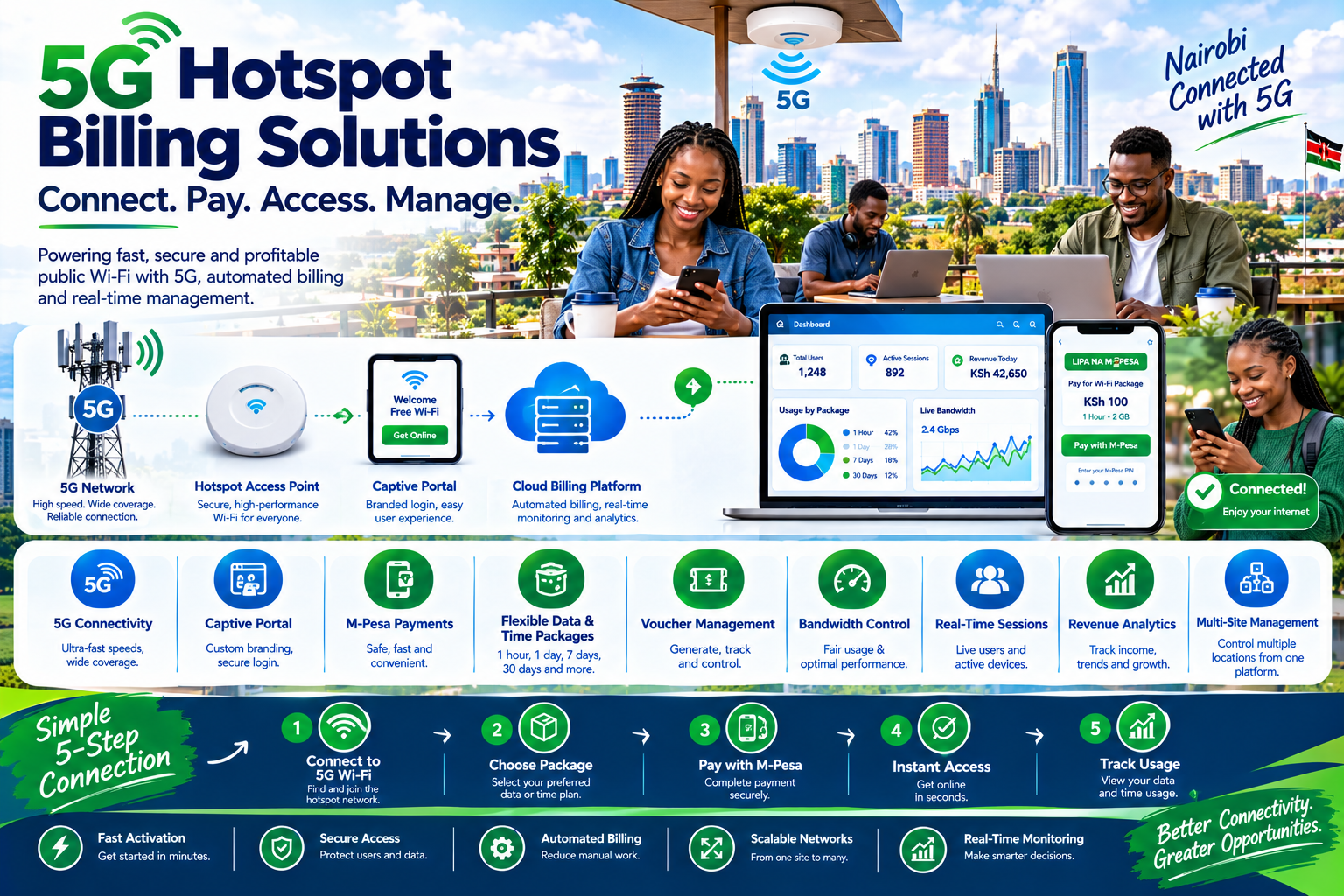
5G hotspot billing solutions are arriving at exactly the moment Kenya’s connectivity entrepreneurs were ready for them — the marriage of the country’s fastest mobile networks with the proven business model that already sells internet by the hour, the day, and the voucher.
For years, the hotspot economy ran on 4G, and it ran well: routers on rooftops, portals on phones, M-Pesa confirmations at midnight. 5G hotspot billing solutions now extend that same proven model onto networks that are dramatically faster.
The entrepreneurs who built this industry — trading-center operators, estate WiFi sellers, event connectivity teams — are watching 5G coverage expand street by street and asking the obvious next question: what does this speed mean for revenue?
The answer, delivered by modern 5G hotspot billing solutions, is: quite a lot — and the operators who understand it first will collect it first.
Table of Contents
ToggleWhat 5G Hotspot Billing Solutions Actually Are
Strip away the buzzwords and 5G hotspot billing solutions are the systems that sell 5G-served internet the way every successful hotspot business already sells it: in packages, paid by mobile money, enforced automatically.
The ingredients are the ones operators already trust. A captive portal displaying packages and prices. An M-Pesa flow that activates access in seconds. Session management that counts down time and cuts off cleanly when the purchase ends.
What changes is the engine underneath — and what that engine makes possible. 5G hotspot billing solutions pair the familiar storefront with radios capable of serving several times more users at dramatically higher speeds.
The result is not a new business model but an upgraded one: the same portal, the same packages, the same automation — carrying a far more powerful product. That continuity is deliberate, because the 5G hotspot billing solutions philosophy is to keep what worked and multiply what it can deliver.
Why 5G Changes the Hotspot Business
Three numbers explain the excitement. Speed: real-world 5G delivers hundreds of megabits where 4G delivered tens. Latency: connections that respond in single-digit milliseconds.
Capacity: many more simultaneous devices per site, all served comfortably at once. Each of these three converts directly into things a hotspot operator can sell.
Speed is inventory. A 5G hotspot billing solutions deployment offers a product customers feel the moment they connect — downloads in seconds, video calls that never stutter, streams that never buffer.
Capacity changes the arithmetic of the mast itself. Where a 4G site strained at forty comfortable users, a 5G hotspot billing solutions network on 5G serves the same street with room to spare — and every additional comfortable user is additional revenue.
Latency quietly creates a new customer category: the gamer, the day trader, the professional on video calls from morning to evening. These customers pay premiums, and the premium packages sold through 5G hotspot billing solutions are where the new margins live.
The Billing Layer: Familiar Logic at Higher Speeds
The pleasant surprise for operators is how much existing knowledge carries over. The portal, the packages, the M-Pesa prompts, the device binding, the session enforcement — all the machinery of a proven system remains, now fed by faster radios.
Speed tiering becomes the star feature. A basic package at comfortable browsing pace and a premium package at full 5G velocity — the difference is dramatic enough to sell itself. Platforms built for 5G hotspot billing solutions enforce those tiers in real time, at network level.
Volume handling matters more, too. Higher capacity means more simultaneous paying sessions, and the billing layer must meter, track, and report hundreds of concurrent customers without blinking. The stronger 5G hotspot billing solutions platforms were engineered for exactly this density.
Reporting gets richer as well: revenue per hour, package popularity, speed-tier uptake, peak patterns. The operator who reads those numbers on a 5G hotspot billing solutions dashboard prices with evidence in a market moving faster than ever.
The Hardware: 5G Routers and What They Cost
The 5G radio lives in new hardware, and the shopping deserves honesty. 5G routers and CPE units cost more than their 4G equivalents — a genuine premium that buys genuine capacity.
Dual-mode capability is the essential spec: routers that speak 5G where coverage exists and fall back to 4G seamlessly where it does not. A 5G hotspot billing solutions deployment on dual-mode hardware never goes dark — it simply slows for a while.
Outdoor CPE units extend the model into fixed wireless: weatherproof radios mounted on rooftops, feeding whole households and offices. The same platform manages both mobile hotspot and fixed 5G hotspot billing solutions customers from one dashboard.
Placement rules carry over completely: elevation, antenna choice, and tested signal at the exact mounting point. The physics of siting a 5G unit resembles siting a 4G mast — and the operators who test first protect their 5G hotspot billing solutions investment the same way they always have.
Capacity: The New Customer Math
The most commercially significant change is per-site capacity. A 5G site comfortably serves several times the users of a 4G site at the same quality — which rewrites the revenue ceiling of every location.
That capacity converts straight into income. The operator running 5G hotspot billing solutions at a busy stage no longer turns customers away at peak; every comfortable connection is a package sold.
Congestion management remains a discipline even at 5G speeds. Per-user limits, fair queues, and priority rules keep one heavy streamer from taxing a full house — and 5G hotspot billing solutions platforms carry that bandwidth governance forward, scaled to the new headroom.
Capacity planning becomes more forgiving, too. Operators grow into headroom instead of fighting ceilings, and the 5G hotspot billing solutions dashboard shows utilization honestly — so upgrades happen on schedule rather than in crisis.
The New Products 5G Makes Possible
Speed creates products that never existed at 4G economics. Premium speed tiers, gaming packages, 4K streaming tiers, and business-grade connections all become real, enforceable, sellable offers.
Gaming deserves special mention. Latency is the gamer’s currency, and a 5G hotspot billing solutions platform selling dedicated gamer packages — priority handling, low latency, generous data — reaches a young, passionate audience that pays willingly for performance.
Business packages form the second tier. Small offices, remote workers, and professional tenants need fiber-class reliability without fiber waits, and a 5G hotspot billing solutions deployment delivers exactly that, billed monthly through the same portal.
Event connectivity becomes the third product. Stadiums, conferences, and exhibitions gather thousands of devices in one place — exactly where 4G chokes. A 5G hotspot billing solutions pop-up at an event sells premium access to a captive, high-value crowd that has nowhere else to go.
Fixed Wireless Access: 5G as the Fiber Alternative
The quiet revolution inside 5G is fixed wireless access — radios delivering home and office internet without trenches, poles, or permission slips. Estates and neighborhoods the fiber crews have not reached become serviceable overnight.
For the operator, FWA is the hotspot business wearing formal clothes: the same portal, the same packages, the same M-Pesa flow — monthly instead of hourly. 5G hotspot billing solutions manage both models side by side from one dashboard.
Landlords and estate managers were the earliest adopters. A building connected by a 5G FWA link and run on 5G hotspot billing solutions delivers fiber-class internet in days, with tenants paying for packages exactly as they pay for tokens.
The economics favor speed of deployment. Where fiber takes months of digging and negotiation, a 5G hotspot billing solutions FWA launch takes a week — and in markets where internet access is the amenity tenants ask about first, that speed wins buildings.
M-Pesa at 5G Speed
The payment layer — the heart of every hotspot business — translates perfectly onto 5G. The STK push, the instant confirmation, the automatic activation: the flow customers already trust, now carrying higher-value packages.
Higher transaction values raise the stakes on speed. When a customer pays a premium for premium performance, activation must be instant — and the 5G hotspot billing solutions platforms keep that loop tight: pay, activate, browse, all in seconds at any hour.
Reconciliation scales with the volume. Stray payments, manual sends, and delayed confirmations get matched to accounts automatically, so no shilling ever arrives without its access. The discipline that made 4G collections invisible carries into 5G hotspot billing solutions operations unchanged.
And the reporting closes the loop: revenue by tier, by hour, by site, by package. The operator of a 5G hotspot billing solutions network reads their business exactly the way they always have — only the numbers are bigger.
Who Gains Most From the 5G Shift
Urban operators gain first, simply because coverage arrives there first: dense estates, central business districts, and university neighborhoods where foot traffic meets signal.
Event venues gain dramatically. Conferences, weddings, exhibitions, and match days all generate concentrated demand that 4G could never satisfy — and a 5G hotspot billing solutions pop-up turns that demand into premium revenue in a single weekend.
Business customers become reachable at last. The SME that waited months for fiber installation becomes a same-week sale for an operator offering a 5G hotspot billing solutions FWA package with monthly billing and a portal the office manages itself.
And existing 4G operators gain a growth path rather than a disruption — upgrading their busiest sites one at a time while the 5G hotspot billing solutions platform stays constant beneath the improving radios.
The Migration Path: From 4G to 5G Without Starting Over
The migration story is deliberately boring, in the best possible way. The billing platform does not change; the radio beneath it does. Operators keep their portals, their packages, their customers, and their dashboards while swapping hardware site by site.
Dual-mode routers make the transition gradual. Each site upgrades when its economics justify it, and the 5G hotspot billing solutions platform serves old and new hardware identically in the meantime.
Packages migrate in tiers as well: existing 4G offerings continue unchanged while premium 5G tiers launch wherever coverage exists. The 5G hotspot billing solutions dashboard tracks which sites run which generation, so the operator always sees the portfolio clearly.
The financial pacing stays in the operator’s hands: upgrade the busiest site first, let its premium revenue fund the next, and let the 5G hotspot billing solutions reports confirm each step before the following investment.
Costs and Economics: Paying for Speed Wisely
Honesty about costs keeps the 5G decision sound.
Hardware premiums, data plan premiums, and coverage limits are all real, and pretending otherwise is how budgets collapse.
The counterweight is pricing power.
Customers pay meaningfully more for dramatically better experiences, and the 5G hotspot billing solutions platforms make that premium collectable — tiered, enforced, and reported rather than promised.
The discipline is matching spend to coverage: 5G hardware where 5G signal lives, proven 4G where it does not. The 5G hotspot billing solutions operator who phases investment by coverage spends wisely at every step.
Data plan terms deserve a careful read before anything is purchased: fair usage thresholds, hotspot permissions, and business-plan options.
The operators who verified terms before building their 5G hotspot billing solutions foundation avoided the classic mid-peak surprise entirely.
The Mistakes That Waste the 5G Opportunity
The first is buying speed where speed does not exist — 5G hardware mounted in a 4G-only neighborhood. Test coverage at the exact mounting point, at peak evening hours, before spending a shilling.
The second is skipping the terms check: building a resale business on a consumer plan whose policy forbids exactly that.
Business plans exist for 5G hotspot billing solutions operators, and finding them starts with reading the contract.
The third is launching premium without delivering premium — a 5G label stretched over a congested backhaul.
Customers pay premiums for felt performance, and 5G hotspot billing solutions reputations are built or broken by whether the speed is real.
The fourth is ignoring fallback: single-mode hardware that goes dark whenever coverage dips. Dual-mode or nothing is the professional rule.
The fifth is over-investing before demand is proven — outfitting five sites when one pilot would answer every question. Run one site, read the 5G hotspot billing solutions numbers for a month, then scale with evidence.
Security: Faster Pipes, Same Rules
Speed changes the product; the trust requirements stay identical. M-Pesa PINs entered only on the customer’s own phone, guest traffic segmented from business systems, and admin access locked to named people.
Higher transaction values make clean records more valuable, not less.
Every session timestamped, every payment receipted, every dispute settled by scrolling — the 5G hotspot billing solutions receipt discipline carries forward without modification.
Firmware currency matters more on newer hardware. 5G radios are young technology, updates arrive regularly, and the operators who patch on schedule with backups taken first stay ahead of the threats that prey on neglected boxes.
Data hygiene completes the stack: minimal collection, plainly stated consent, and records kept only as long as they serve the customer.
The 5G hotspot billing solutions standard here is the same one every trusted network has always followed — respect the user, and the user stays.
The Payoff: What the 5G Era Actually Delivers
For operators positioned well, the 5G era delivers three compounding advantages.
The first is a premium product: speeds customers genuinely feel, sold at genuine premiums through 5G hotspot billing solutions tiering that makes the upgrade visible and worthwhile.
The second is capacity economics: more revenue per site, more comfortable customers per mast, and headroom that turns peak hours from a liability into the best-earning window of the day on a 5G hotspot billing solutions dashboard.
The third is future-proofing.
The operator whose platform already speaks 5G rides every coverage expansion as it arrives — new neighborhoods, new venues, new customers — on the same 5G hotspot billing solutions foundation built today.
None of this requires abandoning what already works.
It requires pointing the proven model at the faster future — and the operators who make that move while coverage grows are the ones whose networks set the pace everyone else eventually follows.
Frequently Asked Questions
Is 5G coverage wide enough to build a business on yet?
Coverage is concentrated in urban centers and expanding steadily, so the honest answer is: build where the signal lives.
Operators checking coverage maps and testing mounting points can launch profitable 5G hotspot billing solutions sites in covered areas today while staying on 4G elsewhere.
Do I need new billing software to move to 5G?
No — the billing layer is radio-agnostic.
Operators moving to 5G keep their existing portal, packages, and payments, because capable 5G hotspot billing solutions platforms manage 4G and 5G hardware side by side from one dashboard.
How much more does 5G hotspot hardware cost?
Expect a meaningful premium over 4G equipment, varying by router class and capability.
The operators who succeed with 5G hotspot billing solutions treat the premium as capacity they can sell — and recover it through premium packages within months.
Can one 5G site really serve more customers than 4G?
Yes — comfortably several times more simultaneous users at the same quality.
That capacity is the core commercial argument behind 5G hotspot billing solutions, because every additional comfortable customer is additional revenue from the same location.
What packages sell best on 5G?
Premium speed tiers, gaming packages, and business-grade monthly plans lead the list.
The 5G hotspot billing solutions operators earning most structure a ladder where the premium tier’s difference is genuinely felt — and let the upgrade sell itself.
Does M-Pesa billing work the same on 5G?
Exactly the same — the STK push, instant activation, and automatic records are unchanged.
The 5G hotspot billing solutions payment flow simply carries higher-value packages through the loop customers already trust.
Can 5G replace fiber for estates and offices?
In covered areas, genuinely yes — fixed wireless access delivers fiber-class speeds without the trenching.
Estates running 5G hotspot billing solutions FWA deployments report tenants unable to tell the difference, at a fraction of the deployment time.
What happens when 5G coverage drops to 4G?
Dual-mode hardware falls back automatically, and sessions continue at 4G speeds.
Designing 5G hotspot billing solutions deployments around dual-mode routers is what keeps customers online through every coverage gap.
Can I resell 5G data legally?
It depends on the provider’s terms — consumer plans often restrict resale while business plans exist precisely for operators.
Verifying permissions before building a 5G hotspot billing solutions business is the step that separates sustainable operations from shutdowns.
Should a new operator start on 5G or 4G?
Start where your target location’s coverage and customer budget point: 4G remains the broader, cheaper foundation, while 5G wins in covered urban pockets.
Many operators begin on 4G and grow into 5G hotspot billing solutions premium tiers as coverage arrives.
How are speed tiers actually enforced on 5G?
Through network-level rate limiting attached to each package, applied in real time by the platform.
This enforcement is what makes the premium tiers inside 5G hotspot billing solutions honest — the customer paying for speed receives exactly that speed.
Are events and temporary venues a good 5G fit?
Among the best — concentrated crowds, high willingness to pay, and short deployments suit the model perfectly.
Operators running 5G hotspot billing solutions pop-ups at events routinely earn in a weekend what a fixed site earns in a month.
Do 5G data plans have fair usage limits?
Most do, and the thresholds matter enormously to a resale business.
Reading the policy before committing is standard practice among 5G hotspot billing solutions operators — the ones who priced their packages against real thresholds rather than advertised headlines.
What is the smartest first step this week?
Test 5G coverage at your best existing site during peak hours, and price one premium tier against what your busiest customers already pay.
That single page of notes — signal reading, customer list, honest premium pricing — is the foundation every successful 5G hotspot billing solutions migration has started from.
Who wins the 5G era?
The operators who treated speed as inventory: testing coverage before buying, pricing premiums honestly, and scaling one proven site at a time.
Their 5G hotspot billing solutions networks grow with every coverage expansion the carriers deliver — and by the time 5G is everywhere, the operators who moved early will already own the customers everyone else is still chasing.