
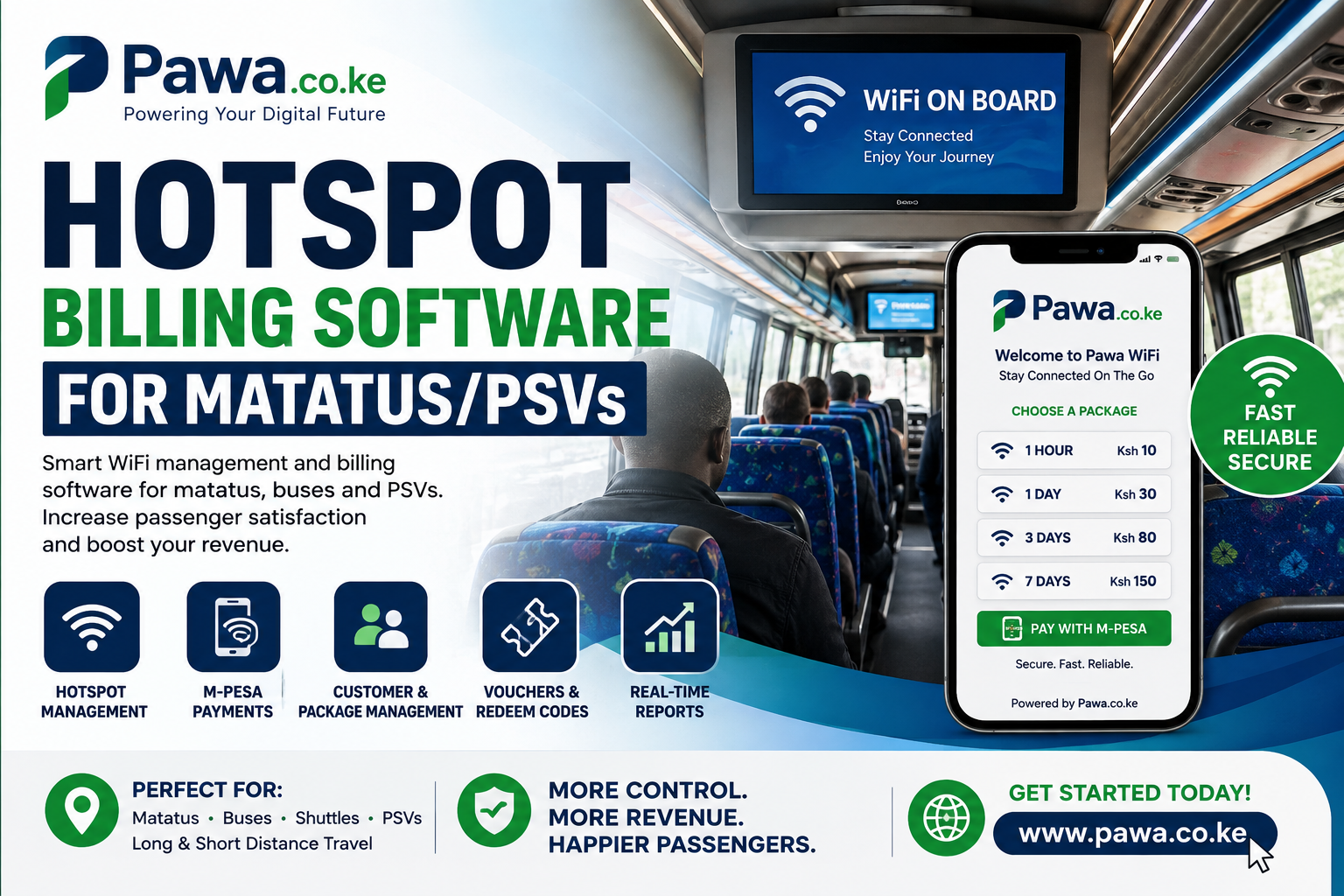
Hotspot Billing Software for Matatus/PSVs in Kenya
Hotspot billing software for matatus/PSVs is becoming increasingly relevant as public transport operators look for practical ways to provide passengers with paid or sponsored WiFi while maintaining control over connectivity, payments, users, packages, and network usage.
For a matatu, shuttle, bus, or other PSV, onboard WiFi can turn connectivity into an additional service offered to passengers during their journeys. However, simply installing a router and sharing a password is not enough for a commercial WiFi operation. Operators need a system that can control who accesses the network, determine how long customers remain connected, manage packages, record payments, and prevent unauthorized usage.
This is where hotspot billing software for matatus/PSVs becomes useful. A properly configured billing platform can connect the passenger-facing hotspot with network equipment and payment processes, allowing the operator to create a more organized WiFi service.
For Kenyan operators considering this model, Pawa.co.ke provides WiFi and ISP billing functionality designed around hotspot management, customer packages, M-Pesa payments, vouchers, routers, and access control.
Hotspot Billing Software for Matatus/PSVs in Kenya
Hotspot billing software for matatus/PSVs in Kenya allows transport operators to manage WiFi access in moving or stationary public-service vehicles through defined packages and authentication rules.
A passenger may connect to the vehicle’s WiFi network and be directed to a captive portal. Instead of receiving a permanent shared password, the passenger can select a package, make the required payment, and receive internet access according to the rules configured by the operator.
This approach creates a structured system for monetizing onboard connectivity.
For example, an operator could create short-duration packages for passengers taking relatively short journeys and longer packages for passengers travelling between cities. The actual prices should be determined after considering route length, customer demand, internet costs, payment charges, equipment, and competition.
The important point is that WiFi becomes a managed service rather than an informal passenger amenity.
Hotspot Billing Software for Matatus/PSVs and Passenger WiFi
Hotspot billing software for matatus/PSVs can help transform passenger WiFi from a basic router installation into a controlled commercial service.
Consider a matatu travelling from Nairobi to Nakuru. Passengers may spend several hours inside the vehicle. During that journey, they may want to browse social media, communicate through messaging applications, work remotely, attend online activities, stream content, or access other internet services.
The operator can offer WiFi access through a captive portal instead of distributing one password to everyone.
The passenger connects to the vehicle’s network, opens the login page, selects a package, completes payment where applicable, and receives access.
This workflow provides greater control than a shared password because the operator can associate access with individual packages and expiry rules.
Hotspot Billing Software for Matatus/PSVs for Paid Internet Access
Hotspot billing software for matatus/PSVs can support a prepaid approach to onboard connectivity.
A transport business could create several access options based on its customer base.
A short trip could have a low-cost package.
A longer journey could have a longer-duration package.
A premium package could offer a higher speed or greater usage allowance where the network infrastructure supports it.
The exact package design should depend on the vehicle’s route and the available internet capacity.
For example, if an operator sells 30 WiFi packages at KES 20 during a day, the gross sales would be KES 600. If the same vehicle averages 60 packages at KES 20, gross daily sales would become KES 1,200.
Those figures represent sales, not profit.
The operator would still need to account for internet connectivity, software, power, equipment maintenance, payment-related costs, vehicle-related arrangements, and other operating expenses.
Hotspot Billing Software for Matatus/PSVs with M-Pesa Payments
Hotspot billing software for matatus/PSVs becomes particularly practical in Kenya when it supports mobile payments.
Passengers are already familiar with M-Pesa, making mobile payment a natural option for purchasing digital services.
A WiFi billing platform can be configured so that the customer selects a package and completes the required payment before access is activated.
This can reduce the need for a conductor or driver to manually confirm every WiFi payment.
Pawa’s WiFi and ISP billing functionality is designed around payment and access management, including M-Pesa-related workflows.
For a transport operator, automated payment processing can make onboard WiFi easier to administer, particularly when several vehicles are involved.
Hotspot Billing Software for Matatus/PSVs Using Captive Portals
Hotspot billing software for matatus/PSVs can use a captive portal to control how passengers enter the network.
A captive portal is the webpage that appears when a user connects to a managed WiFi hotspot.
Instead of immediately receiving unrestricted internet access, the passenger may see a page containing:
- Available WiFi packages
- Payment instructions
- Login options
- Terms of use
- Vehicle or operator branding
- Customer support information
- Promotional messages
This creates a professional passenger experience.
The portal can also become a marketing channel. A transport company could use the WiFi landing page to promote its services, routes, loyalty programs, partner businesses, or other relevant offers.
Hotspot Billing Software for Matatus/PSVs Without Shared Passwords
Hotspot billing software for matatus/PSVs reduces dependence on shared WiFi passwords.
A shared password creates several problems.
A passenger can give it to another person.
A former passenger can continue using the password if they are still within range.
Multiple users can consume bandwidth without contributing to revenue.
The operator may have no accurate record of active customers.
With authenticated hotspot access, users can receive access according to defined rules.
For example, a package can expire after the selected duration. This prevents a customer from receiving unlimited access simply because they learned the WiFi password.
Hotspot Billing Software for Matatus/PSVs and MikroTik Routers
Hotspot billing software for matatus/PSVs can work with network equipment such as MikroTik routers to create controlled access.
The router acts as an important part of the network infrastructure because it can help enforce authentication and bandwidth policies.
Pawa’s ISP billing offering is designed to work with MikroTik-based environments, making the combination relevant for operators building managed WiFi services.
The specific hardware configuration will depend on the vehicle, expected number of users, internet source, route, coverage requirements, and power availability.
A small vehicle carrying 14 passengers does not necessarily require the same network architecture as a large coach carrying 60 passengers.
Hotspot Billing Software for Matatus/PSVs and Bandwidth Control
Hotspot billing software for matatus/PSVs should be paired with sensible bandwidth management.
One of the biggest mistakes in passenger WiFi is assuming that a single internet connection can provide unlimited high-speed access to every passenger simultaneously.
Imagine a bus with 50 passengers.
If 20 passengers start watching high-resolution video simultaneously, the available bandwidth can quickly become congested.
Other passengers may experience slow browsing.
Bandwidth management can help prevent a few heavy users from consuming disproportionate network resources.
An operator could configure different packages with different speed policies where technically appropriate.
The goal is not necessarily to give every customer maximum speed. The goal is to create a predictable and usable experience for the largest practical number of passengers.
Hotspot Billing Software for Matatus/PSVs and Data Packages
Hotspot billing software for matatus/PSVs can also support package structures based on time, speed, or data allowance depending on the technical configuration.
A transport company might offer:
Short WiFi access for passengers on short routes.
Journey WiFi access for longer trips.
Premium WiFi for customers who require greater access.
Voucher-based access for passengers who receive promotional codes.
The operator should test package performance rather than creating dozens of plans immediately.
A simple package structure is easier for passengers to understand.
If customers have to compare ten different packages before boarding, the purchase process becomes unnecessarily complicated.
Hotspot Billing Software for Matatus/PSVs on Long-Distance Routes
Hotspot billing software for matatus/PSVs can be especially relevant for long-distance transport.
Passengers travelling for several hours have more time to use onboard internet.
Routes connecting Nairobi with cities such as Mombasa, Kisumu, Eldoret, Nakuru, Kericho, Malindi, and other destinations can involve significant travel time.
The longer passengers remain inside the vehicle, the greater the potential value of onboard connectivity.
However, operators should consider the quality of connectivity along the route.
A WiFi network inside a vehicle cannot provide good internet if its upstream connection repeatedly loses service.
The operator should therefore evaluate the mobile network coverage or other connectivity technology available along the intended route.
Hotspot Billing Software for Matatus/PSVs on Short Routes
Hotspot billing software for matatus/PSVs can also work on shorter urban and peri-urban routes.
The package structure simply needs to reflect the journey.
If passengers typically remain inside the vehicle for 30 to 60 minutes, a short-duration package may be more attractive than a 24-hour plan.
For example, a KES 10 or KES 20 package could potentially be tested for short journeys.
However, these prices are examples rather than recommended market prices.
The operator should compare the package price with customer demand and the cost of providing connectivity.
Hotspot Billing Software for Matatus/PSVs and Route-Based Pricing
Hotspot billing software for matatus/PSVs can be incorporated into route-specific business strategies.
Different routes may have different passenger demographics and travel times.
A university shuttle may serve students who are highly interested in affordable internet.
A corporate shuttle may serve passengers who value reliable connectivity for work.
A tourist shuttle may use WiFi as part of a premium travel experience.
A long-distance coach may treat WiFi as an additional revenue stream.
This means the same WiFi pricing structure may not work equally well across every vehicle.
Hotspot Billing Software for Matatus/PSVs and Vehicle Identification
Hotspot billing software for matatus/PSVs becomes increasingly important when an operator has multiple vehicles.
Imagine a company operating 20 buses.
Each vehicle may have its own router, internet connection, access point, and passenger activity.
Without organized records, determining which vehicle is generating revenue becomes difficult.
A structured system can help operators maintain router and customer records and monitor network activity more systematically.
The operator can then compare performance between vehicles.
Vehicle A may generate KES 25,000 in monthly WiFi sales.
Vehicle B may generate KES 8,000.
Instead of assuming the difference is random, the operator can investigate route length, passenger numbers, package pricing, internet performance, and customer adoption.
Hotspot Billing Software for Matatus/PSVs and Revenue Tracking
Hotspot billing software for matatus/PSVs can provide useful financial information for transport operators.
Revenue tracking is important because WiFi should be evaluated as a business activity rather than simply as a technical project.
Suppose one vehicle generates KES 18,000 in monthly WiFi payments.
If the associated internet and operational expenses total KES 11,000, the remaining KES 7,000 represents the contribution before other costs.
Another vehicle may generate KES 25,000 but have KES 20,000 in associated expenses.
Although the second vehicle generates more sales, the first may have better operating economics.
This demonstrates why operators should monitor both revenue and costs.
Hotspot Billing Software for Matatus/PSVs and Customer Expiry
Hotspot billing software for matatus/PSVs can automatically manage package expiry.
This is particularly important for prepaid access.
If a passenger buys one hour of WiFi, the system should know when the package expires according to its configured rules.
If the operator sells a daily package, the access should follow the defined validity period.
Automated expiry reduces manual intervention.
The conductor does not need to remember which passenger purchased which package.
The system handles the access rules according to its configuration.
Hotspot Billing Software for Matatus/PSVs and WiFi Vouchers
Hotspot billing software for matatus/PSVs can also support voucher-based access where appropriate.
Vouchers can be useful when a transport company wants to distribute WiFi access as part of a promotion.
For example, a bus company could include a WiFi voucher with selected ticket categories.
A business partner could sponsor a certain number of WiFi vouchers.
A loyalty campaign could reward frequent passengers with internet access.
Voucher management gives operators another way to distribute connectivity without relying entirely on direct passenger purchases.
Hotspot Billing Software for Matatus/PSVs and Passenger Experience
Hotspot billing software for matatus/PSVs should not be viewed purely as accounting software.
The passenger experience matters.
A customer should be able to understand:
- How to connect.
- Which network to select.
- How to open the login page.
- Which packages are available.
- How to pay.
- When access begins.
- How long access lasts.
- Where to get assistance.
If the process is confusing, customers may abandon the purchase.
Simple instructions displayed inside the vehicle can help passengers understand the process quickly.
Hotspot Billing Software for Matatus/PSVs and Onboard Branding
Hotspot billing software for matatus/PSVs can create opportunities for digital branding.
The captive portal could contain the transport company’s name and visual identity.
It could also promote:
- Routes
- Customer support
- Ticketing services
- Loyalty programs
- Partner offers
- Travel information
- Special promotions
This turns WiFi into more than connectivity.
The network becomes another digital touchpoint between the transport operator and passengers.
Hotspot Billing Software for Matatus/PSVs and Advertising
Hotspot billing software for matatus/PSVs can potentially support advertising-led WiFi models.
Instead of charging every passenger directly, a transport operator could explore sponsored access.
For example, an advertiser could pay the transport company to display a promotional message on the WiFi portal.
The passengers could then receive a limited amount of free access.
This model changes the economics.
Instead of relying entirely on passenger payments, the operator could combine:
- Passenger WiFi revenue
- Advertising revenue
- Sponsorships
- Premium packages
The commercial model should be tested carefully because advertising revenue is not guaranteed.
Hotspot Billing Software for Matatus/PSVs and Free WiFi
Hotspot billing software for matatus/PSVs can also be useful where an operator wants to provide limited free WiFi.
For example, the operator could provide a small amount of free access before offering paid packages.
The free tier can introduce passengers to the service.
After the free allocation ends, the customer can choose whether to purchase additional access.
This creates a freemium model.
The business must ensure that free usage does not consume so much bandwidth that paying customers receive poor performance.
Hotspot Billing Software for Matatus/PSVs and Multiple Vehicles
Hotspot billing software for matatus/PSVs becomes more valuable as the fleet grows.
A single vehicle can potentially be managed with relatively simple processes.
A fleet requires more organization.
Operators may need to track:
- Vehicle routers
- Internet connections
- Access points
- Packages
- Passenger accounts
- Payments
- Expired users
- Revenue
- Technical problems
Centralized management can reduce administrative complexity.
Pawa is positioned for operators managing hotspot and ISP-style environments, including router records, customer management, package management, and payment-related functions.
Hotspot Billing Software for Matatus/PSVs and Fleet Expansion
Hotspot billing software for matatus/PSVs can help a transport company expand its WiFi service gradually.
The best approach is usually to test one or a few vehicles first.
Track the results.
Suppose a pilot vehicle produces:
- KES 15,000 monthly sales
- KES 8,000 connectivity and operating costs
- KES 7,000 remaining contribution
The operator can then assess whether installing the same system in another vehicle makes commercial sense.
If another vehicle has a different route and lower passenger demand, its performance could be significantly different.
Pilot testing therefore reduces expansion risk.
Hotspot Billing Software for Matatus/PSVs and Cost Management
Hotspot billing software for matatus/PSVs does not eliminate the costs of providing internet.
Operators still need to account for:
- Internet subscriptions
- Router equipment
- Access points
- Cabling
- Power
- Software
- Maintenance
- Installation
- Replacement equipment
- Technical support
- Payment costs
Suppose a vehicle’s WiFi service generates KES 20,000 per month.
If total monthly costs are KES 13,000, the remaining KES 7,000 is a useful contribution.
If costs increase to KES 19,000, the same revenue produces only KES 1,000.
The operator must therefore monitor costs continuously.
Hotspot Billing Software for Matatus/PSVs and Internet Connectivity
Hotspot billing software for matatus/PSVs cannot compensate for unreliable upstream internet.
This is one of the most important considerations in onboard WiFi.
A vehicle can have excellent internal WiFi equipment but still provide a poor passenger experience if the internet source is unreliable.
Depending on the route, operators may evaluate mobile broadband, multiple SIM providers, dedicated connectivity solutions, or other suitable technologies.
A moving vehicle presents different connectivity challenges from a stationary hotspot.
The operator should test the route before promising continuous high-speed access.
Hotspot Billing Software for Matatus/PSVs and Backup Internet
Hotspot billing software for matatus/PSVs can be combined with a backup connectivity strategy where the economics justify it.
A vehicle operating on a major long-distance route may experience connectivity gaps.
Having an alternative connection could improve continuity in some circumstances.
However, redundancy increases costs.
An operator should compare the financial impact of downtime with the cost of maintaining backup connectivity.
If a vehicle normally generates KES 500 per day from WiFi, spending a very large amount on redundancy may not make financial sense.
If a fleet generates tens of thousands of shillings in daily digital-service revenue, the calculation changes.
Hotspot Billing Software for Matatus/PSVs and Power Management
Hotspot billing software for matatus/PSVs needs reliable vehicle power.
Routers and related networking equipment need electricity.
A poorly designed installation could create interruptions whenever the vehicle’s power system experiences instability.
The installation should therefore be designed appropriately for the vehicle.
Operators should consider power consumption, safe wiring, equipment protection, and backup requirements.
Technical installation should be performed by qualified personnel where necessary.
Hotspot Billing Software for Matatus/PSVs and Network Security
Hotspot billing software for matatus/PSVs should be supported by appropriate network security.
Passengers should not have access to router administration interfaces.
Management credentials should be protected.
Network configurations should be reviewed regularly.
Customer traffic should be separated from administrative access where appropriate.
These precautions reduce the risk of unauthorized changes and network compromise.
Security is particularly important for a fleet because a problem affecting a shared configuration could potentially impact multiple vehicles.
Hotspot Billing Software for Matatus/PSVs and Customer Support
Hotspot billing software for matatus/PSVs should be accompanied by a straightforward support process.
Common passenger complaints might include:
“My payment was successful but I cannot browse.”
“The WiFi disappeared.”
“The connection is slow.”
“My package expired.”
“I connected but there is no internet.”
Each problem should be investigated systematically.
Payment problems should be checked against payment records.
Authentication problems should be checked against user records.
Speed problems should be compared with current network utilization.
Coverage problems should be investigated at the passenger’s physical position inside the vehicle.
Hotspot Billing Software for Matatus/PSVs and the Conductor’s Role
Hotspot billing software for matatus/PSVs can reduce the amount of manual work required from conductors.
The conductor should not have to manually activate every passenger’s WiFi package.
An automated workflow can allow the passenger to purchase access directly.
This allows the conductor to focus on transport-related responsibilities.
The conductor can still help passengers who do not understand the connection process, but the actual billing and authentication can be handled electronically.
Hotspot Billing Software for Matatus/PSVs and Passenger Data
Hotspot billing software for matatus/PSVs can produce operational information about WiFi usage.
Operators may be able to assess package sales, transaction volumes, customer activity, expiry patterns, and other relevant operational information depending on their configuration.
This data can help answer questions such as:
Which routes generate the most WiFi sales?
Which package is most popular?
What time do customers purchase most frequently?
Do passengers prefer short or long-duration packages?
Which vehicles have the highest adoption?
These insights can guide future decisions.
Hotspot Billing Software for Matatus/PSVs and Business Decisions
Hotspot billing software for matatus/PSVs becomes more valuable when operators use data to improve the business.
Suppose a company discovers that 70% of WiFi sales occur on long-distance routes while urban routes generate only 20%.
The company may decide to prioritize WiFi installation on long-distance vehicles.
Alternatively, it might discover that a low-cost package generates significantly more repeat purchases than a premium package.
The operator can then adjust the package structure.
This is much more effective than making decisions based solely on assumptions.
Hotspot Billing Software for Matatus/PSVs and Pawa
Hotspot billing software for matatus/PSVs is one area where Pawa can provide useful infrastructure for operators interested in managed WiFi.
Pawa’s platform is designed around WiFi and ISP billing workflows, including customer management, package management, M-Pesa payments, vouchers, routers, and hotspot access.
For an operator building a passenger WiFi business, this can provide a centralized foundation for managing the commercial side of the network.
Explore Pawa WiFi and ISP billing solutions
Hotspot Billing Software for Matatus/PSVs and Business Automation
Hotspot billing software for matatus/PSVs replaces many manual processes with automated workflows.
Without software, an operator may need to:
- Receive payment confirmations manually.
- Generate passwords.
- Track customers.
- Monitor expiry.
- Record revenue.
- Manage vouchers.
- Update package information.
As the number of passengers increases, this becomes inefficient.
Automation allows the system to handle repetitive operations according to predefined rules.
The operator can then focus on network performance, customer experience, route expansion, and financial management.
Hotspot Billing Software for Matatus/PSVs and Scalability
Hotspot billing software for matatus/PSVs should be selected with future growth in mind.
A company operating one vehicle today may operate 10 or 50 vehicles later.
The billing system should therefore make it practical to add customers, packages, routers, and locations as the business expands.
Starting with an unnecessarily complex system can waste money.
However, starting with a system that cannot grow can create migration problems later.
A scalable platform provides a middle ground.
Hotspot Billing Software for Matatus/PSVs and External Business Systems
Hotspot billing software for matatus/PSVs can form part of a larger digital business ecosystem.
Transport companies may already use systems for payroll, property, point-of-sale operations, customer communication, or other business processes.
For example, Zama.co.ke provides business software solutions that can be relevant to organizations managing broader operational processes.
Similarly, Vega.co.ke provides business-oriented software solutions.
These systems do not replace hotspot billing, but they demonstrate how WiFi operations can sit alongside other digital business processes.
Hotspot Billing Software for Matatus/PSVs and Business Operations
Hotspot billing software for matatus/PSVs should be treated as one component of a broader transport business.
The transport operator still needs to manage vehicles, drivers, maintenance, fuel, customers, routes, finances, and regulatory responsibilities.
WiFi should therefore have clear business objectives.
The objective could be additional revenue.
It could be passenger satisfaction.
It could be advertising.
It could be a premium service.
It could be customer retention.
Defining the objective makes it easier to determine whether the investment is successful.
Hotspot Billing Software for Matatus/PSVs and Property-Based Passenger Networks
Hotspot billing software for matatus/PSVs can also complement WiFi services deployed at terminals, waiting areas, offices, and transport facilities.
If a transport business operates a passenger terminal or waiting facility, it could provide WiFi there as well.
This creates another opportunity to use the same billing concepts across multiple environments.
Property-related digital operations can also be supported through platforms such as PMS.co.ke, particularly where transport businesses operate offices or managed properties.
Hotspot Billing Software for Matatus/PSVs and Business Expansion
Hotspot billing software for matatus/PSVs can support a gradual digital expansion strategy.
An operator could start with one vehicle.
After validating customer demand, the operator could add more vehicles.
The business could later introduce WiFi at waiting areas or terminals.
Eventually, the operator could manage connectivity across an entire fleet.
The critical principle is to scale after validating the economics.
Hotspot Billing Software for Matatus/PSVs and Revenue Example
Hotspot billing software for matatus/PSVs can help an operator evaluate a simple revenue scenario.
Suppose one vehicle sells 40 WiFi packages per day at an average transaction value of KES 15.
Daily sales would be:
40 × KES 15 = KES 600
Over 30 days:
KES 600 × 30 = KES 18,000
If monthly WiFi-related operating expenses total KES 10,000, the remaining amount would be:
KES 18,000 − KES 10,000 = KES 8,000
This is not a guaranteed profit because actual costs and sales vary.
The example simply demonstrates how an operator can evaluate the economics using real assumptions.
Hotspot Billing Software for Matatus/PSVs and Break-Even Planning
Hotspot billing software for matatus/PSVs should be introduced alongside a clear break-even calculation.
Suppose installation and equipment cost KES 30,000.
If the business generates an average operating contribution of KES 6,000 per month, the simple recovery period would be:
KES 30,000 ÷ KES 6,000 = 5 months
But actual recovery may take longer due to downtime, repairs, demand fluctuations, vehicle changes, and other expenses.
This is why conservative projections are better than optimistic promises.
Hotspot Billing Software for Matatus/PSVs and Passenger Demand
Hotspot billing software for matatus/PSVs cannot create passenger demand by itself.
The route must already have customers who value internet access.
Before installing the system, operators should investigate:
- Average passenger numbers.
- Journey duration.
- Existing passenger WiFi options.
- Mobile data usage.
- Passenger willingness to pay.
- Route connectivity.
- Competitor offerings.
A small passenger survey can provide valuable information.
For example, asking 50 passengers whether they would pay KES 10 for WiFi during a two-hour journey can provide more useful information than relying on a generic online business projection.
Hotspot Billing Software for Matatus/PSVs and Passenger Surveys
Hotspot billing software for matatus/PSVs should ideally be introduced after market validation.
Ask passengers what they actually want.
Some may prefer free limited WiFi.
Others may prefer cheap unlimited access for the duration of their journey.
Some may not care about onboard WiFi because they already have mobile data.
Understanding this difference helps prevent unnecessary investment.
Hotspot Billing Software for Matatus/PSVs and Customer Retention
Hotspot billing software for matatus/PSVs can contribute to customer retention when WiFi service is reliable.
A passenger who repeatedly travels on the same route may become familiar with the WiFi service.
If the service is affordable and dependable, it can become an additional reason to choose the same transport provider.
This can be particularly relevant for long-distance travel where passengers have several hours to use the service.
Hotspot Billing Software for Matatus/PSVs and Digital Transformation
Hotspot billing software for matatus/PSVs represents one part of the broader digital transformation of public transport.
Transport businesses are increasingly using technology for payments, communication, fleet management, ticketing, customer service, and operations.
Passenger WiFi can fit into this wider digital environment.
Rather than treating WiFi as a standalone router installation, operators can treat it as a measurable digital service.
Hotspot Billing Software for Matatus/PSVs and Third-Party Services
Hotspot billing software for matatus/PSVs can also coexist with other Kenyan business platforms.
For example, SpaceKits.co.ke can be relevant when an operator is evaluating Starlink hardware and installation-related services.
Other business technology providers can support different parts of the transport company’s digital infrastructure.
The important consideration is ensuring that each technology solves a specific operational problem.
Hotspot Billing Software for Matatus/PSVs and Long-Term Planning
Hotspot billing software for matatus/PSVs should be considered as part of a long-term business strategy.
Before investing, determine:
What is the target route?
How many passengers are expected?
How many passengers are likely to pay?
What is the average package value?
What internet connection will be used?
What equipment is required?
What are monthly operating costs?
How will customer support work?
What happens during internet outages?
How will the service scale to additional vehicles?
These questions provide a stronger foundation than simply purchasing a router and hoping passengers will pay.
Hotspot Billing Software for Matatus/PSVs and Practical Implementation
Hotspot billing software for matatus/PSVs can be implemented in stages.
First, select the vehicle and route.
Second, test connectivity along the route.
Third, select suitable network equipment.
Fourth, configure the hotspot and authentication system.
Fifth, create a small number of packages.
Sixth, connect the payment workflow.
Seventh, test the complete customer journey.
Finally, launch the service and monitor performance.
Testing is important because technical problems discovered after deployment can negatively affect passenger trust.
Hotspot Billing Software for Matatus/PSVs and Why Pawa Matters
Hotspot billing software for matatus/PSVs needs to connect the technical and commercial sides of the business.
A router alone provides network connectivity.
Billing software adds customer and payment management.
A payment system allows customers to purchase access.
A captive portal provides the passenger-facing interface.
Together, these components create a commercial WiFi service.
Pawa provides functionality aimed at connecting these types of operations through its WiFi and ISP billing environment.
For operators looking to create managed hotspot services in Kenya, Pawa.co.ke is a practical starting point for exploring the billing side of the deployment.
Hotspot Billing Software for Matatus/PSVs and Frequently Asked Questions
Hotspot Billing Software for Matatus/PSVs What Is It?
Hotspot billing software for matatus/PSVs is software used to manage paid or controlled WiFi access for passengers. It can connect customer authentication, packages, payments, vouchers, routers, and expiry rules into a structured workflow.
Hotspot Billing Software for Matatus/PSVs Can Passengers Pay Through M-Pesa?
Yes. A suitable WiFi billing system can integrate M-Pesa payment workflows so that passengers can purchase packages electronically.
Hotspot Billing Software for Matatus/PSVs Can It Work With MikroTik?
Yes. Pawa’s ISP billing environment supports MikroTik-oriented hotspot and ISP management workflows. The actual hardware configuration depends on the vehicle and network requirements.
Hotspot Billing Software for Matatus/PSVs Can I Offer Different Packages?
Yes. Operators can create different access packages based on factors such as duration, speed, or other configured limitations.
Hotspot Billing Software for Matatus/PSVs Can I Manage Multiple Vehicles?
A scalable billing platform can support management of multiple routers, customers, packages, and network locations, making it more practical for fleet operators than manually managing each vehicle.
Hotspot Billing Software for Matatus/PSVs Is WiFi Automatically Profitable?
No. Profitability depends on passenger demand, package prices, internet costs, equipment, maintenance, payment expenses, and other operating costs.
Hotspot Billing Software for Matatus/PSVs Is It Suitable for Long-Distance Buses?
It can be particularly relevant for long-distance buses because passengers have more time to use internet services. However, the operator should first test connectivity along the route.
Hotspot Billing Software for Matatus/PSVs Can I Provide Free WiFi?
Yes. An operator can explore free, sponsored, or limited-access WiFi models depending on the business strategy and network capacity.
Hotspot Billing Software for Matatus/PSVs Considerations
Hotspot billing software for matatus/PSVs can turn onboard WiFi into a structured digital service rather than an informal passenger amenity.
The opportunity is particularly interesting in Kenya because mobile payments, prepaid services, and WiFi usage are already familiar to many customers.
However, successful implementation depends on more than software.
Operators need reliable connectivity, appropriate network equipment, sensible package pricing, bandwidth controls, secure authentication, customer support, and accurate financial planning.
The most important step is to validate the route before investing heavily.
Determine the number of passengers.
Understand how long they travel.
Find out whether they already have mobile data.
Test the connectivity.
Calculate equipment and monthly operating costs.
Then create packages that customers are actually willing to purchase.
Once the business demonstrates demand, automation becomes increasingly valuable.
Instead of relying on shared passwords, manual payment confirmation, handwritten customer records, and manually managed vouchers, a dedicated billing platform can bring these activities together.
For Kenyan transport businesses interested in building passenger WiFi around prepaid packages, M-Pesa payments, customer management, vouchers, and MikroTik-compatible network infrastructure, Pawa provides a relevant platform to explore.
Start with Pawa WiFi and hotspot billing
A successful onboard WiFi business should ultimately be measured by real numbers: paying passengers, average transaction value, monthly revenue, connectivity costs, equipment costs, uptime, repeat purchases, and net operating contribution. Those figures—not generic income promises—will determine whether WiFi makes commercial sense for a particular matatu, PSV, shuttle, or bus fleet.