
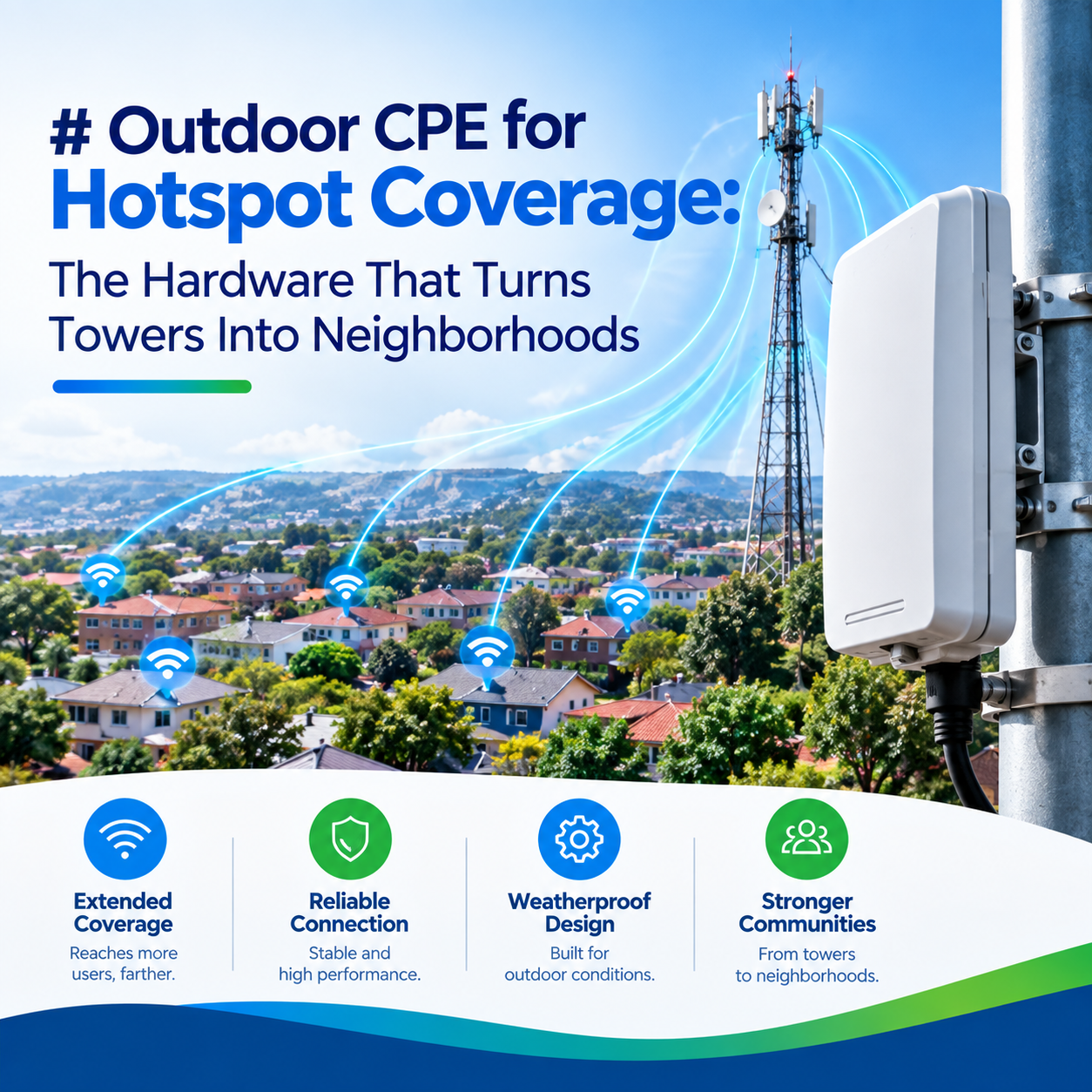
Outdoor CPE for hotspot coverage is the unglamorous hardware standing between a wireless internet operator and every customer they will ever serve.
Towers, masts, and rooftops carry the signal — but it is the customer premises equipment mounted on walls, poles, and rooftops that decides whether the network’s promise reaches a laptop, a phone, or nothing at all.
In the wireless ISP world, the difference between a thriving coverage area and a struggling one is rarely the tower. It is the quality, placement, and discipline of the outdoor CPE for hotspot coverage deployed at every customer’s end of the link.
This article examines what outdoor CPE actually is, why it matters more than most new operators believe, and how the operators with the strongest networks choose, install, and maintain the devices that hold their entire business together. Because in this trade, the network is only ever as good as its weakest mounted unit.
Table of Contents
ToggleWhat Outdoor CPE Actually Is
Strip away the acronyms and the concept is physical and simple. Outdoor CPE — customer premises equipment — is the weatherproof radio unit mounted outside a customer’s building, pointing back toward the operator’s tower or access point.
It receives the wireless signal, converts it into a standard network connection, and feeds it indoors where routers and devices consume it. Every unit of outdoor CPE for hotspot coverage is both a receiver and a transmitter: it hears the tower and answers it, forming a dedicated link that ordinary WiFi cannot achieve across distance.
The “outdoor” in the name describes its habitat — sealed against rain, dust, sun, and temperature swings that would kill indoor equipment within months. The design reflects the job: directional antennas, weatherproof housings, and cooling built for a life on walls.
In the broader outdoor CPE for hotspot coverage ecosystem, CPE serves two roles. It forms the fixed link for individual homes and businesses, and it acts as the point-to-point bridge that carries connectivity down a valley, across a road, or into a compound cluster.
Both roles share the same truth: the CPE is the customer’s first impression of the network, and it is permanent. A tower can be upgraded remotely, but a poorly chosen outdoor CPE for hotspot coverage unit must be physically revisited, one customer at a time.
Why CPE Quality Matters More Than Operators Expect
New operators habitually spend on towers and save on CPE — a trade that reverses itself painfully within the first year. The reasons are physical. The tower’s signal arrives at the customer’s wall already weakened by distance, obstructions, and weather.
Only a capable outdoor CPE for hotspot coverage unit can capture that weakened signal cleanly and deliver the speeds the customer paid for. A weak receiver turns a strong tower into a slow network, and the customer blames the operator, not the radio.
The second reason is longevity. CPE lives outdoors, in ultraviolet, rain, dust, and lightning season — the harshest environment in networking. Units chosen for price alone fail in patterns every veteran recognizes: faded housings, water ingress, and connectors corroded green.
Operators who track their outdoor CPE for hotspot coverage fleet closely notice these patterns early — one failure type repeating across the same batch, one connector design corroding across a whole estate. That early warning is worth more than any warranty.
The third reason is support economics. Every CPE problem is a truck-roll problem: a technician, a ladder, an afternoon, and a customer waiting. A fleet of five hundred units with a ten percent annual failure rate means fifty visits a year.
At real costs, those visits can erase the margin an entire route earns. That arithmetic is why professionals agonize over outdoor CPE for hotspot coverage selection the way other businesses agonize over vehicles — the fleet is the business’s hands, and hands that fail cost money every time they do.
The Main Types and When Each Fits
The outdoor CPE for hotspot coverage market splits into a few functional families, and matching the type to the job is the operator’s first skill. Fixed wireless CPE — the directional dish or panel units pointed at a tower — serves the classic model: one home, one dedicated link, one contract.
These units prioritize range and signal discipline over everything else. Mesh and repeater-style CPE extends coverage into dead corners: the compound behind the wall, the block shadowed by the building on the corner.
Ruggedized portable units serve mobile and temporary sites — events, construction compounds, and seasonal markets that move. And bridge units, pairs of radios configured as a wireless link, carry connectivity across distances no cable could economically cross.
Every category within outdoor CPE for hotspot coverage selection shares one shopping rule: buy for the link’s physics, not the brochure’s maximum. A unit rated for twenty kilometers is the wrong choice for a 900-meter link — the mismatched power causes interference and the mismatched price erodes margin.
The right outdoor CPE for hotspot coverage choice is the least powerful unit that comfortably closes the link with headroom. That rule saves money twice: at purchase, and in interference the network never has to fight.
The Link Budget: The Physics Behind Every Installation
Every outdoor CPE for hotspot coverage decision rests on a piece of engineering called the link budget — the honest accounting of whether a signal can actually make the journey. The tower’s transmit power starts the ledger, and distance subtracts from it with every kilometer.
Fresnel clearance — the oval zone around the direct path — subtracts when trees, roofs, and ridges intrude into it. Cable loss, connector quality, and antenna gain adjust the balance. The CPE’s receiver sensitivity decides whether the remaining signal is usable at all.
Operators who run this math before mounting equipment never experience the classic failure: the installation that works at 6 a.m. and collapses at 5 p.m. when the leaves move and the neighborhood wakes. The professional standard is headroom — installing outdoor CPE for hotspot coverage links with enough margin to absorb rain, foliage growth, and the interference that eventually arrives.
A link closed “just barely” is a link scheduled to fail. Modern tools have made this discipline accessible: signal-mapping applications, tower-side monitoring, and installer training on reading live signal reports at the moment of installation.
The best operators institutionalize it completely. No outdoor CPE for hotspot coverage install is signed off without a recorded signal quality reading — the receipt that protects both the customer relationship and the technician’s afternoon six months later.
Placement: The 80% of Performance Decided Before Power-On
Ask veteran installers what determines a CPE unit’s performance, and they give the same three answers: placement, placement, placement. The same outdoor CPE for hotspot coverage unit produces dramatically different results depending on where it hangs.
Height comes first. The unit that clears the neighborhood roofline hears the tower cleanly; the unit behind a neighbor’s wall hears reflections and interference. Elevation is the cheapest performance upgrade in wireless — and the most frequently skipped.
Alignment comes second. Directional units demand pointing precision measured in degrees, and the outdoor CPE for hotspot coverage installers who fine-tune alignment while watching live signal readings deliver networks that stay stable for years. Installers who “aim and hope” deliver networks that work until the first windy day nudges the mount sideways.
Mounting integrity completes the discipline: wall plugs, brackets, and pole clamps chosen for masonry, wood, or metal as the site demands. Units torqued correctly, sealed properly, and grounded where lightning is a neighbor.
The operators with the best uptime records treat outdoor CPE for hotspot coverage installation as a craft with standards — documented, trained, and checked. Every shortcut taken on a roof this year becomes a truck roll next year.
Frequency and Interference: The Invisible Environment
Every outdoor CPE for hotspot coverage deployment operates inside a shared, invisible environment — the radio spectrum — and that environment grows more crowded every year. The 2.4 GHz band is saturated nearly everywhere, with microwaves, Bluetooth, and every consumer router in the neighborhood competing for the same air.
The 5 GHz band offers capacity with shorter reach, while licensed and lightly licensed bands offer clean spectrum for operators who plan for it. Professional outdoor CPE for hotspot coverage deployments match band to job: 2.4 GHz for penetration through walls and foliage, 5 GHz for clean backhaul links, and higher bands where congestion would strangle service.
Interference planning is now a standard pre-installation step for serious operators. Spectrum scans at the mounting point reveal what else is shouting on the same frequencies before the unit is purchased, not after. The operators who scan first deploy into clear air and stay clean; the ones who install blind fight interference for years.
That single habit — scanning before mounting — separates professional outdoor CPE for hotspot coverage networks from struggling ones more reliably than any hardware choice on the invoice.
Power Over Ethernet and the Wiring Discipline
The physical connection between the CPE and the indoors is where many networks quietly develop their long-term weaknesses. Outdoor CPE is powered through its network cable — Power over Ethernet — and that same cable is the data path carrying every byte the customer will ever receive.
Professional outdoor CPE for hotspot coverage installations treat cabling as infrastructure, not consumable. Outdoor-rated cable, drip loops that keep water from wicking indoors, connectors sealed against moisture, and injectors protected inside the building.
The alternative shows up in every veteran’s memory: green-crusted connectors, water in the cable jacket, and the intermittent fault that takes three visits to find. Cable runs are kept short where possible, and the outdoor CPE for hotspot coverage installer who cannot keep a run short adds powered injectors rather than stretching cheap cable past its rated distance.
Surge protection sits at the building entry on every professional install — a small device that absorbs what lightning and grid spikes deliver, sacrificing itself instead of the customer’s equipment and the operator’s afternoon.
The operators whose fleets survive their third rainy season all share the same wiring discipline: sealed, grounded, protected, and documented. Those four words decide whether outdoor CPE for hotspot coverage hardware becomes a decade asset or an annual expense.
Fleet Management: Running CPE as a Business Asset
The moment an operator’s CPE fleet passes twenty units, it stops being a collection of installs and becomes a managed asset base. Professional operations maintain a registry: every unit’s model, serial, install date, location, customer, and signal readings at commissioning.
That registry turns failures into lookups instead of investigations. When a customer calls with slow service, the operator checks the unit’s history before the truck rolls — and often solves the problem over the phone.
Monitoring completes the discipline. Modern CPE reports its own health remotely, and the operators watching their outdoor CPE for hotspot coverage fleet dashboards catch degrading units before customers do. A signal slowly declining over weeks is a connector corroding or an alignment drifting — fixable on a scheduled visit rather than an emergency one.
Planned maintenance beats reactive repair on cost, and the difference compounds across a fleet. Spare strategy belongs to the same chapter: the professional inventory keeps spares of every deployed model, so a failed unit means a swap-in visit rather than a wait-for-delivery outage.
The operators who scaled to hundreds of customers all institutionalized this asset discipline early. A fleet managed as inventory stays predictable; a fleet managed as memories stays on the phone every evening. That predictability is one of the quietest competitive advantages outdoor CPE for hotspot coverage operators carry into every market they enter.
The Economics: What the Hardware Actually Costs a Business
The business math of outdoor CPE for hotspot coverage decisions has two columns, and new operators habitually read only the first. The purchase column is obvious: per-unit cost, times the number of customers.
The second column is lifetime cost — and it dominates. Installation labor, truck rolls over the unit’s life, failure replacements, and the churn caused by poor service all attach to the hardware decision. A cheap unit that fails in eighteen months costs more than a quality unit that serves four years, once the visits and the churn are counted.
Operators who modeled this honestly found the quality tier of outdoor CPE for hotspot coverage hardware cheaper by the year — not despite the higher price, but because of it. The financing patterns follow the same logic.
Many operators bundle the CPE into the connection fee, recovering it over the contract — a model that aligns everyone’s incentives on longevity. Others charge a deposit, returned when the unit comes back, keeping the fleet circulating and accountable.
Either way, the fleet is capital, and capital decisions belong to the business plan rather than the moment of purchase. The operators who treated their outdoor CPE for hotspot coverage fleets as capital recovered it; the ones who treated it as expense replaced it — and the difference shows up every month the network runs.
The Mistakes That Plague New Operators
The failure patterns repeat across every new wireless operator, and naming them is cheaper than making them. The first is the tower-heavy, CPE-light budget — spending on visibility and saving on the devices that actually deliver the product.
The second is skipping spectrum scans, installing into interference, and fighting it for years. The third is placement compromise: the unit mounted where the ladder reached instead of where the physics pointed.
The fourth is wiring shortcuts — indoor cable run outdoors, unsealed connectors, surge protection promised for “next visit.” The fifth is no registry: a fleet nobody can look up, rebuilt from memory after every failure.
The sixth is no spares, so every failure becomes an outage until delivery arrives. The seventh is ignoring firmware — years-old software carrying known bugs and vulnerabilities that updates would have patched.
Each of these errors is avoidable at the planning stage, and the operators who grew cleanly institutionalized their way past every one: documented standards, trained installers, and outdoor CPE for hotspot coverage fleets treated as the business’s hands rather than its afterthought.
The pattern across the market is consistent — the operators who survive their first three years are the ones who treated hardware discipline as a business skill rather than a technical chore.
The Payoff: What Good CPE Discipline Actually Buys
Ask wireless operators with five years of history what their outdoor CPE for hotspot coverage discipline earned them, and the answers converge on four things.
Uptime: networks that stay online through seasons, storms, and grid events, because the units, the mounts, and the wiring were built for it.
Retention: customers who experience few outages rarely shop for alternatives, and every month of retention is pure margin.
Efficiency: fewer truck rolls, fewer emergency visits, and support calls resolved by looking up the unit’s history instead of rolling a vehicle.
Growth: fleets that scale by repetition rather than firefighting — the difference between the operator whose second hundred customers feel routine and the one whose second hundred feel like chaos. None of these benefits arrive with the hardware.
They are manufactured through selection, placement, wiring, and fleet discipline — the unglamorous craft behind every outdoor CPE for hotspot coverage network that simply works, year after year.
The operators who internalize it stop seeing CPE as the cheapest line in the budget and start seeing it as what it is: the physical handshake between the network and every customer it will ever have.
Frequently Asked Questions
What is the difference between outdoor CPE and a normal router?
A router distributes internet inside a building; outdoor CPE is the weatherproof radio mounted outside that captures the tower’s signal and feeds it indoors.
The two work together, and the outdoor CPE for hotspot coverage unit is the half that determines whether the tower’s signal ever arrives at all.
How long should quality outdoor CPE last?
Properly selected, installed, and maintained units serve four to six years or more.
Operators tracking their outdoor CPE for hotspot coverage fleets see the difference between quality and cheap hardware arrive as scheduled maintenance versus surprise failures.
Do I need professional installation?
For tower-facing directional units, yes — alignment precision and ladder safety both argue for trained hands.
The operators with the most reliable outdoor CPE for hotspot coverage networks all invested in installer training early, and their uptime records show it.
Can one CPE unit serve a whole building?
Yes — a unit feeding an indoor router can serve an entire household, and stronger units can feed small compounds. The right choice depends on the building’s layout and the outdoor CPE for hotspot coverage design of the network behind it.
What does “link budget” mean for my installation?
It is the honest accounting of whether the signal can make the journey — tower power, distance, obstructions, and receiver sensitivity, balanced with headroom.
Professional outdoor CPE for hotspot coverage installs are signed off with headroom, because a link closed “just barely” is a link scheduled to fail.
How do I know if interference will be a problem?
Scan the spectrum at the mounting point before purchasing anything.
The operators who scan first deploy into clear air; the ones who install blind fight interference for the life of the outdoor CPE for hotspot coverage link.
Does rain really affect the signal?
At higher frequencies and over longer distances, yes — rain fade is a real engineering factor.
This is why professional outdoor CPE for hotspot coverage links are built with headroom rather than closed at the margin.
What maintenance does outdoor CPE need?
Periodic visual inspections, connector checks, alignment verification after storms, and firmware updates.
The operators whose outdoor CPE for hotspot coverage fleets age gracefully schedule this care; the ones who skip it rediscover their fleets one emergency at a time.
Should I buy all one model or mix?
Standardize — one or two models across the fleet means shared spares, familiar troubleshooting, and faster installs. Operators who standardized their outdoor CPE for hotspot coverage fleets report support time cut dramatically versus those who accumulated variety.
What happens if a unit fails?
A managed fleet turns failure into a swap: registry lookup, spare unit, one visit, restored service.
That recovery speed is the practical payoff of disciplined outdoor CPE for hotspot coverage fleet management.
What is the smartest first step for a new operator?
Write your fleet standards before your first install — model, mounting, wiring, protection, and documentation — then hold every installation to them.
The operators who did this grew cleanly, and the ones who didn’t rebuilt their standards one truck roll at a time, discovering eventually what every veteran of outdoor CPE for hotspot coverage knows: the network is only as good as its weakest mounted unit, and the business is only as profitable as its fleet discipline allows.
The smartest operators treat every outdoor CPE for hotspot coverage install as a deposit into the network’s long-term reputation, made one rooftop at a time — and the operators who adopt that view early are the ones whose outdoor CPE for hotspot coverage fleets are still quietly earning years after their competitors’ hardware has been replaced twice over.