
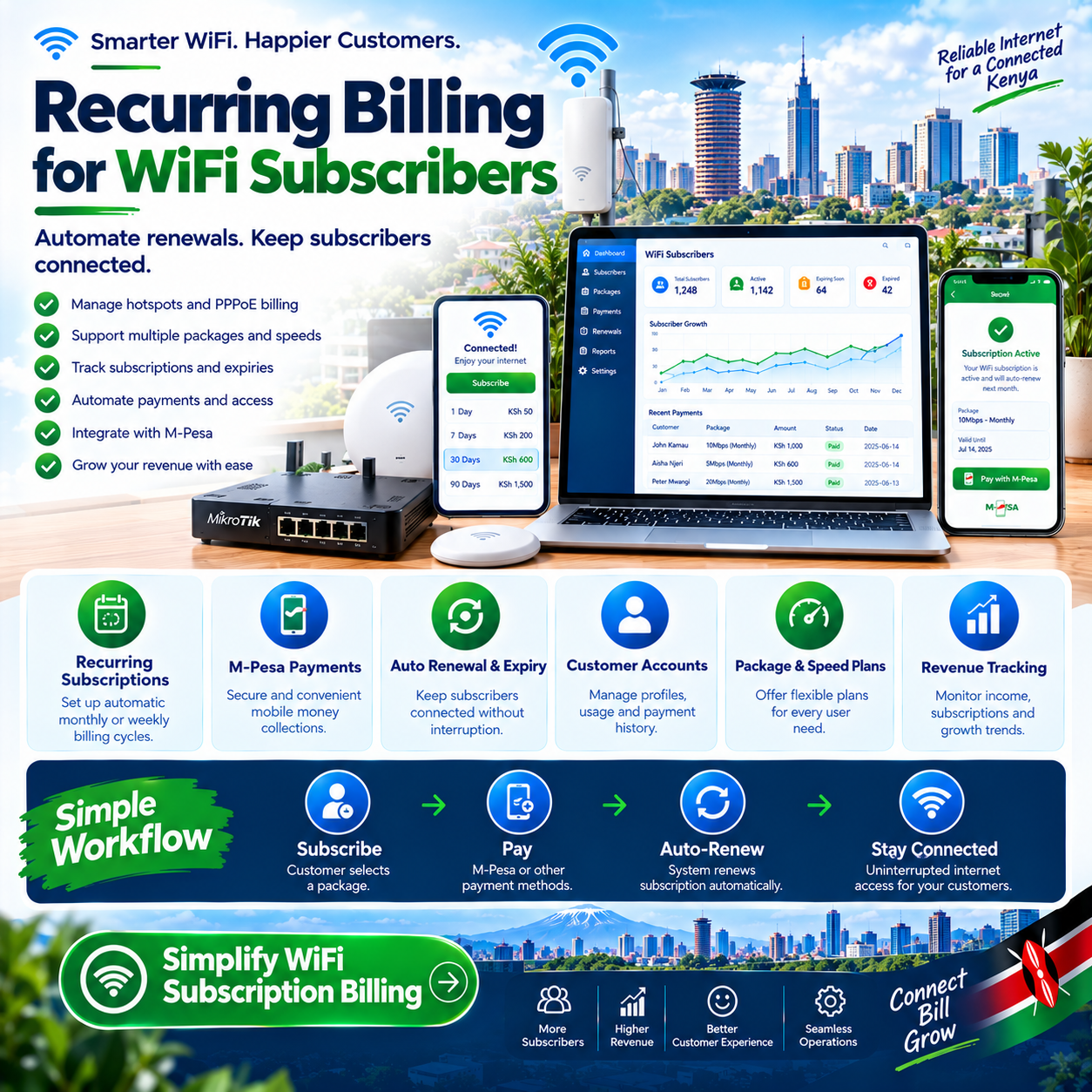
Recurring billing for WiFi subscribers is the difference between an internet business that starts over every morning and one that builds on itself every month.
Under one model, the operator wakes each day to sell yesterday’s customers all over again — vouchers, reminders, door knocks, and the quiet hope that everyone renews.
Under the other, subscriptions renew themselves: the same customers, the same packages, the same income arriving like a tide that no longer depends on anyone’s memory.
That second model is what recurring billing for WiFi subscribers delivers, and it has quietly become the dividing line between operators who struggle month to month and operators who plan years ahead.
This article explores the complete picture: what recurring billing actually involves, why predictability transforms a WiFi business, how the mechanics work on the ground, and what it feels like for the subscribers paying through it.
Because the operators who moved to recurring billing for WiFi subscribers all discovered the same truth — steady revenue is not luck, it is architecture.
What Recurring Billing for WiFi Subscribers Actually Is
Strip away the jargon and the concept is refreshingly familiar.
Recurring billing is the subscription model: a customer signs up once for a package — monthly, weekly, or annual — and their payment renews automatically at each cycle’s end.
Instead of buying access transaction by transaction, the subscriber holds a standing arrangement, and recurring billing for WiFi subscribers keeps that arrangement alive without anyone knocking on doors.
The operator’s role shifts from seller to manager: packages are defined once, subscribers are enrolled once, and the system handles every renewal from there.
Payment collection, access activation, expiry handling, and receipting all run on schedule — which is the entire promise of recurring billing for WiFi subscribers.
The model is not new to the world; gyms, streaming services, and insurance have run on it for decades.
What is new is how perfectly it now fits the WiFi business — because mobile money made automatic renewal possible for exactly the customers who buy connectivity.
A recurring billing for WiFi subscribers system simply extends the subscription logic to the one expense customers already treat as essential.
Why Predictability Transforms Everything
The first gift of recurring billing for WiFi subscribers is the one finance people treasure most: predictable revenue.
When three hundred subscribers renew monthly, the operator knows — within a narrow band — what next month’s income will be.
That knowledge changes decisions downstream: bandwidth purchases get planned instead of panicked, upgrades get scheduled instead of postponed, and expansion gets funded from forecasts rather than surprises.
Businesses running on recurring billing for WiFi subscribers describe the shift as moving from weather to climate — the day-to-day still varies, but the season is always known.
The second gift is the end of the collection treadmill.
Under transactional selling, every month begins at zero: last month’s customers owe nothing until convinced to buy again.
Under subscriptions, the customer base carries forward — and the energy once spent re-selling shifts to serving and growing, which is the compounding logic behind every operator who adopted recurring billing for WiFi subscribers early.
The third gift is business value itself.
A WiFi operation with a known subscriber base and predictable monthly revenue is a sellable, financeable, expandable asset — something a voucher book could never be.
The Subscriber’s Side: Why Customers Prefer It Too
Recurring billing is not an operator convenience imposed on customers — done well, it is what customers actually want.
The subscriber’s deepest frustration with pay-as-you-go is the lapse: internet dies mid-month, mid-task, mid-evening, because nobody remembered to top up.
With recurring billing for WiFi subscribers, the lapse disappears — the renewal happens before expiry, and the connection simply continues.
That continuity matters most to the households that depend on connectivity: the student with deadlines, the remote worker with meetings, the family that streams every evening.
The second subscriber benefit is budgeting.
A known monthly amount fits household finances the way rent does — better than the drip-drip uncertainty of daily vouchers.
And the third benefit is the end of payment chores: no queues, no reminders to self, no last-minute M-Pesa scrambles at 11 p.m.
Subscribers on recurring billing for WiFi subscribers arrangements describe the experience in one phrase, over and over: “I don’t even think about it anymore.”
That sentence — connectivity becoming invisible infrastructure — is the strongest loyalty signal a WiFi business can earn.
The Models: How Renewals Actually Happen
A capable recurring billing for WiFi subscribers system supports several renewal mechanics, and the strongest operators match the model to their customers.
The first model is the standing wallet: the subscriber loads a balance — five hundred, a thousand — and the system draws the monthly package from it automatically, notifying them with every deduction.
The second is the renewal prompt: on the package’s expiry date, the system sends an M-Pesa STK push, the subscriber taps their PIN, and the next cycle begins.
The third is the scheduled debit arrangement, where supported: the subscriber authorizes the renewal once, and subsequent cycles collect on their own.
Each model trades a little automation against a little control, and recurring billing for WiFi subscribers deployments often run all three side by side.
The wallet suits the budget-conscious who want hard spending limits.
The renewal prompt suits everyone else — it keeps the subscriber in command while removing every chore except one tap.
And hybrid enrollments — pay-as-you-go customers invited into subscriptions after a pattern of repeat purchases — are how the smartest operators grow their recurring base without a single cold pitch.
The M-Pesa Mechanics: Where Renewals Live or Die
Every working recurring billing for WiFi subscribers system stands on the quality of its mobile money flow, because the renewal moment is where revenue either completes or quietly leaks.
The mechanics that matter come in sequence.
Timely reminders: the subscriber hears from the system before expiry — three days out, one day out, morning of — so the renewal is never a surprise.
One-tap renewal: the STK push arrives pre-filled with the exact amount, and the entire transaction takes seconds.
Instant activation: the moment payment confirms, the new cycle opens — no gap, no manual step, no waiting.
Failure handling: when a renewal bounces — insufficient float, a busy line, a changed number — the system retries intelligently and tells the subscriber exactly what happened.
Platforms engineered for recurring billing for WiFi subscribers treat these four as core features rather than extras, because each one measurably moves the renewal rate.
The difference shows up in the numbers: operators who moved from memory-based renewals to automated recurring billing for WiFi subscribers flows routinely report renewal rates climbing from the sixty-percent range into the nineties.
That gap — thirty points of revenue that used to evaporate monthly — is the entire business case, hiding inside a payment flow.
Grace Periods and the War on Churn
Churn — subscribers who lapse and never return — is the silent tax on every connectivity business, and recurring billing for WiFi subscribers systems fight it with structure rather than persuasion.
The first weapon is the grace period: when a renewal fails, access continues for a defined window — twenty-four hours, forty-eight — while reminders work.
The subscriber who meant to pay experiences a gentle nudge instead of a cliff; the subscriber who forgot gets rescued before the frustration sets in.
Networks that deployed grace periods through recurring billing for WiFi subscribers platforms report recovering a striking share of would-be churners — people who left under hard cutoffs simply because paying was interrupted, not abandoned.
The second weapon is the pause option: subscribers traveling or away can suspend a cycle instead of cancelling outright, keeping the relationship alive.
The third is the win-back flow: lapsed subscribers receive a returning offer — a discounted first month back — automated by the same platform that manages recurring billing for WiFi subscribers everywhere else.
The fourth is listening to exit reasons: the system’s lapse data shows whether churn clusters on price, on payment failures, or on service quality — three very different problems with three very different fixes.
Operators who read their churn reports monthly stop treating cancellations as mysteries and start treating them as a solvable leak.
Designing Subscription Packages That Stick
The package ladder under recurring billing for WiFi subscribers follows different logic than the voucher menu — because subscriptions are relationships, not transactions.
The monthly package is the anchor: priced as the obvious value against thirty days of daily vouchers, it converts the steady majority.
The weekly option catches the cautious and the seasonal — a stepping stone that upgrades to monthly once trust is earned.
The annual plan, discounted meaningfully, converts the most loyal into a year of guaranteed revenue and funds the operator’s infrastructure ahead of time.
Speed tiers layer across all of it: standard subscriptions for households, premium tiers for the heavy users who genuinely feel the difference.
The pricing reference remains the customer’s alternative — the daily bundle arithmetic — and a recurring billing for WiFi subscribers monthly plan positioned visibly below that math sells itself at the renewal prompt.
Loyalty pricing adds the retention layer: the rate that improves after twelve months, quietly rewarding the subscribers who never left.
Operators who tuned their subscription ladders against renewal data — rather than launch-day guesses — consistently find their monthly tier becoming the business’s heartbeat.
Combining Recurring With Pay-As-You-Go
The strongest networks do not choose between subscriptions and vouchers — they run both, and recurring billing for WiFi subscribers platforms handle the blend natively.
The structure is a customer lifecycle.
New users arrive through pay-as-you-go: small purchases, low commitment, zero friction.
The system watches the patterns — and the regulars, the repeat buyers, the every-evening households become natural subscription candidates.
An invitation lands: “You spend more than our monthly plan costs — want the plan?”
A meaningful share always says yes, and the operator’s recurring base grows from evidence rather than persuasion.
Inside the same recurring billing for WiFi subscribers dashboard, both revenue types report separately — transactional income showing the funnel’s top, recurring income showing its settled bottom.
The ratio between them becomes the operator’s health metric: as recurring share grows, the business grows stabler underneath them.
That migration path — voucher to subscription, transaction to relationship — is the quiet growth engine behind the market’s most durable WiFi operations.
The Mistakes That Weaken Recurring Systems
The predictable failures repeat across deployments, and naming them is cheaper than making them.
The first is the silent renewal: charging subscribers without notice, which turns a convenience into a grievance the first time someone checks their statement.
Every trusted recurring billing for WiFi subscribers deployment communicates before it collects — reminders, confirmations, receipts, always.
The second is the rigid menu: one package, one price, no exits — which forces the budget-tight month into full cancellation instead of a lighter tier.
The third is hard cutoffs without grace: the subscriber whose renewal bounced at midnight wakes disconnected, annoyed, and halfway to the competitor down the road.
The fourth is ignoring failed-payment data: the same subscriber bouncing three cycles in a row is asking for help — a different plan, a different date, a conversation.
The fifth is neglecting the calendar: renewals bunched on the first of the month strain the payment flow, while spread dates keep recurring billing for WiFi subscribers operations smooth.
The sixth is treating churn as fate rather than data, closing the loop the platform already opened.
Each fix costs an afternoon; ignoring them costs subscribers every month — which is why the operators who audit their recurring billing for WiFi subscribers settings quarterly keep the renewal engine clean.
Who Gains Most From the Recurring Model
The subscription model rewards every shape of connectivity business, but some gain with special force.
Estate operators gain the most obvious win: tenant packages that renew themselves end the landlord’s collection rounds permanently, and recurring billing for WiFi subscribers automation turns the building’s internet into a set-and-forget income line.
Rural and peri-urban ISPs gain stability in markets where individual sales are small: a few hundred recurring subscribers become a foundation that funds growth without monthly relaunches.
Café and venue operators gain predictability on top of walk-in traffic — the regulars who bought daily vouchers become monthly members, and the venue’s baseline revenue solidifies.
Schools and institutions gain budget alignment: termly or annual subscriptions that match how education actually pays.
And portfolio operators gain the compounding version — every location’s subscriber base reporting into one recurring billing for WiFi subscribers dashboard, the whole business visible as a single recurring number.
Across every case, the pattern is identical: recurring revenue converts customers from a monthly gamble into an asset.
Scaling on a Recurring Foundation
Growth feels different when the base beneath it renews itself.
The operator adding a second location inherits more than equipment — they inherit a playbook: packages that worked, renewal flows that held, churn lessons already learned.
Every new site launches with recurring billing for WiFi subscribers templates that replicate across the portfolio, so the second location’s subscribers enroll into the same automation the first one proved.
The financial effects compound with scale.
Recurring revenue supports planning: backbone upgrades, new masts, and staff hires all get timed against income the operator can already see.
And the valuation effect deepens: a portfolio of subscriber bases is a business, while a portfolio of voucher counters is a set of jobs.
The operators who scaled on recurring foundations describe the same transition — the business stopped needing their hustle every month and started needing their decisions every quarter.
That shift is what recurring billing for WiFi subscribers was always pointing toward: an operation that grows steadily because it keeps what it earns.
The Payoff, Counted Honestly
Ask operators two years after moving to subscriptions what changed, and the answers gather into four themes.
Revenue that forecasts: monthly income known in advance, budgeted against, and grown on purpose rather than hoped for.
Hours returned: the collection rounds, renewal chases, and expiry arguments replaced by a dashboard that shows the month already earned.
Subscribers who stay: grace periods, reminders, and loyalty pricing quietly holding the customer base steady, month after month.
And a business with a shape: assets, metrics, and value — the difference between running a hustle and owning an enterprise.
None of it required new customers, new hardware, or new prices — only a new relationship with the customers already there.
That is the case for recurring billing for WiFi subscribers in one sentence: the customers were coming back anyway, and the subscription simply made their return automatic.
Frequently Asked Questions
Do subscribers actually agree to automatic renewals?
Overwhelmingly yes, when the flow is transparent — reminders before every charge, one-tap confirmation, and instant receipts build the trust that makes renewal welcome rather than suspect.
Operators running honest recurring billing for WiFi subscribers flows report enrollment rates climbing every quarter as word of the convenience spreads.
What happens when a renewal payment fails?
A well-built system retries intelligently, notifies the subscriber clearly, and holds a grace period while the issue resolves.
This failure handling is where recurring billing for WiFi subscribers platforms earn their keep — recovering payments that hard cutoffs would have converted into churn.
Can I offer both subscriptions and daily vouchers?
Yes — and the strongest networks run both, with vouchers serving new and casual users while subscriptions capture the regulars.
The migration from one to the other happens naturally on platforms supporting recurring billing for WiFi subscribers alongside pay-as-you-go.
How do I convince existing customers to switch?
Invite the pattern, not the person: the system identifies repeat buyers, and an offer priced visibly below their current spend converts them with one message.
Operators who grew their recurring base this way found recurring billing for WiFi subscribers enrollment almost selling itself.
What if a subscriber wants to pause instead of cancel?
Good platforms support suspensions — a paused cycle keeps the relationship alive and the return automatic.
That flexibility is one of the retention quiet-winners inside recurring billing for WiFi subscribers deployments.
Are monthly subscriptions always better than daily sales?
Not always better — different customers need different products, which is why the ladder matters: weekly for the cautious, monthly for the steady, annual for the committed.
A well-designed recurring billing for WiFi subscribers menu serves every rhythm instead of forcing one.
How much can renewal rates realistically improve?
Moving from manual renewals to automated flows with reminders and grace periods routinely lifts renewal rates from the sixty-percent range into the nineties.
That recovery — measured on every recurring billing for WiFi subscribers dashboard — is the model’s clearest proof.
Can I run recurring billing across multiple locations?
Yes — centralized platforms manage subscriber bases per site while reporting the whole portfolio’s recurring revenue in one view.
Portfolio operators standardize on recurring billing for WiFi subscribers architecture precisely because growth becomes replication.
What should I communicate to subscribers at enrollment?
Everything that builds trust: the price, the renewal date, the reminder schedule, the pause option, and the cancellation path.
Transparency at signup is what makes recurring billing for WiFi subscribers feel like a service rather than a trap.
What is the smartest first step?
Identify your twenty most consistent repeat customers, design a monthly package priced just below their current spend, and invite them personally into the first subscription cohort.
That small, tested beginning — expanded on evidence — is exactly how every thriving recurring billing for WiFi subscribers operation started, and the operators who kept refining their renewal flows discovered the same truth every time: the steadiest income in this business was never won from strangers, it was kept from the customers who were already staying — which is the whole promise of recurring billing for WiFi subscribers, delivered one automatic renewal at a time.