
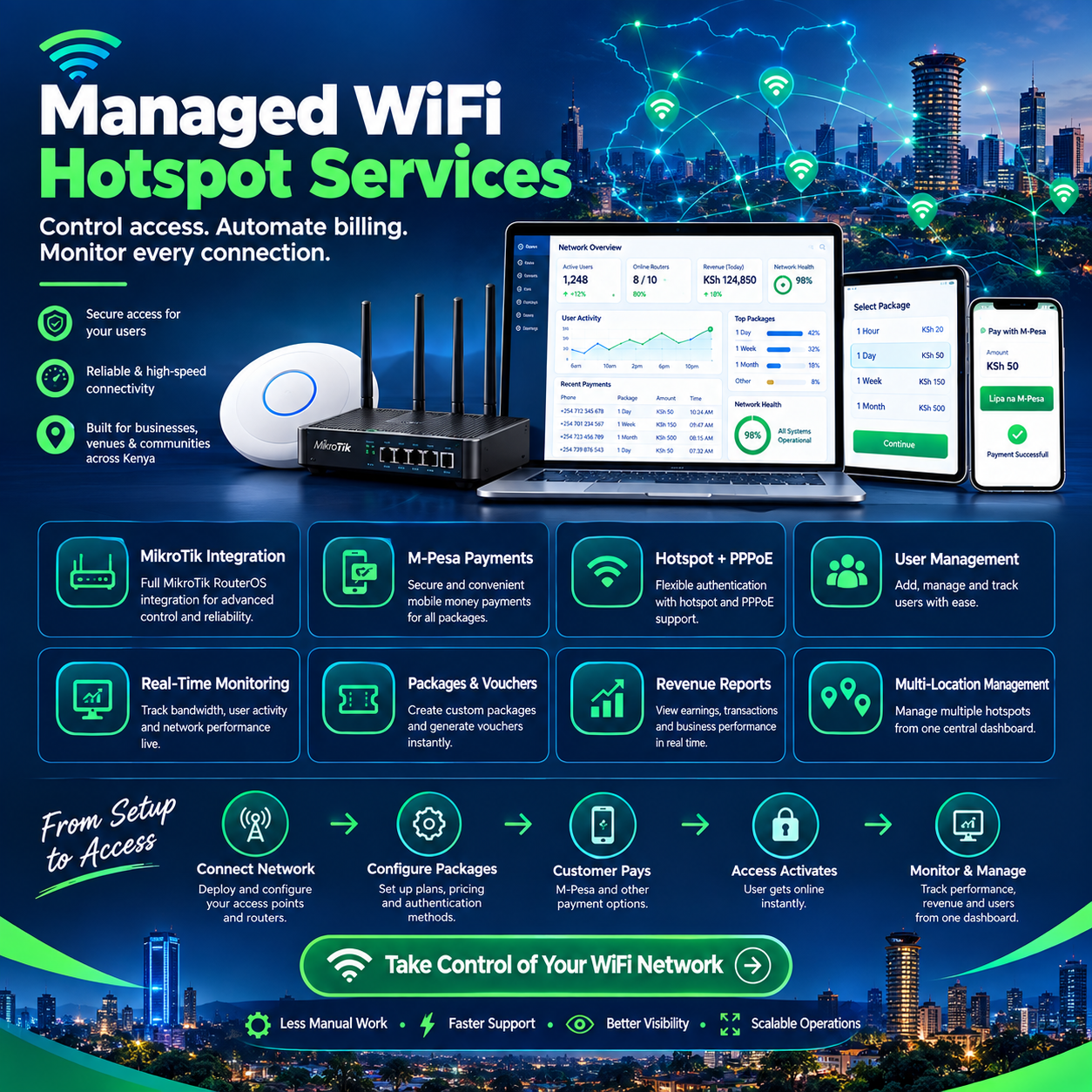
Managed WiFi hotspot services are quietly solving one of the most common dilemmas in business today — the venue that knows it should monetize its internet but has nobody to run the operation.
Every café owner, hotel manager, and estate caretaker has faced the same fork in the road.
Running a paid WiFi operation promises steady income, but it demands equipment decisions, payment systems, customer support, and midnight troubleshooting — skills nobody behind a coffee counter signed up for.
Managed WiFi hotspot services split the difference brilliantly: the venue provides the space and the audience, while a specialist provider handles everything technical, commercial, and operational.
The result is a partnership where each side does what it does best — and both profit from the same connection.
This article walks through the complete picture: what managed services actually include, who needs them, how the money flows, and why this model has become the fastest-growing corner of the connectivity economy.
Because the story of managed WiFi hotspot services is really the story of two businesses helping each other grow — oneWiFi connection at a time.
What Managed WiFi Hotspot Services Actually Are
Strip away the industry language and the concept is refreshingly simple.
Managed WiFi hotspot services means a specialist provider installs, operates, and maintains a complete paid WiFi operation on behalf of a venue — end to end, hands-off, guaranteed.
The venue owner signs one agreement. The provider handles everything else: the equipment, the portal, the payments, the enforcement, the support, and the reporting.
Think of it as the difference between buying a car and hiring a chauffeur.
A venue that buys equipment and software owns a machine it must learn to drive; a venue that signs up for managed WiFi hotspot services simply arrives each day to find the system running, the money collected, and the problems solved.
The word “managed” is doing the heavy lifting in that definition.
It means the provider carries the operational burden — the 11 p.m. payment that didn’t activate, the router that rebooted during a storm, the customer who can’t connect.
The venue carries none of it.
That division of labor is the entire value proposition of managed WiFi hotspot services, and it explains why the model has spread from hotels to cafés to entire estates.
The provider brings expertise the venue could never justify hiring; the venue brings the location and audience the provider could never access alone.
Together, they run a business neither could run by themselves.
Who Needs Managed WiFi Hotspot Services
The list of venues that benefit from managed WiFi hotspot services reads like a tour of everyday commercial life — because almost every venue with foot traffic has the same problem.
Cafés and restaurants sit at the top: owners who know laptop workers and evening crowds represent revenue, but whose staff already juggle enough behind the counter.
For them, managed WiFi hotspot services deliver the income without adding a single task to anyone’s shift.
Hotels and guesthouses follow close behind — venues where guest WiFi is a service promise, and a failure reflects on the entire brand.
A managed provider guarantees that promise stays kept, around the clock, without the manager becoming a network technician.
Estates and landlords form the third group: property owners tired of collecting internet payments door to door, who hand the entire operation to managed WiFi hotspot services and watch tenants pay through the portal instead.
Schools and academies join the list — institutions that need metered, controlled student access but have no IT department to run it.
Event venues, salons, clinics, and waiting rooms complete the map: any business where people gather, phones come out, and idle minutes could become income.
The common thread across every one of these venues is identical: the audience is already there, the demand is already real, and the only missing ingredient is someone to run the operation.
That missing ingredient is precisely what managed WiFi hotspot services supply.
How the Managed Model Actually Works
The mechanics of managed WiFi hotspot services unfold as a clean partnership, and understanding the flow explains why the model works so well.
It begins with an assessment: the provider surveys the venue, tests the connection, measures coverage, and designs a package structure that fits the venue’s actual traffic.
Then comes the installation: routers, access points, and the billing platform go live — usually within a day or two, with the portal branded for the venue.
From that moment, the managed WiFi hotspot services arrangement shifts into operation mode, and everything runs on autopilot.
Customers connect, land on the branded portal, choose a package, and pay through M-Pesa — with sessions activating automatically and enforcing themselves.
The provider monitors the network remotely, catches problems before customers notice them, and handles every support query that arrives.
The venue owner watches the whole operation through reports: revenue collected, customers served, packages sold — all visible without touching a single setting.
Money flows on an agreed schedule: the managed WiFi hotspot services provider takes their share or fee, and the venue receives theirs.
The beauty of the arrangement is its clarity — one agreement, one monthly settlement, and zero operational involvement for the venue.
That simplicity is why venues that try the managed model rarely return to running WiFi themselves.
What the Managed Provider Actually Handles
The scope of managed WiFi hotspot services is broader than most venue owners expect — and that breadth is exactly what makes the model valuable.
The first responsibility is infrastructure: the provider selects, installs, and maintains all the equipment — routers, access points, mounts, and power protection.
When hardware fails or needs upgrading, replacing it is the provider’s job, not the venue’s expense.
The second responsibility is the commercial layer: packages designed for the venue’s traffic, prices tuned to the local market, and promotions adjusted seasonally.
The managed WiFi hotspot services provider treats pricing as a living variable — testing, reading the data, and tuning monthly while the venue never thinks about it.
The third responsibility is the payment flow: M-Pesa integration, instant activation, automatic reconciliation, and receipts for every transaction.
The fourth is enforcement: device binding, session limits, and clean cutoffs that keep every purchase serving exactly one customer.
The fifth is support — the quiet hero of managed WiFi hotspot services: every “I can’t connect” message, every stuck payment, every confused first-timer gets handled by the provider’s team, not the venue’s staff.
And the sixth is reporting: clean, honest numbers delivered to the venue on a schedule, showing exactly what the partnership earned.
Six responsibilities, one signature — that is the complete scope of what a venue hands over when it signs up for managed WiFi hotspot services.
The Revenue Models: How Managed Services Get Paid
Every managed WiFi hotspot services partnership runs on one of three payment structures, and understanding them helps venues choose the right fit.
The first model is revenue share: the provider and venue split the income from every session sold — typically in proportions agreed upfront.
This model aligns both sides perfectly: the provider earns more when the venue earns more, so both parties are motivated to grow the same numbers.
The second model is the flat management fee: the venue pays a fixed monthly amount, and keeps all the revenue the operation generates.
This suits high-traffic venues that expect strong collections and prefer keeping the upside.
The third model is the hybrid: a smaller fixed fee plus a modest revenue share — the structure that balances managed WiFi hotspot services risk between both parties on uncertain traffic.
Choosing between them comes down to one question: who should carry the variance?
Venues with proven, steady foot traffic often favor flat fees and full upside.
Venues testing the waters prefer revenue share, where the managed WiFi hotspot services provider carries the risk of a slow start.
The most important advice veterans give: whatever the model, put the settlement schedule, the reporting format, and the support commitments in writing before the first session is ever sold.
Clear agreements are what turn managed partnerships into decade-long relationships.
The Technology Behind Managed WiFi Hotspot Services
The machinery that powers managed WiFi hotspot services has matured dramatically — and understanding it shows why one provider can now operate dozens of venues simultaneously.
At the center sits the cloud platform: the billing engine that manages every venue, every package, and every payment from a single dashboard.
Each location’s portal, packages, and enforcement rules run as configuration on that platform — meaning a new venue goes live in hours, not weeks.
Remote monitoring is the second pillar: the provider’s team watches every network’s health in real time, catching degrading equipment and congestion before customers ever notice.
This is what allows managed WiFi hotspot services to promise uptime that self-run operations rarely achieve — problems get fixed proactively, not after complaints.
The payment layer is the third pillar: deep M-Pesa integration that collects, activates, reconciles, and receipts automatically across every location.
And the reporting layer closes the loop: revenue per venue, per package, per hour — the evidence that drives both the provider’s tuning and the venue’s settlement.
The operator experience ties it all together: a managed WiFi hotspot services provider running twenty venues checks them all from one phone, the way a fleet manager checks vehicles.
That leverage — many venues, one dashboard — is the entire reason the managed model scales, and why providers can serve locations a venue could never staff individually.
The Venue Owner’s Experience: What It Actually Feels Like
Ask venue owners six months into a managed WiFi hotspot services partnership what changed, and their answers describe a transformation in daily life.
The first thing they notice is silence — the WiFi questions that used to interrupt their staff simply stop.
Customers connect themselves, pay themselves, and resolve their own questions through the portal, while support queries route to the provider’s team instead of the counter.
The second thing they notice is the money: a new income line arriving on schedule, month after month, from a resource that previously sat as pure cost.
Owners running managed WiFi hotspot services partnerships describe the settlement reports as their favorite reading — income they never worked to collect.
The third change is reputational: the venue’s WiFi becomes known as fast and reliable, and that reputation draws exactly the customers venues want most.
Remote workers, students, and professionals start choosing the venue because of the network — and they buy food and drinks while they’re there.
The fourth change is the deepest: the venue owner stops thinking about WiFi entirely.
No equipment decisions, no pricing questions, no outage anxiety — the managed WiFi hotspot services provider carries all of it, invisibly.
That mental freedom, owners consistently say, is worth as much as the revenue itself — because their attention returns to the business they actually built.
Managed Versus DIY: The Honest Comparison
Every venue weighing managed WiFi hotspot services eventually runs the comparison against doing it themselves — and the honest arithmetic favors managed services more often than pride admits.
The DIY path demands four investments the venue rarely budgets for: time to learn the systems, staff hours to handle support, capital for equipment mistakes, and attention for monthly tuning.
Each of those costs is invisible until it arrives — the weekend spent configuring a router, the barista fielding connection complaints, the equipment bought twice after the first wrong choice.
The managed path replaces all four with a single monthly settlement and a phone number to call.
The professional managed WiFi hotspot services provider has already made every mistake once, on someone else’s network — which is precisely what the venue is paying to avoid.
The comparison gets sharper at the failure moments.
When a payment fails at 9 p.m., a DIY venue has nobody to call; a managed venue has a support team whose job is that exact moment.
When equipment dies in a storm, the DIY venue buys replacements retail; the managed WiFi hotspot services provider swaps from spares and bills nothing extra.
And when pricing needs tuning, the DIY venue guesses while the managed provider reads evidence from a dozen similar venues.
That pattern across a portfolio is the managed model’s unfair advantage — every lesson learned anywhere improves every venue served.
The Mistakes That Undermine Managed Partnerships
The recurring failures in managed WiFi hotspot services relationships are well known, and naming them protects both sides of the partnership.
The first is the vague agreement: no written settlement schedule, no defined support response times, no clarity on who pays for what — a partnership destined for its first disagreement.
Professional managed WiFi hotspot services engagements start with paper: terms, timelines, and responsibilities documented before installation day.
The second mistake is the silent handover: the provider installs everything but never briefs the venue’s staff on what to tell customers — leaving the counter confused during the first week.
A one-page briefing sheet fixes what silence would have wasted.
The third is under-communicating results: providers who deliver revenue but no reports leave venues wondering what the partnership earned.
The strongest managed WiFi hotspot services providers send clean monthly statements as a habit — because transparency is what renews contracts.
The fourth is the venue that interferes: changing portal messages, demanding package changes against the data, or treating the provider as staff rather than partner.
The fifth is neglecting the customer experience: either side forgetting that the paying customer is the only source of everyone’s income.
Every one of these mistakes is avoidable with the same habit — treat the partnership as a real business relationship, documented and reviewed, and the managed WiFi hotspot services arrangement compounds in value for years.
Security and Trust: The Foundation of the Model
Money and customer data flow through every managed WiFi hotspot services operation, which makes security the bedrock the entire partnership stands on.
The payment rule comes first and never bends: customers enter their M-Pesa PIN only on their own phones, inside the payment provider’s own secure environment.
Any managed arrangement that touches payment credentials directly should be ended on sight.
Network segmentation comes second: guest traffic isolated on its own layer, venue business systems on another, with the two never touching.
This single structure protects the café’s till, the hotel’s booking system, and the estate’s cameras from every device that connects to the portal.
Data discipline completes the stack: platforms behind professional managed WiFi hotspot services collect only what transactions require, state consent plainly, and secure records with the same infrastructure guarding the payments.
Trust, in this model, is a shared asset — the venue’s reputation rides on the provider’s systems, and the provider’s business rides on the venue’s name.
The partners who treat security as a joint responsibility are the ones whose customers never have a reason to doubt.
And in a market where one bad experience travels through a whole neighborhood’s WhatsApp groups, that trust is worth more than any marketing the partnership could buy.
Scaling: From One Venue to a Managed Portfolio
The true power of managed WiFi hotspot services reveals itself at scale — when the provider running one venue discovers they can run ten.
The second venue inherits everything the first one proved: the package structure, the portal design, the payment flow, the support playbook.
Deployment becomes repetition rather than reinvention — the managed WiFi hotspot services template replicates across locations, and each new venue goes live within days.
The portfolio view ties the growth together: every location reporting into one dashboard, revenue visible per venue and in total, problem networks flagged automatically.
Providers at this stage describe the business in fleet terms — venues as vehicles, each earning independently, all maintained from one workshop.
The economics compound with every addition: shared platform costs, shared support team, shared spare inventory — the managed WiFi hotspot services model grows more profitable per venue as the portfolio expands.
Venues benefit from the same scale in reverse: a provider with many locations brings proven pricing, tested packages, and a support operation no single venue could justify alone.
That mutual leverage is what makes the managed model the fastest-growing structure in the connectivity economy — each new partnership strengthens every partnership that came before it.
The Payoff: What Both Sides Actually Gain
Ask the parties in mature managed WiFi hotspot services relationships what the model delivered, and the answers mirror each other perfectly.
Venue owners report income that arrived without labor — a new revenue line from a resource they already owned, collected around the clock by someone else’s system.
They report their staff returned to their actual jobs, their attention returned to their actual business, and their WiFi became a selling point instead of a source of complaints.
Providers report a business built on leverage — many venues, one platform, one team — with revenue that grows by partnership rather than by construction.
They report the compounding effect of portfolio learning: every venue’s pricing insight, support lesson, and hardware experience improving all the others.
And both sides report the same foundation underneath it all: a relationship where each party does what it does best, and neither carries what it cannot.
That symmetry is the entire argument for managed WiFi hotspot services in one sentence — the venue had the customers, the provider had the machinery, and the partnership turned both into a business neither could have run alone.
Frequently Asked Questions
What exactly does a managed WiFi provider handle?
Everything operational: equipment, installation, the portal, payments, enforcement, support, maintenance, and reporting — the venue signs one agreement and the managed WiFi hotspot services provider carries the rest.
Do I need my own internet connection for managed services?
Either way works — the provider can build on the venue’s existing connection or supply one as part of the managed WiFi hotspot services package, depending on what the assessment recommends.
How does the money split work?
Through the model chosen at signing: revenue share, flat fee, or hybrid — with settlements on a documented schedule and reports backing every figure.
The clearest managed WiFi hotspot services relationships put all three elements in writing before launch day.
Who handles customer complaints about WiFi?
The provider does — support queries route to the managed team, not the venue’s staff, which is one of the model’s biggest daily benefits.
That support commitment is a core clause in every professional managed WiFi hotspot services agreement.
What happens if the equipment fails?
The provider replaces it — hardware maintenance and replacement sit inside the managed scope, usually from on-hand spares rather than waiting on orders.
That guarantee is precisely what venues pay for when they choose managed WiFi hotspot services over running things themselves.
Can the portal carry my venue’s branding?
Yes — logos, colors, and messages all carry the venue’s identity, turning every login into a brand moment.
Branding is standard across managed WiFi hotspot services deployments and often the feature venues mention first.
How long does setup take?
Most venues go live within a day or two: the assessment, the installation, the package configuration, and a staff briefing.
The providers behind established managed WiFi hotspot services operations treat launch day as routine.
Can a managed provider run several of my locations?
Yes — and that is where the model shines: one agreement, one dashboard, and consistent packages across every branch.
Multi-location venues standardize on managed WiFi hotspot services precisely because growth becomes replication.
What happens if my revenue is lower than expected?
With revenue-share models, the provider shares the downside automatically; with flat fees, the agreement’s review clause opens renegotiation.
Honest managed WiFi hotspot services providers tune pricing and packages against the data before the relationship ever feels strained.
Is my venue’s business network safe from guest users?
Yes — professional deployments segment guest traffic onto its own isolated layer, keeping business systems unreachable.
That separation is a security standard in every managed WiFi hotspot services deployment worth signing.
Can I exit the agreement if it doesn’t work?
That depends on the contract terms — which is exactly why exit clauses belong in the written agreement from day one.
Reputable managed WiFi hotspot services providers are confident enough in their results to offer fair exit terms upfront.
What is the smartest first step for a venue considering this?
Invite two or three providers to assess the venue, compare their proposed packages, terms, and reporting — then check references from venues they already serve.
That one week of diligence has produced more successful managed WiFi hotspot services partnerships than every sales pitch combined — and the venues that ran it discovered the same truth every time: the customers were already walking through the door, the demand was already in their pockets, and managed WiFi hotspot services were simply the missing machinery that turned an everyday crowd into income the venue never had to lift a finger to earn — which is why the owners who made the call describe their managed WiFi hotspot services partnership the same way, every time: the best decision they made for their business without doing any of the work.