
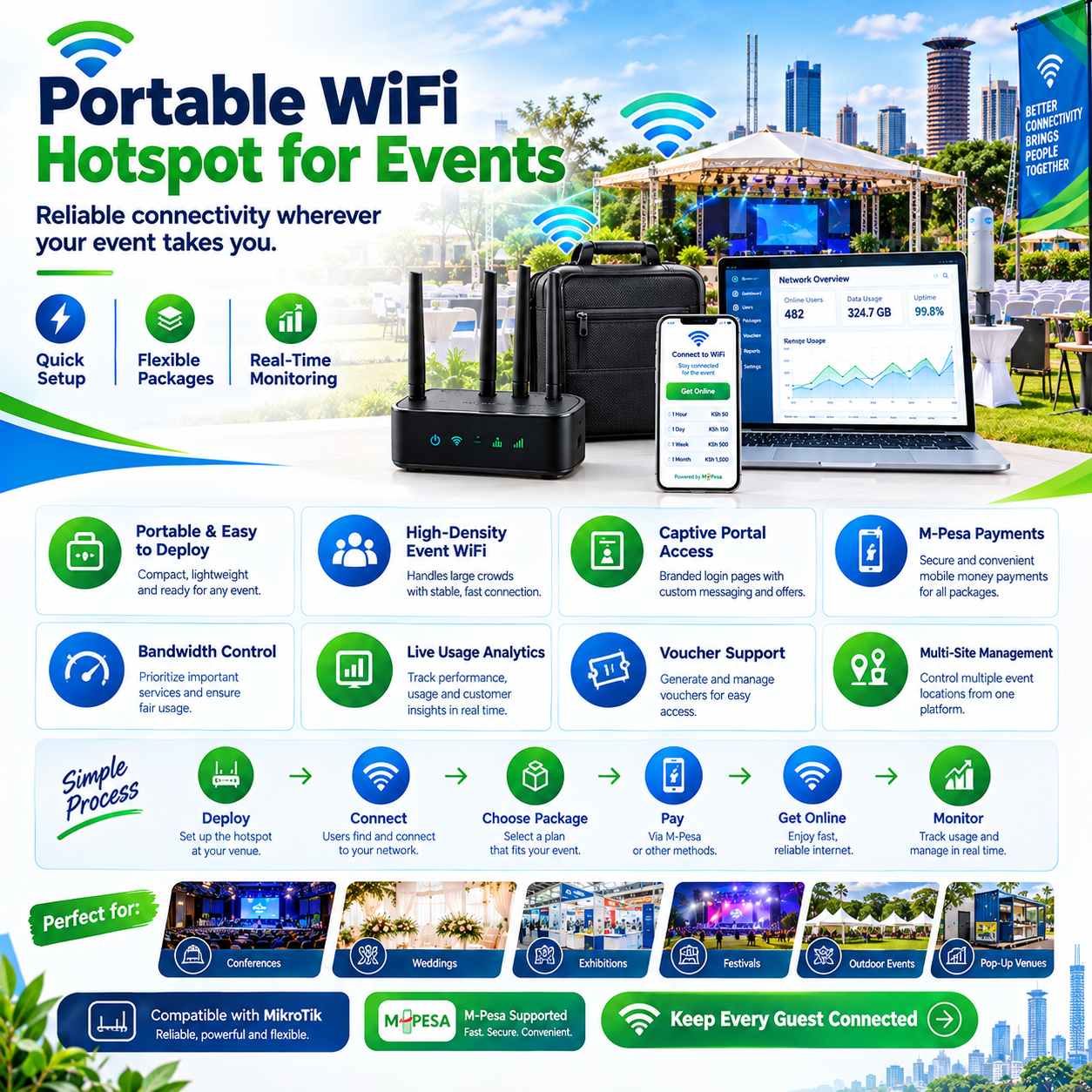
A portable WiFi hotspot for events is one of the most exciting business opportunities in the events economy — a complete internet operation that packs into a vehicle, deploys in an hour, and collects money from every attendee with a phone in hand.
Wherever crowds gather — weddings, conferences, concerts, church rallies, tournaments, expos — connectivity becomes suddenly scarce and instantly valuable.
The venue’s network chokes under three hundred devices. Mobile data crawls under load. And attendees with money to spend have nowhere to spend it on internet.
That gap is exactly where a portable WiFi hotspot for events earns its keep — arriving with the crowd, serving the crowd, and collecting from the crowd.
This article walks through the complete opportunity: what the setup involves, which events pay best, how the money flows, and how operators turn one successful weekend into a calendar full of bookings.
Because the story of every thriving portable WiFi hotspot for events business is the same — the operator saw a crowd, brought the bandwidth, and let the portal do the selling.
Table of Contents
ToggleWhat Portable WiFi Hotspot for Events Actually Is
Strip away the jargon and the concept is wonderfully practical.
A portable WiFi hotspot for events is a self-contained internet business built for temporary deployment: routers, access points, a data connection, power protection, and a billing portal — all packed to travel and all live within an hour of arrival.
The operator arrives before the event, mounts the equipment, powers it up, and watches the portal go live before the first guest parks.
From that moment, every attendee with a phone becomes a potential customer — and the portable WiFi hotspot for events sells to them automatically, through packages priced for the occasion.
The word “portable” carries the entire business model.
Unlike a fixed hotspot that waits for customers to arrive, a portable WiFi hotspot for events follows the gatherings — going where the crowds already are, on the days they gather.
That mobility transforms the economics: one investment in equipment serves a different venue every weekend, and every venue brings a fresh crowd of first-time buyers.
The word “event” carries the rest — because events concentrate demand in a way daily life never does.
A hundred people in one field for one afternoon, all with phones and time to fill, represent more connectivity demand than a quiet street produces in a week.
That concentration is what makes a portable WiFi hotspot for events genuinely profitable — high demand, short duration, premium willingness to pay.
Why Events Are the Perfect Market
Three structural facts make the event market uniquely rewarding for a portable WiFi hotspot for events operation.
The first is density: events pack hundreds of phones into one physical space, and every one of them competes for signal that suddenly cannot cope.
The second is impatience: event attendees have hours to fill — waiting for speeches, matches, or performances — and filling idle time is exactly what purchased internet does.
The third is willingness to pay: event-goers are already spending — on tickets, food, transport — and a small connectivity charge blends invisibly into the day’s budget.
A portable WiFi hotspot for events sits at the intersection of all three: dense demand, captive time, and open wallets.
The competitive emptiness completes the picture.
At a fixed location, an operator faces the bundle on every customer’s phone; at an event, the customer’s bundle has collapsed under crowd load — and the portable WiFi hotspot for events is the only thing in the field that actually works.
That temporary monopoly is why event operators report the highest conversion rates in the connectivity business.
Everyone who connects is a buyer, because everyone who connects came to fill time.
And the calendar guarantees renewal: weddings, rallies, tournaments, and conferences recur season after season, which means one successful portable WiFi hotspot for events deployment becomes a repeatable, bookable business.
The Events It Serves Best
The map of profitable portable WiFi hotspot for events deployments reads like a calendar of gatherings.
Church conventions and crusades lead the list — thousands of attendees, long durations, and waiting time between sessions that connectivity fills perfectly.
Political rallies follow: dense crowds, hours of waiting, and media teams desperate for working uploads.
Sports tournaments — from football finals to athletics meets — convert spectator hours into session sales, and the portable WiFi hotspot for events at a stadium gate serves a crowd that came to wait.
Weddings and conferences occupy the premium end: smaller crowds, higher budgets, and organizers who pay for guaranteed coverage rather than selling to guests.
Trade fairs and expos create the busiest digital traffic of all — exhibitors uploading, buyers browsing, and everyone needing connectivity that the venue never provisioned.
Graduations, funerals, and family gatherings complete the map — the gatherings that draw hundreds to places no network was built to serve.
Each event type teaches the operator something different about their portable WiFi hotspot for events business: conventions teach volume, conferences teach premium pricing, and tournaments teach all-day endurance.
The operators who learn all three build calendars, not weekends — bookings stacked month after month, each one funded by the equipment they already own.
How the Setup Actually Works
The mechanics of a portable WiFi hotspot for events deployment follow a clean sequence that becomes routine by the third event.
The night before: equipment packed and tested — routers, access points, mounts, cables, power banks, and the data connection, each item on a checklist that never changes.
Arrival: one to two hours before gates open, enough to mount, connect, and verify before the first guest arrives.
Deployment: access points positioned for the crowd zones, the backbone connected, power protected, and the portable WiFi hotspot for events portal tested with a real purchase before doors open.
Go-live: the portal appears on every attendee’s phone the moment they connect — packages displayed, prices visible, payment one tap away.
From first sale to last logout, the system runs itself: payments confirm, sessions activate, time counts down, and the operator watches the dashboard fill.
Strike-down reverses the sequence: equipment off, packed, and home before the venue closes — leaving nothing behind but a satisfied crowd.
That complete cycle — pack, deploy, sell, strike — is the entire operating rhythm of a portable WiFi hotspot for events business, and mastery of it is what separates professionals from improvisers.
The Three Business Models
Every portable WiFi hotspot for events operation earns through one of three models, and the strongest operators learn to run all three.
The first is direct sales: attendees buy their own sessions through the portal — hourly passes, day packages, premium tiers — and the operator collects per sale.
This is the classic model, and it thrives at the biggest gatherings: conventions, rallies, and tournaments where hundreds buy through a portable WiFi hotspot for events portal without a single counter transaction.
The second is the sponsor model: a brand or the organizer pays a flat fee, and every attendee browses free beneath the sponsor’s banner.
Churches sponsor convention WiFi, brands sponsor tournament coverage, and the portable WiFi hotspot for events delivers guaranteed attention to the sponsor’s name all day long.
The third is the organizer contract: the event planner pays for managed coverage as part of the production — WiFi joining sound, lighting, and photography on the vendor list.
Premium weddings, corporate conferences, and expos all buy this tier, and a portable WiFi hotspot for events operator holding an organizer contract earns more before the gates even open than retail sales would deliver all day.
The professionals stack the models: organizer fees as the base, sponsorships where the audience fits, and direct sales to every attendee beyond the sponsored allocation.
That stacking is what turns one portable WiFi hotspot for events deployment into three revenue streams from the same crowd.
Packages Built for Event Crowds
The package menu is where a portable WiFi hotspot for events meets its market, and event pricing follows its own logic.
Event attendees think in sessions, not months: an hour for the waiting, an afternoon for the tournament, a full day for the convention.
The proven ladder prices to that rhythm — a short session at the bottom, an event-day pass in the middle, and a premium tier at the top for streamers and media teams.
The reference price is the moment, not the month: attendees compare against what their dead phone data would have cost, and a portable WiFi hotspot for events priced fairly against that collapsed alternative sells itself.
Speed tiers earn their place at events more than anywhere else.
The attendee streaming a match live, the exhibitor uploading product photos, the journalist filing a story — all pay willingly for a portable WiFi hotspot for events premium tier that genuinely delivers.
Day passes dominate at full-day gatherings, and bundling them with early-bird pricing rewards the crowd that connects before noon.
The dashboard closes the loop after every event: which packages sold, at which hours, at which price points — evidence the operator carries into the next booking.
Operators who tune their portable WiFi hotspot for events menus against that data, event after event, consistently find their middle package becoming the bestseller — and price the next event’s ladder accordingly.
M-Pesa and the Payment Flow
At an event, the payment flow carries more weight than anywhere else in the connectivity business — because the crowd is transient and every hesitation loses a buyer forever.
The automated M-Pesa flow is the standard: the attendee taps a package, an STK push lands on their phone, they enter their PIN, and their session opens within seconds.
No booth, no queue, no cash changing hands over a crowd — the portable WiFi hotspot for events sells through every phone in the field simultaneously.
Speed matters more at events because the purchase happens between things: between speeches, between matches, between sessions.
A flow that completes in under a minute captures the buyer; a flow that stumbles loses them to whatever happens next on the schedule.
Reconciliation runs quietly beneath the noise: every payment matched to a session automatically, every receipt timestamped, and the operator’s day-end report accurate to the shilling.
For the organizer, that clean record matters too — a portable WiFi hotspot for events deployment that reports transparently earns the invitation back next season.
And for the operator, the deepest value is the database: every attendee who bought is a recorded customer, reachable when the next event comes to town.
That growing list of buyers is the compounding asset behind every established portable WiFi hotspot for events business.
Coverage and Capacity: The Event Physics
The engineering discipline behind a portable WiFi hotspot for events deployment is matching two numbers: how many devices will connect, and how much bandwidth the backbone can carry.
Device counts are estimable with surprising accuracy: attendance figures, times a realistic connection rate, times the packages being sold.
The operator who plans for three hundred devices provisions accordingly — and the portable WiFi hotspot for events that holds under peak load earns the reputation that fills the next calendar.
Backbone selection is the critical decision: a strong 4G or 5G connection tested at the venue beforehand, or a bonded multi-SIM setup where a single carrier would choke.
Testing before the event is the professional habit that separates reliable operators from hopeful ones — signal checked at the actual grounds, at the actual hours, with real speed tests.
Bandwidth governance completes the engineering: per-user speed caps, session limits, and queue rules that keep one streaming attendee from taxing the whole portable WiFi hotspot for events experience.
Placement is the final physical art: access points elevated toward the crowd zones, mounted safely, and positioned where the density actually gathers.
The operator who walks the grounds before mounting — mapping the stage, the seating, the food area — deploys coverage that feels invisible because it simply works everywhere.
That invisible reliability is the product attendees actually buy from a portable WiFi hotspot for events, and it is earned entirely before the first guest connects.
Power: Keeping the Network Alive All Day
No chapter of the portable WiFi hotspot for events playbook matters more than power, because events run long and the grid is never guaranteed.
The professional kit treats power as core equipment: deep-cycle batteries or power stations sized for the full event duration, plus solar panels where the day runs long.
Surge protection rides on every line, because generators and event power supplies are exactly the dirty electricity that kills routers.
The portable WiFi hotspot for events that survives a generator stumble unnoticed keeps every customer and every shilling; the one that goes dark refunds its reputation to the whole field at once.
Battery math becomes routine with practice: router draw, access point draw, hours of coverage — planned with margin rather than hope.
Charging discipline completes the kit: equipment topped overnight, spares packed, and nothing dependent on the venue’s goodwill at 6 a.m.
The operators whose portable WiFi hotspot for events deployments run flawlessly through twelve-hour events all share the same secret: they budgeted power like it was the product, because at an event, it is.
The Event Day, Hour by Hour
The rhythm of a successful portable WiFi hotspot for events deployment tells the story of the model better than any theory.
5:30 a.m.: the operator loads the vehicle — everything checked against the list the night before.
7:00 a.m.: arrival at the grounds, a walk of the site, and mounting begins — access points up, backbone connected, power running.
8:30 a.m.: the portal tested with a live purchase, and the portable WiFi hotspot for events dashboard open on the operator’s phone as the first early arrivals park.
9:00 a.m.: gates open, and within minutes the first sales appear — early birds buying day passes before the speeches begin.
Midday: the peak — hundreds connected, sessions selling steadily, and the dashboard showing the portable WiFi hotspot for events performing exactly as the capacity plan promised.
Afternoon: the lull managed with off-peak pricing, and the sponsor banner doing its quiet work on every login screen.
Evening: the final surge — attendees buying extensions for the closing hours, and the day’s revenue approaching its target.
6:00 p.m.: strike-down, the crowd leaving, and the operator packing equipment that earned its keep one more time.
That single day, repeated across a calendar of bookings, is the entire business — and the operators who live it monthly describe the portable WiFi hotspot for events rhythm as the most satisfying work in the connectivity trade.
The Mistakes That Sink Event WiFi
The recurring failures are well documented, and naming them is cheaper than making them.
The first is arriving untested: signal assumed rather than verified, and a portable WiFi hotspot for events that discovers its weak backbone in front of five hundred witnesses.
The second is undersized power: batteries planned for eight hours serving a ten-hour event, and the network dying precisely during the headline hour.
The third is overselling capacity: more packages sold than the backbone carries, until the crowd’s experience collapses and the operator’s name travels home with them.
The fourth is the hard cutoff with no grace: a session expiring mid-match, and a portable WiFi hotspot for events operator spending the afternoon answering one annoyed attendee after another.
The fifth is skipping the sponsor conversation: leaving banner revenue on the table while charging attendees for what a brand would have paid to deliver free.
The sixth is treating each event as one-off: no customer records captured, no organizer relationships built, and a business that restarts from zero every weekend.
Each mistake is avoidable with the same discipline — test before deploying, size power honestly, cap capacity deliberately, and record every buyer.
The operators who internalized those habits watch their portable WiFi hotspot for events calendars fill while their competitors wonder why theirs stay empty.
Building a Repeat-Client Business
The deepest advantage of the portable WiFi hotspot for events model is that events recur — and the operators who plan for recurrence build calendars instead of hustles.
The first layer is the organizer relationship: every planner who saw a deployment run cleanly adds the operator to their vendor list, and next season’s booking arrives before this season’s equipment cools.
The second layer is the attendee database: every buyer recorded through the portal becomes a reachable audience when the operator posts their next appearance.
A portable WiFi hotspot for events operator with two thousand past buyers holds a marketing list no poster budget could buy.
The third layer is the venue network: grounds, stadiums, and conference centers that hosted one successful deployment call for the next — and eventually offer exclusive arrangements.
The fourth layer is the service ladder: the operator who began selling sessions graduates to organizer contracts, then to full event connectivity packages with crew and guarantees.
Each rung raises the revenue per event without raising the equipment cost — the compounding structure behind every established portable WiFi hotspot for events business.
And the reputation effect ties it all together: in the events world, word travels through a small community of planners, and the operator known for flawless deployments never lacks for a Saturday booking.
The Payoff, Counted Honestly
Ask operators a year into the portable WiFi hotspot for events business what it delivered, and the answers converge with striking consistency.
Revenue that concentrates: one strong event earning what a fixed location collects in a month, at margins made richer by the temporary monopoly the crowd creates.
A calendar instead of a gamble: bookings stacked through organizer relationships, repeat venues, and a buyer database that markets itself.
Equipment that pays for itself repeatedly: the same kit deployed weekend after weekend, each deployment funded by the last one’s receipts.
And a business with a reputation: the operator whose networks simply work at the moments that matter most — the speech, the match, the ceremony — becoming the name planners ask for by default.
None of it required permanent premises, monthly rent, or a fixed customer base.
It required showing up where the crowds already were — with bandwidth, power, and a portal that sells while the operator watches the dashboard fill.
That is the complete case for the portable WiFi hotspot for events business: the gatherings were happening anyway, the phones were already in every hand, and the only thing missing was someone who packed the network and drove it there.
Frequently Asked Questions
How much does it cost to start?
A serious kit — routers, access points, power stations, mounts, and the billing platform — runs the cost of a decent laptop, recoverable within a few strong events.
Operators who sized their portable WiFi hotspot for events kits honestly typically earn the investment back inside the first quarter.
Do I need technical skills?
No — modern platforms handle the portal, payments, sessions, and enforcement automatically, and the deployment skills are learnable in one or two assisted events.
The habits that matter are testing signal beforehand, sizing power honestly, and reading the portable WiFi hotspot for events dashboard after every deployment.
How do attendees actually pay?
Through the portal by M-Pesa — they tap a package, enter their PIN, and their session opens within seconds.
That automated flow is what lets a portable WiFi hotspot for events serve hundreds of buyers without a single counter or queue.
What if the venue has no network coverage?
Test before you commit: a site with no usable signal is a booking to decline, and the operator who verifies coverage at the actual grounds protects the whole investment.
Bonded multi-SIM setups rescue borderline sites, and experienced portable WiFi hotspot for events operators know which venues need them before the contract is signed.
Can I charge attendees and take a sponsor at the same time?
Yes — the strongest deployments stack models: the sponsor funds a free baseline session, and paid packages serve everyone who wants more.
That structure earns the portable WiFi hotspot for events operator three ways from one crowd: sponsor fee, session sales, and organizer goodwill.
How many attendees can one setup serve?
A well-built kit comfortably serves several hundred devices when the backbone and capacity plan match the crowd.
The disciplined portable WiFi hotspot for events operator sizes honestly to attendance figures rather than hoping the evening peak will forgive an undersized plan.
What happens when a session expires mid-event?
The attendee sees a countdown, receives a low-time warning, and extends with one tap in seconds.
Handled smoothly, expiry becomes a natural second sale — the built-in rhythm of a portable WiFi hotspot for events deployment that converts genuine need into revenue without friction.
Do I need insurance or permits?
Liability expectations vary by venue and organizer, so put the arrangement in writing: what the operator provides, what the organizer provides, and who answers for what.
Professional portable WiFi hotspot for events operators treat the written agreement as part of the kit — packed alongside the routers on every job.
Can I run this alongside my fixed hotspot business?
Yes — and the combination is the industry’s best structure: fixed locations earning through the week, and the same equipment doubling into events on weekends.
Operators who added a portable WiFi hotspot for events arm to their fixed business report the weekend income often matching the weekday total.
What is the smartest first step this week?
List the five biggest recurring events in your area, call two organizers, and offer a pilot deployment at a trial rate with full reporting.
That single page of calls has launched more portable WiFi hotspot for events businesses than every other preparation combined — and the operators who made them discovered the same truth every time: the crowd was already gathering, the phones were already in hand, and the portable WiFi hotspot for events opportunity was simply waiting for someone to drive the network there.