
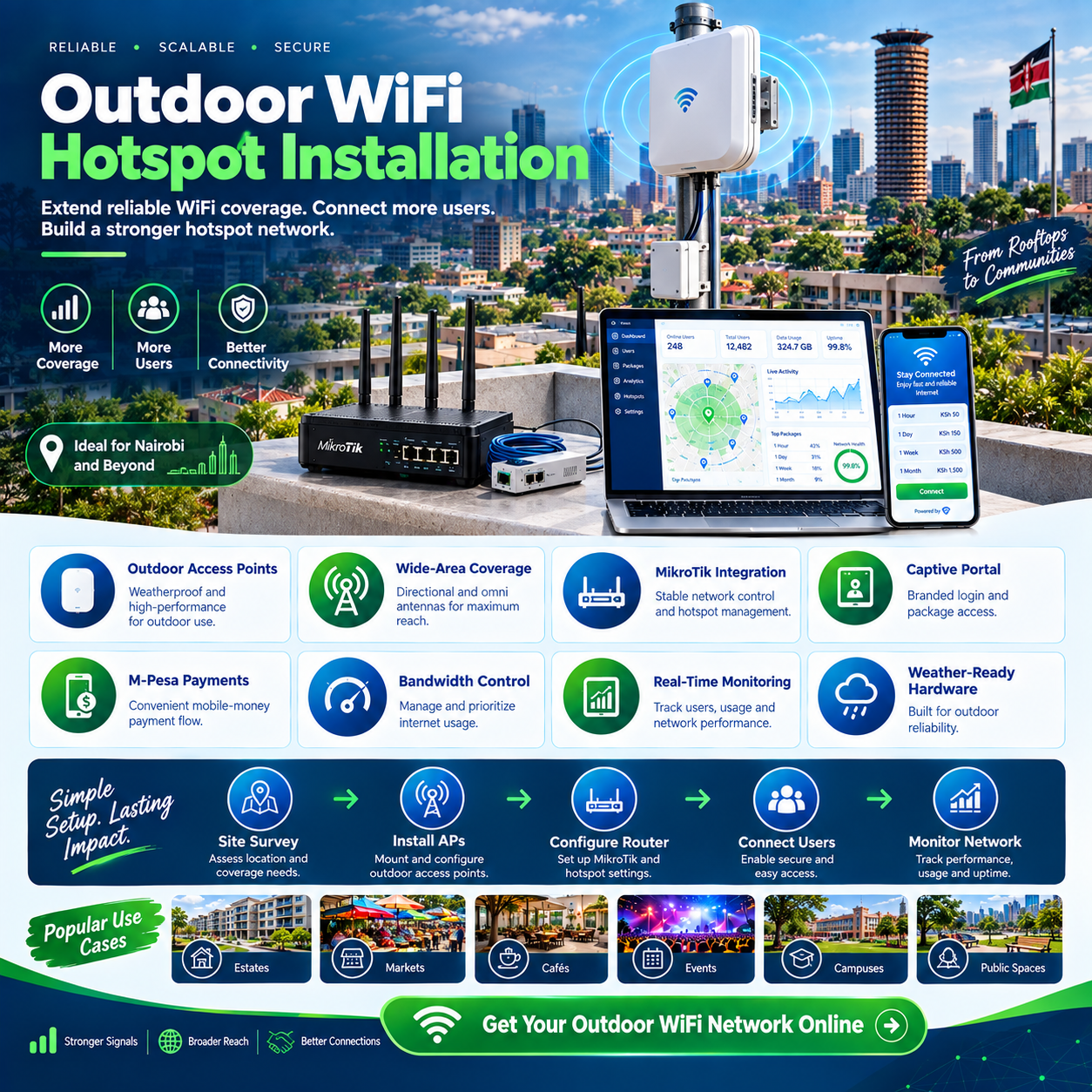
Outdoor WiFi hotspot installation is the craft that turns rooftops, poles, and walls into the physical foundation of every successful connectivity business.
Behind every hotspot that serves a trading center, an estate, or a university neighborhood stands a carefully mounted piece of equipment that endures rain, sun, dust, and lightning — and keeps working through all of it.
The difference between a network that thrives and one that frustrates is rarely the billing platform or the internet package.
It is the quality of the outdoor WiFi hotspot installation that put the hardware where the physics needed it to be.
Done well, the installation disappears into the background — customers simply find that the network works, everywhere, every day.
Done poorly, it produces the familiar misery of dead zones, storm outages, and technician visits that never end.
This article walks through the complete discipline: what a proper outdoor WiFi hotspot installation involves, how professionals plan and execute it, and the habits that keep installed networks earning for years.
Because in this business, the hardware mounted today decides the revenue collected tomorrow — and the outdoor WiFi hotspot installation is where that decision gets made.
What Outdoor WiFi Hotspot Installation Actually Is
Strip away the technical language and the concept is refreshingly physical.
An outdoor WiFi hotspot installation is the complete process of placing internet-distributing equipment outside — on rooftops, masts, poles, and walls — so that signal reaches the people and places it needs to reach.
The work spans several trades at once: site planning, equipment mounting, electrical protection, cable routing, and finally the testing that proves the network works.
Each installation serves a purpose within a larger system — extending a mast’s coverage, feeding a building’s indoor network, or bridging connectivity across a distance no cable could cross.
What separates professional outdoor WiFi hotspot installation from amateur work is not the equipment itself, but everything around it: the planning before, the discipline during, and the verification after.
Outdoor equipment lives in the harshest environment networking knows — ultraviolet sun, driving rain, corrosive dust, and seasonal storms.
An installation is therefore not a placement task but a weatherproofing craft, where every bracket, seal, and cable route is chosen for a life outdoors.
The operators who understand this build networks that run for years without a ladder.
The ones who don’t, rediscover their equipment one repair visit at a time.
That difference — between years of quiet service and seasons of emergency visits — is the entire value of a disciplined outdoor WiFi hotspot installation.
Why Installation Quality Decides Business Success
The commercial weight of outdoor WiFi hotspot installation quality is easy to underestimate, because a poorly installed network often works — briefly.
The failures arrive later, in patterns every veteran operator recognizes.
The mount that loosens in the wind and tilts the antenna a few degrees, quietly degrading coverage until complaints begin.
The connector that corrodes through one rainy season, throttling speeds for a whole street of paying customers.
The cable that wicks water indoors during a storm, killing the router and the day’s revenue with it.
Each of these failures traces back to an outdoor WiFi hotspot installation that cut a corner — usually a corner that cost nothing to do correctly.
The economics sharpen the argument.
Every installation failure is a truck roll: a technician, a ladder, an afternoon, and a customer whose patience eroded while they waited.
A network of fifty installations with sloppy standards generates a steady calendar of such visits, and the repair costs quietly eat the margin the route earns.
A network built on disciplined outdoor WiFi hotspot installation practices, by contrast, runs for years with maintenance measured in scheduled inspections rather than emergency calls.
The operators who grew to hundreds of customers all learned the same lesson early: installation quality is not a technical preference — it is a business strategy.
The Site Assessment: Where Every Installation Begins
Every professional outdoor WiFi hotspot installation starts on the ground, not on the roof — with an assessment that decides everything that follows.
The first question is coverage: who needs to reach the network, from where, and through what obstacles?
Walking the site with a map of the intended users reveals the geometry — the buildings that block, the open spaces that invite, the elevation that solves both.
The second question is signal: what does the site actually hear, at the actual mounting height, during the actual peak hours?
Professionals testing for an outdoor WiFi hotspot installation run signal checks at candidate mounting points before purchasing anything — because a location that reads strong at 10 a.m. may collapse at 8 p.m. when the neighborhood wakes.
The third question is structure: what will the equipment mount to, and can that structure safely carry it?
A flimsy pole that sways in the wind will sway the antenna with it, and a roof that leaks around brackets creates problems no network wants.
The fourth question is power: where does electricity reach, how reliably, and what protection does the installation need?
And the fifth is access: can a technician safely reach this mount for future maintenance, or is the outdoor WiFi hotspot installation being built where nobody will dare to climb?
Fifteen honest minutes of assessment prevent months of regret — and the operators who assess first are the ones whose installations never need to be redone.
Equipment Selection: Choosing Hardware for a Life Outside
The hardware chosen for an outdoor WiFi hotspot installation must be selected for its environment, not just its price — because outdoor conditions eliminate indoor-grade equipment within months.
The access points and radios come first: units rated for outdoor duty, with sealed housings, wide temperature tolerance, and mounting hardware designed for poles and walls.
Power over Ethernet capability matters next, because it lets a single cable carry both power and data to the mounted unit — the standard that keeps outdoor outdoor WiFi hotspot installation work clean and safe.
Antenna choice follows the coverage plan: omnidirectional units for serving a surrounding area, directional panels for reaching a specific zone, and the discipline to match the antenna to the map rather than the brochure.
Surge protection is not an accessory but a core component — a small device at the building entry that sacrifices itself instead of the equipment when lightning or grid spikes arrive.
Mounting hardware completes the kit: stainless brackets, quality wall plugs, and pole clamps sized for the actual structure — the unglamorous parts that decide whether the outdoor WiFi hotspot installation survives its second storm season.
The shopping rule professionals repeat: buy for the environment first, the performance second, and the price last.
A cheap unit that fails in eighteen months costs more than a quality unit that serves five years — once the replacement visits and the lost customers are counted.
That arithmetic, run honestly, is what turns outdoor WiFi hotspot installation equipment budgets from expenses into investments.
Mounting and Placement: The Physics Before the Power
Placement is where an outdoor WiFi hotspot installation earns or loses most of its performance — before a single cable is connected.
Height comes first, and the rule is simple: higher is better, up to the point where the cable run or the wind load becomes a problem.
A unit mounted above the local roofline hears and is heard cleanly; a unit tucked behind a parapet fights reflections and interference for its entire life.
Clearance comes second: the antenna needs an unobstructed view of the area it serves, and every wall, tree, or water tank between the unit and its users subtracts signal.
Orientation comes third — directional units demand precise aiming, and the professionals performing an outdoor WiFi hotspot installation fine-tune alignment while watching live signal readings, degree by degree.
Installers who “aim and hope” deliver networks that work until the first windy day nudges the mount sideways.
Mounting integrity completes the placement discipline: brackets torqued to the structure, sealant applied where penetrations occur, and the whole assembly rated for the wind it will eventually face.
The operators whose networks survive the seasons treat mounting as a craft with standards — documented, practiced, and checked at every outdoor WiFi hotspot installation before the ladder comes down.
Every shortcut taken at height this year becomes a return visit next year — which is why the professionals never take one.
Cabling and Power: The Lifeline Discipline
The cable connecting an outdoor unit to the indoors is the installation’s lifeline — and the place where amateur outdoor WiFi hotspot installation work develops its longest-lasting weaknesses.
Professional practice treats cabling as infrastructure rather than consumable.
Outdoor-rated cable only — indoor cable sun-cracks and waterlogs within a season, and the failure it causes looks mysteriously like “bad internet.”
Drip loops at every entry point: the small downward bend that keeps rain from wicking along the cable and into the building.
Sealed connectors at every junction, because the corrosion that creeps into unprotected joints throttles the whole outdoor WiFi hotspot installation link one rainy month at a time.
Surge protection at the building entry on every professional run — placed before the cable reaches anything expensive.
Cable runs kept within rated distances, with powered injectors added where runs stretch long rather than stretching cheap cable past its limits.
And the entire route planned for serviceability: a technician arriving next year should reach every junction without dismantling the outdoor WiFi hotspot installation piece by piece.
Power protection completes the discipline — surge arrestors on the electrical side, and backup power where the business depends on staying live through outages.
The operators whose installations survive their third rainy season all share the same four words: sealed, grounded, protected, documented.
Weatherproofing: Building for the Seasons
Every outdoor WiFi hotspot installation is ultimately a promise made to the weather — and the weather always collects on that promise eventually.
The sun tests the husing: ultraviolet degrades cheap plastics until they crack, which is why outdoor-rated enclosures are non-negotiable.
The rain tests the seals: every entry point — cable glands, connector joints, mounting holes — must shed water, because water inside a housing ends the unit’s life quietly and completely.
The wind tests the mounts: a bracket that flexes in a storm bends the antenna’s aim, and the coverage that was engineered slowly becomes coverage that was remembered.
The heat tests the electronics: units sealed in dark boxes that bake in afternoon sun fail young, which is why professional outdoor WiFi hotspot installation work provides shade or ventilation where the climate demands it.
The dust tests everything else — working into connectors, coating vents, and grinding at anything that moves.
Seasonal maintenance is the answer to all five: a scheduled inspection before each rainy season, seals checked, mounts verified, drainage confirmed.
The networks that age gracefully belong to operators who scheduled that care; the ones that age badly belong to operators who forgot the weather was a party to every outdoor WiFi hotspot installation they ever made.
The Installation Day, Step by Step
A professional outdoor WiFi hotspot installation follows a rhythm that becomes routine by the third job — and each step protects the ones after it.
The day begins the night before: equipment checked against the plan, tools packed, and the site assessment reviewed one last time.
On site, the sequence starts with the mount: brackets fixed to the structure, level and torqued, with sealant at every penetration.
The unit goes up next — antenna oriented per the coverage plan, hardware tightened, and the outdoor WiFi hotspot installation physically complete before a single cable is run.
Cabling follows the planned route: drip loops formed, entries sealed, surge protectors placed, and the run tested before it is buried or clipped into place.
Power comes next — injector connected, unit powered, and the first signal readings taken while the technician is still at the mount.
That moment matters: alignment adjusted on the ladder, with live readings, saves a second climb and locks in the performance the coverage plan promised.
Back indoors, the network side completes the outdoor WiFi hotspot installation: router configured, portal connected, and the first test devices connected at the edges of the intended coverage.
The final step is verification — speeds measured at real user positions, dead zones hunted down, and every finding recorded.
The technician who signs off with evidence, rather than optimism, hands the operator a network whose performance is known rather than hoped.
Testing and Sign-Off: Proving It Works
No outdoor WiFi hotspot installation is complete until it has been tested the way customers will actually use it.
The first test is coverage: walking the intended service area with a real phone, checking signal and speed at the positions users will actually occupy.
Dead zones discovered at this stage are fixed with a mount adjustment or an added unit — discoveries made after launch cost customers instead.
The second test is load: the network performing under the weight of the evening peak, not the quiet of the afternoon installation.
Professionals schedule their outdoor WiFi hotspot installation verification for a busy hour whenever possible, because a network that tests well at 2 p.m. may choke at 8.
The third test is the payment loop: a real package purchased through the portal, a session activated, and a clean cutoff verified when the time ends.
The fourth is the recovery test — power cut deliberately, and the network watched as it restores itself, because the grid will run that test unprompted soon enough.
Documentation closes the process: signal readings, mounting details, cable routes, and equipment serials recorded at sign-off.
That record is the outdoor WiFi hotspot installation‘s birth certificate — the reference that turns every future support call into a lookup instead of an investigation.
The Mistakes That Haunt Installations
The recurring installation failures repeat across every market, and naming them is cheaper than making them.
The first is the unassessed site: equipment mounted where the ladder reached rather than where the coverage plan pointed.
The second is indoor-grade hardware outside — a outdoor WiFi hotspot installation built on units that were never rated for the weather they must live in.
The third is the bare cable run: no drip loop, no sealing, no surge protection — an installation quietly scheduled to fail during its first serious storm.
The fourth is aiming by eye: directional antennas installed without live signal readings, and performance left to fortune.
The fifth is skipping the load test: a network verified at midday that meets its first real crowd at evening peak and folds.
The sixth is no documentation — an outdoor WiFi hotspot installation whose details live only in the installer’s memory, which is to say nowhere.
The seventh is the rushed sign-off: the ladder down and the truck gone before the verification tests proved anything.
Each mistake costs an afternoon to avoid and months of service to regret — which is why the professionals hold their standards even on the days the schedule pushes hardest.
Maintenance: The Years After the Ladder Comes Down
The outdoor WiFi hotspot installation that gets maintained outlives and out-earns the one that gets forgotten — and the difference costs only a few scheduled hours a year.
The seasonal rhythm is simple: an inspection before each rainy season, when seals, mounts, and drainage get checked while the weather is still friendly.
Remote monitoring fills the gaps between visits — modern equipment reports its own health, and the operator watching dashboards catches a degrading unit before customers do.
A signal slowly drifting downward over weeks is a connector corroding or a mount shifting — a scheduled repair rather than an emergency.
Firmware updates ride the same rhythm: patches applied on schedule, with backups taken first, keeping the outdoor WiFi hotspot installation secure as well as sturdy.
Cleaning belongs to the routine too: dust cleared from housings, vegetation trimmed back from antenna paths, and corrosion treated the day it appears.
Spare strategy completes the discipline — spares of every deployed model kept on hand, so a failure means a swap visit rather than a wait-for-delivery outage.
The operators who institutionalized this care watch their installations serve five, six, seven years — while the networks around them get rebuilt, one emergency at a time.
That longevity is the quiet dividend of treating every outdoor WiFi hotspot installation as the beginning of a relationship rather than the end of a job.
The Payoff: What Discipline Actually Builds
Ask operators with established networks what disciplined installation earned them, and the answers converge.
Uptime: networks that stay online through the seasons, because the mounts, seals, and protection were built for the weather that eventually came.
Reputation: a service that simply works becomes the neighborhood standard, recommended in the conversations where customers are decided.
Efficiency: truck rolls reserved for genuine upgrades rather than preventable repairs, and support calls answered by records instead of ladders.
And growth: installations that replicate — each new site inheriting standards that made the last one reliable, so the network scales by repetition rather than firefighting.
None of it arrived with the equipment.
It was manufactured through assessment, placement, weatherproofing, and verification — the unglamorous craft behind every network that quietly earns, year after year.
The operators who internalize it stop seeing installation as the day the equipment goes up and start seeing it as the day the business is built.
Because that is what a proper outdoor WiFi hotspot installation actually is: the foundation stone of everything the network will ever earn.
Frequently Asked Questions
How high should equipment be mounted?
High enough to clear the local roofline and obstacles, balanced against safe cable runs and maintainable access.
The professionals performing an outdoor WiFi hotspot installation choose height from the coverage plan, not from whatever the ladder can reach.
Can I install the equipment myself?
Simple single-unit installations are achievable with careful preparation — but tower-facing directional work, structural mounting, and electrical protection reward trained hands.
Most operators who started DIY adopted professional standards after their first storm season taught them what an outdoor WiFi hotspot installation really has to survive.
How long does a typical installation take?
A straightforward single-site install takes a few hours: assessment verified, mount fixed, cable run, and tests completed.
Multi-unit sites take a day or more — and the sign-off testing is the part of an outdoor WiFi hotspot installation that should never be rushed.
Does rain really affect outdoor WiFi?
Yes — heavy rain attenuates signal, especially at higher frequencies and longer distances, and water ingress destroys unprotected equipment outright.
This is why professional outdoor WiFi hotspot installation work builds in headroom, sealing, and surge protection as standard.
What maintenance does an installation need?
A seasonal inspection of seals, mounts, and cable entries, plus firmware updates and remote health monitoring between visits.
Operators who schedule this care keep their outdoor WiFi hotspot installation networks earning for five years and beyond.
What happens during a power cut?
With surge protection and backup power, the network rides through outages unnoticed; without them, every blackout refunds the operator’s reputation to the whole coverage area.
Power planning is listed as core infrastructure in every serious outdoor WiFi hotspot installation plan.
How do I know where to point a directional antenna?
With live signal readings taken while adjusting on the mount — degree by degree, watching the numbers improve.
That alignment discipline is the difference between an outdoor WiFi hotspot installation that performs and one that merely points.
Can one installation serve a whole neighborhood?
Yes — a well-placed mast installation with proper equipment routinely covers hundreds of users across a dense area.
The reach depends on the coverage plan and the physics respected during the outdoor WiFi hotspot installation, not on hope.
What documentation should an installation leave behind?
Mounting details, equipment serials, signal readings, cable routes, and configuration records — the complete reference for every future service visit.
The operators who demand this from every outdoor WiFi hotspot installation turn support into a lookup rather than an investigation.
What is the smartest first step before any installation?
Walk the site twice — once to map the users and obstacles, and once at peak hours to test the actual signal at the candidate mounting points.
That honest groundwork, done before any purchase, is how every thriving outdoor WiFi hotspot installation began — and the operators who kept those standards across every site they built discovered the same truth every time: the networks that earned for years were never the ones with the best equipment, but the ones whose outdoor WiFi hotspot installation treated the weather, the physics, and the testing with the respect they always collect.