
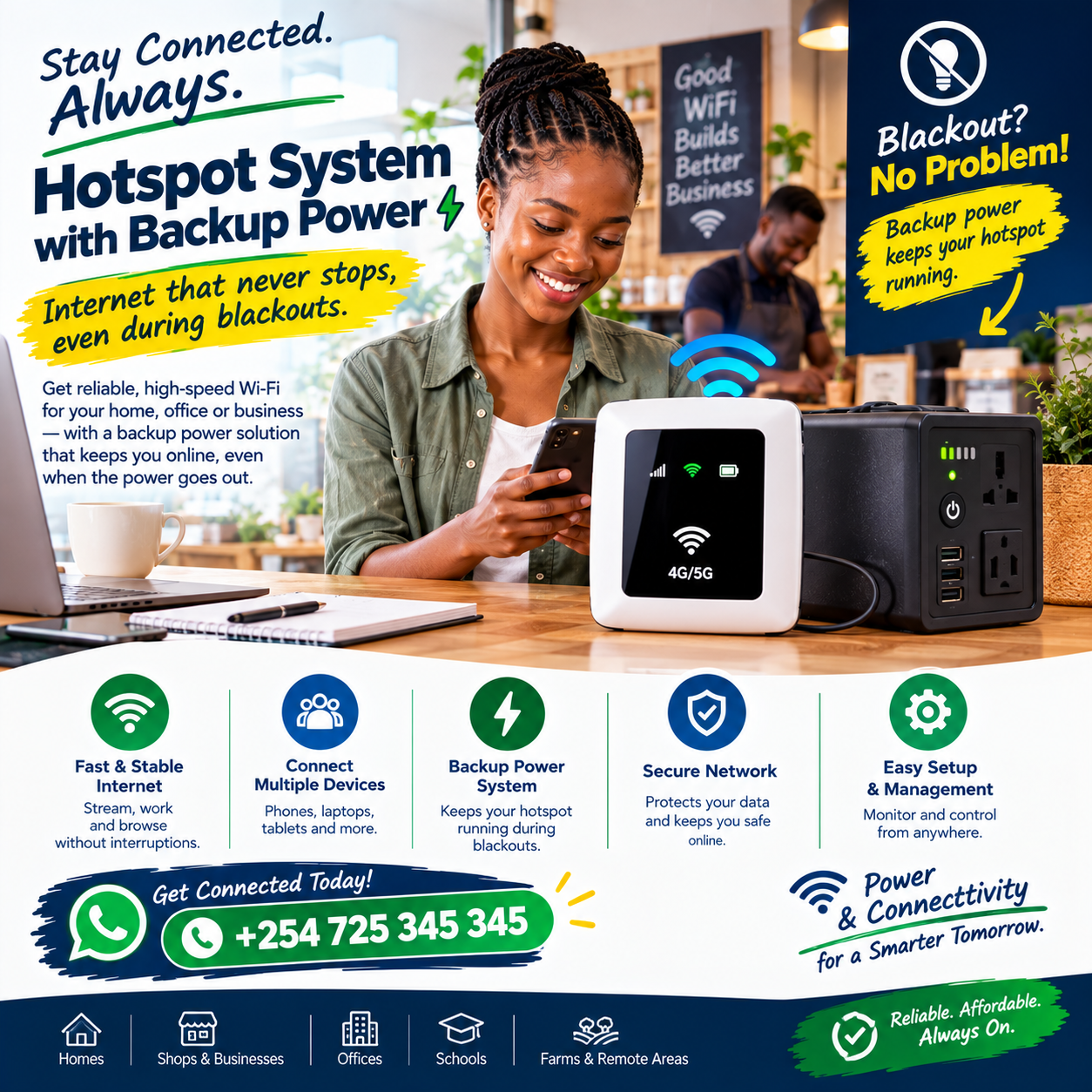
A hotspot system with backup power during blackouts is the design philosophy separating networks that earn through every hour of the year from networks that go dark exactly when their customers need them most.
In this market, the grid is a business partner with terrible reliability — present at noon, absent at midnight, and unpredictable on the days that matter most.
Every operator knows the scene: the evening peak arrives, the neighborhood is home and hungry for connectivity, and the power dies.
What happens in the next ten minutes decides everything. Does the network stay up, collecting revenue while every competitor goes dark? Or does it join the blackout and refund its reputation to the entire coverage area?
A hotspot system with backup power during blackouts answers that question in advance — with batteries, inverters, solar, and design choices that keep the mast alive through every outage.
This article walks through the complete discipline: what backup power actually involves, how operators size it, what it costs, and why the networks that outlasted the grid built resilience into their bones.
Because blackouts are not an occasional hazard in this business — they are a permanent character of it, and a hotspot system with backup power during blackouts is simply what professionalism looks like in response.
Table of Contents
ToggleWhat a Hotspot System With Backup Power During Blackouts Actually Is
A hotspot system with backup power during blackouts is a network engineered to keep serving customers through grid failure — a combination of equipment, power storage, and automation that continues selling, authenticating, and connecting while the neighborhood sits in the dark.
The ingredients are physical and familiar: a battery bank or inverter system that carries the load, surge protection that survives the grid’s return, and a design that treats outages as scheduled events rather than surprises.
What the backup powers matters as much as how long it powers it: the router, the access points, and the upstream connection — the three organs a network cannot lose.
Operators who built a true hotspot system with backup power during blackouts think in terms of the full chain — power reaching the equipment, equipment staying online, and customers staying connected to the portal.
A backup that runs the router but not the access points protects nothing; a backup that runs everything but dies at hour two protects only half the outage.
The craft is matching the power to the outage profile the area actually experiences — and that profile is knowable from the operator’s own logs.
That matching between reality and resilience is what distinguishes a hotspot system with backup power during blackouts from a power bank taped to a router.
Why Blackouts Cost More Than the Outage
Blackouts cost more than the outage itself, and the arithmetic explains why veterans treat them as the primary business threat.
The direct cost is lost revenue: an evening blackout wipes out the day’s best-selling window — the hours when households are home, streaming, and buying.
The indirect cost is worse: every outage is a public demonstration that the network fails, watched by the entire coverage area at once.
Customers judge networks by their worst moments, and a hotspot system with backup power during blackouts eliminates the worst moment entirely.
Then comes the churn math: a customer who lived through three blackouts this month is halfway to the competitor whose network stayed up during at least one of them.
And there is the hardware toll — power returning after an outage arrives dirty, carrying spikes that protected networks shrug off and unprotected ones absorb fatally.
Operators who counted all four costs reached the same conclusion: a hotspot system with backup power during blackouts is not an expense but an insurance policy that pays monthly dividends.
The market rewards it visibly: on the night the grid fails, the operator whose network stays up becomes the only network on the street — and customers notice in exactly the way that builds market share.
That flip from outage to opportunity is the commercial heart of a hotspot system with backup power during blackouts.
The Grid Reality: Designing From Data
Designing a hotspot system with backup power during blackouts begins with honest data about the grid itself — because resilience sized to imagination is either wasted or insufficient.
The first data point is frequency: how many outages does the area experience per week, and do they cluster around weather, faults, or maintenance?
The second is duration: do outages last twenty minutes or eight hours, and do the long ones land during peak selling hours?
The third is timing: blackouts at 3 a.m. cost little; blackouts at 8 p.m. cost the day.
Operators who logged their outages for one month discovered their grid’s personality — and built their hotspot system with backup power during blackouts to match it rather than to a generic standard.
The fourth data point is the return: how dirty is the power when it comes back, and what does the area’s surge history say?
Areas with violent returns need stronger protection as a core budget line, not an afterthought.
The fifth is seasonality: storm-season outages multiply in many areas, which means the backup system should be verified before the season — never during it.
That groundwork turns power design from guesswork into engineering, and it is the first chapter of every hotspot system with backup power during blackouts that actually worked.
The Backup Options: Layers That Buy Different Kinds of Time
The market offers several power tools, and a professional hotspot system with backup power during blackouts usually combines them rather than choosing one.
The uninterruptible power supply is the entry layer: batteries that carry the equipment instantly when the grid drops, with no gap in service.
A modest UPS keeps a router and access points alive for several hours — enough for most urban outages, and the foundation of any hotspot system with backup power during blackouts.
The inverter-and-battery bank is the mid-tier step up: larger capacity, rechargeable from the grid or solar, and sized for the long outages rural and peri-urban areas know well.
Deep-cycle batteries are the correct chemistry — car batteries die young under the daily discharge this duty demands.
Solar charging makes the system independent: panels feeding the battery bank by day give a hotspot system with backup power during blackouts freedom from the grid’s schedule entirely.
The generator is the heavy fallback: fuel-powered endurance for the multi-day outage, kept for emergencies rather than routine duty.
Lithium power stations have joined the toolkit — clean, portable, fast-charging, and increasingly the preferred core of a modern hotspot system with backup power during blackouts.
The professionals layer them: instant-carry batteries at the bottom, solar to sustain, and a generator standing behind everything for the rare marathon outage.
The layering rule is simple — every layer buys a different kind of time, and a complete hotspot system with backup power during blackouts owns all three: the seconds, the hours, and the days.
Equipment choice matters inside the layers too: modern routers and radios with low power draw stretch every battery hour further.
Efficiency at the device level is resilience at the system level — a truth every operator building a hotspot system with backup power during blackouts learns to price.
Sizing the System: An Afternoon of Honest Arithmetic
Sizing is where a hotspot system with backup power during blackouts succeeds or wastes money — and the math is friendlier than most operators expect.
The first step is the load audit: adding up the wattage of every device the backup must carry, from the router to the last access point.
A typical hotspot draws surprisingly little — often less than a household television — which means modest batteries buy real hours.
The second step is the duration target: the outage profile from the grid audit translates directly into hours the system must deliver.
An area with two-hour evening outages needs a very different battery bank than one with overnight blackouts — and a hotspot system with backup power during blackouts sized from actual data spends exactly what reality demands.
The third step is headroom: professionals size to about eighty percent of theoretical capacity, because batteries age and outages run long.
The fourth is recharge time: a bank drained by last night’s outage must be full again before tonight’s — which is where solar input or adequate charging current earns its place.
The fifth is the seasonal review that re-verifies the whole hotspot system with backup power during blackouts before every storm season.
Five steps, one afternoon of arithmetic — and the difference between a system that protects the business and one that merely decorates it.
Keeping the Business Layer Alive
Power is only half the blackout story; the other half is keeping the commerce running — because a hotspot system with backup power during blackouts must keep selling, not just transmitting.
The portal must stay reachable: when the grid dies, customers in the dark still reach for their phones, and the operator whose portal answers collects the whole neighborhood’s demand.
That requires the router and the upstream data link to share the backup — because a network without its connection is alive but mute.
Sessions must survive the transition: well-engineered equipment holds its state through the grid switch, so no paying customer disconnects mid-session when the batteries take over.
That seamlessness is the quality mark of a true hotspot system with backup power during blackouts — the outage happens and nothing observable changes for the customer.
The billing platform’s cloud link completes the chain: payments arriving during the blackout must still confirm and activate, riding the same batteries as the radios.
Notifications add the finishing touch: a platform that messages customers “we’re still online” during an outage converts the event into marketing.
Operators who wired this full chain describe the blackout as their best advertising — the night the neighborhood went dark and only one network kept answering is remembered for months.
That memory is worth more than any campaign, and it is manufactured deliberately by a hotspot system with backup power during blackouts.
The Customer Experience: Unremarkable, and That Is the Point
From the customer’s side, a hotspot system with backup power during blackouts produces an experience so uneventful it feels unremarkable — which is exactly the goal.
The session that continues through the outage, the payment that confirms at 9 p.m. in a dark neighborhood, the portal that answers when every other screen has gone silent — these moments build trust no discount can buy.
Customers talk, and the conversations after a survived blackout all carry the same sentence: “theirs stayed on.”
That sentence is the growth engine of every hotspot system with backup power during blackouts — referrals generated not by promotion but by performance at the moment competitors failed.
The trust effect compounds into pricing power: customers pay premiums for reliability, because reliability is the product they are actually buying.
The retention effect closes the loop: households that experienced the difference rarely return to networks that fold at the first flicker.
There is a fairness dividend too — customers notice when an operator honors every purchased minute through an outage instead of letting the blackout consume them.
Every respected hotspot system with backup power during blackouts treats that as sacred: no outage ever eats a paying customer’s time.
Maintenance: Reliability Is Manufactured Between Outages
A hotspot system with backup power during blackouts is a living system, and its reliability is built between outages, not during them.
Batteries age, and the professional routine tests capacity on a schedule — because a bank that quietly lost half its life will announce it during the worst possible outage.
Terminal cleaning, ventilation checks, and charge verification belong to the monthly rhythm of any serious power system.
Solar panels need their surfaces cleaned — dust is the quiet thief of charging capacity, and a dirty panel is a system slowly going blind.
The generator, where one stands behind the layers, gets its exercise runs and fuel rotations — because a backup that fails to start during the emergency it was bought for is worse than none.
Remote monitoring completes the discipline: modern power systems report their own state, and the operator watching the hotspot system with backup power during blackouts telemetry catches the weakening battery before the grid does.
The seasonal audit is the anchor habit: before every storm season, the full chain gets verified — load tested, batteries checked, solar output measured, generator exercised.
Operators who institutionalized this care watch their systems protect the business for years.
Operators who trusted theirs blindly discover the truth at 8 p.m. on the night it matters — which is why the maintenance calendar is the real heart of a hotspot system with backup power during blackouts.
The Economics: Four Incomes One Investment Protects
The honest ledger of a hotspot system with backup power during blackouts compares its cost against four incomes it protects.
The first is direct revenue: the peak-hour sessions that continue selling through the outage — often the most profitable hours of the entire day.
The second is retention: the customers not lost to the competitor whose network also went dark, worth their full subscription value for months afterward.
The third is hardware: the routers and radios not killed by dirty power returning after the outage — replacements that alone can match the cost of the protection.
The fourth is reputation: the market share gained the night the neighborhood learned which network keeps its promises.
Operators who ran this arithmetic found the same conclusion: a hotspot system with backup power during blackouts typically repays its investment within months, then earns returns for years.
The costs are front-loaded and knowable — batteries, inverter, panels, wiring — while the benefits recur silently every time the grid blinks.
Financing the build in layers helps budgets: instant-carry batteries first, solar next, generator last — each layer justified by the outage data it answers.
And the asset holds value: quality power equipment resells, and batteries remain useful across equipment upgrades.
That durability makes the hotspot system with backup power during blackouts one of the safest capital investments in the entire connectivity trade.
The Mistakes That Undermine Backup Systems
The recurring failures are well known, and naming them is cheaper than making them.
The first is undersizing: a battery bank built for two hours facing the four-hour outage — protecting the network’s reputation for exactly half the emergency.
The second is the wrong chemistry: car batteries pressed into deep-cycle duty, dying within months and leaving a hotspot system with backup power during blackouts that exists only on paper.
The third is the forgotten upstream: batteries carrying the radios while the data link dies with the wall socket — a network alive but serving nobody.
The fourth is no surge protection on the return: the system survives the outage and then loses the equipment when dirty power comes home.
The fifth is the untested system: batteries never load-tested, a generator never started, and a hotspot system with backup power during blackouts that fails its first real audition.
The sixth is neglect: batteries aged unchecked, panels gathering dust, and a protective layer that eroded silently between storm seasons.
Each failure is avoidable with the same two habits — size from real data and verify on a schedule.
The operators who kept those habits watch their hotspot system with backup power during blackouts deliver through every emergency it was built for.
The Payoff: What Resilience Actually Buys
Ask operators years down the road what their hotspot system with backup power during blackouts ultimately gave them, and the answers converge.
Continuity: a business that earned through every hour of the year, including the hours its competitors spent dark.
Reputation: the local standing that comes from being the network that stays up — a title awarded once and defended by every subsequent outage.
Asset protection: equipment that lived its full service life because dirty power never reached it.
And compounding market share: every blackout converted from a liability into a demonstration, each one recruiting customers from the networks that folded.
None of it required exotic technology or unusual capital — only the decision to treat outages as a design requirement rather than a complaint.
That decision, made early and maintained honestly, is what separates the networks that grew from the networks that survived — and the hotspot system with backup power during blackouts is where that separation is built.
The operators who built it describe the deepest payoff in the simplest terms: their business stopped depending on the grid’s mood.
And that independence — income that flows whether the power company performs or not — is the quiet promise every hotspot system with backup power during blackouts fulfills, one dark evening at a time.
Frequently Asked Questions
How long can a backup system keep a hotspot running?
It depends on battery capacity and equipment draw — a well-sized system carries a typical hotspot through several hours, and layered systems with solar or generator support cover overnight and multi-day outages.
Operators sizing a hotspot system with backup power during blackouts start from their grid’s actual outage profile rather than a generic target.
What equipment does the backup need to power?
The router, the access points, and the upstream data connection — all three together, because a network missing any one of them serves nobody.
This full-chain rule is the first design principle of every working hotspot system with backup power during blackouts.
How much does a basic backup setup cost?
A modest UPS layer costs less than most operators fear, and layered systems with solar scale upward from there.
Most operators recovering peak-hour revenue through outages find their hotspot system with backup power during blackouts pays for itself within months.
Can solar really power a hotspot reliably?
Yes — hotspot equipment draws modest power, and a correctly sized panel-and-battery combination runs it through daylight hours and banked hours at night.
Solar is the layer that makes a hotspot system with backup power during blackouts independent of the grid’s schedule entirely.
Do I need a generator?
Only for multi-day outages — and in areas where those happen, a small generator standing behind the batteries completes the defense.
Most urban deployments never need that layer, which is why professionals match their hotspot system with backup power during blackouts to their grid’s personality.
What batteries should I use?
Deep-cycle batteries — or modern lithium power stations — because the duty cycle demands discharge-and-recharge endurance that car batteries cannot survive.
Battery chemistry is the foundation decision of any hotspot system with backup power during blackouts meant to last years.
Will customers stay connected when the grid switches to batteries?
Yes — a properly wired UPS or inverter carries the load instantly, and well-engineered equipment holds its sessions through the transition with no visible interruption.
That seamlessness is the quality mark of a professional hotspot system with backup power during blackouts.
How do payments work during a blackout?
Normally — the portal and the mobile money flow ride the same backup as the radios, so customers in the dark pay and connect exactly as they would at noon.
Keeping the payment chain alive is what makes a hotspot system with backup power during blackouts a business tool rather than just a light.
How do I know what size system I need?
Add up your equipment’s wattage, measure your area’s typical outage durations, and size to cover the longest common outage with twenty percent headroom.
That arithmetic, run from real data, is the sizing method behind every effective hotspot system with backup power during blackouts.
How often should the system be tested?
Monthly at minimum — a load test that proves the batteries deliver, plus a full verification before every storm season.
Untested capacity is the most common failure in any hotspot system with backup power during blackouts, and testing is the cheapest insurance in the entire build.
What maintenance does it need?
Battery checks, terminal cleaning, panel cleaning, ventilation checks, and generator exercise runs — a monthly rhythm that keeps every layer ready.
Operators who kept this calendar watched their hotspot system with backup power during blackouts serve for years without surprise failures.
What happens when dirty power returns after an outage?
Surge protection at the entry point absorbs it — sacrificial devices that die instead of the equipment behind them.
That protection is a mandatory layer in every hotspot system with backup power during blackouts, because the grid’s return is often more dangerous than its absence.
Can I add backup power to an existing hotspot?
Yes — the UPS or inverter layer installs between the wall socket and the equipment, usually within an afternoon.
Retrofitting is how most hotspot system with backup power during blackouts deployments actually begin.
Does backup power help win customers?
Profoundly — the night the neighborhood goes dark and one network stays up is remembered longer than any promotion, and the referrals that follow are the most credible marketing that exists.
Operators who lived it describe their hotspot system with backup power during blackouts as their best salesperson.
What is the single biggest mistake to avoid?
Building the system and never testing it — batteries that age silently and generators that never start have ended more backup plans than any outage ever did.
Verification on a schedule is what keeps a hotspot system with backup power during blackouts real rather than theoretical.
Can I monitor the power system remotely?
Yes — modern inverters and power stations report their state, and the operator watching the telemetry catches weakening batteries before the grid exposes them.
Remote visibility is the final layer of a mature hotspot system with backup power during blackouts.
Where should an operator start this week?
Log the grid honestly for a month — frequency, duration, and timing of every outage — and add up the equipment’s power draw.
Those two numbers, set side by side, are the complete design brief for a hotspot system with backup power during blackouts — and the operators who built from that brief discovered the same truth every time: the grid would never change, the outages would keep coming, and the only question was whether the network would meet them ready — which is exactly what a hotspot system with backup power during blackouts guarantees, outage after outage, year after year.
The investment protects revenue, reputation, and equipment simultaneously — three assets no other addition to a network touches at once — and the operators who made it describe their hotspot system with backup power during blackouts the same way every time: the best money they ever spent was the money that kept them earning when everyone else went dark.
That is the full promise of a hotspot system with backup power during blackouts — independence from the grid’s mood, reliability customers can feel, and a business that treats every blackout as its moment to shine — delivered one dark evening at a time by a hotspot system with backup power during blackouts.