
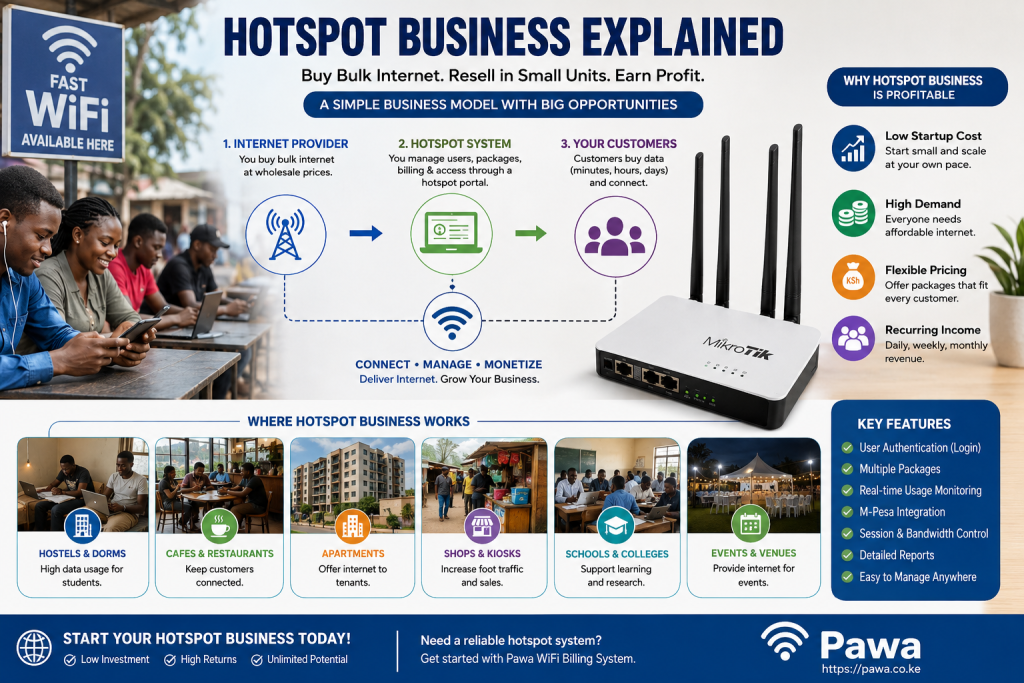
Introduction: Understanding Hotspot Business Explained
Definition: Hotspot business explained is when operators buy bulk internet and resell it in smaller increments through a login portal.
The question of what hotspot business explained really means is fundamental for anyone considering entry into Kenya’s growing WiFi services industry. Understanding hotspot business explained has become increasingly important as digital adoption accelerates and internet access demand intensifies across the country. This comprehensive guide explores everything you need to know about hotspot business explained, from basic concepts through advanced operational strategies.
Hotspot business explained is more than just a simple internet reselling operation. The sophistication of how hotspot business explained works has evolved dramatically, incorporating billing systems, customer management, network infrastructure, and strategic positioning. For entrepreneurs seeking to launch profitable ventures, mastering hotspot business explained is absolutely essential for success.
The evolution of hotspot business explained reflects Kenya’s changing technology landscape. Five years ago, hotspot business explained meant basic operations with simple billing. Today, hotspot business explained encompasses cloud-based systems, mobile payment integration, multi-location networks, and professional infrastructure that mirrors established ISP operations. Understanding hotspot business explained today means recognizing this operational complexity and sophistication.
This guide breaks down every component of hotspot business explained, helping you understand exactly how the model works, why it’s profitable, how to get started, and how to scale successfully. Whether you’re contemplating entry or already operating, deepening your understanding of hotspot business explained will improve your business results significantly.
Table of Contents
- Understanding the Model: Hotspot Business Explained Fundamentals
- The Business Model: How Hotspot Business Explained Works
- Revenue Streams: How Hotspot Business Explained Generates Profit
- Customer Base: Who Uses Hotspot Business Explained Services
- Market Opportunity: Why Hotspot Business Explained Thrives in Kenya
- Operational Structure: What Hotspot Business Explained Requires
- Technology Stack: Infrastructure Behind Hotspot Business Explained
- Pricing Strategies: How Hotspot Business Explained Monetizes Access
- Competitive Landscape: Understanding Hotspot Business Explained Competition
- Getting Started: Launching Your Hotspot Business Explained
- Scaling Your Operation: Growing Your Hotspot Business Explained
- Success Metrics: Measuring Hotspot Business Explained Performance
Foundation and Business Model Mechanics
Understanding the Model: Hotspot Business Explained Fundamentals
Before diving into operational details, establishing a solid foundation in what hotspot business explained fundamentally is will guide all subsequent decisions. Understanding hotspot business explained begins with recognizing it as a reselling model rather than infrastructure ownership.
At its core, hotspot business explained describes a business where operators acquire internet connectivity from upstream providers and redistribute that access to end users. Rather than building their own fiber networks (which would be prohibitively expensive), hotspot business explained operators leverage existing infrastructure, buying capacity at bulk rates and reselling at retail rates—capturing margin on the difference.
The elegance of hotspot business explained lies in its simplicity. One operator, one location, one internet connection can become a profitable business generating thousands of shillings monthly. Scale this model across multiple locations, and hotspot business explained can become a substantial revenue generator. This scalability is why hotspot business explained has attracted thousands of entrepreneurs across Kenya.
Understanding hotspot business explained also requires recognizing the customer relationship. Unlike traditional ISPs requiring annual contracts, hotspot business explained operations typically serve customers buying data for minutes, hours, or days. This flexibility—which represents a strength of hotspot business explained for customers—creates both opportunities and challenges for operators managing hotspot business explained.
The relationship between hotspot business explained and customer satisfaction is direct and immediate. When hotspot business explained delivers excellent speeds, customers purchase more data and recommend the service to friends. When hotspot business explained fails to deliver promised quality, customers migrate to competitors instantly. This instant feedback loop means that understanding hotspot business explained quality requirements is essential for success.
The Business Model: How Hotspot Business Explained Works
The mechanics of how hotspot business explained operates reveal why the model is so appealing to entrepreneurs and why it’s so sustainable when executed properly.
The Upstream-Downstream Dynamic: How Hotspot Business Explained Creates Margin
Hotspot business explained profit emerges from a simple dynamic: buying wholesale and selling retail. The upstream provider supplies hotspot business explained operators with high-speed, high-volume internet connectivity at bulk rates. Hotspot business explained operators then resell this connectivity in smaller increments at retail rates.
Example of how hotspot business explained generates profit:
- Upstream provider offers hotspot business explained operator: 20 Mbps dedicated connection for KES 5,000 monthly
- This hotspot business explained operator sells 1 GB bundles for KES 100
- At 5 Mbps average usage, 1 GB takes approximately 27 minutes to download
- In 8 operating hours daily, hotspot business explained can sell approximately 15-20 bundles daily
- Daily revenue from hotspot business explained: KES 1,500-2,000
- Monthly revenue from hotspot business explained: KES 45,000-60,000
- Monthly profit from hotspot business explained after connectivity cost: KES 40,000-55,000
This is why hotspot business explained is appealing—month-one profitability is achievable in decent locations. The capital required for hotspot business explained is minimal compared to profit potential, creating exceptional ROI.
Captive Portal Technology: The Infrastructure Behind Hotspot Business Explained
Understanding hotspot business explained requires understanding the captive portal—the technology enabling how hotspot business explained actually works at customer experience level.
When customers connect to a hotspot business explained network, their first request gets intercepted and redirected to a login page. This captive portal prompts customers to either create an account or purchase access. Once customers complete purchase (typically through M-Pesa), the portal grants them internet access. Hotspot business explained operators control this experience entirely through their billing platform.
This technical mechanism is what enables hotspot business explained business model to work. Without this captive portal technology, there would be no way to enforce pay-for-access, no way to collect payments, no way to manage subscriptions. Hotspot business explained relies entirely on this technology for feasibility.
The sophistication of captive portal systems used in modern hotspot business explained has improved dramatically. Advanced hotspot business explained portals integrate with M-Pesa, accept multiple payment methods, display advertisements, manage bandwidth allocation, and generate comprehensive analytics. This technological sophistication is what distinguishes professional hotspot business explained operations from amateur setups.
The Role of MikroTik RouterOS: Technical Foundation for Hotspot Business Explained
Professional hotspot business explained operations depend on MikroTik RouterOS—open-source networking operating system that enables the technical capabilities hotspot business explained requires. Understanding hotspot business explained requires understanding MikroTik’s role.
MikroTik RouterOS provides the infrastructure for hotspot business explained:
- Hotspot server functionality (captive portal)
- RADIUS authentication (integration with billing systems)
- Bandwidth management (enforcing speed limits)
- User authentication and access control
- IP addressing and network isolation
This is why hotspot business explained operators consistently choose MikroTik—it provides all technical capabilities hotspot business explained requires in a single, affordable platform. For hotspot business explained to be profitable at scale, this integrated approach is essential.
Revenue Streams: How Hotspot Business Explained Generates Profit
Hotspot business explained isn’t limited to simple data sales. Sophisticated operators understand multiple revenue streams available within hotspot business explained:
Primary Revenue: Data Sales Through Hotspot Business Explained
The primary revenue in hotspot business explained comes from data bundle sales. Understanding hotspot business explained pricing strategies:
Common hotspot business explained pricing models:
- 1 GB for KES 50-100
- 5 GB for KES 200-400
- Unlimited daily pass for KES 50-150
- Monthly subscriptions for KES 500-1,500
At decent locations, hotspot business explained operations serve 50-200 daily customers. With average customer spend of KES 100-150 daily, this translates to KES 5,000-30,000 daily revenue from hotspot business explained data sales alone.
The beauty of hotspot business explained is the passive nature once infrastructure is operational. Customers self-serve through the portal; no manual intervention required for hotspot business explained transactions.
Secondary Revenue: Advertising Through Hotspot Business Explained
Modern hotspot business explained operations include advertising opportunities within the captive portal. When customers connect, hotspot business explained operators can display ads from local businesses, earning commission on clicks or impressions.
Hotspot business explained advertising revenue typically generates:
- KES 1,000-3,000 monthly from smaller operations
- KES 10,000-20,000 monthly from high-traffic hotspot business explained locations
- This represents bonus revenue beyond primary data sales in hotspot business explained
Tertiary Revenue: Sponsored Content in Hotspot Business Explained
Some hotspot business explained operators partner with brands to display promotional content or offers to users when they connect. Hotspot business explained sponsored content might include:
- Mobile carrier promotions
- E-commerce platform advertising
- Financial services offers
- Hotspot business explained operators earning KES 2,000-8,000 monthly from partnerships
Affiliate Revenue: Monetizing Traffic in Hotspot Business Explained
Hotspot business explained traffic can be monetized through affiliate partnerships. When customers click through to partner sites, hotspot business explained operators earn commission on subsequent purchases.
Hotspot business explained affiliate revenue potential:
- Mobile money services (M-Pesa agent partnerships)
- Online betting platforms
- E-commerce platforms
- Insurance or financial services
- Average hotspot business explained affiliate earnings: KES 3,000-10,000 monthly
Customer Base: Who Uses Hotspot Business Explained Services
Understanding hotspot business explained requires understanding who benefits most from its value proposition. Different hotspot business explained customer segments have distinct needs:
Individual Consumers: The Core Hotspot Business Explained Market
Individual consumers seeking occasional internet access represent hotspot business explained’s largest customer base. These customers:
- Don’t have home WiFi
- Are traveling and need temporary connectivity
- Want to avoid home data plan depletion
- Prefer pay-as-you-go flexibility of hotspot business explained
Hotspot business explained appeals to this segment because it requires no contracts, no commitment, and no monthly subscriptions. Customers buy exactly what they need when they need it.
Students: Growing Hotspot Business Explained Market Segment
Students using hotspot business explained for studying, research, and communication:
- Need affordable data options (students budget-conscious)
- Study in groups (locations with hotspot business explained attract student study groups)
- Prefer pay-per-bundle over monthly subscriptions
- Represent loyal customer base for hotspot business explained
Hotspot business explained locations near schools and universities typically see strong student demand. Building brand loyalty among students ensures consistent hotspot business explained revenue.
Remote Workers: Emerging Hotspot Business Explained Segment
Remote workers utilizing hotspot business explained for:
- Backup connectivity when home internet fails
- Working from café or public spaces (increasing trend in Kenya)
- Flexibility of temporary connectivity
- Mobile work requirements
This segment represents growing hotspot business explained opportunity as remote work adoption increases in Kenya.
Businesses: Corporate Hotspot Business Explained Customers
Small businesses use hotspot business explained for:
- Guest WiFi in retail spaces
- Employee connectivity in mobile operations
- Temporary office connectivity
- Cost-effective backup internet
Corporate hotspot business explained customers typically have higher data consumption and spend more than individual consumers, improving hotspot business explained profitability significantly.
Market Opportunity: Why Hotspot Business Explained Thrives in Kenya
Kenya’s market conditions create exceptional opportunity for hotspot business explained:
Internet Penetration: Why Hotspot Business Explained Market is Growing
Kenya’s internet penetration sits around 45-50% of population—substantially below developed nations but representing millions of potential hotspot business explained customers. This gap represents opportunity: those without home internet need hotspot business explained services for connectivity.
Growing internet awareness means more people understand value of hotspot business explained and are willing to pay for access. As Kenya develops economically, this willingness increases.
Mobile-First Market: Why Hotspot Business Explained Works in Kenya
Kenya is a mobile-first market where smartphones outnumber computers 10:1. Hotspot business explained caters perfectly to mobile-first users who expect portable connectivity, quick transactions, and flexible payment options. This market characteristic makes hotspot business explained exceptionally well-suited to Kenya.
M-Pesa Integration: Why Hotspot Business Explained Thrives in Kenya
M-Pesa integration enables hotspot business explained payment processing without requiring credit cards or complex payment infrastructure. Customers with basic phones can purchase hotspot business explained access instantly through M-Pesa, reducing friction and increasing conversion.
This payment ecosystem advantage is why hotspot business explained thrives in Kenya compared to other markets. Hotspot business explained in countries without M-Pesa-equivalent services face greater payment friction.
Urban Growth: Why Hotspot Business Explained Locations Matter
Kenya’s rapid urbanization creates densely populated areas where hotspot business explained can serve large customer concentrations from single locations. Urban areas—where hotspot business explained is most concentrated—have highest market opportunity.
Unreliable Home Connectivity: Why Hotspot Business Explained Demand Remains High
Many Kenyans lack reliable home internet or find costs prohibitive. Hotspot business explained offers affordable alternative that works on-demand. This reliability gap ensures sustained hotspot business explained demand.
Operational Structure: What Hotspot Business Explained Requires
Hotspot business explained operations require multiple components working together:
Physical Infrastructure for Hotspot Business Explained
Hotspot business explained requires:
- Location: Strategic site with foot traffic and target customer base
- Internet connection: Upstream bandwidth from ISP (KES 3,000-10,000 monthly)
- Router: MikroTik or equivalent (KES 3,000-20,000)
- Access points: WiFi coverage equipment (KES 2,500-10,000)
- Modem: External connectivity device (KES 2,000-5,000)
- Security: Surveillance and theft protection (KES 5,000-15,000)
Total physical infrastructure for basic hotspot business explained: KES 20,000-60,000
Software Infrastructure for Hotspot Business Explained
Hotspot business explained also requires:
- Billing system: Manages customer accounts and payments (Pawa WiFi or equivalent)
- Captive portal: Customer-facing login interface
- Payment gateway integration: M-Pesa and other payment methods
- Analytics platform: Performance tracking and reporting
- Security systems: Encryption, authentication, fraud prevention
Professional hotspot business explained billing platforms cost KES 2,000-5,000 monthly or KES 24,000-60,000 annually.
Staffing for Hotspot Business Explained
How many people does hotspot business explained require?
- Solo operation: One person can run basic hotspot business explained from home/shop
- Single location: Usually one technician sufficient for hotspot business explained management
- Multiple locations: Requires dedicated manager plus technicians for each hotspot business explained site
Staffing is where hotspot business explained scales most efficiently—one operator can manage multiple locations remotely using cloud-based systems.
Technology Stack: Infrastructure Behind Hotspot Business Explained
The technology choices directly impact hotspot business explained profitability and reliability:
Billing Platform: The Heart of Hotspot Business Explained
The billing platform is central to hotspot business explained operations. Pawa WiFi exemplifies modern hotspot business explained billing solutions with:
- Cloud-based infrastructure (reliability for hotspot business explained)
- M-Pesa integration (payment processing for hotspot business explained)
- Multi-location management (scaling hotspot business explained across sites)
- Real-time analytics (performance tracking for hotspot business explained)
- Automatic failover (continuity for hotspot business explained)
Choosing professional billing platform dramatically improves hotspot business explained success rates compared to self-hosted or basic solutions.
Router and Access Point: Hotspot Business Explained Connectivity
The hardware selection impacts hotspot business explained performance:
- Budget approach: Used equipment, KES 3,000-8,000 total (suitable for solo hotspot business explained)
- Professional approach: New equipment, KES 15,000-30,000 total (for scaling hotspot business explained)
- Enterprise approach: Redundant systems, KES 50,000+ (for multi-location hotspot business explained)
Professional hotspot business explained requires reliable equipment reducing downtime risk.
Payment Processing: Critical for Hotspot Business Explained
M-Pesa integration is non-negotiable for hotspot business explained in Kenya. The best hotspot business explained solutions integrate:
- STK Push (customer-initiated M-Pesa prompts)
- Mobile money APIs (automatic payment processing)
- Multiple payment methods (flexibility for hotspot business explained customers)
- Reconciliation systems (automatic verification for hotspot business explained accuracy)
Payment integration quality directly impacts hotspot business explained conversion rates and customer satisfaction.
Strategies, Scaling, and Success
Pricing Strategies: How Hotspot Business Explained Monetizes Access
Pricing is critical to hotspot business explained profitability. Poor pricing destroys potential profit; strategic pricing maximizes returns.
Data Bundle Pricing: Core Hotspot Business Explained Revenue
Hotspot business explained pricing varies by:
- Location: Premium locations (CBD) command higher prices for hotspot business explained
- Speed: Faster connections justify premium hotspot business explained pricing
- Competition: More competitors force lower hotspot business explained prices
- Target market: Budget customers prefer cheap hotspot business explained; corporate customers accept premium pricing
Typical hotspot business explained pricing tiers:
- Entry level: 500 MB for KES 30-50 (budget hotspot business explained customers)
- Standard: 1 GB for KES 50-100 (average hotspot business explained purchase)
- Premium: 5 GB for KES 200-400 (power users of hotspot business explained)
- Ultimate: Unlimited daily for KES 100-200 (high-volume hotspot business explained customers)
Offering tiered hotspot business explained pricing captures different customer segments and maximizes total revenue compared to single-price approach.
Time-Based Pricing: Alternative Hotspot Business Explained Model
Some hotspot business explained operators price by duration rather than data:
- 1 hour: KES 30-50
- 4 hours: KES 80-120
- 24 hours: KES 150-250
Time-based hotspot business explained pricing works well for casual users and café locations where customers stay limited periods.
Subscription Pricing: Loyalty-Building Hotspot Business Explained Strategy
Monthly subscriptions capture committed hotspot business explained customers:
- Basic: KES 500 monthly (10 GB)
- Standard: KES 1,000 monthly (30 GB)
- Premium: KES 1,500 monthly (unlimited)
Subscription hotspot business explained customers provide predictable recurring revenue and higher lifetime value.
Dynamic Pricing: Advanced Hotspot Business Explained Strategy
Sophisticated hotspot business explained operations adjust prices based on demand:
- Peak hours: Higher prices for hotspot business explained
- Off-peak: Lower prices to fill capacity in hotspot business explained
- Demand-based: Premium pricing when network nearing capacity for hotspot business explained
- Seasonal: Higher prices during holidays for hotspot business explained
Dynamic hotspot business explained pricing maximizes revenue from finite bandwidth.
Getting Started: Launching Your Hotspot Business Explained
Turning hotspot business explained understanding into actual business requires execution. How to launch hotspot business explained:
Step 1: Choose Your Hotspot Business Explained Location
Location determines hotspot business explained success more than any other factor. Evaluate hotspot business explained potential locations by:
- Foot traffic: High traffic enables higher hotspot business explained revenue
- Target market: Students, office workers, travelers each suit different hotspot business explained locations
- Competition: Assess existing hotspot business explained networks in area
- Internet availability: Ensure upstream connectivity available for hotspot business explained
- Rent affordability: Site cost must be profitable for hotspot business explained operations
Best hotspot business explained locations include: shopping centers, transport hubs, schools, universities, office parks, cafés.
Step 2: Secure Upstream Connectivity for Hotspot Business Explained
Contact local ISPs to arrange hotspot business explained internet service. Negotiate:
- Bandwidth: Adequate for projected hotspot business explained customer base
- Price: Wholesale rates for hotspot business explained operators (typically KES 3,000-10,000 monthly)
- Service level: Uptime guarantees important for hotspot business explained reliability
- Support: Responsive support critical for hotspot business explained service continuity
For hotspot business explained scaling, consider multiple providers for redundancy.
Step 3: Select Hotspot Business Explained Hardware
Choose equipment appropriate for hotspot business explained scale:
- Router: MikroTik RB951G-2HnD (entry) to RB2011UiAS (professional) for hotspot business explained
- Access points: TP-Link, Ubiquiti, or Mikrotik depending on hotspot business explained budget
- Modem: Required for hotspot business explained connectivity from ISP
- Installation materials: Cables, connectors, mounting equipment for hotspot business explained setup
Total hardware investment for basic hotspot business explained: KES 15,000-40,000
Step 4: Select Hotspot Business Explained Billing Platform
Choose professional hotspot business explained solution:
- Cloud-based (reliability for hotspot business explained)
- M-Pesa integrated (payment processing for hotspot business explained)
- Multi-location capable (future hotspot business explained scaling)
- Affordable pricing (reasonable cost for hotspot business explained startup)
Pawa WiFi represents ideal hotspot business explained platform meeting all these criteria.
Step 5: Configure Hotspot Business Explained Network
Set up network components for hotspot business explained:
- Configure router and access points for hotspot business explained
- Set up RADIUS authentication linking hotspot business explained billing to hardware
- Test captive portal and payment processing for hotspot business explained
- Verify coverage across intended hotspot business explained service area
- Document configuration for future reference and hotspot business explained troubleshooting
Step 6: Test Hotspot Business Explained Systems
Before launch, thoroughly test hotspot business explained:
- Customer connection experience
- Payment processing (M-Pesa specifically)
- Speed performance
- Coverage at edges of service area
- Different device compatibility (phones, tablets, laptops) for hotspot business explained access
Step 7: Market Your Hotspot Business Explained Service
Promote hotspot business explained:
- Social media (WhatsApp, Facebook, Instagram) about your hotspot business explained
- Physical signage at location advertising hotspot business explained
- Word-of-mouth through friends and family regarding hotspot business explained
- Special promotions (discounts, loyalty rewards) to drive hotspot business explained adoption
Step 8: Launch and Optimize Hotspot Business Explained
Begin operations and continuously optimize:
- Monitor hotspot business explained customer feedback
- Track revenue and profitability of hotspot business explained operation
- Adjust pricing based on hotspot business explained market response
- Improve coverage or equipment if needed for hotspot business explained expansion
- Build customer base through quality service for growing hotspot business explained
Scaling Your Operation: Growing Your Hotspot Business Explained
Successful hotspot business explained single-location operations can expand:
Multi-Location Hotspot Business Explained Strategy
Scaling hotspot business explained to multiple locations requires:
- Unified billing system: Cloud platform managing all hotspot business explained sites centrally
- Consistent branding: Same SSID and portal experience across hotspot business explained locations
- Centralized management: Dashboard controlling all hotspot business explained operations
- Shared infrastructure: Leveraging backend systems for multiple hotspot business explained sites
This enables operators to manage 5-10 hotspot business explained locations with minimal additional staff.
Franchise Hotspot Business Explained Model
Some successful hotspot business explained operators franchise their model:
- Provide hotspot business explained training to franchisees
- Supply hotspot business explained equipment at wholesale rates
- Manage billing and backend for franchisees’ hotspot business explained operations
- Receive percentage of franchisees’ hotspot business explained revenue
Franchising accelerates hotspot business explained scaling without capital intensity.
Corporate Hotspot Business Explained Contracts
Scaling hotspot business explained includes targeting corporate customers:
- Provide WiFi for offices (hotspot business explained as service for companies)
- Supply connectivity for retail chains (hotspot business explained enabling customer WiFi)
- Partner with property management (hotspot business explained as tenant amenity)
Corporate hotspot business explained contracts provide stable, high-volume revenue.
Success Metrics: Measuring Hotspot Business Explained Performance
To optimize hotspot business explained, track these metrics:
Revenue Metrics for Hotspot Business Explained
- Daily revenue: Track daily hotspot business explained sales trends
- Monthly revenue: Comprehensive hotspot business explained financial performance
- Customer acquisition cost: How much does each hotspot business explained customer cost to acquire
- Customer lifetime value: How much revenue does average hotspot business explained customer generate
These metrics reveal hotspot business explained financial health and profitability.
Customer Metrics for Hotspot Business Explained
- Active customers: Number of customers using hotspot business explained daily
- Repeat customers: Percentage returning to hotspot business explained (loyalty indicator)
- Customer satisfaction: NPS or satisfaction ratings for hotspot business explained
- Customer churn: Percentage abandoning hotspot business explained
Customer metrics reveal whether hotspot business explained experience satisfies market.
Network Metrics for Hotspot Business Explained
- Uptime: Percentage of time hotspot business explained network operates (target: 99%+)
- Average speed: Actual speeds customers achieve on hotspot business explained
- Peak connections: Maximum simultaneous users on hotspot business explained
- Data volume: Total data processed through hotspot business explained
Network metrics indicate hotspot business explained infrastructure quality.
Competitive Landscape: Understanding Hotspot Business Explained Competition
The hotspot business explained market includes multiple competitors:
Other Hotspot Business Explained Operators
Individual entrepreneurs running hotspot business explained single locations. These competitors:
- Have local knowledge of hotspot business explained market
- Can offer competitive hotspot business explained pricing
- May lack professional infrastructure for hotspot business explained
- Represent lowest-barrier-to-entry hotspot business explained competition
Established ISPs Offering Hotspot Business Explained
Major carriers like Safaricom, Airtel, and fiber companies offer hotspot business explained services:
- Have vast infrastructure advantage
- Offer premium hotspot business explained service quality
- Command higher hotspot business explained prices
- Represent strongest hotspot business explained competition but serve different market segment
Mobile Hotspot Business Explained Alternatives
Smartphone mobile hotspot and USB dongles represent hotspot business explained substitutes:
- No infrastructure requirements for hotspot business explained
- More expensive per GB than hotspot business explained
- Less convenient than hotspot business explained for some use cases
- Indirect hotspot business explained competition
Related Resources for Hotspot Business Explained
SpaceKits WiFi Hardware Solutions – Complete hardware and equipment options for launching and scaling your hotspot business explained infrastructure, from entry-level setups to professional multi-location deployments enabling hotspot business explained growth.
Pawa WiFi Billing Platform – Professional cloud-based billing solution powering hotspot business explained operations with M-Pesa integration, multi-location management, and real-time analytics essential for successful hotspot business explained.
Pawa WiFi Implementation Guide – Step-by-step technical guidance for implementing hotspot business explained infrastructure and configuring all components necessary for launch and optimization of hotspot business explained.
SpaceKits Financing Options – Equipment financing solutions enabling entrepreneurs to launch hotspot business explained with flexible payment terms, making initial investment more manageable for hotspot business explained startup.
Conclusion: Mastering Hotspot Business Explained
Understanding hotspot business explained is the foundation for entering Kenya’s thriving internet access market. Hotspot business explained is fundamentally a reselling model—acquiring bulk connectivity and redistributing to retail customers—but when executed professionally, hotspot business explained generates substantial profit with minimal capital investment.
The key insights about hotspot business explained:
Hotspot business explained profitability is proven. Month-one profitability is achievable in viable locations, and annual returns of 200-500% on initial investment are realistic with proper execution of hotspot business explained.
Hotspot business explained is scalable. What begins as single-location hotspot business explained can expand to multi-location networks, franchises, or corporate contracts, enabling operators to scale substantially.
Hotspot business explained requires professional infrastructure. While basic hotspot business explained is possible with minimal equipment, professional-grade billing systems, reliable connectivity, and quality hardware distinguish successful hotspot business explained from struggling operations.
Hotspot business explained depends on market selection. Location matters more than any other variable for hotspot business explained success. High-traffic areas with target customer concentration enable thriving hotspot business explained operations.
Hotspot business explained success requires customer focus. The best hotspot business explained operators prioritize customer experience—reliable service, competitive pricing, excellent support—creating loyalty and word-of-mouth growth.
Kenya’s market conditions create exceptional opportunity for hotspot business explained. Growing internet demand, mobile-first users, M-Pesa payment ecosystem, and urban growth all support hotspot business explained expansion. For entrepreneurs seeking profitable ventures with manageable capital requirements, hotspot business explained represents compelling opportunity.
With clear understanding of how hotspot business explained works, thorough planning, professional infrastructure, and customer focus, you can build successful hotspot business explained operations contributing to Kenya’s digital transformation while generating personal wealth.
Start your hotspot business explained journey today. The market rewards entrepreneurs who execute well, and with knowledge in this comprehensive guide, you’re positioned to succeed.