
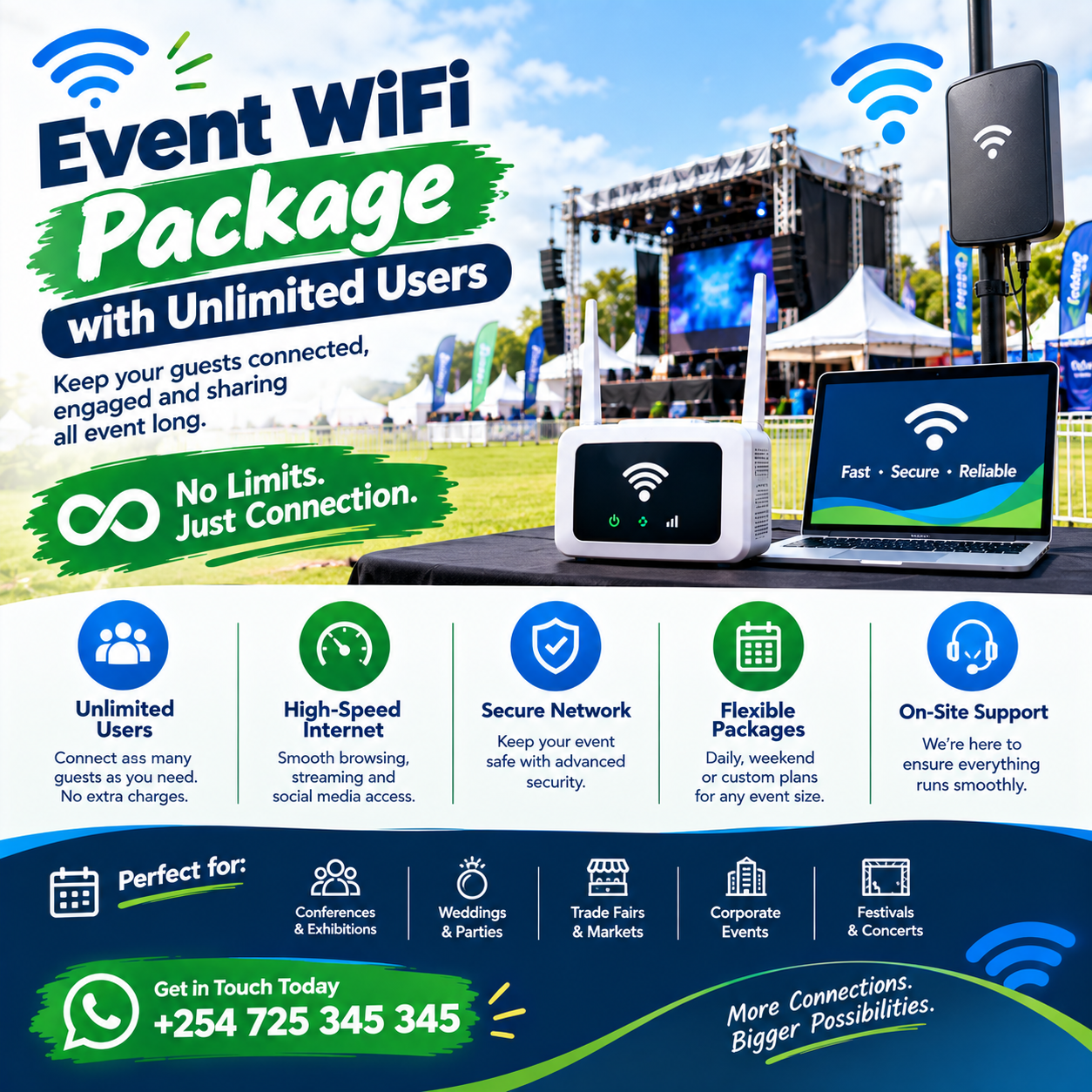
An event WiFi package with unlimited users is one of the most attractive products in the entire connectivity trade — a single offering that tells every organizer the same beautiful thing: bring as many people as you want, and the network will serve every last one of them.
Weddings of five hundred. Conventions of five thousand. Tournaments, expos, crusades, and graduations where nobody knows the final headcount until the day itself.
For organizers, the scariest question about event connectivity has always been capacity: what happens if more people show up than the package covers?
An event WiFi package with unlimited users deletes that question entirely — one price, one agreement, and every device in the crowd welcome.
For operators, it is equally powerful: a product that sells on simplicity, prices with confidence, and removes the awkward moments when a crowd outgrows a metered plan.
This article walks through the complete picture: what the unlimited-user package really involves, how to engineer it honestly, how to price it profitably, and why organizers reach for it first.
Because “unlimited” is a promise — and the operators who structure an event WiFi package with unlimited users properly are the ones who keep it, event after event, with a reputation that fills the calendar.
Table of Contents
ToggleWhat an Event WiFi Package With Unlimited Users Actually Is
Strip away the jargon and the concept is refreshingly clear.
An event WiFi package with unlimited users is a single, all-inclusive connectivity offering: the organizer pays one price, and every attendee, vendor, and guest at the event can connect — no device caps, no per-user fees, no headcount estimates required.
The package bundles everything the event needs: the bandwidth, the equipment, the setup, the support, and the entire day of service.
From the organizer’s side, it reads like the simplest line item on any event budget — one entry, one price, zero complexity.
From the operator’s side, it is a carefully engineered product wearing a simple face, because “unlimited users” never means “unlimited engineering.”
Behind the scenes, the operator has sized the backbone, planned the access points, and tuned the bandwidth rules so the network performs for the crowd the organizer actually expects.
The honesty inside an event WiFi package with unlimited users is what makes it work: the operator prices for reality, then delivers simplicity to the customer.
Attendees experience it as the friendliest connectivity possible — they connect, and they browse, with no packages to choose and no payments to make.
The organizer experiences it as risk removal: whatever the headcount turns out to be, the agreement already covers it.
That dual simplicity — effortless for the crowd, predictable for the planner — is the entire appeal of an event WiFi package with unlimited users.
Why Unlimited Users Is a Sales Superpower
The commercial magic of an event WiFi package with unlimited users lies in the anxieties it removes from the buying decision.
Every organizer planning an event lives with uncertainty: the guest list that grows, the plus-ones who arrive unannounced, the vendors who bring five devices each.
A metered package forces the organizer to guess — and every wrong guess becomes a mid-event crisis or an awkward overpayment.
An unlimited package converts that guessing game into one clean number, which is why organizers reach for it first.
The psychology is the same one that makes all-you-can-eat buffets popular: certainty feels like value, even when the average customer uses less than the maximum.
Operators selling an event WiFi package with unlimited users report the same pattern in every pitch meeting: the moment “unlimited” is mentioned, the negotiation shifts from “can we afford this” to “when can you deliver.”
The second superpower is the word-of-mouth effect inside the event.
Attendees who connect easily tell each other, and the crowd’s collective experience becomes part of the event’s success story.
Organizers remember whose WiFi worked, and the event WiFi package with unlimited users that delivered becomes the default booking for every future gathering.
The third superpower is pricing confidence: the operator prices for the crowd they expect, builds headroom for the crowd that arrives, and profits either way.
That confidence is invisible to the customer — and it is exactly what a well-built event WiFi package with unlimited users is designed to protect.
The Business Models Behind the Unlimited Package
An event WiFi package with unlimited users earns through several structures, and the strongest operators learn to offer the one that fits each event.
The first and most common is the flat organizer contract: the planner pays one fixed price, and the operator delivers coverage for every attendee.
This model thrives at weddings, conferences, and corporate events where the organizer controls the budget and wants one clean invoice.
The second is the sponsor-funded package: a brand, bank, or telco pays the flat fee, and every attendee browses free beneath the sponsor’s banner.
This structure turns the event WiFi package with unlimited users into advertising inventory — the sponsor buys the crowd’s goodwill, and the operator collects from the sponsor instead of the crowd.
The third is the hybrid: the organizer covers a baseline package, and premium add-ons — guaranteed speeds for media teams, dedicated vendor lines — are sold on top.
That layering lets the operator serve the whole crowd through the event WiFi package with unlimited users base while capturing extra revenue from the heavy users.
The fourth model is venue-based: grounds, stadiums, and conference centers buy an annual unlimited arrangement and offer connectivity as part of their own package.
Each model shares the same core: one unlimited promise, engineered once, sold many times.
The operators who master the event WiFi package with unlimited users across all four structures build businesses that no single model could support alone.
Engineering “Unlimited” Honestly
The phrase “unlimited users” is a promise, and the engineering behind an event WiFi package with unlimited users is what turns that promise into performance.
Unlimited never means infinite — it means the operator has planned for the realistic maximum and built margin beyond it.
The first engineering step is the device forecast: expected attendance, times a realistic connection rate, plus the vendor and staff devices that never appear on any guest list.
A wedding of four hundred might mean six hundred devices by the time phones, tablets, and vendor equipment are counted.
The second step is backbone sizing: bandwidth chosen not for the average moment but for the peak — the speech everyone streams, the photos everyone uploads, the final everyone watches.
Professionals engineering an event WiFi package with unlimited users provision the backbone for the busiest single hour of the day, not the average of all hours.
The third step is distribution: access points placed by crowd zones rather than by convenience, elevated, and tested at the actual venue.
The fourth step is bandwidth governance: per-user speed profiles that let every connected device browse comfortably while no single streamer starves the room.
That governance is what makes the unlimited promise survivable — the event WiFi package with unlimited users shares its bandwidth deliberately instead of hoping for the best.
The fifth step is the stress test: a trial load pushed through the system before the event, proving the design rather than assuming it.
Operators who engineered this way describe the same experience: their “unlimited” packages survived every crowd they met, because the limits were engineered out before the doors ever opened.
The Fair-Use Architecture Nobody Sees
Here is the professional secret inside every successful event WiFi package with unlimited users: unlimited access coexists with invisible fair-use rules.
The attendee experience is simple — connect and browse, no limits, no choices, no payment prompts.
The engineering underneath is deliberate: per-device speed profiles that guarantee comfortable browsing to everyone while capping the extremes.
Video streaming at standard quality, background downloads throttled, and interactive traffic like calls and messaging prioritized — the event WiFi package with unlimited users manages its bandwidth the way a good host manages a buffet.
Nobody feels restricted, because the rules are tuned to the experience rather than the megabytes.
Priority tiers add refinement where contracts demand it: the organizer’s operations table, the media team, and the VIP zone can carry elevated speeds inside the same unlimited umbrella.
Device binding quietly protects the capacity too: each connection tied to a device, blocking the one abuser whose tethering would have shared the network with the parking lot.
These invisible disciplines are why the event WiFi package with unlimited users performs at its peak hour instead of collapsing into the slideshow that metered and unmanaged networks become.
The attendees never see the machinery — they simply find that the network stayed fast from the first speech to the last dance.
That invisibility is the craft, and it is what separates engineered unlimited packages from hopeful ones.
Pricing the Unlimited Package
Pricing is where an event WiFi package with unlimited users either becomes a bestseller or a loss leader — and the professionals price with a clear method.
The first input is cost: the bandwidth for the day, the equipment depreciation, the crew hours, the transport, and the support commitment.
The second input is value: what the unlimited promise is worth to an organizer who would otherwise gamble on metered plans and headcount guesses.
The third input is the anchor: what the organizer is already spending on sound, décor, photography, and catering — connectivity priced as a small fraction of production feels effortless.
Operators pricing an event WiFi package with unlimited users against the event budget, rather than against their own costs, consistently find room for healthy margins.
The fourth input is size tiering: the same unlimited promise priced by expected scale — an intimate wedding, a mid-size conference, and a stadium convention each carry their own figure.
That tiering keeps the promise intact while matching the price to the engineering behind it.
The fifth input is the add-on ladder: guaranteed media speeds, dedicated vendor lines, and extended-hours coverage priced separately on top of the base package.
Veterans of the event WiFi package with unlimited users trade all repeat the same pricing rule: sell the simplicity, price the engineering, and never apologize for either.
Because the organizer is not buying megabytes — the organizer is buying the certainty that whatever happens, the network holds.
The M-Pesa and Payment Layer
The payment flow inside an event WiFi package with unlimited users is refreshingly different from retail hotspot work — because the big transaction happens before the crowd arrives.
The organizer’s payment completes through the same trusted rails: an M-Pesa push, a PIN, an instant confirmation, and a receipt that joins the event budget’s paperwork.
That clean pre-payment is why unlimited packages suit operators financially: the day’s income is largely secured before the first guest parks.
On the day itself, the attendees never pay at all — the event WiFi package with unlimited users opens its doors to every device without a prompt, a portal choice, or a single shilling changing hands.
The add-on layer revives the retail flow where it fits: media teams buying guaranteed-speed upgrades and vendors adding dedicated lines pay through the same automated M-Pesa flow.
Every transaction, organizer or add-on, lands in the platform’s records — timestamped, reconciled, and reportable.
For the operator running multiple events, that reporting becomes the business’s memory: revenue per event, per package type, per add-on tier.
And the organizer’s receipt does double duty — it is both a payment record and the proof of service that earns the event WiFi package with unlimited users provider the next booking.
That financial cleanliness, from deposit to final invoice, is one of the model’s quiet advantages over per-session retail work.
Selling to Organizers: The Pitch That Wins
The commercial skill behind the event WiFi package with unlimited users is the pitch — and winning operators follow a strikingly consistent approach.
They lead with the organizer’s nightmare, not the technology: “what happens when three hundred extra guests arrive and the network folds?”
Then they answer it with the product: one package, unlimited users, and the headcount worry deleted from the plan.
They bring proof rather than promises — photos of past deployments, speed readings taken at comparable events, and the contacts of organizers who watched the work.
They translate the product into event outcomes: guests who stay connected stay longer, spend more, share more, and leave happier.
They show the sponsor angle: the organizer’s own partners can fund the event WiFi package with unlimited users and take the branding on every connection.
And they close with the simplest terms in the trade: one price, unlimited users, full-day coverage, and a named contact who answers on the day.
The organizer who hears that pitch against the backdrop of a past network failure signs quickly — and stays signed for every event after.
Operators who refined this pitch report a telling pattern: unlimited packages became their lead offer, with everything else sold as attachments to it.
That product-led selling is how the event WiFi package with unlimited users moved from a niche option to the anchor of the event connectivity business.
The Event Day, Hour by Hour
The rhythm of a delivered event WiFi package with unlimited users tells the model’s story better than any theory.
Morning: the crew arrives early, mounts the access points in the proven positions, connects the backbone, and runs the verification tests while the venue is quiet.
A final check of the unlimited portal confirms the welcome screen every device will see — branded, friendly, and free of any payment prompt.
Gates open, and the connections begin: phones finding the network in the parking lot, the lobby, the first rows of seats.
By the opening session, hundreds of devices ride the event WiFi package with unlimited users — and the dashboard shows the load exactly where the capacity plan said it would be.
Midday is the peak: every guest connected, vendors taking payments, media uploading, and the network holding its speed because the engineering left no room for surprises.
The crew monitors quietly from a corner table — a dashboard glance here, a signal check there — invisible the way good infrastructure should be.
Afternoon holds steady: the crowd’s rhythm shifts but the coverage follows, from the main stage to the breakout tents to the catering area.
Evening brings the finale, and the network carries it — the last speeches streamed, the closing photos uploaded, the goodbyes shared online in real time.
Strike-down reverses the morning: equipment packed, records archived, and the day’s report prepared for the organizer.
That report — connections served, uptime, zero incidents — is the event WiFi package with unlimited users delivery note, and it doubles as the booking confirmation for next season.
The Mistakes That Break an Unlimited Promise
The recurring failures are well known, and naming them is cheaper than making them.
The first is the unverified venue: signal assumed rather than tested, and an event WiFi package with unlimited users discovering its weak backbone while the crowd watches.
The second is the undersized backbone: unlimited sold as a word rather than engineered as a capacity, and the peak hour becoming the day’s embarrassment.
The third is missing the vendor load: guest counts planned while the thirty vendors with five devices each went unnoticed, and the network buckling under the uncounted.
The fourth is no fair-use tuning: one streamer consuming the shared bandwidth while a hall of guests waits, and the unlimited promise dying in a single afternoon.
The fifth is skipping the crew: the operator selling the event WiFi package with unlimited users and then leaving it unattended, with no one present when a support question arrives.
The sixth is the vague contract: “unlimited” written without scope — hours, zones, add-ons — and the disagreement arriving with the invoice.
The seventh is the hard stop at the contracted end-time: the wedding running long and the network switching off during the speeches that mattered most.
Grace hours and clear scope terms exist precisely to prevent that moment.
Each mistake is avoidable with the same discipline — test the venue, engineer the peak, count the vendors, tune the sharing, and write the scope down.
The operators who kept those habits watch their unlimited packages become the product planners ask for by name, which is the quiet triumph of the event WiFi package with unlimited users done right.
From One Event to a Standing Calendar
The deepest advantage of the event WiFi package with unlimited users is that events recur — and operators who plan for recurrence build calendars instead of hustles.
The first layer is the organizer relationship: every planner who watched an unlimited package absorb a bigger-than-expected crowd becomes a loyal repeat client.
The certainty they bought once is the certainty they buy again — and recommend to every planner in their network.
The second layer is the venue list: grounds, halls, and stadiums that hosted one flawless deployment call for the next, and eventually negotiate standing arrangements.
A event WiFi package with unlimited users operator holding two or three venue relationships holds a pipeline that fills itself.
The third layer is the service ladder: the operator who delivered basic unlimited graduates to media tiers, vendor lines, and multi-day festival coverage — each rung priced above the last.
The fourth layer is the crew: a second kit and a trained assistant let the operator serve two unlimited contracts on the same Saturday.
That duplication is how the solo operator becomes an enterprise — two events running in parallel, both managed from one dashboard.
The operators who scaled this way all followed the same sequence: prove the package once, document the engineering, then clone both.
That discipline is what turns an event WiFi package with unlimited users offering from a weekend job into a standing business with a waiting list.
The Sponsor Stack: Two Incomes From One Crowd
The most profitable deployments stack a sponsor on top of the event WiFi package with unlimited users — and the structure benefits every party at once.
The organizer’s connectivity budget shrinks or disappears: the sponsor funds the unlimited package, and the event’s WiFi carries the sponsor’s name.
The sponsor receives what no billboard can offer: the gratitude of every guest whose browsing they made possible, delivered at the moment of connection.
“Today’s WiFi is brought to you by…” appears on every welcome screen — a brand placement woven into the event’s experience rather than interrupting it.
The operator collects the same fee either way — from the organizer or from the sponsor — while the event WiFi package with unlimited users delivers identical service.
Sponsors renew because the placement works: banks, telcos, and beverage brands all recognize the value of being the reason a thousand phones connected.
Operators who brokered these arrangements describe them as the easiest upsell in the trade — the organizer introduces the sponsor, the sponsor sees the audience, and the deal closes at the planning table.
That stacking turns one unlimited deployment into a relationship between three businesses, all of whom win.
And the operator who brokers it once holds the template for every future event — the event WiFi package with unlimited users as both a service and a sponsorship vehicle.
The Payoff, Counted Honestly
Ask operators a year into selling the unlimited model what it delivered, and the answers converge.
Premium income: one unlimited contract earning what a dozen retail sessions would, collected before the event begins rather than chased through it.
A reputation for certainty: the operator whose network absorbed every crowd it met becoming the name planners exchange in the WhatsApp groups where vendors are chosen.
Simplified operations: no per-user management, no payment disputes on the day, no headcount reconciliation — the package’s simplicity serving the operator as much as the client.
And a compounding calendar: every flawless event booking the next, until the season’s Saturdays are spoken for by spring.
None of it required exotic technology or unusual capital — only the engineering honesty to stand behind the word “unlimited” and the sales clarity to price it properly.
That combination is the complete case for the event WiFi package with unlimited users: the crowds were always going to be unpredictable, and the package that embraces that unpredictability is the one that wins the events.
The operators who built it describe the shift the same way: they stopped selling connectivity by the head and started selling peace of mind by the day.
And peace of mind, delivered flawlessly at the moments that matter most, is the product planners never stop buying.
Frequently Asked Questions
Does “unlimited users” really mean no limits at all?
It means no limits on who can connect — the engineering underneath manages speeds fairly so every user gets a good experience.
A properly built event WiFi package with unlimited users welcomes every device while governing the bandwidth invisibly.
How many users can one unlimited package actually serve?
A professionally engineered deployment comfortably serves several hundred to several thousand devices, depending on the backbone and equipment tier.
The operator sizes the event WiFi package with unlimited users to the event’s expected scale and builds headroom beyond it.
What happens if more people show up than expected?
Nothing visible — the package’s headroom absorbs the extra devices, which is precisely the promise the organizer paid for.
That absorption capacity is the core engineering behind every event WiFi package with unlimited users worth its name.
Who pays — the organizer or the attendees?
The organizer pays the package, and attendees connect free; sponsors can fund the package instead, with their branding on every connection.
Both flows run through the same platform behind the event WiFi package with unlimited users, recorded and receipted automatically.
Can heavy users slow things down for everyone?
No — fair-use speed profiles cap the extremes while keeping everyone’s browsing comfortable, invisible to the people it protects.
That governance is what keeps an event WiFi package with unlimited users fast at its peak hour.
Can media teams get guaranteed speeds within the package?
Yes — premium add-on tiers deliver elevated, guaranteed speeds for upload-heavy work on top of the unlimited base.
Operators structure these as sellable upgrades, adding revenue to the event WiFi package with unlimited users without complicating the core promise.
What happens if the event runs past its contracted hours?
Grace hours and clear scope terms handle it — professional contracts define the end-time behavior before the event begins.
The operators who wrote those terms into every event WiFi package with unlimited users never face the mid-speech shutdown.
Is this model profitable for the operator?
Highly — one unlimited contract often out-earns dozens of retail sessions, and the income arrives before the event rather than during it.
Operators who priced the event WiFi package with unlimited users against event budgets rather than their own costs found consistent, healthy margins.
How do I convince an organizer to choose unlimited over metered?
Lead with their nightmare — the crowd that outgrew the plan — and answer it with the one-price, no-headcount promise.
The organizer who has lived a network failure signs for the event WiFi package with unlimited users on the spot.
What should the written agreement include?
Scope, hours, zones, capacity tier, add-on pricing, support commitments, and end-time behavior — the terms that make “unlimited” unambiguous.
Operators who documented every event WiFi package with unlimited users engagement built partnerships that lasted years without a single dispute.
Can this work for multi-day festivals?
Beautifully — the same unlimited promise extends across days, with overnight engineering and per-day reporting.
The platforms behind the event WiFi package with unlimited users manage multi-day deployments from one dashboard.
What is the smartest first step this week?
List the five biggest upcoming events in your area, build one tiered unlimited menu, and pitch the two organizers whose past events suffered network failures.
That single page of calls has launched more event WiFi package with unlimited users businesses than every other preparation combined — and the operators who made them discovered the same truth every time: every planner fears the crowd they cannot count, and the event WiFi package with unlimited users that deletes that fear becomes the product the entire events market asks for by name — one ticket sold, one crowd served, and one flawless Saturday at a time, through the event WiFi package with unlimited users.