
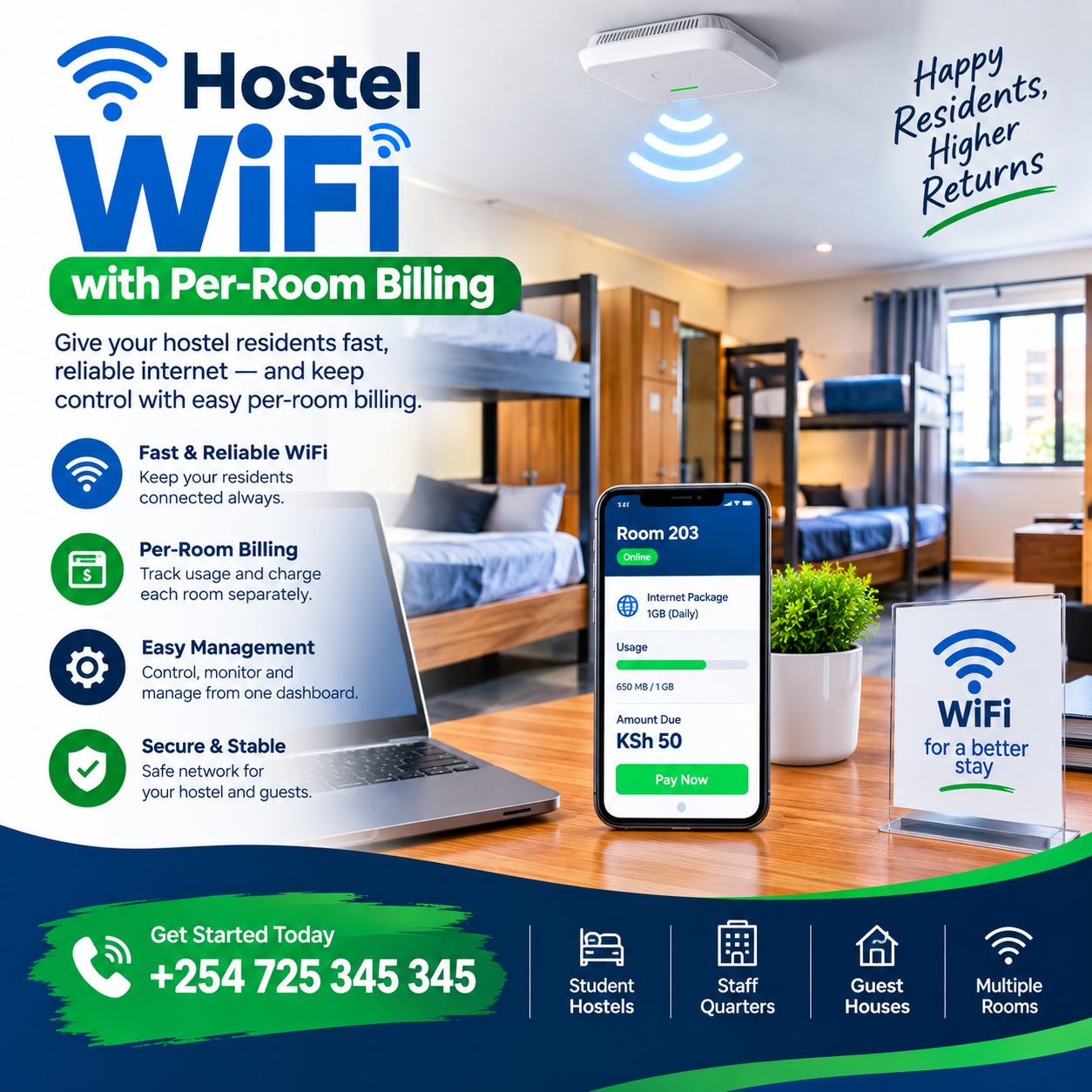
Hostel WiFi with per-room billing is the upgrade transforming student housing across the country — the system that takes a hostel’s internet from a shared headache into the most precisely managed income line on the property’s books.
Every hostel owner knows the shape of the problem. One internet connection serves the whole building. Every student, every room, every device draws from it — and the owner pays for all of it while struggling to recover even part of the cost.
Some students hog the bandwidth streaming all night. Some quietly share the password with friends in other buildings. Some pay their WiFi share and some never do, and the caretaker’s notebook fills with marks nobody can reconstruct.
Then the complaints arrive: too slow, too unfair, too expensive — from the very students consuming the most.
The system that resolves all of it at once is hostel WiFi with per-room billing, and this article walks through the complete picture: what it is, why hostels are its perfect home, how it works, what it earns, and what changes for both the owner and the students living there.
Because the internet was always worth paying for in a hostel full of students — the only thing missing was a way to bill it room by room, and hostel WiFi with per-room billing is that way.
What Hostel WiFi With Per-Room Billing Actually Is
Strip away the jargon and the concept is refreshingly simple.
Hostel WiFi with per-room billing is a system where each room in a hostel buys and manages its own internet package independently — through a portal, paid by mobile money, activated instantly, enforced automatically.
The hostel’s single strong connection feeds the whole building, but the billing treats every room as its own customer.
A student in Room 12 buys their monthly package from their phone. The student in Room 3 buys theirs separately. Room 7’s package expires and only Room 7 disconnects — nobody else feels it.
The owner never collects cash for WiFi, never writes a receipt, and never arbitrates a bandwidth dispute again.
The architecture behind hostel WiFi with per-room billing rests on three layers working together.
The first is the network itself: a solid connection, distribution equipment, and access points reaching every floor and every room — the physics half of the system.
The second is the billing platform: the portal students see, the M-Pesa flow they pay through, and the session management that keeps every purchase running on its own clock.
The third is the identity layer — and this is what makes per-room billing possible rather than just per-device billing: each room’s purchase is tied to that room, so coverage follows the tenancy rather than the individual phone.
Together, the three layers turn one shared connection into dozens of independently sold subscriptions — which is the entire commercial engine of hostel WiFi with per-room billing.
The owner’s involvement shrinks to what an owner should do: set the prices, glance at the dashboard, and bank the collections.
Why Hostels Are the Perfect Market for This Model
Of every property type in the market, student hostels benefit from hostel WiFi with per-room billing most completely — and the reasons are structural.
The first reason is demand density.
A hostel packs dozens of students into one building, and students are the heaviest, most consistent internet consumers in the entire economy. Assignments, research, streaming, social media, video calls home, entertainment between classes — connectivity in a hostel is not a luxury; it is infrastructure for daily life.
The second reason is the payment rhythm.
Students live on allowances, HELB disbursements, and family support that arrives on cycles — and hostel WiFi with per-room billing matches that rhythm with weekly and monthly packages rather than rigid annual contracts.
The third reason is the fairness problem the model solves by design.
Under shared WiFi, the student who scrolls lightly and the student who streams nightly consume the same connection while the owner absorbs the same cost. Per-room billing ends that imbalance: each room pays for its own usage tier, and nobody subsidizes anybody.
The fourth reason is turnover management.
Hostels fill and empty with semesters, and the billing system flexes with them — rooms that empty stop generating charges, and rooms that fill start their own packages from day one.
The fifth reason is the simplest one: the competition.
Students compare every network against their phone bundles, and a hostel running hostel WiFi with per-room billing delivers access cheaper and stronger than any bundle could — turning the building itself into the best deal in the student’s budget.
Put those five reasons together and the conclusion writes itself: no property type monetizes internet more naturally than a hostel, and the per-room model is the key that unlocks it.
The Old Way: One Password, Endless Problems
To appreciate what hostel WiFi with per-room billing changes, it is worth sitting honestly with how hostel WiFi ran before — because every owner lived some version of it. The setup was one password, printed on a wall or whispered at the caretaker’s door.
The password leaked immediately — to friends in other buildings, to cousins visiting for the weekend, to the neighbor’s cousin’s friend. The connection slowed under weight nobody authorized, and the owner upgraded the subscription to compensate — paying enterprise money to serve strangers.
Cost recovery was the next chapter of the mess. Some owners folded WiFi into rent and quietly absorbed the heavy users’ cost into everyone’s tenancy. Some collected a WiFi fee monthly, and became debt collectors every month: reminders, excuses, the tenant who “will pay on Friday,” and the Friday that never came.
Some collected cash through the caretaker, and the notebook recorded what the notebook recorded. Every arrangement failed the same test — it could not prove anything, so it could not enforce anything, and the owner’s [WiFi] remained an expense wearing the costume of an amenity.
The complaints completed the picture.”It’s too slow” from the student streaming at midnight. “It’s unfair” from the student whose ten shillings’ worth of browsing drowned in a neighbor’s download. Under one shared password, the owner could neither fix the speed nor assign the fairness — because the system could not see who was using what.
Operators who studied the before-and-after describe the old arrangement precisely: it was not a system at all, and the first gift of hostel WiFi with per-room billing is that the building finally has one.
How Per-Room Billing Actually Works
The mechanics of hostel WiFi with per-room billing unfold as a clean sequence — and each step removes a task the owner used to do by hand. The foundation is the network build: the hostel’s connection, sized for the building’s full evening load, feeding access points positioned so every room receives a strong signal.
That physics comes first because billing software cannot invoice around a weak signal — a paying student with three bars in their room becomes a refund conversation. On top of the network sits the platform: the portal students reach the moment they connect, showing the room packages and prices the owner has defined.
The student selects their package — a week, a month, a semester — and completes payment through an M-Pesa push on their own phone. Within seconds, the room’s access activates, bound to the student’s devices and running on its own countdown.
When the package expires, that room’s access pauses automatically — with a gentle on-screen notice and a one-tap renewal waiting. No other room flickers. No caretaker climbs a ladder. No conversation happens at the gate.
The owner’s dashboard completes the picture: every room listed, every package status visible, every payment timestamped, revenue summarized by day, week, and semester.
That is the complete loop of hostel WiFi with per-room billing — a system where the building’s most valuable amenity sells itself, room by room, without the owner touching a transaction.
The Tenant Experience: Why Students Prefer It
The model succeeds long-term because the student’s side of hostel WiFi with per-room billing is genuinely better — and students, the most network-savvy customers alive, recognize it immediately.
The first improvement is ownership.
Under the shared password, a student’s internet lived at the mercy of the whole building’s behavior. Under per-room billing, a student’s package is theirs — their speed tier, their countdown, their renewal, all visible on their own screen.
The second improvement is the buying experience itself.
Paying from a phone in their own room, at midnight, on the day the allowance lands — the transaction matches how students already buy everything else. Nobody waits for the caretaker, nobody carries cash to a gate, nobody explains a late payment to a landlord.
The third improvement is honest pricing.
Students see every package and its price openly, and choose the tier that fits their budget that month — the light user pays little, the heavy streamer pays for what they consume. That transparency ends the quiet resentment that shared arrangements always bred, where light users subsidized heavy ones invisibly.
The fourth improvement is reliability.
Because the platform enforces fairly — device binding, session management, no free-riders — the connection performs better for everyone, and students feel the difference within days. Students describe well-run hostel WiFi with per-room billing in the same sentence used for every service they love: “I just pay on my phone and it works.”
And that sentence, repeated across a hostel’s WhatsApp groups, becomes the marketing that fills next semester’s rooms.
Room Packages and Pricing: The Ladder That Fits Student Budgets
The package menu is where hostel WiFi with per-room billing meets its market, and student pricing follows its own well-understood rhythm. The foundation package is the monthly room rate — priced visibly below what the same month of bundles would cost, because that comparison is where the sale is won.
Students do the arithmetic in seconds, and a monthly package that beats the bundle math converts without persuasion.The weekly package serves the short-stay tenant, the student deciding whether to commit, and the end-of-semester visitor.
It is the bridge product — the trial run that upgrades to monthly once trust is earned.The semester package rewards the committed: a discounted full-term rate that locks in revenue the owner can plan against and spares the student monthly renewals.
Speed tiers add the second dimension on hostel WiFi with per-room billing platforms: a standard tier for everyday use, and a premium tier for the students whose coursework, streaming, or gaming genuinely needs more. The premium tier sells on felt difference rather than marketing — and its margin is the highest on the menu.
Shared-room arrangements flex naturally too: two students splitting one room split one package, and the platform’s device capacity accommodates both. And the pricing review closes the loop each semester: the dashboard shows which packages sold, which tiers upgraded, and where the next term’s menu should adjust.
Owners who tuned their hostel WiFi with per-room billing menus against that data semester after semester consistently found the monthly tier becoming the building’s heartbeat — renewed by habit, priced by evidence.
Bandwidth Fairness: Every Room Gets Its Share
The deepest technical promise inside hostel WiFi with per-room billing is fairness — and it is delivered by machinery the students never see. The governing principle is simple: the connection serves the rooms that paid for it, in proportion to what they paid.
Per-room speed profiles deliver that proportion: standard packages receive their comfortable floor, premium packages receive their boost, and no room can starve another. The midnight streamer in Room 9 no longer slows the essay deadline in Room 14 — the platform governs the sharing automatically, room by room.
Device binding adds the second layer: each package ties to the devices of the room that bought it, ending the era of passwords traveling across the fence. The visiting cousin, the friend from the next building, the neighbor’s relative — they no longer ride on a package that was never theirs.
Session management completes the architecture: countdowns visible to each room, warnings before expiry, and renewals one tap away. The cumulative effect is a building where the network behaves the same way every night — predictable, fast enough, fair by construction.
Students who lived under the old shared password notice the change within their first week on hostel WiFi with per-room billing, and the notice usually arrives as a compliment. Owners describe the fairness dividend in practical terms: the complaint messages about speed simply stop arriving, because the fights between users — which produced most of the complaints — were engineered out of existence.
That calm, delivered automatically, is one of the quietest but most valuable returns on the model.
The Money Model: What the Owner Actually Earns
The financial case for hostel WiFi with per-room billing deserves the same honest arithmetic as any business decision — and the numbers reward the model strongly at typical hostel scale. The income side starts with the base recovery: the subscription that once sat as pure cost now divides into student packages that cover it completely.
At even moderate adoption — most rooms on standard packages — the connection pays for itself with room to spare.
The surplus is where the model becomes an income line: every package sold above the subscription’s cost flows to the owner at near-total margin, because the bandwidth was already purchased. Premium tiers deepen that surplus: the students who need more speed pay more, and their upgrades cost the owner nothing additional.
The indirect returns stack beside the direct ones. Vacancy rates improve in student housing where WiFi is fast and fairly billed — connectivity now ranks among the first questions prospective tenants ask. The “WiFi na instant” hostel rents faster than its neighbor, at the same rent, because the amenity finally works the way students expect.
The administrative savings complete the ledger: the caretaker’s collection rounds, the receipt writing, the monthly chasing — all of it disappears into the platform.
Owners who moved from shared-password arrangements to hostel WiFi with per-room billing describe the same discovery: the internet shifted from the expense column they resented to the income line they checked happily.
And the shift required no new building, no new staff, and no new rent — only the billing architecture applied to a connection they already had.
Move-Ins, Move-Outs, and Vacant Rooms: The Flexibility Test
Semester turnover is where shared WiFi arrangements always broke — and where hostel WiFi with per-room billing proves its design most clearly. The move-in is immediate: a new tenant occupies Room 21, connects, buys their package from the portal, and is online before their bags are unpacked.
No waiting for the caretaker, no pro-rating argument, no shared password handed over with the keys. The move-out is cleaner still: the departing student’s package simply runs to its natural end or stops at cancellation, and the room’s billing status closes without a conversation.
No refunds to negotiate, no leftover credit to chase, no residue on the books. The vacant room costs the owner nothing — an unoccupied room generates no package, consumes no billing, and reactivates the day its next tenant arrives.
Compare that with folded-in- rent WiFi, where the owner pays for the connection through every empty room on the corridor. Semester surges become manageable rather than chaotic: the January rush of new tenants onboards themselves through the portal at whatever hour they arrive.
The owner watches the dashboard fill rather than standing at the gate collecting payments in the rain. Mid-semester arrivals and departures — the late registrants, the transfers, the students whose plans changed — all flow through the same self-service loop.
That turnover fluidity is the operational gift of hostel WiFi with per-room billing: the billing follows the tenancy exactly, in every direction, without a single manual adjustment.
The Mistakes That Sink Hostel WiFi
The predictable rollout errors repeat across every hostel that deploys this model, and naming them is cheaper than making them.
The first is the silent launch: the portal goes live without telling the students, and a week of confusion gets misread as rejection. Every smooth adoption of hostel WiFi with per-room billing began with communication — a notice in the corridors, a message in the building’s groups, and a demonstration at the gate.
The second is the weak-coverage room: billing rolled out while the far corner of the top floor still fought for signal, and the paying tenant in that room became a grievance. Fix the physics before or alongside the billing — the survey that maps every room’s signal is the first task of any deployment.
The third is overpricing against the bundle: a menu set above what students pay on their own SIMs sends them quietly to their phones and away from the portal. The portal does not set the market; it reveals it — and the owners who won priced visibly below the bundle math.
The fourth is the absent grace period: a package expiring the night before an assignment deadline, with a hard cutoff and no renewal prompt, converting a loyal tenant into a critic. Warnings, countdowns, and one-tap renewals exist precisely to prevent that moment.
The fifth is ignoring the dashboard: the platform’s reports showing adoption rates, peak hours, and package preferences — evidence nobody reads.
The sixth is keeping the old back door: a shared password still circulating alongside the portal, quietly draining the packages the model was built to sell.
Each mistake is avoidable with the same discipline — communicate, verify the coverage, price against the alternative, grace the expiry, and close the old doors.
The owners who kept those habits watch their hostel WiFi with per-room billing systems become the building’s quietest-working asset.
Scaling: One Hostel Becomes a Portfolio
The deepest business value of hostel WiFi with per-room billing emerges at the second property — because everything that made the first deployment work is now a template. The network build transfers: the sizing method, the access point placement, the coverage survey — applied to the next hostel’s own floor plan.
The package menu transfers: the same ladder, the same semester structure, the same pricing logic — tuned to the new building’s tenant mix rather than reinvented. The rollout playbook transfers: the communication sequence, the demonstration, the grace period — the steps that made the first building adopt smoothly.
And the dashboard extends across all of it: one screen showing every room in every property, revenue per building, and package status across the whole portfolio. Owners running hostel WiFi with per-room billing across multiple hostels describe management as reading rather than running — the portfolio visible in one session, decisions made from evidence.
The financing compounds with scale: proven collections from the first building fund the equipment for the second, and clean records make lenders and partners comfortable. The risk diversifies too: a slow semester at one property is cushioned by the others, and no single building’s vacancy threatens the whole income.
That compounding structure — templates shortening every deployment, revenue funding every expansion — is how the model grows from one building’s amenity into a portfolio-wide business. Every multi-property owner in the market traces their growth to the same origin: the first hostel where hostel WiFi with per-room billing was deployed properly enough to clone.
Beyond Students: Where Else Per-Room Billing Fits
The model’s natural home is student housing, but the same architecture serves any building where rooms are rented and connectivity matters. Bedsitter rows and rental blocks adopted it first among the non-student properties: tenants buying monthly room packages ended the landlord’s WiFi collection rounds exactly as they do in hostels.
Boarding houses and colleges-in-residence run the same loop, with term packages replacing semester ones. Guesthouses with long-stay tenants use weekly and monthly structures, with the portal handling check-ins that once required the front desk.
Worker accommodations — the housing behind farms, factories, and construction sites — bill rooms the same way, giving management clean records where cash once flowed. In every setting, the pattern is identical: rooms as customers, packages as the product, the portal as the counter, and the owner out of the transaction entirely.
That portability is a strategic asset for the property investor: the hostel WiFi with per-room billing system deployed in one building type transfers to the next without redesign. The platform flexes to each property’s rhythm — semesters, months, terms, or weeks — while the underlying architecture stays constant.
That constancy is what turns the model from a single-building fix into a portfolio-wide standard.
The Payoff, Counted Honestly
Ask hostel owners a year after deploying hostel WiFi with per-room billing what changed, and the answers gather into four themes.
Income: the connection that once drained the accounts became a covered cost and then a surplus line — collected automatically, semester after semester.
Calm: the collection rounds, the password leaks, the speed disputes, and the fairness arguments all ended — replaced by a system that enforces itself identically in every room.
Reputation: a building where the WiFi simply works, priced fairly, became the hostel students recommend — and occupancy told the story within a semester.
And control: a dashboard where every room, every package, and every shilling is visible — the owner finally reading their own amenity instead of guessing at it. None of it required new construction, new staff, or new rent.
It required the billing architecture applied to a connection the building already had — and the discipline to launch it communicated, covered, and fairly priced.
That is the complete case for hostel WiFi with per-room billing: the students were always going to need the internet, the connection was always there, and the only thing the building was ever missing was a way to sell it one room at a time.
Frequently Asked Questions
Can students really manage their own packages without the caretaker?
Yes — the portal handles selection, payment, activation, and renewal entirely from the student’s phone. That self-service flow is the defining feature of hostel WiFi with per-room billing, and it is what removes the caretaker from the transaction.
What happens when a student’s package expires?
The room’s access pauses automatically with a clear on-screen notice and a one-tap renewal — while every other room continues unaffected. That room-level isolation is the core enforcement mechanism behind hostel WiFi with per-room billing.
Can one package be shared across the corridor?
No — device binding ties each package to the devices of the room that bought it, and sharing attempts fail quietly. This enforcement is standard in hostel WiFi with per-room billing systems and recovers the revenue that leaked passwords always drained.
How does the system handle two students sharing one room?
Naturally — the room holds one package, and the platform’s device capacity accommodates both occupants’ devices on it. Shared-room arrangements are a standard scenario in hostel WiFi with per-room billing deployments.
What happens in vacant rooms between semesters?
Nothing — a vacant room generates no package, consumes no billing, and reactivates the day its next tenant buys. That flexibility is one of the clearest financial advantages of hostel WiFi with per-room billing over folding WiFi into rent.
Do I need to upgrade my internet connection first?
Possibly — the connection must carry the building’s full evening load, and the deployment begins with a sizing check against that peak. The owners who verified capacity before launching hostel WiFi with per-room billing avoided the evening congestion that loses tenants.
Will weak-signal rooms become a problem?
Only if unaddressed — the professional rollout starts with a room-by-room coverage survey, and dead corners get an access point before billing begins. That sequencing is standard practice in every well-run hostel WiFi with per-room billing deployment.
How should packages be priced?
Visibly below what the same month of bundles costs, with a ladder of weekly, monthly, and semester options plus a premium speed tier. Owners who priced their hostel WiFi with per-room billing menus against the bundle math converted tenants without persuasion.
What about students who prefer paying cash?
The owner can issue a room package from the dashboard for a counter payment — keeping every sale recorded without paper. That hybrid path is built into hostel WiFi with per-room billing platforms for exactly this case.
Can I see which rooms have paid at any moment?
Yes — the dashboard lists every room, its package status, its expiry, and its payment history, all timestamped. That visibility is what turns hostel WiFi with per-room billing from an amenity into a managed asset.
Does this work across several hostels?
Yes — additional properties inherit the packages and portal as configuration, with revenue reporting per building into one dashboard. Portfolio owners standardize on hostel WiFi with per-room billing architecture precisely because growth becomes replication.
What stops students from complaining about fairness?
The fairness is structural: every room pays for its own tier and receives its own enforced share of the bandwidth. That engineered equality is why complaints dropped to near zero in buildings running hostel WiFi with per-room billing properly.
What is the smartest first step this week?
Survey every room’s signal strength, price a three-rung package ladder against the local bundle math, and announce the system to your tenants before it goes live.
That sequence — physics, pricing, communication — is how every successful hostel WiFi with per-room billing deployment began, and the owners who ran it discovered the same truth every time: the students were always going to need the connection, the revenue was always there to be collected, and the hostel WiFi with per-room billing system simply turned the building’s busiest amenity into its cleanest income — one room, one package, and one automatic renewal at a time.