
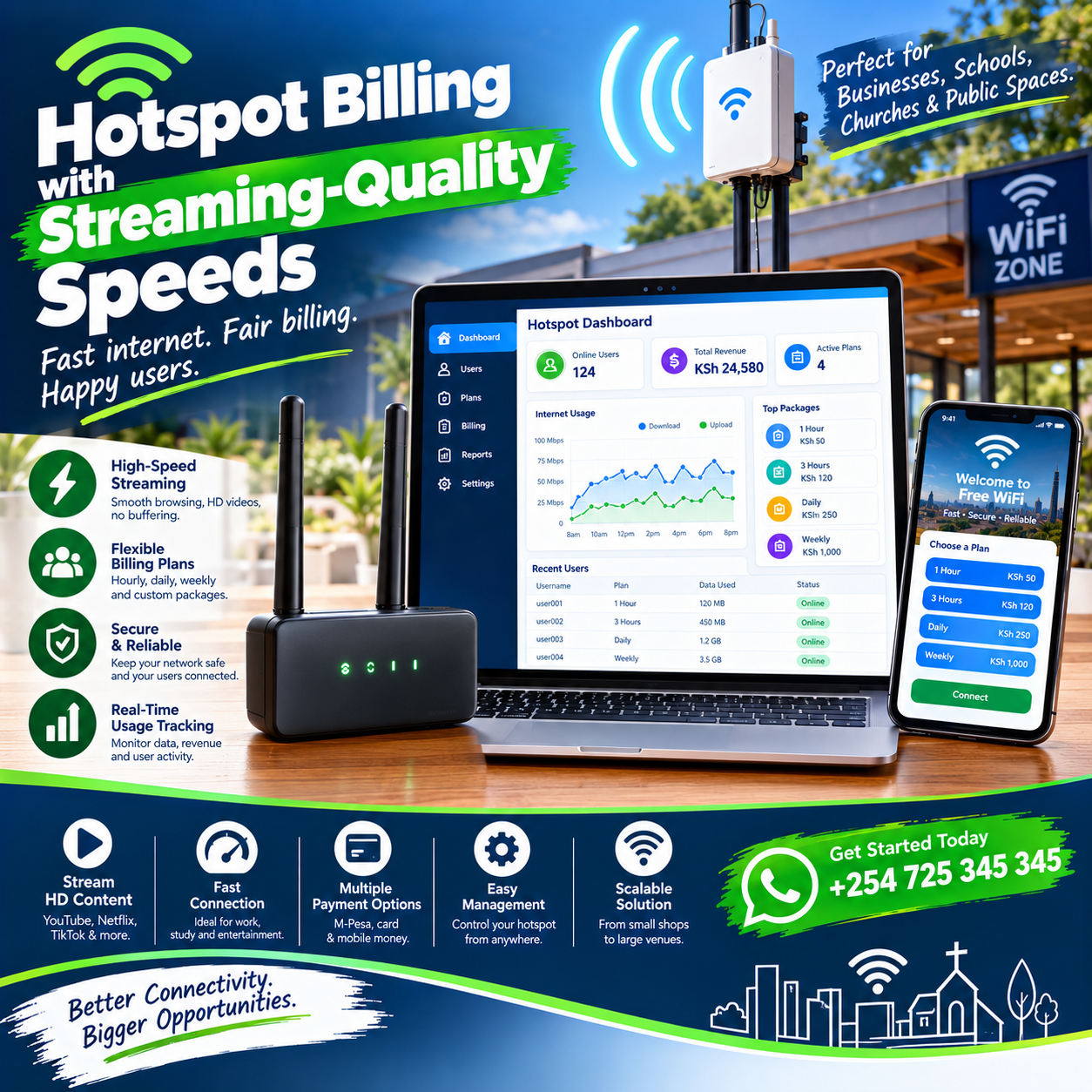
Hotspot billing with streaming-quality speeds is the upgrade reshaping the entire hotspot trade — a way of selling internet where every package delivers the one experience customers now use to judge every network: video that plays smoothly, from the first second to the last.
Something fundamental changed in how this market buys connectivity.
A decade ago, customers tested a network by opening a page. Today, they press play — on a series, a match, a sermon, a tutorial — and the verdict arrives within five seconds.
If the video plays, the network is good. If the wheel spins, the network is finished, no matter what else it does well.
That single shift explains why the operators winning right now are the ones delivering hotspot billing with streaming-quality speeds — selling sessions engineered around smooth video rather than raw megabits on a speed test.
This article walks through the complete picture: what streaming-quality delivery actually requires, why buffering is the most expensive problem in the trade, how the technology and billing work together, and how operators turned the spinning wheel from their biggest complaint into their strongest selling point.
Because the customers were always going to press play — and hotspot billing with streaming-quality speeds is simply how the operator makes sure the video answers.
Table of Contents
ToggleWhat Hotspot Billing With Streaming-Quality Speeds Actually Is
Strip away the jargon and the concept is refreshingly practical.
Hotspot billing with streaming-quality speeds is a complete selling system where the packages, the network, and the enforcement are all engineered around one outcome: every paying customer can stream video comfortably for the entire session they bought.
The system has three working parts that must agree with each other.
The first is the billing layer — the portal, the packages, the M-Pesa flow, and the session enforcement that the trade already knows.
The second is the network engineering — a backbone and distribution setup sized so that streaming works at peak, not just at noon.
The third is the promise alignment — packages named, priced, and tiered around video quality rather than abstract data volumes.
What makes this different from ordinary hotspot operations is that alignment.
Most networks sell “internet” and hope the customer’s expectations land wherever the network happens to be.
Operators delivering hotspot billing with streaming-quality speeds sell a felt outcome instead — HD without stutter, matches without stalls, series without the wheel — and the customer feels the difference within the first minute of the first session.
That alignment between what is promised, what is sold, and what is delivered is the entire discipline.
And it is learnable, buildable, and repeatable — which is why hotspot billing with streaming-quality speeds has become the standard the market’s most successful operators now run.
Why Streaming Became the Benchmark
To understand why hotspot billing with streaming-quality speeds won the market, you have to understand what customers actually do with their sessions.
Study the traffic on any busy hotspot and the pattern is overwhelming: the majority of consumption is video.
Football highlights. Series episodes. Church services. Music videos. Tutorials. News. TikTok loops that consume an evening without anyone noticing.
Video is not one use case among many — it is the internet for most customers, and their judgment of the network is really a judgment of their last video experience.
This is why the spinning wheel became the most expensive symbol in the trade.
The customer does not think in megabits, latency, or contention ratios — they think in one binary outcome: played or stalled.
Operators who studied their own complaints confirmed the pattern: the overwhelming majority began with the same three words — “it keeps buffering.”
That concentration of frustration is also a concentration of opportunity.
The operator who fixes the one thing every customer notices has fixed the one thing every customer talks about.
And in a market where recommendations travel through WhatsApp groups faster than any advertising, the network known for smooth video acquires a reputation that markets itself.
That is the quiet commercial logic behind hotspot billing with streaming-quality speeds: it targets the exact experience the market already uses to choose.
The Real Cost of Buffering: The Quiet Revenue Leak
Every operator knows buffering annoys customers.
Fewer operators have counted what it actually costs — and the arithmetic is why serious operators now treat hotspot billing with streaming-quality speeds as a revenue project rather than a technical one.
The first cost is abandoned purchases.
A customer who connects, presses play, watches the wheel spin, and disconnects — was a sale in progress that the network’s own quality cancelled.
That loss is invisible in the accounts, because the money never arrived to be missed.
The second cost is silent churn.
Buffering customers rarely complain before leaving; they simply drift to the competitor whose network plays smoothly.
The first the operator hears about it is a quieter evening and a dashboard trending down for reasons nobody can name.
The third cost is reputation decay.
One customer’s frustrated “this network keeps buffering” posted in an estate group outweighs a month of the operator’s own promotion.
The fourth cost is the downgrade spiral: quality problems force price cuts to retain customers, which squeezes the budget for the upgrades that would have fixed the quality — and the business circles the drain.
Operators who added up all four costs reached the same conclusion: buffering was not a nuisance, it was the largest unmeasured expense in the business.
And fixing it through hotspot billing with streaming-quality speeds was not an upgrade — it was plugging the biggest leak they had.
How the Technology Actually Works
The engineering behind hotspot billing with streaming-quality speeds is honest and knowable — three layers that must be sized together or none of them work.
The first layer is the backbone, and the sizing rule is the heart of the whole discipline.
Video streaming has a per-viewer floor: a comfortable standard-definition stream needs a modest steady rate, HD needs more, and a room full of simultaneous viewers multiplies that need at exactly the same hours.
The professional method is concurrency math: expected peak users, times the per-user floor for the quality being promised, plus headroom for the moment everyone presses play at once.
Operators who sized their backbones this way discovered the classic failure they had been living with: a connection that looked fast on a speed test but collapsed every evening when the whole neighborhood pressed play together.
The second layer is distribution — access points positioned and powered to carry the load, because a weak link between the backbone and the customer’s seat wastes everything behind it.
The third layer is intelligent sharing, and this is where the billing platform earns its name in hotspot billing with streaming-quality speeds.
Per-user speed floors guarantee every paying customer the minimum their package promises — enforced at the network level, automatically, all evening.
Traffic prioritization keeps the interactive and streaming flows responsive while bulk downloads wait their turn.
Session enforcement ties every guarantee to a payment: the customer who bought the HD tier receives HD-capable delivery for exactly the session they paid for.
Those three layers — backbone, distribution, governed sharing — are the complete machinery, and hotspot billing with streaming-quality speeds succeeds wherever all three are sized to the same honest standard.
Speed Tiers: Turning Quality Into a Product Ladder
The commercial brilliance of hotspot billing with streaming-quality speeds is that video quality converts directly into a product ladder customers instinctively understand.
The base tier promises smooth standard-definition streaming — the experience every customer expects as the floor of any paid session.
The middle tier promises HD — visibly sharper, and the tier most series-watchers and match-watchers choose once they have felt the difference.
The premium tier promises the full experience — HD stability under load, priority during peak hours, and headroom for the household sharing one session across two screens.
What makes this ladder sell is that the differences are felt, not claimed.
A customer who watched a match in SD yesterday and HD today does not need a salesperson to explain the upgrade — their eyes already made the decision.
Operators building their menus around hotspot billing with streaming-quality speeds report the same pattern across every market: the middle tier becomes the bestseller, because the upgrade from the base tier is visible on the first episode.
The ladder also solves the operator’s hardest pricing problem honestly.
Instead of selling abstract “fast internet” that every competitor claims, the operator sells named, enforceable experiences — and the platform’s enforcement makes the premium tiers real rather than aspirational.
That honesty compounds: customers learn that this network’s tiers mean what they say, which is precisely the trust that premium pricing requires.
The ladder, in short, is where hotspot billing with streaming-quality speeds stops being an engineering project and becomes a menu.
Who the Streaming Customer Actually Is
The customer base behind hotspot billing with streaming-quality speeds is broader and more loyal than most operators expect — and knowing the segments sharpens every package decision.
The first segment is the series household: the family that watches an episode every evening, renews faithfully, and judges the network by whether Tuesday’s episode played without a stall.
Theirs is the steadiest recurring revenue in the trade — predictable, evening-shaped, and renewed by habit.
The second segment is the match crowd: football audiences whose demand spikes on game days and whose willingness to pay rises with the stakes of the fixture.
Match-day packages built on hotspot billing with streaming-quality speeds convert those spikes into premium sales rather than congestion complaints.
The third segment is the faithful: congregations streaming services, students streaming lectures, and professionals streaming everything from sermons to seminars.
The fourth segment is the background crowd — the music-video and short-form audience whose sessions are shorter but numerous, filling the network’s quieter hours with volume.
What unites every segment is the same judgment standard: did the video play.
And what rewards the operator is the same loyalty pattern: customers who found a network where streaming simply works renew at rates the buffering networks never see.
That loyalty, segment by segment, is the customer-side story of hotspot billing with streaming-quality speeds — and it is why the model retains while others churn.
The Evening Peak: Where Fortunes Are Made or Lost
Every lesson in hotspot billing with streaming-quality speeds converges on one window: the evening peak, when the whole neighborhood is home, fed, and pressing play.
The peak is when the money lives — the highest session volume, the longest sessions, and the highest willingness to pay of the entire day.
It is also when undisciplined networks die publicly, because the peak is the load test nobody scheduled.
The professional approach treats the peak as the design target rather than an accident to survive.
Capacity is planned for the 8 p.m. crowd, not the 2 p.m. one — the backbone, the access points, and the sharing rules all sized for the hour that matters.
Packages are shaped around the peak too: evening blocks priced as the flagship product, and off-peak discounts that pull flexible viewers into the quieter hours.
Monitoring closes the loop: the operator watching evening dashboards sees the peak’s true shape — when it builds, when it crests, and which tiers carry it.
Operators who engineered for their peak describe the transformation in the same terms: the best hours of the day stopped being a liability and became the best-earning window they own.
That reversal — peak as profit rather than peril — is the defining achievement of hotspot billing with streaming-quality speeds, and it is visible on the dashboard within the first engineered week.
Fair-Use Governance: The Invisible Referee
Here is the discipline that keeps hotspot billing with streaming-quality speeds honest at scale: governed sharing, invisible to customers and indispensable to the experience.
The principle is simple — every paying customer deserves their floor, and no single customer deserves the whole pipe.
Speed floors guarantee the minimum each package promises; speed ceilings cap the extremes that would otherwise starve the room.
Heavy downloads get shaped to yield whenever live streaming is running, and the network’s shared capacity flows to the experience customers are actually paying for.
Device binding quietly completes the governance: each session tied to its device, so the network serves its buyers rather than the neighbors riding one generous login.
None of this machinery is visible from the customer’s seat.
What the customer sees is the outcome: their episode plays, their match holds, their service behaves the same at 9 p.m. as it did at noon.
That invisibility is the craft — the best-governed networks feel unlimited from the customer’s side while being meticulously finite underneath.
Operators who tuned their governance reported the same discovery: complaints about speed did not just drop, they virtually vanished — because the fights between users, which produced most of the buffering, had been engineered out entirely.
That peace, delivered automatically by hotspot billing with streaming-quality speeds platforms, is what turns a crowded network from a battleground into a service.
Pricing the Streaming Promise
Pricing is where hotspot billing with streaming-quality speeds either captures its value or gives it away — and the operators who price well follow a consistent method.
The first rule is anchoring against the customer’s real alternative: the data bundle on their own SIM.
Streaming on bundles is brutally expensive per evening; a hotspot session priced visibly below the bundle math for the same evening of video wins the comparison permanently.
The second rule is pricing the tiers by experience rather than by megabits.
“HD evening — the whole series, no stalls” sells itself; “10 Mbps” sells only to customers who carry speed-test apps.
The third rule is match-day premiums: the fixtures everyone watches command their own packages, priced to the spike they create.
The fourth rule is the day pass for binge occasions — the season finale, the tournament weekend — sized to capture the marathon viewer at a premium.
The fifth rule is honesty about what each tier includes, stated on the portal in the customer’s language: what plays, how smoothly, on how many screens.
Operators who priced this way report the same outcome: margins improved and complaints fell, because customers who bought a named experience and received it rarely argue.
That alignment between price, promise, and delivery is the commercial heart of hotspot billing with streaming-quality speeds — and it is what lets the premium tiers hold their premium.
Hardware: Shopping for the Experience
The equipment behind hotspot billing with streaming-quality speeds is modest by enterprise standards, and the shopping list follows the experience rather than the brochure.
The backbone comes first, chosen for sustained performance under load rather than headline speed — verified with real streaming tests at the real peak hours, from the real mounting points.
A connection that streams smoothly at 8 p.m. with twenty viewers is worth more than a faster one that folds at ten.
The router comes second: a business-class unit with genuine traffic control, sufficient session capacity, and the headroom to enforce per-user floors while the room is full.
Access points come third — positioned by crowd density, elevated above obstructions, and never outnumbered by the devices they must serve.
Wherever the venue allows, wired runs to the busiest seats remove the wireless lottery entirely — the single cheapest upgrade to perceived quality.
Power protection is non-negotiable: a network that delivers perfect streaming until the first blackout has not finished the job, because the evening peak and the outage season are close cousins.
And the platform beneath it all must enforce the tiers automatically — the machinery that turns hardware capacity into hotspot billing with streaming-quality speeds guarantees without a human in the loop.
None of this requires exotic budgets; it requires buying for the worst moment of the busiest evening.
The operators who shopped that way watch their hardware quietly outperform networks running costlier equipment bought for the wrong numbers.
Marketing the Promise: Selling What Customers Can Feel
The promotional playbook for hotspot billing with streaming-quality speeds is unusually effective, because the product demos itself the moment anyone presses play.
The first channel is the live demonstration: a phone, the portal, an episode playing smoothly — shown at the counter, in the estate, at the stage.
Nothing converts a skeptical customer faster than watching the video not buffer.
The second channel is the guarantee: packages that state the streaming experience plainly, backed by the operator’s willingness to troubleshoot openly when it falls short.
Confidence, stated publicly and honored consistently, becomes a brand asset no competitor can copy by slogan.
The third channel is match-day marketing: the big fixture announced in advance, premium viewing packages offered early, and the venue positioned as the place the whole neighborhood watches.
Operators who ran match nights on hotspot billing with streaming-quality speeds describe them as their best customer-acquisition events — a packed room every one of whom just watched the network perform.
The fourth channel is the community itself: the WhatsApp groups where network reputations live, fed by customers whose episodes simply play.
And the fifth is the referral nudge: bring-a-friend sessions that let satisfied streamers recruit their own households.
Every one of these channels works because the underlying product is real — marketing amplifies hotspot billing with streaming-quality speeds but cannot substitute for it.
That is the healthiest position in the trade: a promise the operator is glad to have customers test.
The Mistakes That Break the Streaming Promise
The recurring failures are well documented, and naming them is cheaper than making them.
The first is selling tiers the network cannot enforce: promising HD on a backbone that buckles at the peak, and converting every premium sale into a premium complaint.
The second is headline-speed thinking: buying bandwidth for the speed test while the evening concurrency collapses it, the classic error that hotspot billing with streaming-quality speeds engineering exists to end.
The third is no governance: one house streaming on four screens while the rest of the room stalls — the unfairness that drives away the many to protect the one.
The fourth is the unverified venue: access points placed by convenience rather than coverage, leaving dead corners where paying customers discover their session cannot play.
The fifth is ignoring the dashboard: the platform’s reports showing exactly which hours, tiers, and seats degrade — evidence nobody reads until the churn explains it.
The sixth is skipping power protection: a flawless network that vanishes with the grid, and an evening peak refunded to the competitor.
The seventh is stale menus: tiers frozen since launch while the customers’ habits, devices, and expectations moved on.
Each mistake is avoidable with the same discipline — size for the peak, enforce what is sold, govern the sharing, verify the coverage, and read the numbers weekly.
The operators who kept those habits watch their streaming promise compound into the strongest reputation in their market — which is the entire return on hotspot billing with streaming-quality speeds done properly.
The Proof: What the Dashboard Shows
The beauty of hotspot billing with streaming-quality speeds is that its results are measurable within days, on a dashboard the operator already owns.
The first metric is the evening curve itself: session volume at peak, climbing as the network’s reputation spreads through the groups where viewing decisions are made.
The second is tier migration: customers upgrading from base to HD once they feel the difference — the clearest signal that the ladder is real.
The third is the silence: complaint messages dropping week over week, replaced by the referrals that complaints used to crowd out.
The fourth is renewal behavior: the same households reappearing evening after evening, their sessions shaped by the series schedule and the fixture list.
And the fifth is the upgrade conversation changing direction — from customers asking what is wrong to neighbors asking what is different.
Operators who tracked their first engineered month consistently report the same sequence: complaints fall in week one, upgrades begin in week two, and by week four the evening peak is the busiest, calmest, most profitable window the network has ever run.
That trajectory is the evidence trail of hotspot billing with streaming-quality speeds — written by the customers, in their own behavior, within a single month.
Scaling: One Engineered Network Becomes a Portfolio
The deepest business value of hotspot billing with streaming-quality speeds emerges at the second site — because everything that made the first network excellent is now a template.
The backbone sizing method transfers: the concurrency math, the per-user floors, the peak-hour design — applied to the new location’s own numbers.
The package ladder transfers: the same tiers, the same language, the same match-day structure — tuned to the new site’s crowd rather than reinvented.
The governance transfers: the sharing rules, the device binding, the priority queues — configured once per site from a playbook the first network already proved.
And the reputation transfers fastest of all: the operator known for smooth streaming in one estate arrives in the next one already recommended.
Multi-site operators running hotspot billing with streaming-quality speeds across their portfolios describe management as reading rather than firefighting — each site’s evening curve visible on one dashboard, degradations flagged before customers feel them.
The economics compound with every addition: platform costs shared, support centralized, and the playbooks shortening with each deployment.
That is the scaling arc of the model — not harder work at each new site, but the same discipline, applied to the next crowd that presses play.
The Payoff, Counted Honestly
Ask operators a year after engineering their networks around hotspot billing with streaming-quality speeds what changed, and the answers gather into four themes.
Revenue: evenings transformed into the best-earning window of the day, with premium tiers selling on felt differences rather than discounts.
Loyalty: the series households, the match crowds, and the faithful renewing by habit — the steadiest customer base the trade produces.
Reputation: the network that plays when others stall becoming the name exchanged in every group where viewing plans are decided.
And calm: a business whose worst moments — the peaks, the storms, the big fixtures — are precisely the moments it was built for.
None of it required exotic technology or unusual capital.
It required sizing honestly, governing fairly, pricing by experience, and letting the video speak for itself.
That is the complete case for hotspot billing with streaming-quality speeds: the customers were always going to press play, and the operator who made sure it plays owns the crowd that watches.
Frequently Asked Questions
What speeds actually count as streaming-quality?
A comfortable standard-definition stream needs a modest steady rate per viewer, HD needs roughly double, and the real requirement is the sum at your peak — concurrency, not headline speed.
The operators behind successful hotspot billing with streaming-quality speeds deployments all sized from their own peak-hour math rather than a generic number.
How many simultaneous streamers can one network handle?
As many as the backbone and governance are sized for — the concurrency math gives the honest figure before a single package is sold.
Disciplined hotspot billing with streaming-quality speeds operators publish that capacity to themselves first and sell within it.
Do I need to replace my existing equipment?
Rarely — most upgrades are a stronger backbone, better access-point placement, and a platform capable of enforcing per-user floors.
The transition to hotspot billing with streaming-quality speeds is usually an engineering pass over what the operator already owns.
How do I stop one heavy user from ruining everyone’s stream?
Through per-user floors and ceilings enforced at network level, plus download shaping that yields to live streaming automatically.
That governance is the core machinery of every hotspot billing with streaming-quality speeds deployment that holds at peak.
What packages should I start with?
A three-rung ladder — smooth SD as the floor, HD as the flagship, and a premium tier with priority at peak — priced against the customer’s bundle math for the same evening.
Operators who launched lean on hotspot billing with streaming-quality speeds refined fastest against their own dashboard data.
What happens during a power cut?
With backup batteries carrying the full chain — router, access points, and the upstream link — streaming continues while the neighborhood sits dark, which is when the network’s reputation is won outright.
Power protection is core infrastructure in every serious hotspot billing with streaming-quality speeds build.
How do I price against the big carriers’ bundles?
Price the evening, not the gigabytes: a session that delivers a full night of smooth video, visibly below what the same evening of streaming would cost on bundles.
That anchoring is the structural advantage every hotspot billing with streaming-quality speeds operator holds.
Can I honestly guarantee no buffering?
You can guarantee the experience your engineering delivers — name the tiers by what they play, enforce them at network level, and sell within your verified capacity.
Honesty of that kind is precisely why hotspot billing with streaming-quality speeds menus hold their premiums while vague “fast internet” claims do not.
How do I market it without a budget?
With the demo that never fails: press play in front of the customer — at the counter, in the estate, on match day — and let the smooth video make the argument.
Every thriving hotspot billing with streaming-quality speeds operation grew on exactly that demonstration.
What is the smartest first step this week?
Test your own network the way customers judge it: stream at your real peak hour, from your real seats, and record where it holds and where it stalls.
That one evening of honest fieldwork — plus the concurrency math to fix what it reveals — is how every operator began delivering hotspot billing with streaming-quality speeds — and the ones who ran it discovered the same truth every time: the crowd was always going to press play, the verdict was always going to arrive in five seconds, and the hotspot billing with streaming-quality speeds that answered smoothly turned the market’s harshest test into its most loyal customers — one episode, one match, and one unbuffered evening at a time, through hotspot billing with streaming-quality speeds.