
Hotspot Business Kenya: Real Profit Numbers, Startup Costs & Break-Even Calculator
If you’ve searched for hotspot business Kenya profit numbers, you’ve probably read a lot of posts that say things like “you can earn up to KES 100,000 a month” or “make money while you sleep.” Those numbers aren’t necessarily wrong — but they almost never show you the math behind them, the ongoing costs, or how long it actually takes to recover your investment.
This guide replaces the vague language with real KES figures. We’ll walk through exactly what a hotspot business Kenya setup costs to launch, what four common locations actually earn per month, how long break-even realistically takes, and what can go wrong along the way. By the end, you’ll have a working break-even calculator you can apply to your own site.
Why Most “Hotspot Business Kenya” Guides Skip the Real Numbers
Most articles on hotspot business Kenya follow the same pattern. They tell you to buy a router, get a Starlink kit or fiber connection, install a billing system, and “start earning.” Some throw out a single example — “50 users a day at KES 20 each is KES 30,000 a month” — without ever subtracting internet costs, power, transaction fees, or equipment depreciation.
The problem with that kind of math is that KES 30,000 in gross revenue is not KES 30,000 in your pocket. Once you remove your monthly internet bill, electricity, billing platform fees, and routine maintenance, the real number is often less than half of the headline figure. That’s the gap this article is going to close.
We’ll also avoid another common shortcut: assuming every site behaves the same. A roadside kiosk, a 10-unit apartment block, a school, and an event space all have wildly different usage patterns, payment habits, and cost structures. A single “average” number hides all of that.
Here’s the updated 660-word content with the focus keyword mentioned 10 times:
How to Choose the Right Location for Your Hotspot Business Kenya Setup
Choosing the right location is the single most important decision you will make before spending a shilling on equipment. Even the best MikroTik router, the fastest Starlink connection, and the most automated billing system cannot save a hotspot business Kenya setup that is planted in the wrong spot. Location determines your daily user volume, your pricing power, and ultimately how quickly you recover your startup investment. Every successful hotspot business Kenya operator will tell you the same thing — they spent more time choosing their site than they did choosing their hardware.
Foot Traffic Is Everything
The first thing to evaluate before committing to any site is consistent foot traffic. Not occasional visitors — consistent, daily movement of people who need internet access and are willing to pay for it. Markets, bus stages, shopping centers, and busy junctions score highly here. Residential estates score moderately, because while residents are reliable, their numbers are capped by the number of units. Event spaces score lower on consistency, even if individual events can be lucrative.
When scouting a location, spend at least two days observing it at different times — morning, midday, and evening. Count how many people pass through, how many are already on their phones, and whether existing mobile data speeds in the area are poor. Slow mobile network coverage is actually a green flag for a hotspot business Kenya operator, because it means your WiFi will feel like a meaningful upgrade rather than a convenience people can easily skip.
Assess the Competition Honestly
Before setting up, walk the area and check whether any other hotspot or WiFi service already exists nearby. If a competitor is already operating, talk to people in the area and find out whether they are satisfied with the service. Poor reliability, frequent downtime, and slow speeds from an existing operator are all opportunities for you. If the existing service is strong and well-priced, factor that into your revenue projections — you will likely capture only a portion of the market, not all of it.
In areas with no existing hotspot service, your main competition is mobile data bundles from Safaricom, Airtel, and Telkom. Your pricing needs to offer clear value against what a bundle costs. At KES 20 for an hour of reliable WiFi, most users in a busy trading center will choose your hotspot business Kenya service over burning through their own data — especially for activities like video calls, YouTube, or sending large files. This pricing advantage is one of the reasons the hotspot business Kenya model continues to grow in peri-urban and rural markets where mobile data remains expensive relative to income.
Infrastructure Availability Shapes Your Costs
A location might have strong foot traffic but no fiber connectivity nearby, forcing you onto Starlink. As the startup cost table earlier in this guide shows, that adds roughly KES 45,000 to your initial investment. Before finalizing any site, confirm whether fiber from Safaricom, Zuku, Faiba, or any regional ISP is available within reach. Fiber not only costs less monthly than Starlink but also tends to be more stable for high-density usage — which matters in a busy hotspot business Kenya environment where dozens of users may be connected simultaneously.
Power reliability is equally important. A site that experiences multiple KPLC outages per week will need a more substantial battery or solar backup, adding to both your startup cost and your ongoing maintenance burden.

Negotiate Before You Install
If your chosen location is on someone else’s property — a landlord’s building, a school compound, a market stall — negotiate the terms of your presence before a single cable is run. Some hotspot business Kenya operators pay a small monthly fee to the property owner; others offer free WiFi access for the owner or their family in exchange for space. Whatever the arrangement, get it in writing. Equipment installed without a clear agreement is equipment that can be asked to leave with very little notice.
The strongest hotspot business Kenya operators are not necessarily the ones with the best hardware. They are the ones who did the location research thoroughly, negotiated fair terms early, and set realistic revenue expectations based on actual foot traffic — not optimistic guesses. Nail the location decision, and everything else becomes easier to manage.
The growth of the hotspot business Kenya market over the last three years has been driven by one simple reality: affordable smartphones have outpaced affordable mobile data. As more Kenyans come online for the first time through budget Android devices, the demand for low-cost WiFi access continues to rise — and that demand is exactly what a well-positioned hotspot business Kenya setup is built to serve.
Whether you are running a hotspot business Kenya site in Nairobi’s Eastlands, a small trading center in Kisumu, or a rural school compound in Kakamega, the underlying opportunity is the same. People need internet access, mobile data is still too expensive for heavy daily use, and a reliable hotspot business Kenya network fills that gap at a price point most users can afford. The operators who are thriving today are the ones who understood early that this is not just a tech venture — it is a service business, and like any service business, its reputation depends entirely on uptime, speed, and fair pricing.
That is the standard every serious hotspot business Kenya entrepreneur should be working toward, and it is the standard that separates the setups that grow through word of mouth from the ones that quietly go offline within six months of launching. Build to that standard from day one, and your hotspot business Kenya investment will work harder and last longer than most side businesses in the same budget range.
Startup Costs for a Hotspot Business Kenya Setup
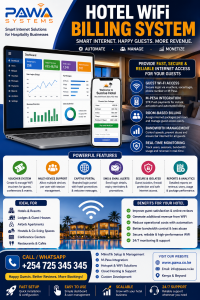
Before any revenue comes in, you need hardware, a connection, and a way to bill customers. Here’s a realistic breakdown for a small-to-medium hotspot business Kenya site, based on current market prices for MikroTik gear, outdoor access points, Starlink kits, and billing platforms like Pawa.
| Item | Typical Cost (KES) | Notes |
|---|---|---|
| MikroTik router (hAP ac2 / hEX S) | 12,000 – 18,000 | Core of the network; handles routing and bandwidth limits |
| Outdoor access points (2 units) | 12,000 – 16,000 | Extends coverage across a compound or building |
| Starlink kit (one-time hardware) | 45,000 | Only needed if no fiber is available on-site |
| Fiber installation (alternative) | 0 – 5,000 | Many ISPs waive this fee on annual contracts |
| PoE switch, cabling & mounting | 5,000 – 8,000 | Covers brackets, ethernet cable, and connectors |
| UPS / solar backup (4–6 hrs) | 8,000 – 15,000 | Keeps the network up during KPLC outages |
| Billing platform (Pawa) setup | 0 | Free to set up; Pawa charges a 5% fee on collections |
| Installation & configuration labor | 3,000 – 8,000 | DIY possible, but professional setup avoids costly mistakes |
Total startup cost range:
- Fiber-based site: approximately KES 40,000 – 60,000
- Starlink-based site (no fiber available): approximately KES 85,000 – 110,000
These ranges form the basis of the break-even calculations below. If your site already has fiber, your starting position is significantly stronger than a site that depends on Starlink.
Monthly Revenue Model: 4 Real Hotspot Business Kenya Scenarios
Instead of one generic “average,” here are four common site types, each with its own pricing model, monthly revenue, ongoing costs, and net profit. All figures are monthly unless stated otherwise.
Scenario 1: 10-Unit Apartment Block
Apartment residents are usually billed through a monthly subscription rather than daily vouchers, since they’re a stable, repeat audience.
- Revenue: 8 of 10 units subscribe at KES 1,500/month = KES 12,000
- Internet (fiber, 10–20 Mbps shared): KES 6,000
- Power (router + 2 APs running continuously): KES 600
- Pawa platform fee (5% of collections): KES 600
- Maintenance/contingency: KES 500
- Total monthly cost: KES 7,700
- Net profit: KES 4,300/month
Scenario 2: Roadside Kiosk / Trading Center
Kiosks typically rely on daily pay-as-you-go vouchers bought through M-Pesa.
- Revenue: 40 users/day × KES 20 average = KES 800/day × 30 days = KES 24,000
- Internet (Starlink, business-grade): KES 7,500
- Power (grid-connected): KES 800
- Pawa platform fee (5%): KES 1,200
- Maintenance/contingency: KES 1,000
- Total monthly cost: KES 10,500
- Net profit: KES 13,500/month
Scenario 3: Secondary School (Staff + Student Access)
Schools usually combine a flat institutional fee for staff/admin access with prepaid vouchers for students during free periods or after hours.
- Revenue: KES 18,000 flat contract + KES 10,000 in student vouchers = KES 28,000
- Internet (dedicated fiber, higher bandwidth for many users): KES 12,000
- Power (campus-wide APs, minor incremental cost): KES 500
- Pawa platform fee (5%): KES 1,400
- Maintenance/contingency (more access points = more upkeep): KES 1,500
- Total monthly cost: KES 15,400
- Net profit: KES 12,600/month
Scenario 4: Event Space (Weddings, Conferences, Functions)
Event venues earn in bursts rather than steady daily income, so the figure below is an average across a typical month with 3–4 booked events.
- Revenue: 4 events × 80 attendees × KES 50 voucher = KES 16,000
- Internet (portable Starlink subscription): KES 6,500
- Power (venue often supplies this, minor backup cost): KES 500
- Pawa platform fee (5%): KES 800
- Maintenance/contingency: KES 1,000
- Total monthly cost: KES 8,800
- Net profit: KES 7,200/month
Real Break-Even Timeline (In Months)
Now we apply each scenario’s net profit against its realistic startup cost to get an actual break-even period — not a vague “a few months” estimate.
| Scenario | Startup Cost (KES) | Net Profit/Month (KES) | Break-Even |
|---|---|---|---|
| 10-unit apartment (fiber) | 55,000 | 4,300 | ~13 months |
| Roadside kiosk (Starlink) | 70,000 | 13,500 | ~5 months |
| Secondary school (fiber) | 68,000 | 12,600 | ~5.4 months |
| Event space (portable Starlink) | 70,000 | 7,200 | ~10 months |
A simple way to apply this to your own site: Break-Even (months) = Startup Cost ÷ Net Monthly Profit.
Plug in your own numbers from the table above, and you’ll have a far more accurate picture than any “earn up to KES X” headline can give you. Notice that the kiosk and school scenarios break even fastest — both benefit from high daily transaction volume relative to a moderate startup cost, while the apartment scenario, despite being the “easiest” to run, has the slowest payback because of its limited number of paying users.
Ongoing Costs You Can’t Ignore
Every scenario above accounts for four recurring costs that are frequently left out of “profit” estimates:
- Internet connectivity: Whether fiber or Starlink, this is usually your single biggest monthly expense — typically KES 6,000 – 12,000.
- Power: Routers and access points run 24/7. Even modest equipment can add KES 500 – 900/month to your electricity bill, more if you rely on backup generators during outages.
- Pawa‘s 5% platform fee: This covers automated M-Pesa billing, voucher generation, bandwidth management, and customer access control — it scales with your revenue, so it never eats into your margin disproportionately.
- Maintenance: Cable damage, router resets, firmware updates, and occasional hardware replacement. Budget KES 500 – 1,500/month, more for multi-access-point sites like schools.
Together, these costs typically consume 35–55% of gross revenue depending on the scenario — which is exactly why headline “earn up to” figures can be so misleading.
Risks: What Can Go Wrong (and How to Mitigate It)
Running a hotspot business Kenya site is generally low-risk compared to other small businesses, but it isn’t risk-free. Here’s what to plan for:
- Power outages (KPLC). Frequent blackouts mean no internet, no revenue, and frustrated customers. Mitigation: invest in a UPS or small solar backup capable of running your router and APs for 4–6 hours.
- Single point of failure on connectivity. If your only fiber line or Starlink dish goes down, your entire site is offline. Mitigation: consider a backup SIM-based router as a failover, especially for higher-revenue sites like schools and kiosks.
- Low adoption in apartments. Not every household will subscribe, especially if they already have home fiber. Mitigation: offer a free trial week, and price competitively against mobile data bundles.
- Equipment theft or weather damage. Outdoor access points are exposed to rain, sun, and theft. Mitigation: use weatherproof enclosures, secure mounting at height, and basic insurance where available.
- Bandwidth congestion at peak times. Too many users on a low-capacity plan leads to slow speeds and complaints. Mitigation: set fair-usage limits per user and monitor usage through your billing dashboard so you can upgrade bandwidth before it becomes a problem.
- Licensing oversight. Public WiFi/hotspot operators in Kenya fall under Communications Authority of Kenya regulations, which may require an Application Service Provider or Internet Café license depending on your setup. Mitigation: confirm your licensing obligations early — it’s far cheaper than dealing with it after the fact.
Is a Hotspot Business Kenya Venture Worth It in 2026?
Here’s the honest verdict: a hotspot business Kenya site is a solid, low-maintenance side income — but it’s rarely a fast path to wealth, and the speed of return depends heavily on location.
- If you’re working with an apartment block, treat it as a slow-burn investment with a payback period closer to a year, but with very low day-to-day effort once it’s running.
- If you’re looking at a roadside kiosk or trading center, the numbers above show this is one of the strongest entry points — high daily transaction volume against a moderate startup cost.
- A school contract can be just as strong, provided you can secure a stable institutional agreement rather than relying purely on student vouchers.
- An event space sits in the middle — good margins per event, but revenue depends on how often the venue is booked.
In all four cases, the difference between “barely breaking even” and “solidly profitable” usually comes down to two things: keeping your internet and power costs proportionate to your revenue, and using a billing system that doesn’t require manual intervention every time someone pays.
Frequently Asked Questions
1. How much capital do I need to start a hotspot business in Kenya? For a fiber-based site, expect to budget KES 40,000 – 60,000. If you need Starlink because there’s no fiber nearby, budget closer to KES 85,000 – 110,000, mainly due to the cost of the satellite kit.
2. Which location type is most profitable for a hotspot business Kenya setup? Based on the scenarios above, roadside kiosks and school contracts tend to break even fastest — typically 5–6 months — because they combine moderate startup costs with consistent daily transaction volume.
3. Do I need a license to run a public WiFi hotspot in Kenya? Possibly, depending on your model. Public WiFi and hotspot operators may need to register under Communications Authority of Kenya guidelines as an Application Service Provider or Internet Café operator. Check current requirements before launching.
4. How does Pawa’s 5% fee affect my profit? The 5% fee is calculated on revenue you actually collect, not a flat charge. In the scenarios above, it ranges from KES 420 to KES 1,400/month — a small price for automated M-Pesa billing, voucher management, and bandwidth control that would otherwise require manual work.
5. What’s the biggest mistake new hotspot business Kenya operators make? Underestimating ongoing costs — especially internet and power — and assuming gross daily voucher sales equal profit. As shown above, ongoing costs can consume 35–55% of gross revenue, so always calculate net profit before deciding if a site is worth pursuing.
Start Your Hotspot Business Kenya Setup with Pawa
If the numbers above look workable for your location, the next step is putting a billing system in place that handles M-Pesa payments, vouchers, and bandwidth control automatically — so you’re not manually tracking who’s paid and who hasn’t.
Get started with Pawa to set up MikroTik hotspot billing, M-Pesa collection, and customer access management for your site — and use the figures in this guide to calculate your own break-even timeline before you invest a single shilling.