
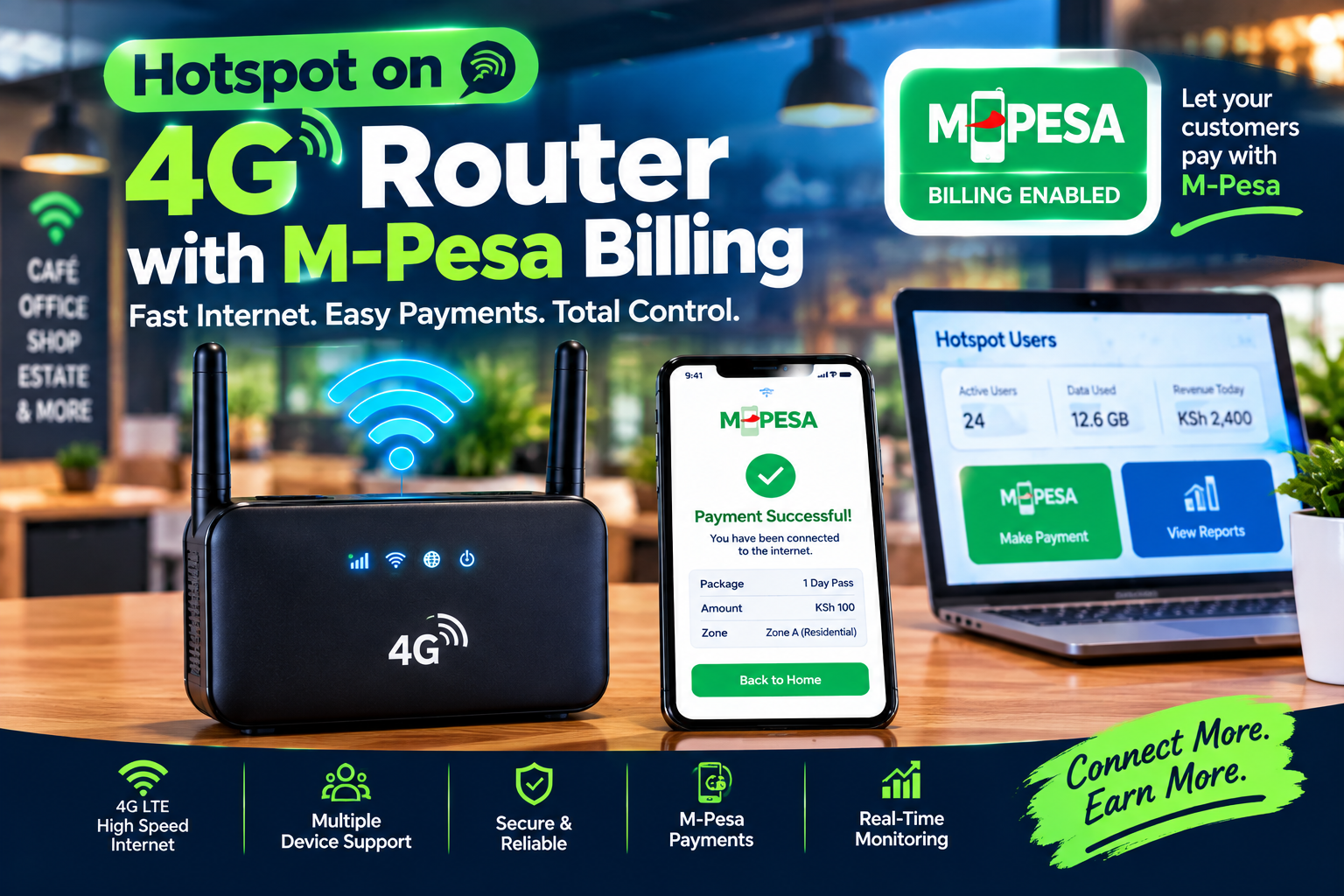
Hotspot on 4G router with M-Pesa billing is the smallest complete internet business in the country — a router the size of a paperback, a data SIM, and a payment system that collects money around the clock.
No fiber trenching. No mast lease. No server room. Just a device most households already recognize, running a business most neighborhoods badly need.
The model has quietly become the on-ramp for thousands of first-time connectivity entrepreneurs, precisely because a hotspot on 4G router with M-Pesa billing demands neither trenches nor towers.
Where a fiber operator needs permissions, digging, and months of patience, the 4G operator needs a strong signal, a good SIM plan, and an afternoon of setup.
This article walks through the entire anatomy of a hotspot on 4G router with M-Pesa billing business — what it costs, how it earns, where it breaks, and what separates the operators earning daily from the ones whose routers became expensive clocks.
Why the 4G Router Changed Everything
The rise of the hotspot on 4G router with M-Pesa billing traces back to one technical fact: mobile broadband coverage now reaches places fiber never will.
Estates on the edge of town, trading centers off the main road, university neighborhoods behind private plots — all of them sit inside strong 4G signals with no cable in sight.
For years that coverage was personal: one household, one SIM, one bundle.
Then two things collided — generous data plans and a new generation of operators asking what a hotspot on 4G router with M-Pesa billing could earn if that household connection started serving a street.
The answer turned out to be: quite a lot.
The router itself costs less than a smartphone. The SIM plan replaces the monthly fiber bill. And the hotspot on 4G router with M-Pesa billing layer automates everything the old voucher sellers did by hand.
Setup that once required a technician now requires an afternoon and a YouTube-sized amount of patience.
The economics attracted exactly the people fiber pricing excluded: the student with side-hustle savings, the boda operator looking for an evening income, the retiree with a strong signal and time to watch a dashboard.
For all of them, a hotspot on 4G router with M-Pesa billing became the first business they could launch from a kitchen table.
And because the whole operation is software-defined, the operator who outgrows their first hotspot on 4G router with M-Pesa billing setup can upgrade, relocate, or clone it without rebuilding anything.
That portability is the model’s superpower — and also the reason doing it right matters more than doing it big.
The Business Model in Plain Numbers
Strip the romance away and every hotspot on 4G router with M-Pesa billing operation runs one arithmetic: buy data wholesale through a SIM plan, sell it retail in affordable slices.
A capable unlimited data plan runs a few thousand shillings monthly.
A hotspot on 4G router with M-Pesa billing selling two hundred shilling packages a day grosses several times that — the gap between the two numbers is the business.
The customer base is the same one every connectivity business serves: people who buy internet the way they buy airtime — small, instant, on demand.
Students before deadlines. Job seekers uploading applications. Households stretching a budget across the month.
None of them will sign a monthly contract, and all of them will tap a payment prompt the moment the price feels right — which is the exact transaction a hotspot on 4G router with M-Pesa billing automates.
The startup budget is where the model gets its reputation: router, first month’s data, power protection, and the billing platform.
A serious launch lands in the range of a decent secondhand laptop — and the operators who track their hotspot on 4G router with M-Pesa billing numbers honestly typically recover that inside the first quarter.
Beyond that, the monthly picture depends on the two levers every operator controls: the data plan beneath the business and the packages sold on top of it — the twin foundations of any serious hotspot on 4G router with M-Pesa billing plan.
Choosing the Right 4G Router
The router is the entire physical business, so the shopping deserves more care than a price tag — and every veteran of a hotspot on 4G router with M-Pesa billing operation has opinions about it.
Four specs matter most.
First, category: the chipset’s LTE class determines real-world speeds, and a router that tops out where the hotspot on 4G router with M-Pesa billing needs headroom will choke exactly at the evening peak.
Second, simultaneous users: consumer routers sag after ten active devices; business-class models handle thirty comfortably.
Third, external antenna support: the ability to bolt on a better antenna is often the difference between a mediocre hotspot on 4G router with M-Pesa billing and a strong one, especially at the edge of coverage.
Fourth, stability: a router that reboots under load or overheats in the afternoon sun refunds customers daily.
The temptation is buying cheap and upgrading later, but the operators who studied their hotspot on 4G router with M-Pesa billing economics found the reverse: the mid-range router pays for itself in retained customers within weeks.
Heat matters more than most buyers expect — routers in sealed boxes die young.
The Data SIM: Your Cost of Goods
In a fiber business, bandwidth is a bill; in a hotspot on 4G router with M-Pesa billing operation, it is inventory — and the SIM plan is the supplier.
This reframing changes every decision that follows.
The plan choice sets the ceiling: a capped bundle makes the operator a careful rationer, while a well-chosen unlimited plan turns the hotspot on 4G router with M-Pesa billing into a genuinely sellable product.
But “unlimited” deserves quotation marks in this market.
Fair usage policies throttle heavy users after thresholds, and an operator who never read the fine print discovers it at 9 p.m. when their hotspot on 4G router with M-Pesa billing slows to a crawl — with a room full of paying customers inside it.
Reading the policy is the cheapest consulting available.
Coverage is the second SIM decision: a strong signal at the doorstep on one network can beat a famous plan on another, and testing SIMs on-site before committing protects the whole hotspot on 4G router with M-Pesa billing investment.
The professional habit is running the numbers monthly: data cost per gigabyte sold, margin per package, and the utilization curve — the three figures that tell an operator whether their hotspot on 4G router with M-Pesa billing foundation is profitable or merely busy.
Dual-SIM routers earn their premium here: two networks mean failover when one congests.
The M-Pesa Billing Layer: Where the Business Actually Lives
The router connects the neighborhood; the billing layer runs the company — and the quality of that layer decides whether a hotspot on 4G router with M-Pesa billing operation collects cleanly or leaks daily.
The core loop is beautifully simple.
The customer connects to the network, lands on the portal, taps a package, and an M-Pesa prompt appears on their phone; they enter their PIN and the session opens — no middleman, no coins, no notebook.
That loop is the entire promise of a hotspot on 4G router with M-Pesa billing setup, and anything slower loses buyers at the moment of decision.
Deep integration matters more than feature lists here: STK push that lands reliably, confirmation that activates within seconds, and reconciliation that catches stray payments without a support ticket.
Operators who chose their hotspot on 4G router with M-Pesa billing platform on payment quality report the same discovery — collections stopped being work and became weather reports.
The platform also carries the enforcement: sessions bound to devices, logins limited to one device at a time, and expiry that lands exactly when the purchased time ends.
Without that enforcement, one voucher serves a corridor — and the hotspot on 4G router with M-Pesa billing quietly becomes a donation box.
Reporting completes the layer: revenue by hour, package popularity, and customer patterns that turn the operator’s guesses into decisions.
The dashboard is where a hotspot on 4G router with M-Pesa billing operation stops being a hobby and starts being a business — read weekly, it pays rent on itself.
Packages and Pricing: Selling in Slices That Fit
The retail side of a hotspot on 4G router with M-Pesa billing business is a ladder of packages, and the ladder’s design determines who climbs it.
Short sessions for the curious and the broke.
Hourly options for the mainstream.
A day pass for the heavy users, priced as the obvious value.
The pricing reference point is never the operator’s costs — it is the bundle menu on the customer’s phone, because every buyer of a hotspot on 4G router with M-Pesa billing package compares it against two taps in their SIM provider’s app.
Price visibly below bundle value, deliver visibly above bundle experience.
Speed tiers add the second dimension: a standard package at base speed and a premium tier at noticeably faster rates — the structure that lets a hotspot on 4G router with M-Pesa billing serve both the budget browser and the deadline-driven professional from one router.
The 4G reality adds a constraint fiber operators never face: total capacity is one SIM, so every package must fit inside it — which is why disciplined operators cap active sessions on their hotspot on 4G router with M-Pesa billing rather than overselling the afternoon.
Off-peak pricing is the secret weapon of the model: nights and mid-mornings usually carry idle capacity, and discounted packages in those windows turn dead airtime into revenue — a trick unique to the hotspot on 4G router with M-Pesa billing structure.
Test the ladder for a week, read the dashboard, adjust: pricing here is a living variable, not a signature.
Bandwidth Management: One SIM, Many Customers
The central engineering challenge of a hotspot on 4G router with M-Pesa billing operation is arithmetic: one SIM’s capacity divided across everyone who paid.
Left unmanaged, three streamers consume the evening and thirty customers experience it.
Managed well, the same capacity serves everyone adequately — per-user speed limits, session caps, and queue rules that stop one heavy user from taxing the whole hotspot on 4G router with M-Pesa billing experience.
This is where capable platforms earn their fees.
The professional configuration sets a comfortable baseline speed per user, prioritizes interactive traffic like video calls, and throttles background bulk downloads — the policy stack that makes a hotspot on 4G router with M-Pesa billing feel fast even at capacity.
Capacity planning follows a simple rule of thumb: count the evening peak users, estimate their realistic needs, and verify the SIM plan can carry the hotspot on 4G router with M-Pesa billing load before selling the packages that assume it.
Overselling is the cardinal sin of this model — the evening that chokes is the evening customers never return for.
The operators who monitor their hotspot on 4G router with M-Pesa billing utilization curves weekly catch congestion before customers do — upgrading plans, pruning packages, or adding a second SIM with the calm of someone who saw it coming.
Power: The Backpack Business Still Needs Electricity
The 4G router’s portability is its charm and its vulnerability — a hotspot on 4G router with M-Pesa billing dies the moment its power does, and the grid tests that commitment regularly.
Power protection is therefore not an accessory; it is core infrastructure.
A modest power bank or small UPS keeps the hotspot on 4G router with M-Pesa billing alive through evening outages, and customers reward that continuity with loyalty that outlasts any price war.
Surge protection belongs beside it, because a hotspot on 4G router with M-Pesa billing router is a small computer, and the same spikes that kill televisions kill routers with less ceremony.
The operators whose businesses survived their first year all describe the same purchase sequence: router first, protection second — never protection “later.”
Placement completes the power story: ventilation matters, dust matters, and a hotspot on 4G router with M-Pesa billing unit mounted in a hot sealed box will underperform and die young, whatever the warranty says.
Signal and Placement: The Physics You Cannot Bill Around
Billing software manages money; physics manages signal — and no hotspot on 4G router with M-Pesa billing platform can invoice around a weak connection.
Site testing before commitment is the whole discipline.
The professional sequence: test candidate SIMs at the exact mounting point, at evening peak, with a speed test on a real device — because the hotspot on 4G router with M-Pesa billing business lives or dies on what that reading says.
Elevation and antenna choice stretch coverage meaningfully: a router on a roof pole with a directional antenna can double the reach of the same hotspot on 4G router with M-Pesa billing setup sitting on a shelf indoors.
The signal report becomes part of the business plan: coverage radius defines the customer map, which defines realistic package volumes — the chain that starts with where the hotspot on 4G router with M-Pesa billing hardware sits and ends with what the bank account collects.
Weak-signal sites are not projects to fix with hope; they are sites to walk away from.
The Mistakes That Kill Small Hotspots
The failure patterns in this business repeat so reliably they deserve their own list — every veteran of a hotspot on 4G router with M-Pesa billing operation can recite them.
The first is overselling: packing more customers onto one SIM than the evening peak can carry, until the network’s reputation collapses one frustrating night at a time.
The second is ignoring the fair usage policy — building a business on “unlimited” the operator never verified, then watching the hotspot on 4G router with M-Pesa billing throttle itself during its own rush hour.
The third is the cheap router that reboots under load.
The fourth is the silent launch: turning the network on without telling the neighborhood, then reading the slow week as rejection — when a poster and a patient afternoon would have filled the hotspot on 4G router with M-Pesa billing portal with first purchases.
The fifth is skipping enforcement, letting shared credentials drain the revenue.
And the sixth is flying blind: never opening the dashboard, never reading the utilization curve, until a slow month arrives like weather.
Every one of these mistakes is avoidable, and the operators who read their hotspot on 4G router with M-Pesa billing numbers weekly sidestep all six by habit.
Scaling: From One Router to a Route
The model’s ceiling is one SIM’s capacity — and the operators who grow past it do so by cloning, not stretching: a second hotspot on 4G router with M-Pesa billing site in a new neighborhood, not a hundred more customers squeezed onto the first.
Cloning works because the template is proven.
Same router class, same package ladder, same platform — the second site inherits everything the first one learned, and the hotspot on 4G router with M-Pesa billing portfolio becomes a route: small sites, run from one dashboard, checked from one phone.
Site selection repeats the original discipline: test signals, count foot traffic, price against the local bundles — then deploy the hotspot on 4G router with M-Pesa billing template that already worked once.
Two profitable sites beat five hopeful ones, every time.
The operators running three sites and beyond all report the same structural shift: the business stopped needing their presence and started needing their decisions — pricing, expansion, upgrades — which is the entire difference between owning a hotspot on 4G router with M-Pesa billing route and working for one.
The Payoff, Stated Honestly
What does a well-run hotspot on 4G router with M-Pesa billing operation actually deliver after the learning curve?
A single strong site earns a steady monthly margin above its data plan — modest individually, reliable, and requiring minutes per day rather than hours.
A route of three to five sites approaches a full income built on assets the operator owns outright, each one verified by its own hotspot on 4G router with M-Pesa billing dashboard before the next site gets deployed.
And the quieter returns compound: a business that collects at 2 a.m., enforces its own rules, and scales by configuration — the hotspot on 4G router with M-Pesa billing model at its best.
Less glamorous than the gurus promise, far more durable than the doubters claim.
The operators who win treat their hotspot on 4G router with M-Pesa billing setup as infrastructure: tested signals, protected power, honest packages, and numbers read weekly.
The model pays for discipline, and it pays quietly, every single day.
Frequently Asked Questions
How much do I need to start?
A serious launch covers the router, first month’s data, power protection, and the billing platform — typically the cost of a decent secondhand laptop.
Operators who track their hotspot on 4G router with M-Pesa billing numbers from day one usually recover the full investment inside the first quarter.
Do I need technical skills?
No — modern platforms handle the portal, payments, sessions, and enforcement automatically, and router configuration follows well-documented guides.
The skills that actually matter are pricing, reading a dashboard, and testing a signal properly before committing.
What happens if my data plan gets throttled?
The network slows, and customers notice — which is why reading the fair usage policy before signing up is non-negotiable.
Operators building a hotspot on 4G router with M-Pesa billing on an unlimited plan verify the thresholds first and price their packages to match reality.
How many customers can one router handle?
Depends on the router class and the SIM plan: a business-class model on a generous plan serves a few dozen comfortable users, while a consumer router sags far earlier.
The disciplined approach is capping active sessions on the hotspot on 4G router with M-Pesa billing portal rather than discovering the limit during the evening peak.
What happens during a power cut?
Without protection, the business goes dark with the grid; with a power bank or small UPS, sessions continue and the operator becomes the only working network on the street.
That continuity is why power protection is listed as core infrastructure in every serious hotspot on 4G router with M-Pesa billing launch plan.
Can I run this from home?
Yes — many operators mount the router at home and serve the surrounding households and compounds.
The requirements stay the same: strong tested signal, fair packages, reliable enforcement, and a hotspot on 4G router with M-Pesa billing platform that collects without supervision.
What is the smartest first step this week?
Test two or three SIMs at your intended location during the evening peak, count the phones and potential customers within coverage, and price a starter package ladder against the bundles people already buy.
That single page of notes — signal readings, traffic count, honest pricing — is the foundation every successful hotspot on 4G router with M-Pesa billing launch has been built on, and the opera
tors who run that test before spending are the ones still earning after everyone else’s routers became paperweights.]