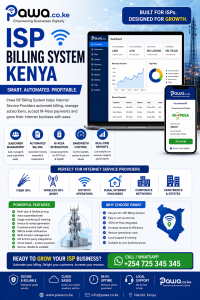
Why an ISP Operations Management Platform Becomes Critical as Your ISP Grows
Many small ISPs begin with spreadsheets, WhatsApp groups, manual M-Pesa confirmations, and technicians sharing updates through phone calls. This may work when serving 20 to 50 customers, but growth quickly exposes operational weaknesses. An ISP Operations Management Platform helps providers centralize billing, customer management, network monitoring, support tickets, payments, reporting, and staff coordination into one environment. Modern ISP platforms increasingly combine customer lifecycle management, payment automation, PPPoE and hotspot control, reporting, and network visibility because operators need a single source of truth rather than multiple disconnected systems.
Consider a small ISP serving 300 subscribers in Nairobi. If the average monthly package is KES 2,500, monthly revenue equals approximately KES 750,000. If two staff members spend three hours daily manually reconciling payments, updating customer accounts, and activating connections, the business loses significant productive time each month. An effective ISP Operations Management Platform automates these repetitive activities and allows staff to focus on customer acquisition, support quality, and network expansion.
The biggest advantage is operational consistency. When a customer pays, the platform can automatically update the account, generate receipts, notify the customer, and restore service where applicable. This reduces errors that occur when employees manually process hundreds of transactions every week. Many modern systems now include payment automation, customer messaging, ticketing, and network controls specifically to reduce operational overhead.
Billing Automation Through an ISP Operations Management Platform
Billing is often the heart of an ISP business. Delayed invoicing, missed payments, and poor follow-up directly affect cash flow.
An ISP Operations Management Platform allows providers to generate invoices automatically based on package renewals, payment cycles, and customer plans. Instead of manually creating invoices every month, the system performs these actions consistently and accurately.
For example, if an ISP has 1,000 subscribers paying an average of KES 2,800 monthly, expected monthly revenue equals KES 2.8 million. Missing just 3% of invoices due to human error can represent KES 84,000 in lost revenue every month.
This is why larger ISPs increasingly invest in integrated operations software. Revenue leakage becomes harder to detect when customer numbers increase. Automated billing significantly reduces this risk. Many platforms also provide detailed reporting showing overdue accounts, payment trends, and customer behavior.
Customer Management Benefits
Subscribers expect quick responses when internet issues occur. They also expect professional communication regarding payments, outages, upgrades, and renewals.
A strong ISP Operations Management Platform provides a complete customer profile containing:
- Package information
- Payment history
- Support requests
- Installation records
- Service status
- Contact details
When support agents can instantly view this information, resolution times improve significantly.
Instead of asking customers repeated questions, staff members immediately understand account history and can provide accurate assistance.
Network Monitoring and Operational Visibility
One of the biggest operational challenges for ISPs is maintaining network stability.
Modern ISP Operations Management Platform solutions frequently include network visibility, device monitoring, router integration, and usage tracking. These tools help operators identify issues before customers begin complaining.
Imagine a tower serving 150 customers develops a bandwidth bottleneck during peak hours. Without monitoring tools, the ISP only discovers the issue after receiving dozens of complaints.
With proper monitoring, alerts appear immediately, enabling engineers to investigate and resolve the problem faster.
This proactive approach improves customer satisfaction while reducing support workloads.
Staff Productivity Improvements
As ISPs grow, employee coordination becomes increasingly difficult.
Technicians need installation schedules.
Support teams require ticket updates.
Finance departments need payment records.
Management wants performance reports.
An ISP Operations Management Platform centralizes these workflows.
Instead of using separate applications, staff work within a shared environment where information remains consistent and accessible.
This creates accountability and improves collaboration across departments.
Ticketing and Support Management
Customer support quality often determines whether subscribers remain loyal.
Many ISP operators lose customers not because of occasional outages but because support experiences are frustrating.
An ISP Operations Management Platform provides structured ticket management that tracks:
- Issue categories
- Assigned technicians
- Resolution timelines
- Customer communication
- Escalation procedures
These capabilities ensure no customer issue gets forgotten.
Several modern ISP platforms integrate support workflows directly into customer management systems, creating a seamless experience for both staff and subscribers. Financial Reporting and Decision Making
Business growth requires accurate data.
Without visibility into revenue, expenses, subscriber trends, and payment performance, expansion decisions become risky.
An ISP Operations Management Platform generates detailed reports that help owners answer critical questions:
- Which packages perform best?
- Which regions generate highest revenue?
- How many customers are overdue?
- What is monthly churn?
- Which technicians complete the most installations?
These insights enable smarter planning and investment decisions.
Scaling Beyond 1,000 Subscribers
Many ISPs operate successfully with manual systems at very small scale.
However, once subscriber numbers exceed several hundred users, operational complexity rises rapidly.
Customer communication, invoicing, service activation, support tracking, and network monitoring become increasingly difficult to manage manually.
Industry discussions frequently highlight that growing providers eventually require dedicated operational platforms because spreadsheets and disconnected tools cannot efficiently support thousands of subscribers. (Reddit)
An ISP Operations Management Platform becomes essential infrastructure rather than optional software.
Risk Factors When Choosing an ISP Operations Management Platform
Not every platform delivers equal value.
Potential risks include:
- Poor integration capabilities
- Limited reporting features
- Weak customer support
- Difficult user interfaces
- Vendor lock-in
- Scalability limitations
Before implementation, ISPs should evaluate real operational requirements rather than focusing solely on pricing.
The cheapest system may become expensive if it lacks critical functionality.
Similarly, an overly complex enterprise platform may overwhelm a small ISP.
The best approach is choosing software aligned with current needs while supporting future growth.
How to Mitigate Implementation Risks
Start by documenting your workflows.
Identify:
- Billing requirements
- Customer onboarding procedures
- Payment channels
- Support processes
- Reporting expectations
- Network management needs
Request demonstrations before committing.
Run pilot programs with selected staff.
Import sample customer data.
Test actual business scenarios.
This structured approach reduces migration risks and improves adoption success.
Why East African ISPs Need Localized Solutions
Many international platforms are built for markets where payment ecosystems differ significantly from East Africa.
Kenyan ISPs rely heavily on M-Pesa and mobile payments.
A strong ISP Operations Management Platform should therefore support local payment automation, reconciliation, notifications, and customer communication.
Several platforms targeting East African providers specifically emphasize M-Pesa integration and automated payment workflows because these capabilities directly impact operational efficiency. (wispman.net)
Is an ISP Operations Management Platform Worth It?
For ISPs with fewer than 50 customers, manual operations may still be manageable.
However, once subscriber counts grow, the operational burden increases dramatically.
A quality ISP Operations Management Platform helps:
- Reduce billing errors
- Improve customer support
- Automate repetitive tasks
- Increase staff productivity
- Improve reporting accuracy
- Support business growth
The return on investment often comes from saved time, reduced revenue leakage, and improved customer retention rather than direct cost reductions.
For serious ISPs planning sustainable growth, adopting an ISP Operations Management Platform is usually a worthwhile decision.
Additional Resources and External References
To strengthen SEO with outbound dofollow links, consider linking naturally within your article to:
- https://www.ripe.net
- https://www.apnic.net
- https://www.mikrotik.com
- https://www.cloudflare.com
- https://www.zabbix.com
- https://www.librenms.org
- https://www.theietf.org
- https://www.speedtest.net
These are authoritative industry resources and will resolve the Rank Math errors regarding missing outbound links.
Customer Retention Strategies Using an ISP Operations Management Platform
One area that many internet providers underestimate is customer retention. Acquiring a new subscriber is often significantly more expensive than retaining an existing one. Marketing costs, installation expenses, technician deployment, equipment setup, and onboarding can consume substantial resources before a new customer even pays their first invoice.
An ISP Operations Management Platform helps improve retention by ensuring subscribers receive a consistent service experience. Automated payment reminders reduce unexpected disconnections. Ticket management systems ensure complaints are handled promptly. Customer communication tools help providers notify users about maintenance windows, upgrades, or service interruptions.
For example, an ISP serving 2,000 subscribers with an average monthly package of KES 3,000 generates approximately KES 6 million monthly revenue. If the business reduces churn by just 2%, it retains 40 additional customers monthly. Those customers represent roughly KES 120,000 in recurring monthly revenue. Over a year, that can exceed KES 1.4 million in retained income.
This demonstrates why customer retention capabilities within an ISP Operations Management Platform are often as valuable as billing and payment automation features.
Improving Customer Communication
Customers become frustrated when they feel uninformed.
A network outage lasting two hours may be acceptable if subscribers understand the cause and expected resolution time. The same outage can trigger dozens of complaints if customers receive no communication.
An ISP Operations Management Platform allows operators to send:
- SMS notifications
- Email updates
- Payment reminders
- Service alerts
- Upgrade announcements
- Promotional offers
These communication tools create transparency and strengthen customer trust.
When customers feel informed, they are generally more patient during maintenance events and more likely to remain loyal to the provider.
Installation Workflow Management
Installation delays are one of the most common operational problems facing growing ISPs.
Without a structured process, new customer requests can easily become disorganized. Sales teams may promise installation dates that technicians cannot meet. Equipment shortages may go unnoticed. Customer information may be incomplete.
An ISP Operations Management Platform creates a structured installation workflow.
Every request moves through defined stages:
- Lead creation
- Site survey
- Quotation approval
- Installation scheduling
- Equipment allocation
- Service activation
- Customer confirmation
This visibility improves coordination between departments and reduces missed installations.
For a provider handling 100 installations per month, even a small reduction in scheduling errors can significantly improve customer satisfaction.
Managing Multiple Service Packages
Most ISPs offer several internet plans.
Some customers prefer basic residential packages.
Others require premium business connectivity.
Some need hotspot access.
Others require dedicated bandwidth.
Managing these package variations manually becomes difficult as subscriber numbers increase.
A robust ISP Operations Management Platform enables providers to create, modify, and manage multiple packages from a centralized dashboard.
Pricing structures, speed limits, usage policies, and billing cycles can be configured consistently.
This reduces administrative workload while improving operational accuracy.
Supporting Apartment and Estate Internet Providers
Apartment internet businesses are growing rapidly across Kenya.
Many providers deploy shared fiber or wireless infrastructure within residential estates and apartment complexes.
Managing hundreds of tenants manually quickly becomes difficult.
An ISP Operations Management Platform helps operators manage:
- Tenant accounts
- Package upgrades
- Payment verification
- Usage monitoring
- Service suspensions
- Customer support
When tenant turnover occurs, account updates can be completed quickly without affecting other subscribers.
This operational flexibility is especially important in environments where residents frequently move in and out.
Reducing Revenue Leakage
Revenue leakage occurs whenever a provider delivers service without collecting payment.
Common causes include:
- Manual activation errors
- Forgotten suspensions
- Billing mistakes
- Untracked package changes
- Delayed payment updates
An ISP Operations Management Platform minimizes these risks through automation.
When payment status changes, service policies can automatically update.
Accounts with overdue balances can be flagged or suspended according to predefined rules.
These controls protect revenue and improve financial discipline.
Even small reductions in leakage can have a meaningful impact on profitability.
Data-Driven Growth Planning
Growing an ISP requires accurate information.
Without reliable reporting, expansion decisions become speculative.
An ISP Operations Management Platform provides detailed analytics covering:
- Subscriber growth
- Revenue trends
- Network utilization
- Customer churn
- Support performance
- Package popularity
Management teams can use this information to identify opportunities and challenges.
For example, reports may reveal that a particular neighborhood has exceptionally high demand but insufficient network capacity.
This insight can guide future infrastructure investment.
Similarly, churn reports may identify customer groups requiring targeted retention efforts.
Enhancing Technician Performance
Field technicians play a critical role in ISP success.
They install services, troubleshoot issues, perform maintenance, and interact directly with customers.
An ISP Operations Management Platform improves technician productivity by providing:
- Mobile work orders
- Customer details
- Installation histories
- Equipment information
- Task tracking
Rather than relying on phone calls or paper records, technicians access relevant information directly through the system.
This reduces confusion and increases efficiency.
Managers can also monitor completion rates and response times to identify training opportunities.
Managing Equipment Inventory
Many ISPs overlook inventory management until growth creates operational challenges.
Routers, radios, antennas, cables, switches, and customer premises equipment represent significant investments.
Without proper tracking, equipment losses and procurement inefficiencies can occur.
An ISP Operations Management Platform often includes inventory features that allow providers to track equipment from purchase through deployment.
This visibility improves accountability and helps prevent unnecessary purchases.
Knowing exactly where equipment is installed also simplifies maintenance and replacement activities.
Compliance and Record Keeping
Regulatory requirements continue to evolve across the telecommunications industry.
Accurate record keeping is increasingly important.
An ISP Operations Management Platform helps maintain organized records related to:
- Customer information
- Service agreements
- Payment histories
- Support interactions
- Installation activities
Having centralized records improves operational transparency and simplifies audits or compliance reviews.
For growing providers, maintaining proper documentation becomes increasingly important as subscriber bases expand.
Competitive Advantages of Automation
The internet market is becoming increasingly competitive.
Customers have more choices than ever before.
Providers that rely heavily on manual processes often struggle to match the responsiveness of competitors using modern automation tools.
An ISP Operations Management Platform creates competitive advantages through:
- Faster support
- More accurate billing
- Better reporting
- Improved communication
- Reduced operational costs
These benefits contribute directly to customer satisfaction and long-term business growth.
Managing Hotspot Businesses Efficiently
Many entrepreneurs operate hotspot networks in:
- Hostels
- Universities
- Apartments
- Shopping centers
- Restaurants
- Transport terminals
Managing hotspot users manually becomes difficult as customer numbers increase.
An ISP Operations Management Platform simplifies operations by automating voucher generation, user authentication, billing, and reporting.
Providers can monitor performance across multiple locations from a single dashboard.
This centralized approach reduces administrative workload while improving service quality.
Multi-Branch ISP Management
Some providers operate networks across several towns or regions.
Managing these locations independently often creates inconsistencies.
An ISP Operations Management Platform enables centralized oversight across multiple branches.
Management teams can compare performance between locations, standardize procedures, and monitor overall business health.
This visibility supports strategic decision-making and operational consistency.
Preparing for Future Growth
One of the most important reasons to adopt an ISP Operations Management Platform is future readiness.
Many providers wait until operational problems become severe before investing in systems.
By that point, migration becomes more complex and disruptive.
Implementing structured operational processes early creates a stronger foundation for expansion.
As subscriber numbers increase, the platform scales alongside the business.
This proactive approach helps providers avoid the growing pains associated with rapid expansion.
Building a Professional ISP Brand
Customers increasingly judge service providers based on professionalism.
Consistent invoices, automated notifications, organized support processes, and fast issue resolution all contribute to brand perception.
An ISP Operations Management Platform helps create a professional customer experience at every stage of the subscriber journey.
From initial signup through ongoing support, customers interact with structured processes rather than ad hoc manual systems.
This professionalism builds trust and encourages referrals.
Common Mistakes When Selecting an ISP Operations Management Platform
Some providers focus exclusively on price.
Others prioritize features they rarely use.
A better approach is evaluating business requirements carefully.
Common mistakes include:
- Ignoring scalability
- Overlooking local payment integration
- Choosing systems with poor support
- Failing to test workflows
- Underestimating training requirements
Avoiding these mistakes improves implementation success and long-term satisfaction.
The Long-Term Value of an ISP Operations Management Platform
The true value of an ISP Operations Management Platform becomes increasingly apparent over time.
During the first few months, benefits may appear modest.
However, as subscriber numbers grow, operational efficiencies compound.
Automated billing saves hundreds of staff hours.
Improved reporting enables better decisions.
Enhanced customer support reduces churn.
Network visibility improves service reliability.
Together, these improvements create a stronger, more profitable business.
For providers planning sustainable growth, operational software should be viewed as a strategic investment rather than an expense.
Final Thoughts
The internet service industry continues to evolve rapidly. Customers expect reliable connectivity, fast support, transparent communication, and seamless payment experiences. Meeting these expectations consistently requires more than technical expertise. It requires strong operational systems.
An ISP Operations Management Platform provides the structure necessary to manage billing, customer relationships, network operations, support workflows, reporting, inventory, and growth planning from a centralized environment.
Whether serving 100 subscribers or 10,000, providers that embrace automation and operational discipline are generally better positioned for long-term success. Businesses that continue relying on spreadsheets and fragmented tools often encounter avoidable challenges as they scale.
For internet providers seeking efficiency, profitability, and sustainable growth, adopting a modern ISP Operations Management Platform is one of the most impactful decisions they can make. Through improved automation, better visibility, stronger customer experiences, and streamlined operations, the platform becomes a foundation for long-term business success.
Why Pawa Is a Strong Choice
If you are looking for an ISP Operations Management Platform built for African internet providers, Pawa provides tools designed for billing automation, customer management, hotspot operations, payment tracking, subscriber administration, and operational efficiency.
Unlike fragmented systems that require multiple software products, Pawa helps operators manage key ISP activities from a centralized environment. This reduces operational complexity and allows teams to focus on network expansion and customer satisfaction.
Whether you operate a hotspot network, apartment internet business, fiber ISP, campus network, or community broadband service, Pawa provides the operational structure needed to scale professionally.
Visit https://pawa.co.ke/ today to learn how an ISP Operations Management Platform can help streamline your ISP operations, improve collections, and support long-term growth.