
ISP Revenue Management Software in Kenya: A Complete Guide for ISPs to Maximize Revenue
The internet service provider (ISP) industry in Kenya is growing rapidly due to increased demand for reliable internet connectivity in homes, businesses, schools, and institutions. However, with this growth comes a major challenge: revenue leakage, inefficient billing systems, and poor subscription management.
This is where ISP Revenue Management Software becomes essential. Modern ISPs can no longer rely on manual billing systems or fragmented tools. To remain competitive, they need an integrated system that automates billing, tracks usage, manages subscriptions, and ensures every shilling earned is accurately captured and collected.
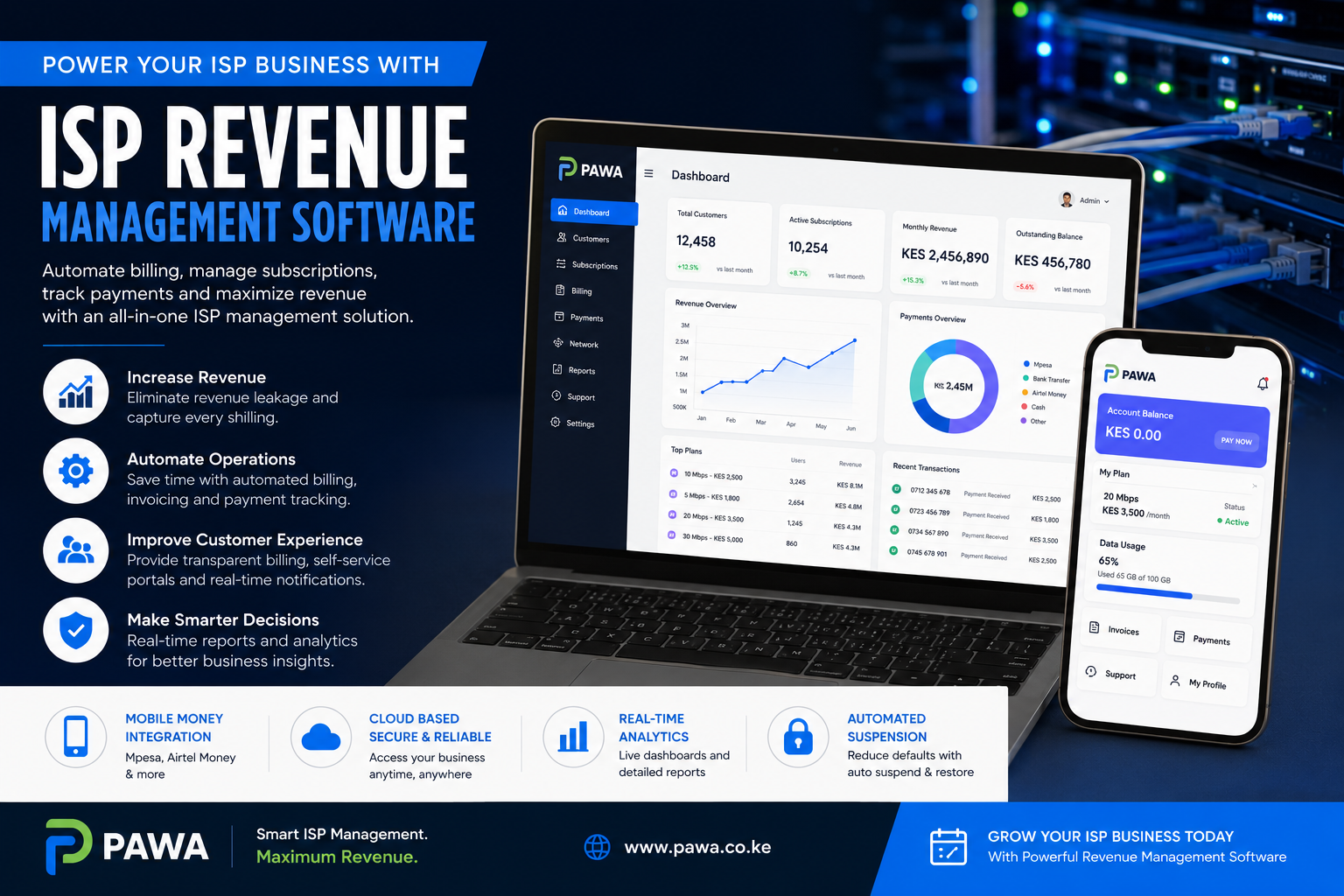
Platforms like PAWA are transforming how ISPs in Kenya manage revenue, streamline operations, and scale sustainably.
What is ISP Revenue Management Software?
ISP Revenue Management Software is a digital system designed to help internet service providers manage all aspects of billing, revenue collection, customer subscriptions, and financial reporting.
It integrates multiple ISP operations into one centralized platform, including:
- Customer subscription management
- Automated billing and invoicing
- Payment tracking and reconciliation
- Bandwidth usage monitoring
- Revenue analytics and reporting
- Debt and arrears tracking
Instead of relying on spreadsheets or manual tracking, ISPs use this software to ensure accuracy, automation, and transparency in all financial processes.
Why ISPs in Kenya Need Revenue Management Software
The Kenyan ISP market is highly competitive, with small, medium, and large providers all fighting for customers. Without proper revenue management, ISPs face serious operational challenges.
1. Revenue Leakage Prevention
One of the biggest problems ISPs face is untracked usage and unpaid services. Customers may consume internet services without proper billing due to system gaps.
ISP Revenue Management Software ensures:
- Every active user is billed correctly
- Suspended users are automatically restricted
- No manual errors in invoice generation
This directly reduces revenue leakage and increases profitability.
2. Automation of Billing Processes
Manual billing is time-consuming and prone to errors. With automation:
- Invoices are generated automatically
- Billing cycles run without human intervention
- Customers receive timely reminders
This improves efficiency and reduces administrative workload significantly.
3. Improved Cash Flow Management
Cash flow is critical for ISP operations, especially when dealing with infrastructure costs like routers, fiber cables, and bandwidth providers.
Revenue management software ensures:
- Faster payment collection
- Real-time payment tracking
- Automatic service suspension for defaulters
This leads to predictable and stable cash flow.
4. Better Customer Experience
Customers expect seamless service and transparent billing. A good ISP system provides:
- Clear invoices
- Usage breakdowns
- Self-service payment portals
- Automated notifications
This improves trust and reduces customer complaints.
Key Features of ISP Revenue Management Software
A powerful ISP billing and revenue system includes multiple integrated features that support end-to-end operations.
1. Automated Billing System
The system automatically generates invoices based on:
- Subscription plans
- Usage-based billing
- Prepaid or postpaid models
This eliminates manual errors and ensures accuracy.
2. Customer Management System (CRM Integration)
The software acts as a central customer database, storing:
- Customer details
- Subscription plans
- Payment history
- Service status
This helps ISPs manage customers more efficiently.
3. Real-Time Payment Tracking
The system integrates with mobile money and payment gateways to track:
- M-Pesa payments
- Bank transfers
- Wallet payments
Payments are instantly reflected in the system, reducing reconciliation delays.
4. Bandwidth and Usage Monitoring
Advanced systems monitor:
- Data consumption per user
- Bandwidth allocation
- Network performance
This helps ISPs optimize resources and prevent abuse.
5. Automated Suspension and Reactivation
If a customer fails to pay:
- The system automatically suspends service
- Once payment is made, service is restored instantly
This reduces revenue loss and enforces discipline.
6. Financial Reporting and Analytics
ISPs can generate detailed reports including:
- Daily, weekly, monthly revenue
- Customer growth trends
- Outstanding balances
- Profitability analysis
These insights help in strategic decision-making.
How ISP Revenue Management Software Works
Understanding how the system operates helps ISPs appreciate its value.
Step 1: Customer Subscription Setup
Customers are added to the system and assigned a package.
Step 2: Automated Billing Cycle
The system generates invoices based on subscription terms.
Step 3: Payment Collection
Customers pay via integrated payment channels.
Step 4: Real-Time Update
Payments are automatically recorded in the system.
Step 5: Service Control
The system manages activation or suspension based on payment status.
Step 6: Reporting
Business owners access real-time financial reports.
Benefits of ISP Revenue Management Software
1. Increased Profitability
By reducing revenue leakage and improving billing accuracy, ISPs can significantly increase profit margins.
2. Operational Efficiency
Automation reduces the need for large administrative teams, cutting operational costs.
3. Scalability
Whether serving 100 or 100,000 customers, the system scales easily without performance issues.
4. Reduced Human Error
Manual processes often lead to billing mistakes. Automation eliminates these errors completely.
5. Enhanced Decision Making
Real-time analytics allow ISPs to:
- Identify top-performing packages
- Understand customer behavior
- Optimize pricing strategies
Challenges Faced Without ISP Revenue Management Software
ISPs that do not use modern systems often face:
- Missed payments
- Billing inconsistencies
- Poor customer tracking
- Manual reconciliation delays
- Network misuse and abuse
These challenges slow down growth and reduce profitability.
ISP Revenue Management Software vs Traditional Systems
| Feature | Traditional System | Modern ISP Software |
|---|---|---|
| Billing | Manual spreadsheets | Automated billing |
| Payments | Delayed tracking | Real-time updates |
| Reporting | Monthly manual reports | Live dashboards |
| Customer management | Scattered records | Central CRM system |
| Revenue leakage | High risk | Minimal risk |
Modern systems clearly outperform traditional methods in every aspect.
The Role of ISP Software in Kenya’s Digital Economy
Kenya’s digital transformation has increased demand for reliable internet connectivity. Schools, businesses, and homes depend heavily on ISPs.
With this growth:
- ISPs must scale efficiently
- Billing must be accurate
- Revenue systems must be automated
Platforms like PAWA play a key role in supporting this ecosystem by providing robust tools for ISP revenue management software, automation, and customer control.
Future of ISP Revenue Management Software
The future of ISP software is evolving rapidly with innovations such as:
AI-Powered Analytics
Predict customer churn and optimize pricing strategies.
Cloud-Based Billing Systems
Allow ISPs to manage operations from anywhere.
Advanced Automation
Fully automated onboarding, billing, and support systems.
Integration with Smart Devices
IoT-based usage tracking and dynamic bandwidth allocation.
These innovations will make ISP operations even more efficient and profitable.
Why Choose Advanced ISP Revenue Management Software
Choosing the right system is critical for success. A strong platform should offer:
- Reliability and uptime
- Secure payment integration
- Scalable infrastructure
- Real-time analytics
- Easy user interface
- Strong customer support
ISPs that invest in modern systems gain a long-term competitive advantage.
Conclusion
The ISP industry in Kenya is becoming increasingly competitive, and businesses that fail to modernize their operations risk falling behind. ISP Revenue Management Software is no longer optional—it is a necessity for growth, efficiency, and profitability.
By automating billing, reducing revenue leakage, and improving customer management, ISPs can significantly improve their financial performance.
Platforms like PAWA provide the tools needed to streamline operations and support scalable growth in the digital economy.
For any ISP looking to grow sustainably, investing in a robust revenue management system is one of the most important decisions they can make in 2026 and beyond.
Frequently Asked Questions (FAQ)
1. What is ISP Revenue Management Software?
It is a system that automates billing, subscription management, and revenue tracking for internet service providers.
2. Why do ISPs need revenue management software?
It helps reduce revenue leakage, automate billing, and improve financial accuracy.
3. Can ISP software integrate with mobile money?
Yes, most modern systems integrate with M-Pesa, bank transfers, and online payments.
4. Is ISP Revenue Management Software suitable for small ISPs?
Yes, it is scalable and works for both small and large ISPs.
5. How does it improve profitability?
By ensuring all customers are billed correctly and payments are tracked in real time.