
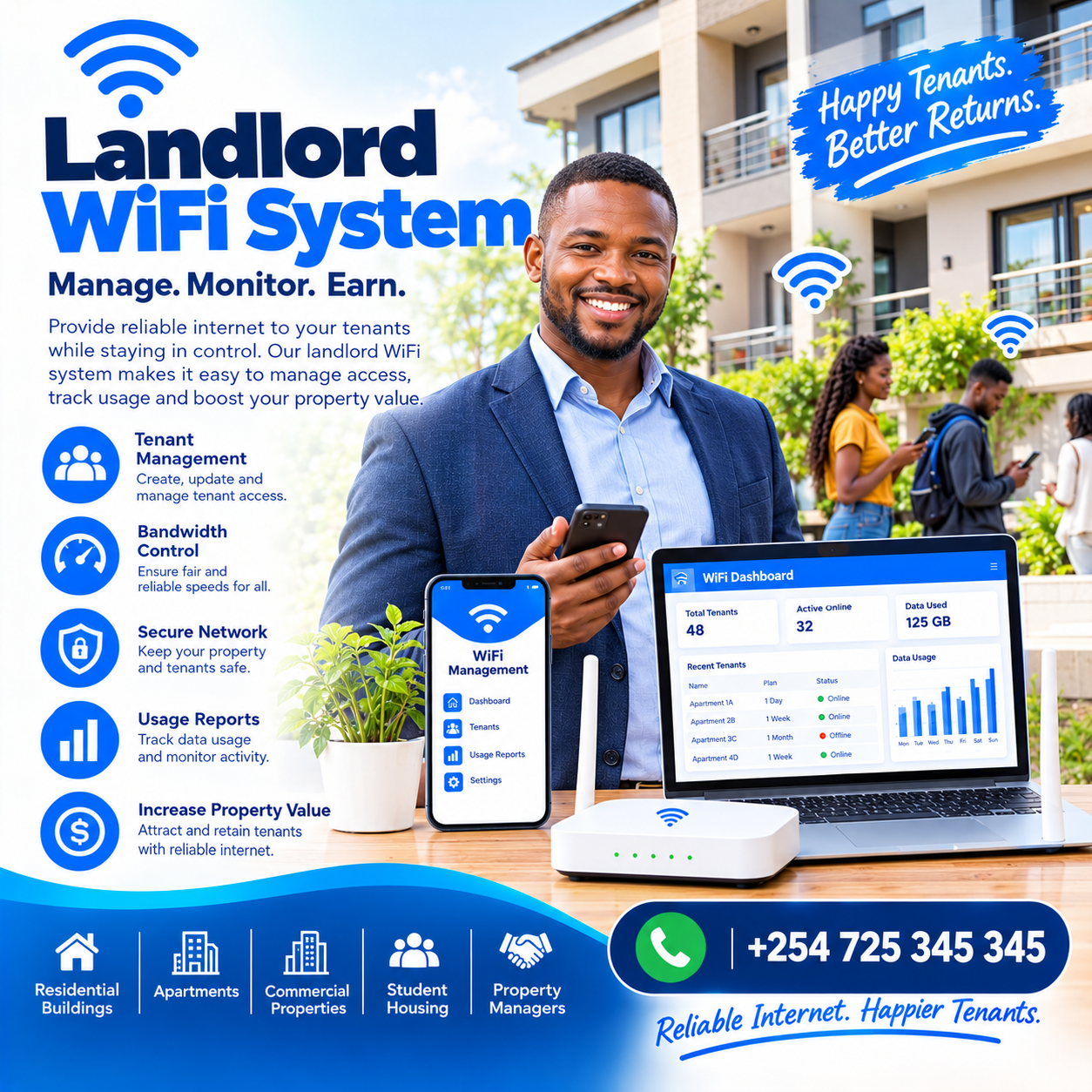
A landlord WiFi system is the complete infrastructure that turns a property’s internet from a silent expense into a managed, automated, income-producing asset — one system that carries signal to every unit, sells packages to every tenant, collects every payment without a single door-knock, and reports the whole story to the owner from a phone.
Every property owner eventually meets the same crossroads: the moment the internet they installed as a goodwill gesture becomes a line item they quietly resent.
The subscription leaves the account on the first of every month without fail, while the recovery of that money depends on knocking on doors, composing reminders, and remembering who paid what. A landlord WiFi system is what stands between those two fates — the machinery that converts a cost the owner subsidizes into an income the owner reads from a dashboard.
This article walks through the complete picture: what a landlord WiFi system actually is, why the informal arrangements it replaces were never sustainable, how each component works, what it earns, and how it changes the landlord’s relationship with their property, their tenants, and their own time.
Because the demand was always there — every tenant in every property wants reliable, fairly priced internet — and a landlord WiFi system is simply the machinery that finally turns that demand into income the owner never has to chase.
Table of Contents
ToggleWhat a Landlord WiFi System Actually Is
Strip away the technical vocabulary and the concept is refreshingly concrete. A landlord WiFi system is the full commercial and technical layer of a rental property’s internet: the network that distributes signal to every unit, the billing platform that sells it per tenant, and the management dashboard that keeps the whole operation visible to the owner from anywhere.
The model underneath is elegantly simple: the property holds one strong connection, the system divides it into individually sold packages, and each tenant buys exactly what they need through a portal on their own phone.
The tenant’s experience is simple: they connect to the network, a clean page appears showing packages and prices, they choose one, they pay through mobile money, and their unit’s access opens instantly.
The landlord’s experience runs in parallel: a dashboard showing every unit’s status, every payment collected, every expiry approaching, and every shilling recorded with a timestamp.
What sits between those two experiences is the landlord WiFi system itself — and its completeness decides whether the property’s internet earns or leaks.
A complete system includes the network layer that carries signal to every unit, the captive portal that greets every device, the payment integration that collects through mobile money, the enforcement that binds access to payment, and the reporting that turns activity into decisions.
An incomplete version — the shared password, the informal collection, the memory-based ledger — performs some of those jobs by hand, and every hand-performed job in property management eventually becomes a dispute.
The market learned this lesson expensively: the landlords who grew their rental income all moved their internet onto purpose-built systems, while the ones who improvised kept absorbing costs they never budgeted.
That is the first principle of the model: the connection serves the tenants, but the landlord WiFi system turns their tenancy into revenue.
And revenue, not goodwill alone, is what makes an amenity sustainable enough to keep its promises year after year.
The Landlord’s Old Problem: The Arrangement That Never Worked
To appreciate what a landlord WiFi system changes, it helps to sit honestly with how property internet ran before — because every landlord lived some version of it.
The setup was one password, printed on a wall or whispered at the caretaker’s door, serving every unit in the property without distinction.
The password leaked immediately — to friends in other buildings, to cousins visiting for the weekend, to the neighbor’s relative — and the connection slowed under weight nobody authorized.
The landlord responded the only way the old model allowed: upgrading the subscription to compensate, paying enterprise money to serve strangers the property never agreed to host.
Cost recovery was the next chapter of the mess: some landlords folded WiFi into rent and quietly absorbed the heavy users, some collected a separate fee monthly and became debt collectors every month, and some handed the task to a caretaker whose notebook recorded what the notebook recorded.
Every arrangement failed the same test — it could not prove anything, so it could not enforce anything, and the property’s internet remained an expense wearing the costume of an amenity.
The complaints completed the picture: “it’s too slow” from the tenant streaming at midnight, “it’s unfair” from the light user drowning in a neighbor’s download, and “when did my internet end?” from everyone.
Under one shared password, the landlord could neither fix the speed nor assign the fairness — because the old arrangement could not see who was using what.
The disputes completed their own cycle: the tenant who swore they paid, the landlord who could not prove they didn’t, and the disagreement that settled by volume of voice because neither side held evidence.
Operators who studied the before-and-after describe the old arrangement precisely: it was not a system at all, and the first gift of a landlord WiFi system is that the property finally has one.
That gift compounds into every other benefit this article describes — because structure, not generosity, is what makes an amenity sustainable and a landlord’s relationship with their tenants calm.
The Five Components: The Anatomy of the Engine
Understanding a landlord WiFi system means understanding its five working parts — because each one performs a job that leaks money or goodwill whenever it is missing or done by hand.
The first component is the network layer: the property’s connection sized for the full evening load, the routers and access points placed so every unit receives a strong signal, and the cabling and power protection built for years of service.
Physics comes first because no billing software can invoice around a weak signal — a paying tenant with three bars in their unit becomes a refund conversation and a review the property did not need.
The second component is the captive portal: the page every connecting device lands on, showing the packages, the prices, and the property’s branding — simultaneously the storefront and the building’s most-read page.
The third component is the payment layer: the machinery that collects through mobile money — the tenant taps a package, an STK push lands on their phone, they enter their PIN, and their unit’s access opens within seconds.
The fourth component is enforcement: the rules that keep every package serving exactly the unit that bought it — device binding, concurrent-login blocks, and expiry that lands precisely when the paid period ends.
The fifth component is reporting: the landlord’s dashboard showing every unit’s status, every payment, every expiry, and every pattern — the property’s internet finally visible instead of guessed.
A landlord WiFi system missing any one of these five components is not a smaller version of the whole — it is a specific, predictable leak with a specific cost.
The complete engine, by contrast, runs the property’s entire internet operation with no human hands in the loop — which is what makes the amenity manageable by an owner who lives across town, works another job, or owns several properties at once.
The landlords who audited their old arrangements always found their losses living exactly where their components were thin, which is why completeness is the first shopping criterion in this corner of the trade.
Income Diversification: The Landlord’s Second Line
The most immediate gift of a landlord WiFi system is financial: a second income line built on infrastructure the property already partially owns.
Rental income has always been the landlord’s single engine — and single-engine incomes carry single-engine risks: vacancies, arrears, and the seasons when the market softens.
A WiFi income line diversifies that picture: the connection that once drained the accounts becomes a covered cost and then a surplus, collected automatically, cycle after cycle.
The arithmetic rewards the model strongly at typical property scale: at even moderate adoption, the tenant packages cover the entire internet subscription completely, with every additional package flowing to the landlord at near-total margin.
Premium speed tiers deepen the surplus: the households whose work, coursework, or streaming genuinely needs more pay more, and their upgrades cost the landlord nothing additional.
The indirect returns stack beside the direct ones: units advertising instant WiFi rent faster at the same price, because connectivity now ranks among the first questions prospective tenants ask.
Vacancy rates improve in properties where the internet works and bills fairly — and every avoided vacant month is worth more than a year of WiFi surplus.
The administrative savings complete the ledger: the caretaker’s collection rounds, the receipt writing, and the monthly chasing all disappear into the platform.
Landlords who moved from shared-password arrangements to a landlord WiFi system describe the same discovery: the internet shifted from the expense column they resented to the income line they checked happily.
And the shift required no new construction, no new staff, and no new rent — only the billing architecture applied to a connection the building already had.
That is why the model has become the standard recommendation among property professionals: it is the rare upgrade that pays for itself before it asks for anything.
Remote Management: The Landlord Who Lives Anywhere
The deepest structural gift of a landlord WiFi system is distance — the property’s internet becoming manageable from anywhere, by an owner who never needs to be physically present for a single transaction.
The old arrangement chained the landlord to the property: collections at the gate, receipts at the door, disputes in the corridor, and every WiFi question routed to whoever held the notebook.
The system dissolves those chains completely: tenants buy through the portal, payments confirm automatically, access activates instantly, and enforcement runs without anyone present.
The landlord’s daily involvement shrinks to two moments: a few minutes setting or adjusting packages, and a glance at the reports — usually with morning tea, from wherever they happen to be.
The dashboard travels with the owner: unit statuses, payment histories, expiry calendars, and revenue trends all visible from a phone, in town or overseas alike.
The diaspora landlord — one of the model’s biggest beneficiaries — manages their property’s internet as easily from abroad as a neighbor would from next door.
Time zones stop mattering: collections arrive through the night, records file themselves, and the morning report is waiting whenever the owner wakes.
The caretaker’s role transforms rather than disappears: collection duties vanish, and the caretaker returns to maintenance and tenant service — usually a promotion on both sides.
The records also protect honest caretakers from the suspicions that handwritten ledgers always left hanging, since every transaction carries a receipt neither party can dispute.
Landlords who made the switch describe the feeling identically: they stopped being the property’s bill collector and went back to being its owner.
That return — from chasing shillings to reading reports — is the everyday experience of a landlord WiFi system running well, and it is why the owners who deploy one rarely volunteer to go back.
Tenant Relations: The Fairness Dividend
Money between landlords and tenants is where relationships fray — and a landlord WiFi system removes the sharpest edge by making every unit’s deal explicit, recorded, and identical.
Under the informal arrangement, every tenant’s WiFi story lived in memory: what was promised, what was paid, what was received — with no evidence on either side.
Under the system, the deal is published: every package, every price, and every term displayed on the portal, identical for every tenant in the building.
The payment carries its own evidence: the tenant’s M-Pesa confirmation on their phone and the landlord’s matching dashboard entry, timestamped to the second.
The “did you receive my money” conversation — the classic that consumed an evening every month — simply loses its habitat.
Fairness becomes structural rather than argued: every unit pays for its own tier and receives its own enforced share of the bandwidth, so the light user stops subsidizing the heavy streamer and the heavy streamer stops apologizing for their habits.
The resentment that poisoned shared arrangements — the quiet grievance of paying the same for receiving less — has nowhere to grow when every unit’s deal is visible and enforced identically.
Tenants also gain dignity: paying feels like topping up rather than being chased, the transaction stays private between them and their phone, and no late payment ever needs explaining to a human being.
Landlords who deployed a landlord WiFi system report the social effect in the same terms across properties: the building’s mood lightened, the complaint messages stopped, and the tenants who felt fairly treated became the ones who renewed, referred, and defended the property’s reputation.
That fairness dividend is among the most valuable returns the system produces — because tenant goodwill is the asset every vacancy depends on.
Packages and Pricing: The Ladder That Fits Tenant Budgets
The package menu is where a landlord WiFi system meets its market, and the ladder’s design determines who buys and how often.
The foundation package is the monthly unit rate — priced visibly below what the same month of bundles would cost, because that comparison is where the sale is won.
Tenants do the arithmetic in seconds, and a monthly package that beats the bundle math converts without persuasion.
The weekly package serves the short-stay tenant, the one deciding whether to commit, and the visitor filling a unit for a fortnight — the bridge product that upgrades to monthly once trust is earned.
The semester and quarterly options reward the committed: discounted long-term rates that lock in revenue the landlord can plan against and spare tenants monthly renewals.
Speed tiers add the second dimension: a standard tier for everyday use, and a premium tier for the households whose work, coursework, or streaming genuinely needs more — enforced at network level rather than promised on the page.
The premium tier sells on felt difference rather than marketing, and its margin is the highest on the menu.
Shared-unit arrangements flex naturally: two tenants splitting one room split one package, and the platform’s device capacity accommodates both without argument.
And the pricing review closes the loop each cycle: the dashboard shows which packages sold, which tiers upgraded, and where the next term’s menu should adjust.
Landlords who tuned their landlord WiFi system menus against that data cycle after cycle consistently found the monthly tier becoming the property’s heartbeat — renewed by habit, priced by evidence.
Payments and Collections: The End of the Chasing Era
The payment layer is where a landlord WiFi system delivers its most visible relief: the permanent end of the landlord’s chasing era.
Under the old model, the landlord’s month began with a list — who paid, who owes, who promises Friday — and the days filled with reminders, gate meetings, and the quiet arithmetic of the tenants who never paid at all.
Under the system, collections happen continuously: tenants paying at midnight, on payday, and through every hour between — with the money confirmed, the access activated, and the receipt issued automatically on both sides.
The landlord’s collection work drops to zero, and the property’s WiFi income stops depending on anyone’s memory, mood, or availability.
The reconciliation layer completes the relief: every stray payment, every duplicate attempt, every delayed confirmation — matched automatically, so no shilling ever arrives without its purpose and no argument ever forms about one.
The payment flow runs on the standard tenants already trust: the STK push lands on their own phone, their PIN stays inside their payment provider’s secure environment, and the confirmation reaches both sides in seconds.
That familiarity means adoption requires no teaching: tenants buying internet through the portal behave exactly as they do buying everything else through their phones.
Landlords who studied their properties before and after deploying a landlord WiFi system found the same verdict: collection rates climbed sharply, arrears collapsed to near zero, and the recovery represented the fastest gain the property ever recorded.
The recovery is not from new tenants — it is from the structural closure of every leak the informal arrangement tolerated.
And the predictability compounds: WiFi income arriving in known patterns, per unit, per cycle — making the property’s finances plannable in a way hand-collected amenities never were.
That predictability is the quiet superpower the payment layer grants: not just more money, but money whose behavior the landlord finally understands.
Enforcement: Keeping Every Package Accounted For
The enforcement layer is where a landlord WiFi system proves its worth daily — because a property network without enforcement is a property where revenue leaks through every open door.
The first mechanism is device binding: every package ties to the hardware of the unit that bought it, so shared credentials simply fail on devices the purchase never touched.
This single rule collapses the sharing economy that shared passwords never controlled — the friend in the next block, the cousin visiting for the weekend, the neighbor’s relative riding on a borrowed login.
The second mechanism is the concurrent-login block: a bound package cannot open a second simultaneous connection, no matter how the credentials travel.
The third is clean expiry: access ends exactly when the paid period ends — with a visible countdown, a renewal warning, and a one-tap top-up that converts the tenant’s genuine need into a natural second purchase.
The fourth is the closed perimeter: no traffic flows before the portal authenticates, management interfaces stay away from the tenant side, and firmware stays current against the bypass tricks that circulate in the same groups where everything else is shared.
The fifth is the dashboard’s arithmetic: devices connected on the network compared against packages sold — a persistent gap is a leak announced in numbers, and the weekly check catches what walls alone miss.
Landlords who deployed this full enforcement stack describe the change in their numbers: device counts dropping to match paid units, collections rising without a single new tenant, and the recovery often representing the fastest gain the property ever recorded.
That recovery is the quiet dividend of a landlord WiFi system taking enforcement seriously — the revenue that was always there, finally arriving where it belonged.
Coverage and Hardware: The Physics Half of the System
The selling platform manages the money; the hardware manages the signal — and no landlord WiFi system earns around physics it ignored.
The connection comes first, sized for the evening peak: the hours when the whole property is home, fed, and pressing play.
A connection that serves twenty comfortable units at noon may fold at two hundred devices by 8 p.m., and the tenants judge the network by exactly that hour.
The access points come next, placed where the coverage plan points rather than where the ladder reached — height clearing the rooflines, building wings divided into zones, and every mounting position a decision the signal will honor or punish for years.
The professional deployment begins with a unit-by-unit signal survey: every room mapped, every dead corner marked, and every weak spot fixed before billing ever begins.
That sequencing is the discipline that separates smooth rollouts from grievance farms — because a paying tenant with a weak signal becomes the property’s loudest critic.
The router is the traffic officer: a business-class unit with genuine capacity to shape, prioritize, and govern every unit sharing the connection.
Power protection is non-negotiable: backup batteries carrying the full chain through the blackouts that always seem to arrive at peak, and surge protection absorbing the dirty power that follows every outage.
Maintenance completes the physics: seals checked before the rains, mounts verified after the winds, firmware updated on schedule, and spares held for every deployed model.
The shopping rule the professionals repeat: buy for the environment first, the performance second, and the price last — because a landlord WiFi system sitting on solid physics outperforms the one compensating for weak foundations with better software.
The Reporting Layer: A Property That Explains Itself
The dashboard is where a landlord WiFi system stops being machinery and starts being management — because the numbers it surfaces are the difference between guessing and knowing.
The first reports answer the daily questions: which units are active, which packages expire this week, what collected today, and how the property’s internet performed.
A capable platform answers those on the first screen, instantly, without exports or notebook archaeology.
The second reports reveal the patterns: the hours that carry the load, the tiers that upgrade, the units that renew faithfully, and the ones drifting toward lapse — the property’s rhythm written in its own transaction history.
That rhythm shapes every decision that follows: capacity planned for the evening peak, pricing tuned to the tiers tenants actually choose, and retention gestures aimed at the units that earn the most.
The third reports protect the revenue: payment success rates, failed transactions, and device-to-package gaps — the early-warning system that catches problems while they are small.
The fourth reports guide growth: whether the property justifies a second mast, whether the premium tier deserves a faster sibling, and which unit types convert best.
Landlords who read their dashboards weekly describe the transformation plainly: decisions that were once felt became measured, and the property began steering by evidence.
That steering is the strategic gift of a landlord WiFi system — not just a network that runs, but an amenity the owner finally understands well enough to grow.
Turnover, Vacancies, and Vacant Units: The Flexibility Test
Property turnover is where informal arrangements always broke — and where a landlord WiFi system proves its design most clearly.
The move-in is immediate: a new tenant occupies their unit, connects, buys their package from the portal, and is online before their bags are unpacked — no waiting for the caretaker, no pro-rating argument, no shared password handed over with the keys.
The move-out is cleaner still: the departing tenant’s package simply runs to its natural end or stops at cancellation, and the unit’s billing status closes without a conversation — no refunds to negotiate, no leftover credit to chase.
The vacant unit costs the landlord nothing: an unoccupied unit generates no package, consumes no billing, and reactivates the day its next tenant arrives.
Compare that with WiFi folded into rent, where the landlord pays for the connection through every empty unit on the corridor.
Move-in surges become manageable rather than chaotic: the January rush of new tenants onboards themselves through the portal at whatever hour they arrive, while the landlord watches the dashboard fill instead of standing at the gate collecting payments in the rain.
Mid-cycle arrivals and departures — the transfers, the early exits, the plans that changed — all flow through the same self-service loop.
That turnover fluidity is the operational gift of a landlord WiFi system: the billing follows the tenancy exactly, in every direction, without a single manual adjustment.
And the vacancy story doubles as marketing: units advertising instant WiFi rent faster at the same price, because the amenity finally works the way tenants expect before they even sign.
Scaling: One Property Becomes a Portfolio
The deepest business value of a landlord WiFi system reveals itself at the second property — because everything that made the first deployment run professionally is now a template.
The network build transfers: the sizing method, the access point placement, the coverage survey — applied to the next property’s own floor plan rather than reinvented.
The package menu transfers: the same ladder, the same pricing logic, the same portal design — replicated as configuration, tuned to the new building’s tenant mix.
The rollout playbook transfers: the communication sequence, the demonstration, the grace period — the steps that made the first property adopt smoothly.
And the dashboard extends across all of it: one screen showing every unit in every property, revenue per building, and package status across the whole portfolio.
Landlords running a landlord WiFi system across multiple properties describe management as reading rather than running — the portfolio visible in one session, decisions made from evidence.
The financing compounds with scale: proven collections from the first property fund the equipment for the second, and clean records make lenders and partners comfortable.
The risk diversifies too: a slow cycle at one property is cushioned by the others, and no single building’s vacancy threatens the whole income.
The landlords who scaled this way all followed the same sequence: prove one deployment completely, document it honestly, then clone it deliberately.
That cloning discipline is what turns a landlord WiFi system from a single-property amenity into the foundation of a portfolio-wide business — one verified property at a time, each one inheriting everything the last one learned.
The Mistakes That Sink Landlord WiFi
The predictable rollout errors repeat across every property, and naming them is cheaper than making them.
The first is the silent launch: the portal goes live without telling the tenants, and a week of confusion gets misread as rejection — when one honest announcement would have filled it with first purchases.
Every smooth adoption of a landlord WiFi system began with communication: a notice in the corridors, a message in the building’s groups, and a demonstration at the gate.
The second is the weak-coverage unit: billing rolled out while the far corner of the top floor still fought for signal, and the paying tenant in that unit became a grievance — fix the physics before or alongside the billing, always.
The third is overpricing against the bundle: a menu set above what tenants pay on their own SIMs sends them quietly to their phones and away from the portal — the portal does not set the market, it reveals it.
The fourth is the absent grace period: a package expiring the night before a deadline, with a hard cutoff and no renewal prompt, converting a loyal tenant into a critic — warnings, countdowns, and one-tap renewals exist precisely to prevent that moment.
The fifth is the hybrid leak: the portal running alongside an informal shared password — every off-system connection a record that does not exist and a dispute waiting to form.
The sixth is ignoring the dashboard: the platform’s reports showing adoption rates, peak hours, and package preferences — evidence nobody reads.
The seventh is the exception culture: the cousin credited quietly, the favor extended off the books — every unrecorded transaction training the property that the system bends.
Each mistake is avoidable with the same discipline: communicate first, verify the coverage, price against the alternative, grace the expiry, close the old doors, and read the reports weekly.
The landlords who kept those habits watch their landlord WiFi system become the property’s quietest-working asset — while neighbors wonder why their own numbers never quite add up.
The Payoff, Counted Honestly
Ask property owners a year after deploying a landlord WiFi system what actually changed, and the answers gather into five themes.
Income: the connection that once drained the accounts became a covered cost and then a surplus line — collected automatically, cycle after cycle, with the leakage engineered out.
Time: the collection rounds, the receipt writing, and the chasing all ended — and the landlord’s role shifted from collecting payments to making decisions.
Calm: records that settle every question before it becomes an argument, and a property where the internet simply behaves the same way every day.
Reputation: a building where the WiFi works, is fairly priced, and resolves its own disputes became the address tenants recommend — and occupancy told the story within a cycle.
And control: a dashboard where every unit, every package, and every shilling is visible — the landlord finally reading their own amenity instead of guessing at it.
None of it required new construction, new staff, or new rent.
It required the infrastructure this article has described — built completely, launched warmly, and maintained lightly.
Because the tenants were always going to need the connection, the revenue was always there to be collected, and the landlord WiFi system is simply what turned the property’s busiest amenity into its cleanest income — one unit, one package, and one automatic renewal at a time.
Frequently Asked Questions
Can tenants really manage their own packages without the caretaker?
Yes — the portal handles selection, payment, activation, and renewal entirely from the tenant’s phone, which is what removes the caretaker from the transaction completely.
That self-service flow is the defining feature of a well-built landlord WiFi system.
What happens when a tenant’s package expires?
The unit’s access pauses automatically with a clear on-screen notice and a one-tap renewal — while every other unit continues unaffected.
That unit-level isolation is the core enforcement mechanism behind any landlord WiFi system worth deploying.
Can one package be shared across units?
No — device binding ties each package to the devices of the unit that bought it, and sharing attempts fail quietly.
This enforcement is standard in every professional landlord WiFi system and recovers the revenue that leaked passwords always drained.
What happens in vacant units between tenancies?
Nothing — a vacant unit generates no package, consumes no billing, and reactivates the day its next tenant buys.
That flexibility is one of the clearest financial advantages a landlord WiFi system holds over folding WiFi into rent.
Can I manage the system while living abroad?
Yes — the dashboard, configuration controls, and reports all run from a phone anywhere in the world, with collections arriving through the night and records filing themselves.
The diaspora landlord is among the model’s biggest beneficiaries, and their landlord WiFi system runs identically whether they are next door or overseas.
What about tenants who prefer paying cash?
The landlord can issue a unit package from the dashboard for a counter payment — keeping every sale recorded without paper.
That hybrid path is built into every capable landlord WiFi system platform for exactly this case.
Can I see which units have paid at any moment?
Yes — the dashboard lists every unit, its package status, its expiry, and its payment history, all timestamped.
That visibility is what turns a landlord WiFi system from an amenity into a managed asset.
Does this work across several properties?
Yes — additional properties inherit the packages and portal as configuration, with revenue reporting per building into one dashboard.
Portfolio landlords standardize on this architecture precisely because a landlord WiFi system scales by replication rather than rebuilding.
What stops tenants from complaining about fairness?
The fairness is structural: every unit pays for its own tier and receives its own enforced share of the bandwidth.
That engineered equality is why complaints dropped to near zero in properties running a landlord WiFi system properly.
How should packages be priced?
Visibly below what the same period of bundles costs, with a ladder of weekly, monthly, and long-term options plus a premium speed tier.
Landlords who priced their landlord WiFi system menus against the bundle math converted tenants without persuasion.
What is the smartest first step this week?
Survey every unit’s signal strength, price a three-rung package ladder against the local bundle math, and announce the system to your tenants before it goes live.
That sequence — physics, pricing, communication — is how every successful landlord WiFi system deployment began, and the landlords who ran it discovered the same truth every time: the tenants were always going to need the connection, the revenue was always there to be collected, and the landlord WiFi system simply turned the property’s busiest amenity into its cleanest income — one unit, one package, and one quietly compounding cycle at a time.