
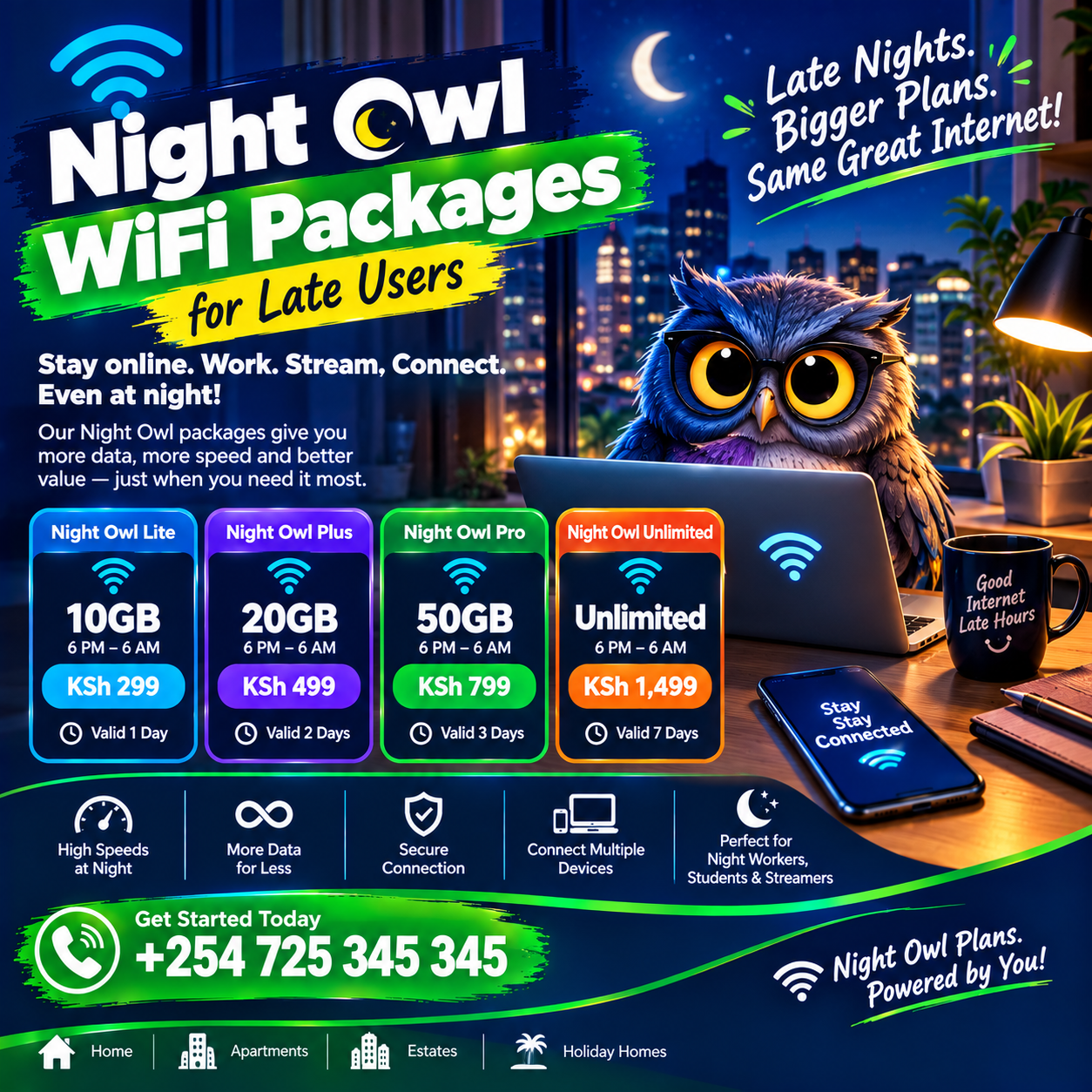
Night owl WiFi packages for late users are the product that finally gives the internet’s quietest crowd what it has always wanted — a package built for the hours after the world goes to sleep, when the students cram, the gamers climb, the shift workers scroll, and the insomniacs stream.
Every operator knows their network has a midnight population. The dashboard shows it every night: sessions alive at 1 a.m., devices streaming at 3 a.m., downloads running while the neighborhood sleeps. And every operator knows what their standard packages tell that population: nothing. The 24-hour passes waste their daylight hours, the evening plans expire before their night begins, and the midnight crowd — loyal, heavy, and completely underserved — keeps improvising with products shaped for someone else’s schedule.
Night owl WiFi packages for late users fix that mismatch with a simple idea: sell the night as the night. A package that activates when the evening crowd goes to bed, runs through the hours every other product ignores, and expires before the morning crowd wakes. The customer gets a product shaped for their actual hours. The operator gets revenue from capacity that was previously giving itself away or sitting completely dark. And the whole arrangement runs automatically, every single night, without anyone lifting a finger.
This article walks through the complete picture: what night owl packages actually are, why the late hours are a hidden market, who the night crowd is, how the unlimited-night structure works, how the packages are designed and priced, how they’re promoted and delivered, and how the operator turns a midnight product into a permanent nocturnal institution.
Because the night arrives on schedule every single day — and the operator with night owl WiFi packages for late users ready is simply the one who gets paid properly when it does.
Table of Contents
ToggleWhat Night Owl WiFi Packages Actually Are
Strip away the novelty and the concept is refreshingly precise.
A night owl package is a WiFi product whose validity is engineered to live inside the late-night window — activating in the late evening or at midnight, running through the hours every other plan ignores, and expiring before the morning crowd arrives.
The customer buys it any time during the day, and the package serves them from the moment the house goes quiet until dawn — the study sessions, the gaming marathons, the shift-worker scrolling, and the sleepless streaming, all under one product.
What distinguishes night owl WiFi packages for late users products from ordinary plans is the deliberate boundary: the validity is engineered to match the customer’s actual night rather than an arbitrary 24-hour clock that wastes its hours on the daytime they sleep through.
That fit is the product’s whole genius. A standard 24-hour pass bought at midnight spends half its value on hours the night owl never uses. The night owl package spends all of its hours exactly where the customer’s life actually happens — and prices itself accordingly.
The structure comes in a few proven shapes: the classic midnight-to-6 a.m. window, the extended night running from 10 p.m. for the early-night crowd, the late-morning bridge that lets the sleeper wake at 10 a.m., and the weekly night pass covering every night of the week under one purchase.
Each shape serves a different nocturnal rhythm, and the operators who offer a small family of them capture the whole range of late-night behavior.
The delivery runs on the standard machinery: bought through the portal, paid by mobile money in seconds, activated automatically at the window’s opening, governed fairly through the night, and expired cleanly before morning — all without the operator touching a single transaction.
That automation is what makes the product practical: night owl WiFi packages for late users offerings run themselves every single night, with every session counted, every boundary enforced, and every record filed.
And the records compound: every night purchase logged, every buyer identified, and every repeat pattern visible — the product writing its own case for tomorrow night as it sells tonight.
The “unlimited” structure deserves its own note: the night’s small crowd makes genuine unlimited feasible — the hours when the network is quietest are exactly the hours when unrestricted data costs the operator almost nothing.
That pairing — unlimited freedom during the network’s emptiest hours — is the engineering insight that makes the product both generous and profitable, and it is covered fully in the sections ahead.
The product, in short, is the network’s night, sold as what it already is: the quietest hours of the day, and the most underserved hours of the business.
Why the Night Is a Hidden Market
The case for night owl WiFi packages for late users products begins with an honest reading of what actually happens on the network after midnight — because the night is not an empty version of the day; it is a different market running on the same infrastructure.
The daytime demand is crowded and duty-driven: workers, students, and families sharing the network for errands, classes, and quick checks. The night demand is sparse and passion-driven: the students cramming for tomorrow, the gamers in their ranked climbs, the shift workers on break, and the streamers finishing what the day deferred.
The night crowd is smaller — but it is deeper. Their sessions run longer, their consumption is heavier, and their loyalty is stronger, because the night is when their real online life happens.
The second truth is the capacity gift: the network’s pipe, congested at 8 p.m., sits nearly empty at 2 a.m. The bandwidth is purchased, powered, and idle — the operator paying for capacity that earns nothing during the hours it is most abundant.
The night owl package monetizes that idle capacity: the unlimited structure that would strangle the evening peak costs almost nothing during the quiet hours — the freedom the night crowd wants is precisely the freedom the network can afford to give.
That alignment — customer demand for unlimited, network capacity for unlimited — is the product’s core arbitrage, and it is why night owl WiFi packages for late users products carry margins the daytime plans cannot match.
The third truth is the market’s invisibility: the night crowd never appears in the daytime statistics, never features in the peak-hour planning, and never finds a product addressing them — which means every network in the area is ignoring them simultaneously.
The operator who serves them captures a market with zero competition: the midnight customer choosing between networks finds exactly one that speaks their language.
The fourth truth is the loyalty effect: night users are the most habit-driven segment in the trade — the student who studies at 1 a.m. does it every night, the gamer’s ranked sessions run on schedule, and the shift worker’s breaks are fixed by their roster.
That habit regularity converts into the steadiest revenue pattern in the business: night customers renew nightly, weekly, or monthly with a consistency no daytime segment matches.
Operators who studied their own networks after midnight describe the discovery plainly: a parallel market had been running on their infrastructure all along — unseen, unserved, and ready to pay.
That is the commercial case for night owl WiFi packages for late users: the trade’s most loyal customers, meeting the trade’s most idle capacity, through a product that finally introduces them.
And the introduction pays every single night.
Who Buys Night Packages: The Midnight Personalities
The offers that win are designed around real customers — and night owl WiFi packages for late users products succeed when each nocturnal personality finds a shape built for exactly how they spend the dark hours.
The first personality is the crammer: the student whose real studying happens after the house sleeps — the exam season marathoner, the assignment finisher, and the researcher whose best focus arrives after midnight.
They buy for the study window, and the package covering midnight to dawn matches their academic rhythm exactly.
The second personality is the gamer: the player whose ranked sessions and squad matches run deepest at night — the low-ping hours when the network is empty and the competition is global.
They are the night crowd’s most demanding and most paying segment: the unlimited-night structure with governed speeds is the product they have been waiting for, and their loyalty once served is absolute.
The third personality is the shift worker: the nurse, the driver, the security guard, and the factory hand whose waking hours invert the world’s — their “evening” beginning at midnight and their browsing happening while the neighborhood sleeps.
For them, the night package is not a luxury but their primary product — the only shape that fits a schedule most networks never consider.
The fourth personality is the binge-streamer: the series finisher whose marathons run past 2 a.m. — the customer who starts watching at 11 and cannot stop at the season’s cliffhangers.
They buy duration rather than speed, and the unlimited structure that removes every mid-binge purchase decision is exactly what their habit needs.
The fifth personality is the insomniac browser: the quiet scroller, the video watcher, and the news reader whose sleeplessness fills the small hours — a segment every network has but none has ever named.
They are the night plan’s most surprised customers: the product that finally acknowledges their existence converts them instantly into its most grateful advocates.
The sixth personality is the content creator: the editor rendering overnight, the uploader pushing files in the empty-bandwidth hours, and the creator whose work schedule follows the network’s quiet rather than the world’s noise.
Operators who mapped their midnight traffic against these six personalities describe the design insight: the night’s crowd is not one market but six, and night owl WiFi packages for late users products win by offering a small family of shapes rather than a single guess.
The crammer takes the midnight window, the gamer takes the speed tier, the shift worker takes the extended bridge, and the streamer takes the unlimited marathon.
Every personality paying is the night’s whole promise.
How Unlimited Nights Actually Work: The Engineering of the Quiet Hours
The word “unlimited” carries the night package’s appeal — and night owl WiFi packages for late users products succeed when the freedom is engineered honestly rather than promised carelessly.
The first engineering truth is the capacity gift: the network’s pipe sits nearly empty at 2 a.m., which means the unlimited structure that would strain the evening peak costs the operator almost nothing at night.
The night’s small population shares a full pipe — and the per-user speeds that would throttle the evening can run generous through the small hours, because the demand simply is not there to contend with.
The second engineering layer is the boundary discipline: the night window’s boundaries — midnight opening, dawn expiry — are what protect the daytime experience, because the unlimited night ends precisely when the morning crowd begins.
That sequencing is the product’s elegance: the night’s freedom and the day’s performance never overlap, so neither crowds the other.
The third layer is the speed guarantee: the night crowd’s gamers and streamers receive governed, consistent speeds through the quiet hours — the performance promise that turns the empty network into the trade’s best late-night connection.
The fourth layer is the automatic sequencing: the night plan activating at its window’s opening, running through its hours, and expiring cleanly before the morning — all without the operator touching a single transaction.
The fifth layer is the bridge design: the shapes that let the night owl extend into the morning — the late riser’s bridge letting the 4 a.m. sleeper wake at 10 without a second purchase — serving the rhythms that don’t fit standard clocks.
Operators who engineered their night owl WiFi packages for late users products this way describe the balance: genuine unlimited for the customer, protected performance for the daytime, and new revenue from hours that were previously the network’s dead weight.
The honest-capacity discipline completes the engineering: the plan sold within the network’s real limits, the night crowd counted, and the speeds promised only what the quiet hours genuinely deliver — because an unlimited night that buffers destroys itself faster than any competitor could.
That honesty is why the product’s reputation compounds: the customer who experiences one night of true, uninterrupted unlimited becomes the plan’s advocate — and the midnight crowd hears about the network that keeps its word.
The unlimited night, in short, is a promise the network makes to its quietest hours — and the engineering is what keeps that promise every single night.
Designing the Night Ladder: Products for Every Nocturnal Rhythm
The craft of night owl WiFi packages for late users products lives in the ladder design — because the night’s six personalities need a small family of offers, not one guess.
The flagship is the classic night pass: midnight to 6 a.m., unlimited data, one clear price — the product whose name says exactly what it is and whose window matches the deepest night.
It is the ladder’s anchor: the purchase the first-timer makes to test the night, and the habit the regular renews every evening.
The second rung is the extended night: the window starting at 10 p.m. — serving the early-night crowd whose darkness begins before midnight, and covering the stretch the classic window misses.
The third rung is the night bridge: the window carrying the night owl into mid-morning — the 4 a.m. sleeper’s shape, waking at 10 with their session still alive.
The fourth rung is the weekly night pass: every night under one purchase — the crammer’s exam month, the gamer’s ranked season, and the shift worker’s roster week, all covered by a single standing arrangement.
Priced visibly below seven nightly purchases, it converts the every-night customer the moment the arithmetic is shown — and it becomes the plan’s most stable revenue.
The fifth rung is the night speed tier: the same window with premium speeds attached — the gamer’s product, the streamer’s luxury, and the upsell that sells on felt difference.
The naming discipline ties the family together: every product named for exactly when it works — “Night Owl,” “Midnight Pass,” “Late Riser” — because the customer should never have to compute the validity.
Operators who built their night owl WiFi packages for late users ladders this way describe the coverage: every nocturnal personality finding a product shaped for their exact hours, and the menu reading like it was written by someone who keeps their hours.
The ladder also stays honest: each rung priced against what the same night would cost on standard plans — so the unlimited freedom rewards the customer rather than taxing them for the convenience.
That fairness is what turns the ladder from a menu into a nightly habit — the offer the night crowd genuinely plans its darkness around.
Pricing the Night: The Quiet-Hours Economics
The pricing layer of night owl WiFi packages for late users products balances the same two forces every product faces — value perception and margin protection — and the operators who balance it well follow patterns the market has proven.
The first principle is the idle-capacity pricing: the night package priced below every daytime equivalent, because the operator’s marginal cost during the quiet hours is nearly zero — the freedom priced honestly from the physics that make it cheap.
The customer pays less for more, and the operator still wins — the rare pricing structure where every party gains.
The second principle is the weekly discount’s visibility: the seven-night pass priced visibly below seven nightly purchases, with the saving stated on the portal — the customer shown the arithmetic that makes the weekly the obvious choice.
The weekly pass is also the operator’s favorite rung: it converts the nightly habit into committed revenue, smoothing the income that nightly purchases scatter.
The third principle is the speed tier’s premium: the gamer’s upgraded night priced meaningfully above the standard — because this segment pays for performance, and the gap is what signals the difference.
The fourth principle is the season’s emphasis: exam weeks for the crammers, tournament seasons for the gamers, and fixture nights for the binge-streamers — the calendar’s special nights priced as the special hours they are.
The fifth principle is the bridge’s honesty: the late-riser shape priced as the extension it is — the customer paying only for the extra morning hours their rhythm requires.
Operators who priced their night owl WiFi packages for late users products this way describe the economics: the ladder’s every rung profitable, the weekly pass stabilizing the income, and the premium tier capturing the night’s highest-value buyers.
The margin check closes the discipline: every night price tested against the network’s real costs, with the quiet hours’ near-zero marginal cost understood before the offers launch.
Nights concentrate idle capacity into hours the network was already paying for — which is what makes well-priced night products among the highest-margin offers in the entire trade.
That margin story is worth stating plainly to every operator considering the product: the night plan sells capacity that would otherwise earn nothing, at prices the customer happily pays for the hours they most want, through machinery that runs itself.
Few products in any business offer that combination.
The Midnight Switch: The Operator’s Nocturnal Rhythm
The operational rhythm of night owl WiFi packages for late users products follows a daily calendar of its own — and the operators who run it well treat midnight as the product’s daily launch moment, every single night.
The evening check is the product’s quiet start: the configuration confirmed, the portal banner visible, and the previous night’s numbers glanced at — one two-minute review that guarantees the night launches clean.
The late evening is the promotion window: the portal banner reminding every evening customer that the night is coming — the customers settling into their evenings seeing the offer they’ll want at midnight, planting tonight’s purchase before the house sleeps.
The midnight switch is the product’s engine starting: the window opening, the night purchases flowing, and the network’s quietest hours beginning to earn.
The night itself runs unattended: the operator asleep like everyone else — the machinery selling, activating, and enforcing through the small hours with no human anywhere in the chain.
That hands-off night is the product’s operational signature: revenue arriving while the owner sleeps, recorded automatically, and waiting on the dashboard by morning.
The morning is the review: the night’s numbers read over breakfast — passes sold, revenue by hour, new buyers counted, and the repeat patterns noted — before the daytime rhythm resumes.
That daily rhythm, repeated every night, compounds in both directions: the product gets better with every night’s evidence, and the customers learn the rhythm — expecting the night plan the way they expect the darkness.
Operators who institutionalized the rhythm describe the feeling precisely: the day acquired a second revenue shift — a known, prepared, profitable window the whole business now plans around, running entirely without them.
That heartbeat is what night owl WiFi packages for late users products deliver: not a one-time launch, but a recurring institution the operator owns and the market anticipates nightly.
And a fixture, unlike a promotion, compounds quietly every single night.
The daily rhythm also reveals the product’s operational beauty: the operator’s involvement is measured in minutes — the evening check and the morning review — while the product works the network’s quietest hours every single night.
That leverage is the product’s quietest gift: the operator earning from every midnight in their coverage area without attending any of them.
Promotion: Making the Night Crowd Know It’s Seen
The best-designed night plan earns nothing if the midnight crowd doesn’t know it exists — and the promotion layer of night owl WiFi packages for late users products runs through channels the operator already owns.
The first channel is the portal banner: every connected customer faces the login screen daily — and the night plan displayed there from evening onward reaches the future night owls hours before their window opens.
The banner’s timing matters: appearing from 8 p.m., when the evening crowd begins thinning and the night plans are forming.
The second channel is the SMS list: the past buyers reachable directly — the announcement landing at 9 p.m., exactly when the night’s decisions are being made.
The third channel is the WhatsApp groups: the campus, estate, and community groups where night routines are discussed — the offer shared there by satisfied night owls traveling further than any flyer.
The fourth channel is the physical layer: the signage at the mast and the shop — the night plan visible at the counter all day, named for exactly the hours it serves.
The fifth channel is the staff voice: the attendant mentioning the night plan once, warmly, to every evening customer still connected at closing — the counter becoming the product’s most credible channel.
The messaging discipline ties the channels together: the window stated in plain clock language — “midnight to 6 a.m.” — the unlimited stated without asterisks, and the price stated against what the customer’s late nights currently cost them in daytime packages.
That honesty is the promotion’s compounding asset: the customers who trusted one night’s promise trust the next — and the product’s reputation builds on experiences kept every single night.
The recognition message is the campaign’s secret weapon: the promotion that says “we see you, night crowd” converts more powerfully than any discount — because the segment has never once been addressed by any network, anywhere.
Operators who promoted their night owl WiFi packages for late users products this way describe the compounding: each night’s buyers became the next night’s audience, and the plan’s reach grew without its budget growing at all.
The owned-media advantage is the product’s quietest strength: the network’s own portal, list, and reputation doing the marketing — aimed at customers whose night is the most reliable part of their entire schedule.
The night plan, in short, promotes itself — once the operator points the channels at it.
The Night Experience: Delivering Through the Hours That Matter
The service half of night owl WiFi packages for late users products is what happens after the purchase — because the night’s reputations are made in the hours the network either holds or fails.
The first experience discipline is the window’s opening: the midnight crowd connecting as the evening traffic drains — the network’s emptiest hours offering its fullest speeds, and the night owl’s first session proving the product’s promise immediately.
The second discipline is the crammer’s continuity: the study session that must not drop at 2 a.m. — the reliability the night package exists to guarantee, delivered through the hours when help desks sleep.
The third is the gamer’s latency: the ranked match at 3 a.m. on the network’s emptiest pipe — the fastest, most consistent connection of the entire day, available only to the crowd that stays up for it.
The fourth is the binge’s continuity: the series marathon running from midnight to dawn without a single interruption — the unlimited structure proving itself through the longest sessions the network ever serves.
The fifth is the expiry moment: the window’s clean close at dawn, delivered with the countdown visible and the renewal prompt ready — the boundary handled so gracefully the night owl’s next purchase is already queued.
The sixth is the support readiness: the night questions answered by the records — the customer’s session status checkable instantly, and the caretaker’s morning briefing covering the night’s queries.
Because the night’s customers are alone with the network, and the connection that holds through their solitude becomes their most trusted service — while the one that fails at 3 a.m. becomes the loneliest frustration in the trade.
Operators who delivered their night owl WiFi packages for late users products this way describe the aftermath: the customers greeting the morning with the night’s satisfaction intact — and the next midnight’s purchase already half-decided.
The night’s experience, in short, is the product’s marketing for the following night — delivered one satisfied customer at a time.
That compounding satisfaction is why the product’s reputation grows on its own: every good night sells the next one before the operator says a word.
Converting Night Owls: From Midnight to Membership
The acquisition half of night owl WiFi packages for late users products is only half the value — the conversion of night regulars into longer-term customers is where the strategy compounds.
The conversion loop begins with the record: every night buyer identified on the platform — first-timer or regular, which shape they buy, which nights they skip — the product building the network’s intelligence as it sells.
The pattern recognition follows: the customer who has bought five consecutive night passes is spending more monthly than a full-day plan costs — the signal the platform’s records make visible without any guessing.
The invitation comes at the right moment: the morning-after prompt offering the upgrade — “your every-night habit, all day, for less than you’re already spending” — the conversion framed by the customer’s own demonstrated behavior.
The full-day plan positioned as the graduation: not a replacement for the night product, but its natural evolution — the offer that meets the customer whose habit has outgrown the window.
The loop’s experience underneath does the real converting: the night buyer who received instant activation, governed speeds, and reliable nights becomes a monthly customer because the network earned it — the night opened the door, and the service kept them.
Operators who ran the full loop describe the compounding precisely: each night leaving the network permanently larger — new customers acquired in silence, retained through the days, and stacked onto the base the next night builds on.
The reverse conversion matters too: the monthly customer whose usage concentrates after midnight discovers the night plan as their dedicated product — the ladder serving both directions of the same relationship.
That two-way flexibility is the ladder’s deepest strength: night owl WiFi packages for late users products and full-day plans complementing rather than competing — each one catching the customers the other’s shape misses.
The product family, in short, is the network’s complete answer to how people actually live: some weeks on the night plan, some months on the full-day, and the network earning through every shape of the customer’s clock.
Portfolio Nights: The Product Across Many Sites
The operators running multiple locations discover that night owl WiFi packages for late users products scale across a portfolio with almost no added effort — because the same configuration, the same clock, and the same playbook extend to every site at once.
The portfolio-wide product is the foundation: the night ladder configured once, pushed to every location’s portal, and sold across every site’s midnight crowd simultaneously — one product, many masts.
The per-site tuning rides on local knowledge: the campus-adjacent mast leading with the crammer’s window, the residential estates emphasizing the streamer’s marathon, and the industrial-area sites running the shift-worker’s bridge — the same product family, shaped to each crowd.
The night capacity check scales across the portfolio: every site’s midnight load reviewed in the same evening window — though the honest finding at most sites is that the night pipe sits empty, waiting for exactly this product.
The consolidated reporting closes the loop: the portfolio’s night performance visible in one view — which sites sold which shapes, which neighborhoods responded hardest, and which locations need different products next week.
The staff briefing scales the same way: every attendant at every site briefed from the same one-pager — the counter voice consistent across the whole portfolio.
The shared learnings compound fastest of all: the pricing that worked at one campus gets tested at the others, the gamer-tier insight from one site reaches every mast, and every night makes the next one smarter everywhere.
Operators who ran portfolio-wide night owl WiFi packages for late users products describe the arithmetic plainly: the offer that once lifted one site’s nights now lifts every site’s nights — the same evening configuration multiplied across the whole portfolio’s revenue.
That multiplication is one of the clearest demonstrations of what unified platforms make possible: the product, the clock, and the machinery traveling to every location without rebuilding anything.
The portfolio night, in short, is where the operator’s growth and the product’s rhythm meet — every new site inheriting a night that already works.
The Numbers: What Night Packages Actually Earn
The financial case for night owl WiFi packages for late users products is measurable within the first month — and the patterns the numbers reveal explain why the strategy compounds night after night.
The first pattern is the pure-margin effect: prepared operators consistently find the night packages producing the highest margin percentages in their entire menu — the idle capacity sold at prices the customer considers generous, through hours that cost the operator almost nothing.
The second is the new-buyer effect: the night plan routinely produces first-time purchasers the daytime menu never reached — the shift workers, the crammers, and the insomniacs finally seeing a product that names them.
The third is the loyalty effect: night buyers show the trade’s steadiest renewal patterns — the habit-driven crowd renewing nightly, weekly, and monthly with a consistency no daytime segment matches.
The fourth is the weekly-conversion effect: the nightly regulars upgrading to weekly passes — the product’s revenue stabilizing into committed income as the habit proves itself.
The fifth is the graduation effect: the night regulars converting into full-day subscriptions — the product’s revenue extending past its own window into the network’s core plans.
The sixth is the compound effect: months of nights stacking — each one’s audience larger than the last, as the rhythm settles, the reputation spreads through the midnight WhatsApp groups, and the product becomes the neighborhood’s quiet habit.
Operators who tracked their night owl WiFi packages for late users numbers across a quarter describe the curve honestly: the first week proved the demand, the fourth proved the rhythm, and by the eighth, the night plan was the planned centerpiece of the network’s after-hours income.
The dashboard makes all of it visible: the platform’s reports isolating the night sales, the new buyers, and the upsell conversions — evidence replacing the guessing that new products usually run on.
That measurability is what lets the strategy improve: every night’s data tuning the next one’s design, until the offer fits the market’s midnight like the hours designed it.
And the fit, once found, becomes the network’s most reliable after-dark pattern — the hours the whole business plans around.
The Mistakes That Waste Nights
The product has its own failure patterns, and naming them is the cheapest protection available to any operator launching night owl WiFi packages for late users offerings.
The first is the vague window: the “night” plan whose start and end never stated on the portal — the customer confused about when it begins, and the product’s cleanest feature lost in ambiguity.
The second is the unlimited that buffers: the unlimited promise launched without checking the night capacity — rare at most sites, but fatal where backhaul maintenance or neighbor networks congest the small hours.
The third is the missing speed governance: the night unlimited offered without per-user tiers — the one heavy user degrading the whole night for every other owl on the network.
The fourth is the single-shape mistake: one package trying to serve six personalities — the crammer, the gamer, the shift worker, and the streamer each left without a product shaped for their night.
The fifth is the forgotten promotion: the plan configured but never announced — the portal banner missing, the SMS unsent, and the product sitting invisible through its own best hours.
The sixth is the boundary blur: the night window bleeding into the morning peak — the unlimited night overlapping the daytime crowd, and the daytime experience degraded by the product’s generosity.
The seventh is the ignored data: the nights run, the numbers never read — every midnight repeating the same design instead of improving on the last one’s evidence.
The eighth is the orphan product: one brilliant night followed by silence — no evening promotion, no weekly rhythm, no next-night invitation — the strategy abandoned at the exact moment it proved itself.
Each mistake is avoidable with the same discipline: state the window plainly, verify the night capacity, govern the speeds fairly, build for every personality, announce every evening, and read the data after every night.
The operators who kept those habits watch their nights compound into the steadiest after-dark revenue pattern they own — while the ones who skipped them keep launching products that never quite repeat.
That is the honest map of the product: the same rigor that runs the network, applied to the hours that deserve it most.
The Payoff, Counted Honestly
Ask operators a quarter after launching night owl WiFi packages for late users products what actually changed, and the answers gather into four themes.
Revenue: the nights that once earned nothing now producing the menu’s highest margins — collected automatically, every single night, with capacity finally working around the clock.
Customers: the new buyers the standard menu never reached — the crammers, the gamers, the shift workers, and the insomniacs — stacked onto the network’s base by a product shaped exactly for their hours.
Loyalty: the most habit-driven segment in the trade renewing with unmatched consistency — the night crowd’s gratitude converting into the steadiest revenue the network owns.
And rhythm: a business with a second shift — the evening check, the midnight switch, and the morning review — the operator’s calendar finally covering every hour their network is alive.
None of it required new bandwidth, new hardware, or new customers.
It required the product this article has described — configured once, launched nightly, and tuned by every night’s evidence.
Because the night arrives on schedule every single day, the crowd was always going to stay up, and the night owl WiFi packages for late users product is simply the network finally meeting its quietest hours with an offer built for them — one pass, one midnight, and one quietly compounding night at a time.
Frequently Asked Questions
How should the night window be structured?
The professional design states the clock plainly — midnight to 6 a.m. as the classic, with extended shapes from 10 p.m. or bridging to mid-morning for the rhythms that need them.
Operators who structured their night owl WiFi packages for late users products with explicit clock language report the fewest disputes and the happiest repeat buyers.
Does unlimited night hurt the daytime network?
No — the sequencing protects it: the night window ends precisely when the morning crowd begins, so the night’s freedom and the day’s performance never overlap.
The operators who engineered their night owl WiFi packages for late users products with clean boundaries deliver genuine night freedom without touching the daytime experience.
Do night packages compete with full-day plans?
No — they feed them: the nightly regular whose monthly spending exceeds the full-day price is the network’s warmest upgrade prospect, identified automatically by the records.
The operators who positioned night owl WiFi packages for late users products as on-ramps rather than rivals report full-day conversions rising steadily from the night base.
What shapes should a beginner launch with?
Three: the classic midnight pass, the extended-night version, and the weekly night pass — the smallest family that covers the crammer, the early-night crowd, and the nightly regular.
Operators who launched night owl WiFi packages for late users products lean refined faster than those who opened with a dozen confusing tiers.
How do I price against standard packages?
Below them, deliberately: the quiet hours’ near-zero cost lets the night plan undercut every daytime equivalent — the customer paying less for more, while the operator still wins on margin.
The operators who priced their night owl WiFi packages for late users products from the idle-capacity economics won the comparison on both sides of the counter.
Can night plans run across a portfolio of sites?
Yes — one configuration, every location: the product pushed portfolio-wide, tuned per site’s crowd, and reported into one dashboard for every night.
Owners running night owl WiFi packages for late users products across multiple sites describe the same multiplication: one evening setup, every mast earning by midnight.
What is the smartest first step this week?
Pull last month’s midnight-hour session data and find your own night shape — then configure one midnight-to-dawn unlimited pass, schedule its portal banner for the evening, and announce it at 9 p.m.
That single page of data and one evening of setup is how every night owl WiFi packages for late users product began — and the operators who ran it discovered the same truth every time: the crowd was always awake after midnight, the capacity was always sitting idle, and the night owl WiFi packages for late users product was simply the operator finally selling the night as what it is — the quietest hours of the network, and the most underserved hours of the business.