
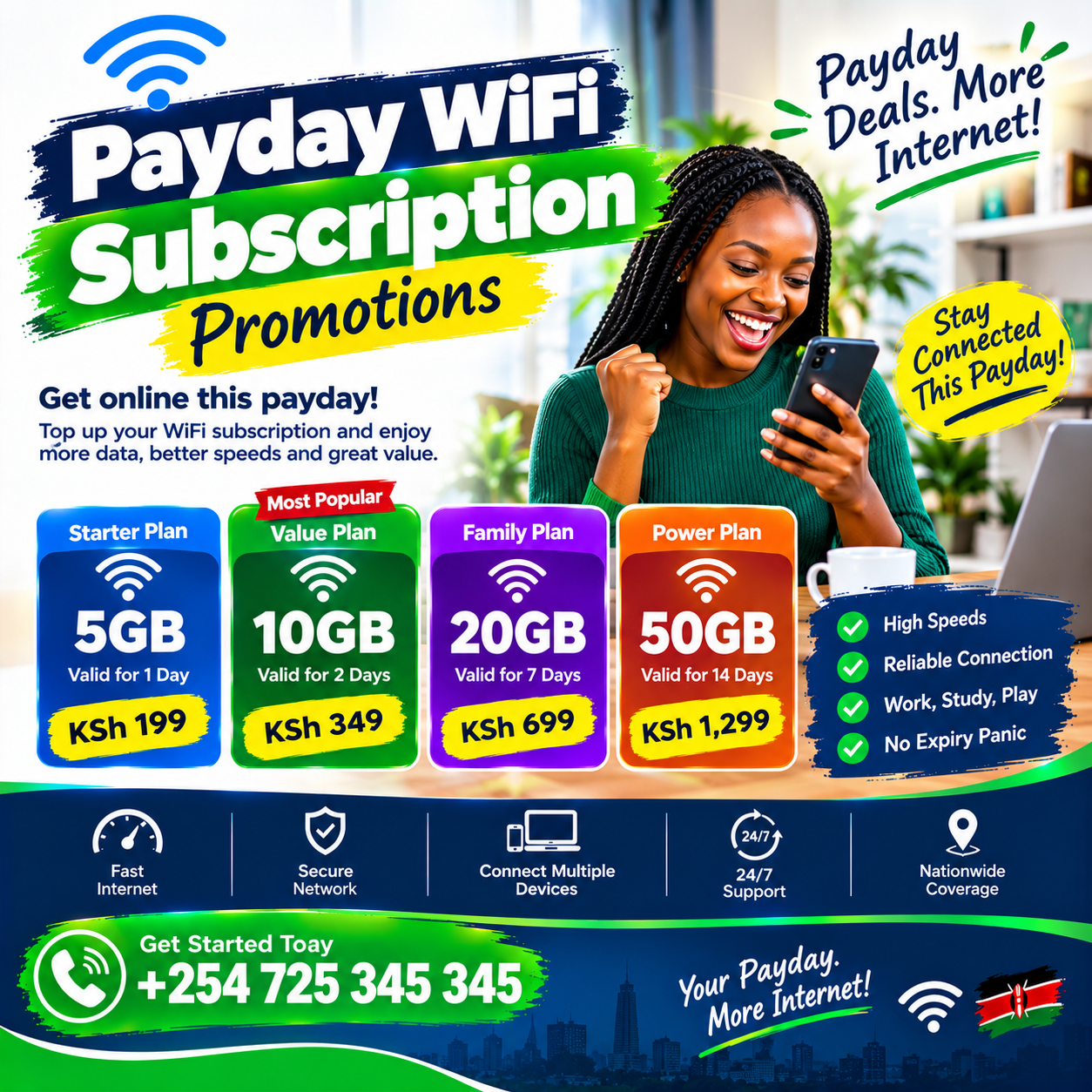
Payday WiFi subscription promotions are the strategy that converts the connectivity trade’s most predictable calendar event into its most valuable revenue outcome — the structured campaign that meets customers exactly when their money lands, and converts that moment into subscriptions rather than one-off sessions.
Every operator knows the rhythm: the last week of the month when salaries land, HELB disburses, and remittances clear — the days when every household in the coverage area makes its spending decisions for the month ahead. In that compressed window, the operator has the most willing, most decisive, and most flush customers of the entire cycle. And the question that separates growing networks from drifting ones is what those customers are offered when they arrive: a casual voucher, or a committed subscription that locks in their business for the next thirty days and beyond.
The payday WiFi subscription promotions strategy answers with structure: subscription offers designed for the salary week, priced for the planning mindset, promoted across every channel the network owns, and timed to the paydays the whole market already follows.
The customer buying on payday receives their month’s connectivity as one deliberate decision — made when the money is present, at a price that rewards the commitment, with the convenience of never thinking about top-ups again. The operator receives the same month’s revenue as a committed stream rather than scattered sessions — predictable, plannable, and compounding with every cycle.
This article walks through the complete picture: what payday promotion campaigns actually involve, why the payday moment is the market’s most powerful conversion point, who the salary-week customer is, how the subscription offers are designed and priced, how they’re promoted and timed, and how the operator turns one successful payday into a recurring-revenue institution.
Because the paydays arrive on schedule every month — and the operator with payday WiFi subscription promotions ready is simply the one who gets paid properly when they do.
What Payday WiFi Subscription Promotions Actually Are
Strip away the jargon and the concept is refreshingly precise.
A payday WiFi subscription promotion is a time-limited campaign that offers subscription packages — monthly, weekly, or term plans — at special value during the salary window: discounted first cycles, bonus validity, bundled speeds, or waived activation — each structure designed to convert the payday buyer from transactional to committed.
The customer buys during the promotion window, receives their subscription with its special terms, and their connectivity runs for the whole cycle without a single top-up decision.
What distinguishes payday WiFi subscription promotions from ordinary discounting is the target conversion: the campaign’s goal is not a sale but a relationship — the one-time customer becoming a monthly subscriber, and the scattered sessions becoming a predictable stream.
The structure comes in a few proven shapes: the discounted first month, where the new subscriber’s entry price drops for the initial cycle; the bonus-validity subscription, where thirty days become thirty-five; the speed-upgrade promotion, where the standard plan runs at premium speeds for the first month; and the loyalty tier, where existing subscribers’ renewals during the window earn their own recognition.
Each shape serves a different conversion goal, and the operators who run a small family of them capture the whole range of payday behavior.
The delivery runs on the standard machinery: promoted through the portal, announced by SMS across the platform’s list, purchased by mobile money in seconds, and activated instantly — all automated, all recorded, all running without the operator touching a transaction during the campaign.
That automation is what makes the campaign practical: payday WiFi subscription promotions offerings run themselves across the busiest conversion week of the month, with every subscriber tracked, every offer honored, and every record filed.
And the records compound: every conversion identified, every new subscriber added to the recurring base, and every cycle’s renewal visible — the campaign writing its own compounding story as it converts.
The subscription inside the name deserves its own note: the promotion is not selling more sessions — it is selling the subscription model itself, converting the customer’s payday money into committed monthly income that renews on schedule and reports into the network’s recurring-revenue line.
That conversion — transactional to committed — is the strategy’s whole economics, and it is covered fully in the sections ahead.
The campaign, in short, is the network’s payday answer: the market’s most willing week, met with the operator’s most valuable product.
Why the Payday Moment Is the Market’s Most Powerful Conversion Point
The case for payday WiFi subscription promotions begins with an honest reading of when customers actually decide — because the payday moment is not simply a busier version of the month; it is the decision point every other day was waiting for.
The first truth is the budget moment: the customer’s month is planned in the days their money lands — rent decided, tokens bought, food budgeted, and connectivity chosen in the same compressed window.
The connectivity decision made on payday is the real one: the customer allocating their month’s budget commits to what they’ll use for thirty days — and the operator present at that moment captures the decision, while the operator absent watches it go to a bundle menu or a competitor.
The second truth is the psychological refresh: a new budget feels like a clean page, and the customer allocating fresh money makes bigger, bolder decisions than the mid-month buyer counting down their balance.
The payday customer buys monthly where the mid-month customer buys daily — the same person, different week, entirely different purchasing power and mindset.
The third truth is the willingness to commit: the customer whose salary has just landed can afford certainty — and the subscription, which felt risky on the 15th, feels natural on the 28th.
That timing psychology is the promotion’s engine: the same subscription offer converts at multiples of its off-payday rate, purely because the moment matches the commitment.
The fourth truth is the competition’s timing: every spending decision in the customer’s life converges on the same week — and the operator who is present, prominent, and prepared during that week captures allocations the absent competitor never sees.
The fifth truth is the compound effect: the customer converted to a subscription on payday becomes revenue for the next thirty days automatically — the payday campaign’s value extending far beyond the week it runs.
Operators who studied their own numbers across cycles describe the discovery plainly: the final week was already their conversion hotspot, running on instinct alone — and payday WiFi subscription promotions planning simply organized what was already happening into something deliberate and much larger.
That reframing changes everything downstream: the payday stops being the tired end of a cycle and becomes the main event — the days the whole business earns its future.
And the operator who treats it that way builds a recurring base that no transactional competitor can match.
Who Converts on Payday: The Salary-Week Personalities
The offers that win are designed around real customers — and payday WiFi subscription promotions campaigns succeed when each salary-week personality finds a conversion path shaped for their situation.
The first personality is the salaried tenant: the worker whose salary lands between the 25th and the 30th, whose month’s connectivity decision happens in that single week — and who has been buying scattered sessions all year because no one ever offered them the monthly at the right moment.
They are the campaign’s primary conversion: the transactional regular whose payday promotion finally matches their purchasing power to the committed product.
The second personality is the HELB student: the disbursement week turning campuses into the densest conversion environments in the trade — students budgeting a semester’s connectivity at once, and the term subscription positioned as the obvious allocation.
They convert for semesters rather than months — and the campaign’s term-based offer meets them at exactly the moment their lump sum arrives.
The third personality is the remittance household: the family receiving support timed for month-start needs, buying connectivity for the whole household — and the family subscription positioned for the shared roof converts the household rather than one device.
The fourth personality is the small trader: the shopkeeper closing their month’s books, budgeting stock and utilities together — with the business subscription positioned into the same planning session.
Their conversion is steady: a business subscriber renewing monthly against documented income is among the network’s most reliable revenue.
The fifth personality is the lapsed subscriber: the customer whose subscription ended mid-month because their money hadn’t arrived — the exact person a payday window brings back, at the moment they can finally afford to return.
The win-back conversion is the campaign’s quiet powerhouse: every payday recovers subscribers the off-payday weeks lost, with the promotion’s timing doing what discounts alone never could.
The sixth personality is the upgrader: the existing subscriber whose payday is when they finally take the premium tier — the speed upgrade they’ve been wanting, purchased the week the budget allows it.
Operators who mapped their payday traffic against these six personalities describe the design insight: the salary week is not one market but six, and payday WiFi subscription promotions campaigns win by offering a small family of conversion paths rather than a single guess.
The tenant takes the first-month discount, the student takes the term plan, the household takes the family subscription, the trader takes the business tier, the lapsed takes the win-back offer, and the upgrader takes the premium — every personality converting.
Designing the Offers: Subscription Structures That Convert
The craft of payday WiFi subscription promotions campaigns lives in the offer design — because the structure determines whether the campaign converts relationships or merely shuffles revenue.
The first structure is the discounted first cycle: the new subscriber’s entry month priced below the standard rate — the lowest-friction conversion available, removing the trial risk that keeps hesitant customers transactional.
The psychology is precise: the customer’s hesitation about committing is priced away for exactly one cycle — after which the subscription’s convenience does the retaining.
The second structure is the bonus-validity subscription: thirty days becoming thirty-five, or twelve weeks becoming thirteen — the value added rather than the price cut, protecting the standard rate while making the offer visibly better.
The third structure is the speed-upgrade promotion: the standard plan running at premium speeds for the first cycle — the customer experiencing the top tier’s difference, with the upgrade decision made for them by their own experience.
That trial-by-experience structure converts upgrades better than any advertisement: the customer who has lived the premium speed for a month rarely returns to standard willingly.
The fourth structure is the family subscription: the multi-device plan positioned for the household’s shared roof — converting the payday decision that covers everyone under one purchase.
The fifth structure is the win-back offer: the lapsed subscriber’s reactivation at special terms — the return priced gently, the relationship resumed, and the recurring revenue restored.
The sixth structure is the loyalty recognition: existing subscribers renewing during the window earning bonus days or tier recognition — the campaign rewarding commitment rather than only chasing new conversions.
The naming discipline ties the family together: every offer named for what it converts — “First Month Special,” “Family payday,” “Welcome Back” — because the customer should see their own situation named on the portal.
Operators who designed their payday WiFi subscription promotions offers with this family describe the coverage: every salary-week personality finding a conversion path shaped for their situation, and the campaign reading like it was written by someone who knows the neighborhood’s paydays personally.
The design also protects the standard rate: every special is a first-cycle or bonus structure, with the regular subscription price untouched when the window closes.
That protection is the discipline that keeps the campaign repeatable month after month — the offers convertible without the base rate ever training the market to wait.
The Calendar: Timing the Campaign to the Money
The operational heart of payday WiFi subscription promotions is the calendar — because the campaign’s power lives in its timing, and the operators who run it well treat the salary week as a fixed appointment.
The campaign window opens on the 24th or 25th: the days salaries begin landing, HELB disburses, and remittances clear — the promotion going live as the money starts moving.
The announcement timing rides the same clock: the SMS and portal banners launching on the 24th, reaching customers as their accounts refresh — the offer arriving in the same hours as the money.
The mid-window reminder follows on the 27th or 28th: the second touch for the customers whose paydays landed slightly later — the campaign still prominent while the majority of the market’s money is present.
The final call runs on the 30th: the last-chance messaging honest and dated — the window closing as the month does, with the standard rates returning on the 1st.
The end-date discipline is non-negotiable: the promotion ending exactly when it promised — because the campaign’s future depends on windows that mean what they say.
The monthly rhythm completes the calendar: the same window, every month — the campaign becoming a fixture the market anticipates, the way it anticipates the paydays themselves.
The per-month tuning rides on top: the offer structure rotated — first-cycle discounts one month, bonus validity the next — keeping the campaign fresh across the year while the timing stays constant.
Operators who institutionalized this calendar describe the feeling precisely: the month acquired a conversion heartbeat — a known, prepared week the whole business plans around, arriving with the money every thirty days.
That heartbeat is what payday WiFi subscription promotions deliver: not a one-time push, but a recurring institution the operator owns and the market’s paycheck schedule guarantees.
And a fixture, unlike a promotion, compounds quietly every single month.
The calendar also protects the rest of the month: because the campaign lives inside its window and ends on schedule, the standard rates keep their integrity from the 1st to the 23rd — the promotions and the pricing each doing their own job.
The campaign, in short, is the network’s monthly appointment with its market’s money — kept punctually, promoted honestly, and converted deliberately.
Promotion: Meeting the Payday on Every Channel
The best-designed conversion offer earns nothing if the neighborhood doesn’t know it exists — and the promotion layer of payday WiFi subscription promotions campaigns runs through channels the operator already owns.
The first channel is the portal banner: every connected customer faces the login screen daily — and the promotion displayed there from the 24th reaches the entire existing base without spending a shilling.
The second channel is the SMS list: the platform’s buyers reachable directly — the announcement landing on the 24th, exactly when paydays are clearing and the conversion decisions are being made.
The third channel is the WhatsApp groups: the estate, campus, and community groups where month-end budgets are discussed — the offer shared there by satisfied subscribers traveling further than any flyer.
The fourth channel is the physical layer: the signage at the mast and the shop — the promotion visible at the counter from the 24th, dated honestly, and removed when the window closes.
The fifth channel is the staff voice: the attendant mentioning the promotion once, warmly, to every customer during the window — the counter becoming the campaign’s most credible channel.
The messaging discipline ties the channels together: the subscription value stated against what the customer’s scattered sessions currently cost, the window stated honestly, and the terms displayed plainly — the same story on every channel, because consistency is what builds campaign trust across months.
The value comparison is the message’s engine: “your daily sessions this month cost more than the monthly plan” — the arithmetic done for the customer, stated openly, converting the transactional regular into a subscriber by showing them their own spending.
Operators who promoted their payday WiFi subscription promotions campaigns this way describe the compounding: each month’s converts became the next month’s audience, and the campaign’s reach grew without its budget growing at all.
The owned-media advantage is the strategy’s quietest strength: the network’s own portal, list, and reputation doing the marketing — aimed at customers whose payday is the most predictable date on their entire calendar.
The campaign, in short, promotes itself — once the operator points the channels at it.
The Subscription Experience: From Conversion to Commitment
The service half of payday WiFi subscription promotions is what happens after the conversion — because the campaign’s reputations are made in the thirty days the subscription either delivers or disappoints.
The first experience discipline is instant activation: the payday subscriber’s purchase opening their full cycle within seconds — the commitment honored immediately, with the subscription’s convenience proving itself on day one.
The second is the renewal automation: the subscriber’s next cycle handled by the machinery — reminders before expiry, one-tap renewals, and grace periods that rescue the customer whose next payday arrives late.
The renewal flow is where the promotion’s economics live: the converted subscriber renewing automatically becomes the recurring revenue the campaign was built to create — and the renewal experience is what keeps them converting month after month.
The third is the mid-cycle touch: the light, honest check-in during the subscription’s quiet weeks — the new subscriber welcomed, the features highlighted, and the relationship warmed between paydays.
The fourth is the tier experience: the subscriber living inside their plan’s speeds and allocations — the daily experience that either validates the payday decision or undermines it.
The premium tiers especially matter here: the upgrader who converted during the promotion living the difference daily — the experience that makes their next upgrade, referral, and renewal self-motivating.
The fifth is the records’ reassurance: every payment, every renewal, and every day of the cycle visible on both sides — the transparency that keeps the committed relationship comfortable.
Because the payday subscriber made a bigger decision than the voucher buyer, and the service that honors it converts one month’s promotion into years of recurring revenue.
Operators who delivered their payday WiFi subscription promotions this way describe the aftermath: the customers entering the next month as subscribers rather than buyers — the campaign’s conversions compounding into the network’s recurring base.
The subscription’s experience, in short, is the campaign’s marketing for every future cycle — delivered one satisfied month at a time.
That compounding satisfaction is why the strategy’s reputation grows on its own: every good cycle renews itself before the operator says a word.
The Recurring Base: The Revenue the Campaign Builds
The deepest value of payday WiFi subscription promotions is what remains after the window closes — the recurring base the campaign stacks with every cycle.
The base compounds monthly: each campaign’s converts joining the subscribers already renewing — the network’s recurring-revenue line growing by the campaign’s yield every month.
The compounding arithmetic is the strategy’s engine: a network converting ten subscribers per campaign becomes one hundred subscribers richer within a year — recurring revenue that no transactional competitor can match.
The predictability compounds alongside: the base’s renewals arriving on known dates, in known amounts — the network’s income becoming plannable in a way session revenue never was.
The planning value reaches every corner of the business: bandwidth purchases, capacity upgrades, and expansion decisions all sized against income the operator can see coming.
The churn management rides the same visibility: the base’s renewal patterns flagging lapsed subscribers early — the win-back offers timed to the next payday, recovering churn before it compounds.
The valuation effect completes the picture: the recurring base is what the business is worth — buyers, lenders, and partners evaluating the network through its committed subscribers, not its transactional volume.
Operators who tracked their payday WiFi subscription promotions results across a year describe the transformation precisely: the network’s revenue split shifting from scattered sessions toward committed subscriptions — the business becoming fundamentally more valuable with every campaign.
The recurring base, in short, is the campaign’s real product: the promotions sell subscriptions, and the subscriptions build the asset.
And the asset, unlike any session, compounds forever.
Portfolio Paydays: The Campaign Across Many Sites
The operators running multiple locations discover that payday WiFi subscription promotions campaigns scale across a portfolio with almost no added effort — because the same offers, the same calendar, and the same playbook extend to every site at once.
The portfolio-wide campaign is the foundation: the offer family configured once, pushed to every location’s portal, and announced across every site’s audience simultaneously — one campaign, many masts.
The per-site tuning rides on local knowledge: the campus-adjacent mast leading with the term plan, the residential estates emphasizing family subscriptions, and the market sites running the business tier — the same campaign, shaped to each crowd.
The consolidated reporting closes the loop: the portfolio’s payday performance visible in one view — which sites converted which personalities, which neighborhoods responded hardest, and which locations need different offers next cycle.
The staff briefing scales the same way: every attendant at every site briefed from the same one-pager — the counter voice consistent across the whole portfolio.
The shared learnings compound fastest of all: the first-cycle discount that worked at one estate gets tested at the others, the term-plan insight from one campus reaches every mast, and every payday makes the next campaign smarter everywhere.
The portfolio’s recurring base compounds the same way: converts from every site joining one subscriber pool — the network’s committed revenue growing across every location simultaneously.
Operators who ran portfolio-wide payday WiFi subscription promotions campaigns describe the arithmetic plainly: the campaign that once converted one site’s payday now converts every site’s payday — the same preparation multiplied across the whole portfolio’s future revenue.
That multiplication is one of the clearest demonstrations of what unified platforms make possible: the offers, the calendar, and the machinery traveling to every location without rebuilding anything.
The portfolio payday, in short, is where the operator’s growth and the campaign’s rhythm meet — every new site inheriting a conversion season that already works.
The Numbers: What Payday Campaigns Actually Convert
The financial case for payday WiFi subscription promotions is measurable within the first cycle — and the patterns the numbers reveal explain why the strategy compounds month after month.
The first pattern is the conversion lift: prepared operators consistently find the salary week converting at multiples of the off-payday rate — the same offer, the same network, transformed by the timing alone.
The second is the new-subscriber effect: the campaigns routinely produce their highest first-time subscription counts of the month during the window — the offer reaching transactional regulars the everyday portal never converted.
The third is the win-back effect: the lapsed subscribers returning during the window at rates the off-payday weeks never produced — the timing recovering churn that discounts alone never touched.
The fourth is the upgrade effect: the existing subscribers taking premium tiers during the campaign — the speed promotions converting the upgraders the standard rates never moved.
The fifth is the retention effect: the payday converts renewing at higher rates than any other acquisition channel — the customers committed when their money was present staying committed when it isn’t.
The sixth is the compound effect: twelve campaigns stacking — each month’s base larger than the last, as the rhythm settles, the reputation spreads, and the recurring line becomes the network’s backbone.
Operators who tracked their payday WiFi subscription promotions numbers across a year describe the curve honestly: the first campaign proved the window, the third proved the rhythm, and by the sixth, the salary week was the planned centerpiece of the network’s entire conversion calendar.
The dashboard makes all of it visible: the platform’s reports isolating the campaign’s conversions, the new subscribers, and the win-backs — evidence replacing the guessing that promotions usually run on.
That measurability is what lets the strategy improve: every cycle’s data tuning the next campaign’s design, until the offers fit the market’s paydays like the calendar designed them.
And the fit, once found, becomes the network’s most reliable conversion pattern — the week the whole business plans around.
The Mistakes That Waste Paydays
The campaign has its own failure patterns, and naming them is the cheapest protection available to any operator running payday WiFi subscription promotions.
The first is the session-only mistake: the payday promotion selling vouchers rather than subscriptions — capturing the salary week’s transactions while missing its conversions entirely.
The second is the fake urgency: the “ending today” that quietly continues for a week — the trust destroyer that poisons every future campaign before it launches.
The third is the unprepared window: offers created on the 26th evening, banners uploaded mid-week, staff surprised by their own promotion — the campaign announcing itself in confusion and converting accordingly.
The fourth is the broken end-date: the promotion running past its promised close — the standard rate’s integrity destroyed, and the market trained to wait for every window.
The fifth is the margin blindness: the first-cycle discount so deep that the conversion’s economics fail — subscribers acquired unprofitably, and the campaign celebrated while it quietly cost money.
The sixth is the forgotten renewal experience: the campaign converting subscribers whose next cycle meets no reminders, no grace, and no care — the churn that erases the conversion the month it happens.
The seventh is the ignored data: the campaigns run, the windows closed, and the numbers never read — every month repeating the same design instead of improving it.
The eighth is the orphan campaign: one brilliant payday followed by silence — no monthly rhythm, no next-window invitation, no recurring-base cultivation — the strategy abandoned at the exact moment it proved itself.
Each mistake is avoidable with the same discipline: sell subscriptions rather than sessions, keep every window honest, prepare before the money moves, protect the standard rate, check the margins, tend the renewals, and read the data after every cycle.
The operators who kept those habits watch their paydays compound into the network’s most valuable monthly tradition — while the ones who skipped them keep running promotions that never quite repeat.
That is the honest map of the campaign: the same rigor that runs the network, applied to the week that builds its future.
The Payoff, Counted Honestly
Ask operators a year after institutionalizing payday WiFi subscription promotions what actually changed, and the answers gather into four themes.
Revenue: the scattered sessions converting into committed subscriptions — the network’s recurring line growing with every cycle, and the income finally behaving predictably.
Customers: the transactional regulars becoming subscribers — the network’s relationships deepening from purchases into commitments, month after month.
Value: the business itself appreciating — the recurring base becoming the asset that lenders, partners, and buyers evaluate first.
And rhythm: a month with a conversion heartbeat — the preparation on the 21st, the launch on the 24th, the push through the salary week, and the review on the 1st — the operator’s calendar finally matching the market’s money.
None of it required new bandwidth, new hardware, or new customers.
It required the strategy this article has described — designed once, timed monthly, and tuned by every cycle’s evidence.
Because the paydays arrive on schedule every month, the money was always going to land, and the payday WiFi subscription promotions campaign is simply the network finally meeting the market’s richest week with its most valuable product — one conversion, one subscriber, and one quietly compounding month at a time.
Frequently Asked Questions
When should payday campaigns start and end?
The proven window opens on the 24th or 25th as salaries begin landing and closes on the 30th or 31st — with the end date honored exactly, because the campaign’s future depends on windows that mean what they say. Operators who timed their payday WiFi subscription promotions to the actual paydays consistently outperformed those who guessed at dates.
Do discounts devalue the subscription?
Not when structured as first-cycle offers: the discounted entry month removes the trial risk, and the standard rate returns when the window closes — the conversion happening at special terms without the base price ever training the market to wait.
The operators who structured their payday WiFi subscription promotions as first-cycle offers grew their recurring base while protecting their standard rates.
Do payday campaigns work alongside voucher promotions?
Yes — and the strongest calendars run both: vouchers capturing the transactional crowd while subscriptions convert the committed — two strategies sharing the same window without competing. The operators who ran both inside their payday WiFi subscription promotions calendars report the campaigns complementing rather than cannibalizing each other.
Can payday campaigns run across a portfolio of sites?
Yes — one offer family, every location: the campaign pushed portfolio-wide, tuned per site’s crowd, and reported into one dashboard for every cycle. Owners running payday WiFi subscription promotions across multiple sites describe the same multiplication: one preparation, every mast converting.
What is the smartest first step this week?
Pull last quarter’s subscription data and find your own payday shape — then design one first-cycle offer, schedule its announcement for the 24th, and prepare the renewal flow that will keep every convert.
That single page of data and one evening of preparation is how every payday WiFi subscription promotions season began — and the operators who ran it discovered the same truth every time: the money was always landing in the last week, the decisions were always made then, and the payday WiFi subscription promotions campaign was simply the operator finally showing up prepared — one offer, one window, and one quietly compounding subscriber base at a time.