
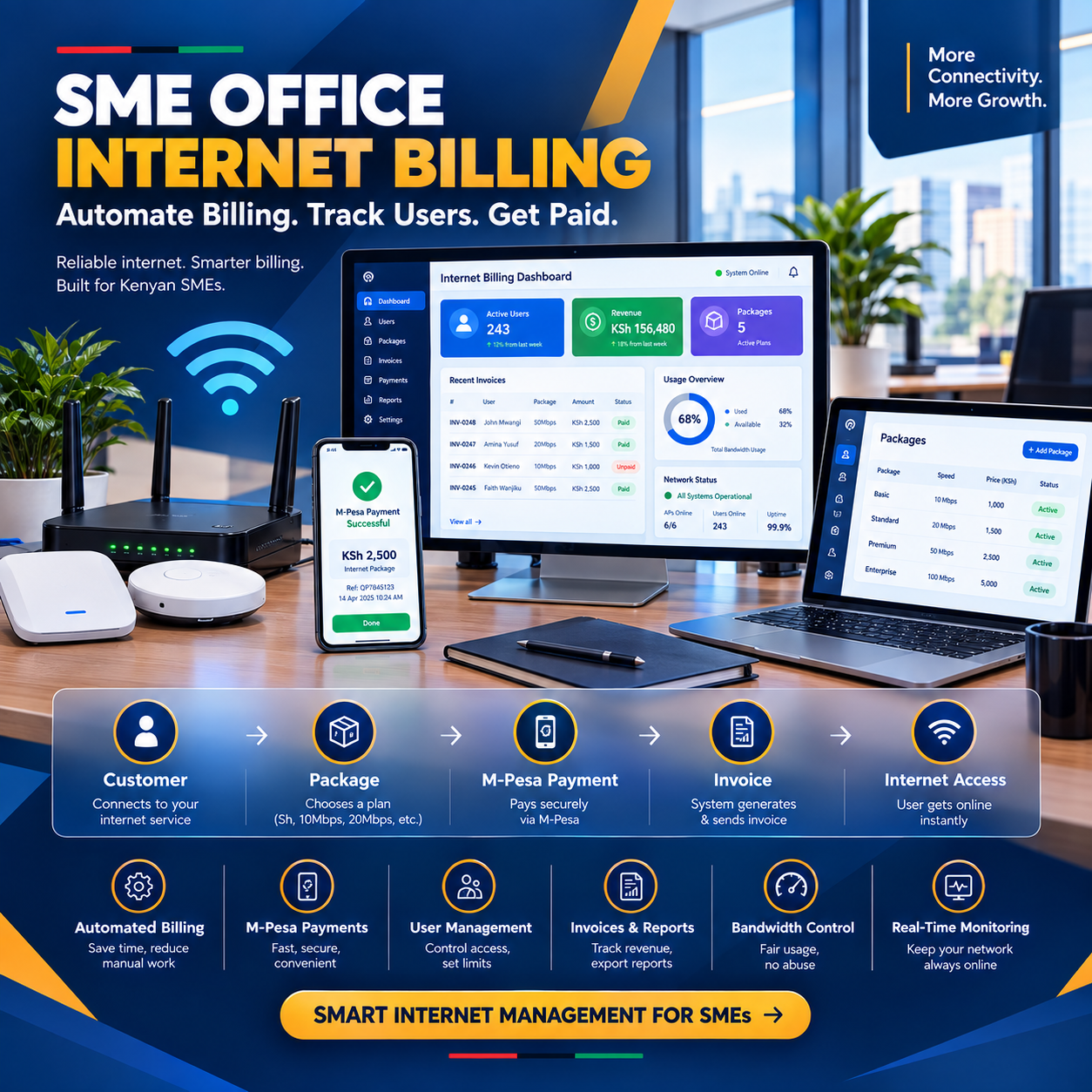
SME office internet billing is the answer to a problem hiding in nearly every small and medium office in the country — a problem most businesses don’t realize they have until it costs them real money.
Walk into a typical SME office and ask who manages the internet. The answer is usually a shrug, a glance at the router in the corner, and a password written on the whiteboard since 2021.
Yet that unmanaged connection is one of the largest recurring costs in the business, and one of the least controlled.
Staff stream videos during working hours. Visitors get the full password with no expiry. Nobody knows how much bandwidth each department actually uses.
The finance person knows exactly what the internet costs monthly. Nobody knows what the business gets for it.
That is the gap proper SME office internet billing exists to close — turning a shared, leaking utility into a managed, measurable, accountable business resource.
This article explores what that change looks like in practice, what it saves, and why the offices that adopt real SME office internet billing rarely go back.
The Unmanaged Office Network: What It Really Costs
The true price of an unmanaged office network never appears on the internet bill, which is why it stays invisible for years
It appears instead in quiet productivity losses — the marketing team waiting for a video call to buffer because two people are downloading files in the corner.
It appears in security exposure, because a password shared with every visitor since the office opened is effectively a password shared with everyone those visitors know.
It appears in zero accountability — the finance office cannot answer which department consumed what, so cost decisions happen blind.
Every SME paying for business-grade bandwidth while running it like a home network is living inside this gap, and structured SME office internet billing exists precisely to name and close it.
There is also the growth problem.
An office of eight people can survive on one shared password and goodwill.
An office of forty cannot — the network slows, complaints multiply, and whoever sits nearest the router becomes the unofficial IT department.
Businesses that grew past this stage describe the same realization: the internet stopped being a utility the moment headcount made it infrastructure.
And infrastructure demands management — which is what proper SME office internet billing provides without demanding an IT hire alongside it.
The final hidden cost is the most ironic one: most SMEs are already overpaying for bandwidth they don’t need, because they bought capacity to compensate for chaos.
Managed properly, many offices discover their existing connection was always sufficient.
What a Good Billing System Actually Does for an SME
Strip away the technical language and effective SME office internet billing does one large thing: it puts a layer of control between the internet connection and the people using it.
Instead of one password for everyone, each person and purpose gets its own managed access.
Staff accounts come with defined rules — how much bandwidth, what speeds, at what hours.
Guest access becomes a proper portal instead of a whispered password.
And every byte consumed becomes visible on a dashboard the office manager can actually read.
The practical effect is that the internet starts behaving like every other managed business resource — accountable, measurable, and deliberate.
The second thing genuine SME office internet billing delivers is fairness.
Bandwidth stops being a first-come-first-served scramble and becomes an allocated resource: the accounts team gets what it needs for its banking portal, the designers get what they need for file transfers, and nobody’s video meeting collapses because someone else is streaming a series.
The third thing it delivers is evidence.
When the internet bill arrives, the office can finally answer the question every other expense answers: what did we get for this?
Usage by department, by hour, by person — the numbers that turn internet from a mystery into a line item.
That trio — control, fairness, evidence — is the complete value proposition inside serious SME office internet billing, and each piece pays for itself in a different way.
Staff Access: From One Shared Password to Individual Control
The most immediate change offices notice after adopting structured SME office internet billing is the death of the shared password.
In its place: individual staff access, each with rules that match the person’s role.
The accountant who needs banking portals all day gets unrestricted business-hour access.
The intern gets a defined quota.
The warehouse tablet that only needs inventory software gets exactly that and nothing more.
This role-based structure is what makes disciplined SME office internet billing genuinely useful rather than merely watchful — access is shaped around work, not restricted against it.
Time policies add the second layer.
Some offices restrict high-bandwidth leisure streaming to lunch hours rather than banning it outright — a policy that respects staff while protecting the workday.
Others set quotas per person that simply slow down rather than cut off, letting everyone feel the limit without anyone hitting a wall mid-task.
The flexibility matters because every office culture is different, and well-designed SME office internet billing adapts to the office rather than forcing the office to adapt to it.
The third layer is the ending of the “former employee still on the network” problem.
Under the shared-password era, everyone who ever visited remained connected forever.
Under managed access, a departing staff member’s access ends with their employment — one click, complete, immediate.
Offices that made this switch report an unexpected benefit: staff stopped asking each other for the password, because the password stopped existing, and with it went the small daily frictions of a network nobody owned.
Guest WiFi: The Client-Facing Side of the Network
Every office hosts visitors — clients, suppliers, interview candidates, auditors — and every one of them asks the same question: what’s the WiFi?
Under the old model, the answer was handing a stranger the keys to the entire business network.
Under proper SME office internet billing, the answer becomes a clean guest portal that opens in seconds and touches nothing it shouldn’t.
The guest connects, lands on a branded page with the company’s name on it, gets a session with sensible limits, and starts browsing.
The business network — files, printers, cameras, accounting systems — stays on a separate, invisible layer the guest can never reach.
This separation is the single most important security upgrade most SMEs ever make to their network, and thoughtful SME office internet billing delivers it as a default rather than a project.
The branding detail matters more than offices expect.
A visitor landing on a polished portal with the company logo forms an impression before the meeting starts.
A visitor being handed a password scribbled on a sticky note forms a different one.
The guest portal becomes a small, quiet piece of the company’s professional image — one that costs nothing extra to maintain once proper SME office internet billing is in place.
Session limits solve the last guest problem: the visitor who stays connected all day.
Guest sessions can expire after a few hours, keeping the network for the people who work there — politely, automatically, without anyone having to ask a guest to disconnect.
That final touch is what separates complete SME office internet billing from a simple password change.
Bandwidth Fairness and the Productivity Question
Here is the uncomfortable truth every office manager eventually confronts: a meaningful share of business bandwidth never touches business work.
Streaming, social video, large personal downloads, automatic phone backups running over office WiFi all day.
None of this is malicious — it is simply what happens when a resource is free, unlimited, and invisible.
Sound SME office internet billing makes the invisible visible first, and manageability follows naturally.
The productivity conversation changes shape once numbers exist.
Instead of suspicions and awkward accusations, the office manager sees actual usage patterns and adjusts policies that apply to everyone equally.
Per-user speed caps mean one person’s habits can no longer degrade everyone else’s workday — the single change that eliminates most office internet complaints.
Priority rules keep business-critical traffic, like video calls and cloud applications, responsive even during busy hours.
Offices running structured SME office internet billing describe the daily experience afterward in consistent terms: the network feels faster without changing the connection, because the same bandwidth finally flows to work instead of noise.
There is a policy design principle worth stating: manage behavior, don’t police people.
Quotas, speeds, and schedules apply to everyone — including management — which keeps the system accepted rather than resented.
Offices that framed their rollout as “making the internet work better for everyone” saw smooth adoption.
Good SME office internet billing provides the tools; the framing provides the peace.
Cost Visibility: Turning Internet From a Mystery Into a Line Item
Ask an SME finance person what the internet costs and they answer instantly — it is on the bill every month.
Ask what the business received for that cost, and the answer usually stops.
Real SME office internet billing completes the sentence with data: usage by department, by time, by type of activity.
This visibility pays off in three direct ways.
First, right-sizing: many offices discover their bandwidth subscription is larger than their genuine needs, or exactly right once waste is managed — either discovery changes the monthly bill.
Second, departmental accountability: when each team’s consumption is visible, budget conversations stop being guesses.
The marketing team’s heavy upload schedule can be planned, budgeted, and justified — or adjusted.
Third, growth planning: the office expanding to thirty staff can see from data whether the current connection survives the addition, before signing a bigger contract.
Businesses running proper SME office internet billing describe this as finally being able to buy internet the way they buy everything else — against evidence.
There is a quieter financial benefit too: leakage ends.
The neighbor’s teenage son who has been quietly using the office network every evening, the printer-room tablet that streams all night, the former employee’s device that never left — every uninvited consumer shows up in the records and can be ended with a click.
Each one recovered is bandwidth the business already paid for, returned to the people who did — the quiet dividend of SME office internet billing done right.
Professionalism: The Network as Part of the Brand
An office network is invisible when it works and unforgettable when it doesn’t
Clients sitting in the meeting room experience the company’s internet directly — the video call that freezes during the pitch, the file that won’t upload before the deadline, the guest WiFi that requires asking three people for a password.
Disciplined SME office internet billing treats these moments as brand moments, because they are.
A visitor portal that opens instantly with the company’s branding says something before anyone speaks: this business has its act together.
A meeting-room connection that holds during a client video call says something during the most important minutes of the month.
Offices that deployed structured SME office internet billing consistently report the same small revelation: client complaints about “your internet” simply stopped, and nobody missed them.
There is also the recruitment angle.
Job candidates interview in the office, connect to the guest network, and form judgments.
Top candidates — the ones who work from connected environments — notice infrastructure.
The business competing for talent against larger firms wins quiet points when its network feels enterprise-grade.
None of this requires pretending to be a big company.
It requires managing the small company’s network with the same seriousness — which is exactly what modern SME office internet billing makes affordable for a ten-person office.
Professionalism, it turns out, is mostly a series of small things that work.
Getting Started: What Deployment Actually Takes
The fear that stops most SMEs from managing their network is the imagined project — servers, consultants, weeks of disruption.
The reality of structured SME office internet billing is smaller by an order of magnitude.
Deployment works with the connection and equipment the office already has.
The management layer configures through a simple interface, and the typical SME office goes live within a day.
The heavier work is not technical — it is decisions: who gets what access, what the guest policy says, which rules apply at which hours.
An office manager can settle those questions in an hour with a pen and paper, then encode them into the SME office internet billing setup in an afternoon.
The rollout conversation with staff matters more than any setting.
Offices that explained the change as an upgrade — faster network, fairer sharing, better guest access — met no resistance.
Offices that announced nothing met confusion, which is a communication failure wearing a technical costume.
The successful pattern is simple: brief the team, launch quietly, adjust for a week, done.
After that, structured SME office internet billing runs on attention measured in minutes per week — a dashboard glance, an occasional new staff account, a policy tweak when the business changes.
The office that feared a project discovers it adopted a habit instead.
The Mistakes SMEs Make — and How to Sidestep Them
The predictable rollout errors repeat across every office, and naming them is cheaper than making them.
The first is over-restricting at launch — clamping down so hard that staff experience the system as punishment rather than upgrade.
The winning offices start gentle: reasonable quotas, fair speeds, and policies that target waste rather than work.
The second is the silent launch — flipping rules on without telling anyone, then spending a week repairing goodwill.
Every smooth deployment of structured SME office internet billing was preceded by an honest conversation; every rocky one by an ambush.
The third mistake is ignoring the dashboard after go-live.
The system’s reports are the office’s new eyes — usage patterns, peak hours, guest traffic — and the manager who reads them monthly keeps finding money.
The fourth is forgetting the guests: launching staff management while visitors still get the old treatment, leaving half the network unmanaged.
The guest portal is half the value of complete SME office internet billing, and it deserves its own policy decisions.
The fifth is under-protecting the hardware — the router in the corner still needs power protection and a sensible location, because the management layer governs the network but does not waterproof it.
None of these mistakes is expensive to fix.
All of them are expensive to repeat, which is why the offices that review their SME office internet billing setup quarterly consistently outperform the ones that set it once and forget it exists.
Security: The Upgrade Nobody Notices Until It Matters
Under the shared-password model, an SME’s business network and its guest traffic share one flat space — printers, files, cameras, and strangers on the same reachable surface.
Proper SME office internet billing separates these worlds by design: business systems on one managed layer, guests on another, and staff on a third with role-appropriate reach.
This separation neutralizes the most common small-business breach path — a visitor’s laptop wandering the internal network uninvited.
Access expiry adds the second layer: former employees, old devices, and stale guest sessions end automatically rather than lingering for years.
Every account on the network belongs to someone current, doing something known.
Structured SME office internet billing thus functions as a security upgrade disguised as a billing tool — the reason many offices adopted it in the first place was an audit, a client’s security questionnaire, or a close call.
Payment and credential hygiene complete the picture: admin access stays with one or two named people, credentials stay off whiteboards, and changes carry records.
The office that once had no answer to “who has access to your network?” now has a complete list, current to the day.
That answer, increasingly, is demanded — by clients, by insurers, by partners — and disciplined SME office internet billing turns it from a scramble into a screenshot.
Scaling: One Office Becomes Two
Growth is where unmanaged networks fail loudest, and where proper SME office internet billing proves it was the right foundation.
A second branch means a second connection, a second set of users — and either a second chaos or one extended system.
Under centralized management, the new branch inherits the company’s policies on day one: the same staff rules, the same guest portal, the same standards.
Head office sees both locations on one dashboard, with usage and costs reported per site.
The manager who once ran one network now runs two with barely more effort — which is the entire difference between scaling and scrambling.
Staff transferring between branches become a one-click change rather than a new setup.
Centralized SME office internet billing treats people as portable, because growing businesses need them to be.
Branch-specific flexibility survives too: the branch with heavier guest traffic can run different guest policies without breaking company-wide consistency.
The pattern across growing SMEs is consistent — the businesses that managed their first office properly expand cleanly, and the ones that didn’t rebuild from scratch at branch two, paying for the early shortcut with interest.
Good SME office internet billing costs the same discipline either way; only the timing of paying it differs.
The Payoff, Counted Honestly
Ask offices a year after adopting structured SME office internet billing what changed, and the answers cluster into four themes.
Money: right-sized bandwidth, ended leakage, and internet decisions finally made against data instead of guesswork.
Time: the informal IT department — whoever sat nearest the router — got their afternoons back, and the office manager’s monthly internet review shrank from an afternoon to a coffee.
Calm: the daily complaints, the frozen calls, the queue for the password — gone, replaced by a network that behaves the same way every day.
And professionalism: the guest portal, the reliable meeting room, the security answer that satisfies clients — small things that accumulate into reputation.
None of these arrived through a bigger connection or a bigger budget.
They arrived through management — which is the entire argument for disciplined SME office internet billing in one sentence: the office was already paying for a good network, and finally started receiving one.
The offices that make this change describe the feeling identically: the internet stopped being weather — something that happened to them — and became infrastructure, something they run.
That shift, in a resource used by every employee every hour, is among the highest-leverage upgrades a growing SME can make.
Frequently Asked Questions
Do we need to change our internet provider to use a system like this?
No — structured SME office internet billing works with the connection and provider the office already has, adding a management layer on top rather than replacing anything underneath.
How long does setup take for a typical office?
Most SMEs go live within a day: connect the management layer, define staff and guest policies, and brief the team.
The technical work is hours; the policy decisions are a meeting.
The modern platforms behind SME office internet billing treat setup as routine and guide the office through it.
Will staff resist the change?
Offices that frame the rollout as an upgrade — fairer speeds, better guest access, a network that works — report smooth adoption.
Resistance appears when the system arrives silently or reads as surveillance, both of which are communication choices, not system features.
What exactly can management see about staff usage?
Aggregate and per-account usage: how much data, at what hours, at what speeds
Structured SME office internet billing is built for resource management, and offices do well to use it that way — transparently, with policies announced.
Can the guest network be branded with our company identity?
Yes — the portal carries the company name and logo, which turns every visitor connection into a small professional moment.
It is the most visible feature of proper SME office internet billing and often the one clients comment on.
What happens when a new employee joins or someone leaves?
New staff get an account in minutes with role-appropriate rules, and departing staff lose access in one click.
The network finally follows the HR list — no more ghosts of employees past lingering on the connection.
That automation is a core promise of disciplined SME office internet billing.
Does this work across multiple branches?
Yes — additional locations inherit company policies and report into the same dashboard, with per-branch visibility.
Growing offices find centralized SME office internet billing scales as cleanly as the business does.
What does it cost compared to what it saves?
Platform fees are modest and predictable, and the honest comparison is against the measurable waste it ends: oversized bandwidth, unauthorized users, and unmanaged consumption.
Most offices find structured SME office internet billing pays for itself in right-sizing alone within the first months.
Can we still give unlimited access to people who genuinely need it?
Yes — policies are per-account, so the director, the design team, or the heavy-upload roles can run unrestricted while everyone else sits on sensible defaults.
Good SME office internet billing bends to the office’s reality rather than forcing one rule on forty different jobs.
Does this replace the need for an IT person?
For most SMEs, no hire is needed — the management layer replaces the daily router-wrangling an IT person would otherwise do.
Offices with existing IT find SME office internet billing makes their person more effective, not redundant.
Can we set different rules for different times of day?
Yes — schedules are standard: relaxed speeds at lunch, full priority during core hours, guest access limited to business times.
Time-based policies are among the most-used features in deployed SME office internet billing setups.
What happens if the system or internet goes down?
Well-built systems fail gracefully — sessions persist, records survive, and connectivity restores cleanly after the disruption.
Asking each vendor that question directly is the fastest way to test whether their SME office internet billing is engineered or just marketed.
What is the smartest first step for an office still deciding?
Run one honest week of observation: who connects, how much is consumed, and what the current arrangement costs in bandwidth, complaints, and security exposure.
That single page of findings, set against what structured SME office internet billing manages from day one, has made the decision for more office managers than any sales conversation — and the offices that make the switch discover the same thing every time: the network they already pay for was always capable of running like proper SME office internet billing promises, and the only thing it was ever missing was management — one account, one policy, and one dashboard at a time, which is the whole story of SME office internet billing done right.