
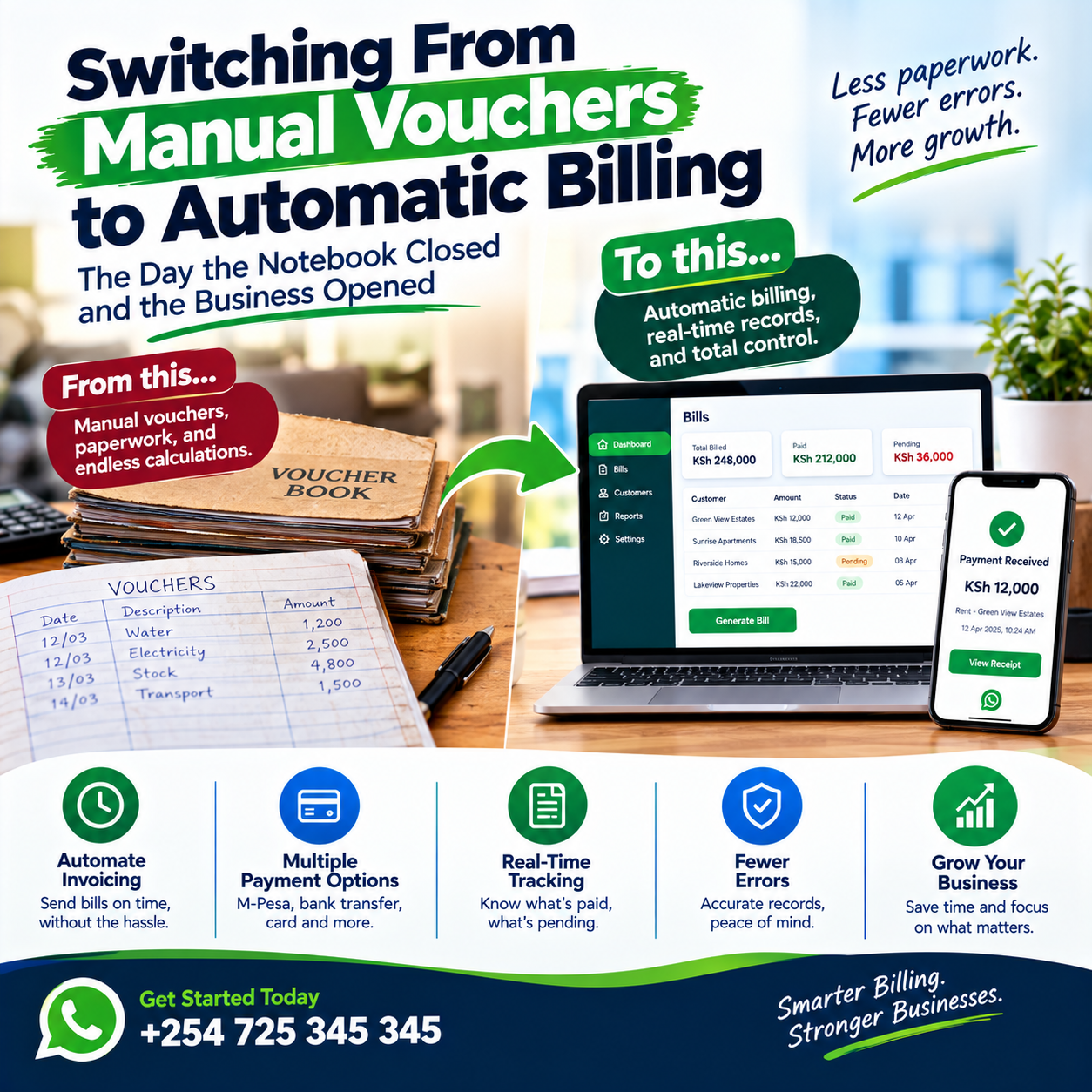
Switching from manual vouchers to automatic billing is the single most transformative upgrade a hotspot operator can make — the moment a business built on printed codes, cash boxes, and handwritten ledgers becomes a system that sells, collects, and reports while the owner sleeps.
Every veteran operator remembers their voucher era with a strange mixture of fondness and exhaustion. The scratch cards stacked in a drawer. The attendant at the counter selling codes one customer at a time. The notebook where every sale was logged by hand, in whatever light was available.
It worked — that is the honest truth about vouchers. They built this entire industry. But they also capped it, because switching from manual vouchers to automatic billing is what releases a network from the limits of human hands and human hours.
This article walks through the complete journey: what the manual era really cost, what the automatic era delivers, how the transition actually unfolds week by week, and why operators who made the switch describe it as the day their business finally started.
Because the vouchers were never the destination — they were the training wheels, and switching from manual vouchers to automatic billing is simply the moment the operator lets go and rides.
The Life of a Voucher Operator: The Era Worth Remembering
Before celebrating the switch, it is worth honoring what the voucher era actually accomplished — because understanding it is the first step in switching from manual vouchers to automatic billing successfully.
Vouchers made internet sellable to everyone. A customer who would never create an account would happily hand over fifty shillings for a printed code — because a voucher works exactly like the airtime cards and electricity tokens the market already understood.
Vouchers also made distribution possible anywhere. Codes traveled through kiosks, shop counters, friends, and family — turning every corner of a neighborhood into a potential point of sale.
And vouchers built trust in an era when digital payments were still earning theirs. So the operator who is switching from manual vouchers to automatic billing today is not correcting a mistake — they are building on a foundation that worked.
But the same era carried costs that compounded daily, and every operator who lived them can recite them from memory. The stock that ran out mid-rush. The codes that were copied and shared. The attendant’s honest mistakes and the dishonest ones the notebook could never settle.
The evening reconciliation that never quite balanced. The sales that happened only when a human was present to sell them. Those costs are why switching from manual vouchers to automatic billing has become the industry’s most common rite of passage — every operator eventually meets the ceiling the vouchers built.
The Real Arithmetic: What Manual Vouchers Quietly Cost
The business case for switching from manual vouchers to automatic billing hides inside an honest audit of the manual operation — and the numbers surprise even the operators running them.
The first cost is time.
Every voucher sold consumed human minutes: the transaction at the counter, the logging afterward, the stock count at day’s end, the reconciliation that ate the evening.
Multiplied across a hundred daily sales, the operator discovers they have been working a second job inside their own business — and the hours are the first thing reclaimed when switching from manual vouchers to automatic billing.
The second cost is leakage.
Uncounted change. Codes sold off the books. Vouchers given as favors. Stock that vanished between the drawer and the notebook.
Most of it was not theft — it was ambiguity, because a handwritten ledger cannot prove anything to anybody.
The third cost is the ceiling on selling hours.
Vouchers sell only when the seller is present, which means the network earns only during the operator’s waking, available hours.
The 2 a.m. customer, the 5 a.m. buyer, the Sunday afternoon rush — every sale outside those hours simply never happened.
That lost revenue is invisible in the accounts and enormous in reality, and it is the mountain switching from manual vouchers to automatic billing exists to recover.
The fourth cost is scale: every new customer added work in proportion, so growth made the business heavier instead of stronger.
Operators who audited all four costs reached the same verdict — the manual system was not free; it was the most expensive system they never knew they were paying for.
What Automatic Billing Actually Is
Strip away the jargon and the destination of switching from manual vouchers to automatic billing is beautifully concrete.
Automatic billing is a system where the customer completes the entire purchase journey themselves: they connect, see the packages on a portal, pay through mobile money, and their access opens instantly.
No printed codes, no counter transaction, no human in the middle of any sale.
The system handles everything the voucher era demanded of humans — selling, recording, activating, enforcing, and reporting — with perfect memory and zero fatigue.
For the operator, the platform behind switching from manual vouchers to automatic billing becomes a dashboard: revenue arriving in real time, sales by the hour, package popularity, and customer patterns all visible from a phone.
Enforcement rides the same machinery: every purchase binds to its device, every session counts down, and every expiry lands cleanly at the moment the paid time ends.
Reconciliation happens by itself — every payment matched to every session, every receipt issued automatically, every dispute settled by scrolling rather than arguing.
The transformation is not cosmetic; it changes what the business is.
Before the switch, the operator was the machine — the seller, the recorder, the enforcer, the accountant.
After switching from manual vouchers to automatic billing, the operator is the owner — setting the rules, reading the numbers, and collecting what the system gathers around the clock.
The Transition Week: How the Switch Actually Unfolds
The practical journey of switching from manual vouchers to automatic billing is shorter than most operators fear — most complete it inside a fortnight.
The first days belong to setup: the platform account created, packages and prices entered, the portal branded with the network’s name, and the mobile money account connected.
This is configuration, not construction — modern platforms walk the operator through it in an afternoon.
The next days belong to testing: real purchases made with real money, sessions activated, devices bound, expiries verified, and deliberate failures provoked to see how the system responds.
The operator who tests ruthlessly before launch is the one whose switching from manual vouchers to automatic billing day feels boring — and boring is exactly what a launch day should be.
Then comes the parallel run: the smartest operators keep vouchers selling while the portal goes live, letting both channels coexist for a short bridge period.
Customers learn the new way at their own pace, the operator collects comparative data from both systems, and nobody is stranded mid-transition.
Finally, the sunset: a clear date announced, the voucher stock wound down, and the portal standing as the only — and now familiar — way to buy.
That staged sequence is the professional pattern behind every smooth switching from manual vouchers to automatic billing story the industry tells.
Telling the Customers: The Communication That Makes or Breaks It
No chapter of switching from manual vouchers to automatic billing matters more than how the customers hear about it — because a silent switch reads as ambush, and ambushes cost goodwill.
The operators who transitioned smoothly all communicated the same three things, early and often.
First, the why: the network is upgrading so customers can buy anytime, pay from their phones, and stop depending on the counter being open.
Framed that way, the change is a gift to the customer, not a convenience for the operator — and customers respond to it that way.
Second, the how: one simple demonstration of the flow — connect, choose, pay, browse — delivered in person, on a poster, and through every WhatsApp group the network touches.
A two-minute live demo converts skeptics faster than any written explanation.
Third, the grace: a free first session, a small launch discount, or a bonus for early adopters — something that thanks the customers for adapting.
Veterans of switching from manual vouchers to automatic billing transitions report the same discovery: the customers adapted faster than anyone expected, because paying by phone was already their native habit.
The resistance that operators dread almost never arrives.
What arrives instead is the quiet question, repeated across every successful transition: “Why didn’t you do this sooner?”
The First Automated Week: What It Actually Feels Like
The emotional arc of switching from manual vouchers to automatic billing is worth describing honestly, because every operator walks the same path.
The first day brings strangeness: the operator keeps reaching for the voucher drawer that no longer matters, and watches the dashboard the way new parents watch a crib.
The first automated sale — a customer buying at 6:40 a.m. while the operator slept — lands as a small revelation.
Money arrived, a session opened, and no human did anything; the business just transacted on its own.
By midweek, the pattern becomes visible: purchases clustering in the morning rush, spiking at lunch, and flowing steadily through the late evening.
Hours the voucher era never earned are now the busiest hours on the switching from manual vouchers to automatic billing dashboard.
By week’s end, the deeper shift arrives: the operator realizes they spent the week watching revenue instead of chasing it.
The drawer is closed, the notebook is retired, and the counter is free for the work that actually grows the business.
That first week is the hinge of the entire journey — the moment the operator stops being the machine and starts being the owner, which is the whole destination of switching from manual vouchers to automatic billing.
The Numbers After the Switch: What the Dashboard Reveals
The financial evidence for switching from manual vouchers to automatic billing arrives quickly, and it clusters into four measurable gains.
The first is the expansion of selling hours.
Where the voucher counter earned perhaps ten hours a day, the portal earns twenty-four — and operators consistently report thirty to forty percent of their new revenue arriving in hours the old system could never serve.
The second is the end of leakage.
Every transaction now carries a timestamp, a receipt, and a matching session record — and the mysterious gaps that haunted the manual ledger simply stop appearing.
Operators who measured their pre-switch leakage found it was often the difference between a struggling month and a comfortable one.
The third gain is conversion.
The portal presents every package with its price, and the payment completes in under a minute — removing the hesitation, the queue, and the changed-mind moments that the counter transaction created.
The fourth gain is data.
Within a month of switching from manual vouchers to automatic billing, the operator knows their peak hours, their best-selling package, their busiest days, and their customer patterns — intelligence the notebook era never produced.
That data becomes the foundation for every pricing and capacity decision that follows, which is why operators describe the switch as installing a brain inside the business.
The Customer Experience: Why Buyers Prefer the New Way
The switch succeeds long-term because the customer’s side of switching from manual vouchers to automatic billing improves just as dramatically as the operator’s.
The old journey demanded things of the customer: find the counter, find the attendant, find the cash, wait in the queue, and hope the right voucher was in stock.
The new journey demands one thing: a phone they already carry.
The customer connects, sees the packages with honest prices, taps their choice, enters their M-Pesa PIN, and browses — the whole journey completed in under a minute, from anywhere, at any hour.
Privacy improves too: no cash counted in public, no transaction narrated to a counter, no dependence on the attendant’s mood or memory.
Fairness sharpens as well: every package and price displayed openly, so the customer chooses exactly what fits without negotiating.
And the expiry experience softens — sessions show countdowns, warnings arrive before time runs out, and extensions are one tap away instead of a walk back to the shop.
Customers describe the difference in one recurring sentence: “I just pay on my phone and it works.”
That sentence is the most valuable marketing asset a network can own, and it is manufactured by switching from manual vouchers to automatic billing with the customer’s convenience at the center.
Keeping the Best of the Old: The Hybrid Grace Period
Here is a nuance that separates smooth transitions from rocky ones: switching from manual vouchers to automatic billing does not require abandoning everything the voucher era did well.
Modern platforms let the operator run both worlds simultaneously — the automated portal as the main channel, and digital vouchers as a tool the operator still controls.
Cash-preferring customers can pay at a counter, and the operator issues a digital voucher from the dashboard — the sale recorded, the receipt automatic, the bookkeeping clean.
Promotions become easier too: complimentary codes for loyal customers, bonus sessions bundled with purchases, and event-day giveaways — all issued from the same platform.
The difference from the old era is subtle but total: the vouchers still exist, but now they are inventory the operator controls rather than paper the operator chases.
That distinction is the mature stage of switching from manual vouchers to automatic billing — automation running the routine, with deliberate exceptions remaining in human hands.
The operators who framed the switch this way — as an upgrade, not an abolition — retained even their oldest, most voucher-loyal customers.
Because what those customers actually loved was never the paper; it was the simplicity.
And the portal delivers simplicity better than the paper ever did.
The Mistakes Operators Make During the Switch
The predictable transition errors repeat across every market, and naming them is cheaper than making them.
The first is the silent switch: the portal goes live with no announcement, and a week of confusion gets misread as customer rejection.
Every smooth switching from manual vouchers to automatic billing story begins with communication, not configuration.
The second is the hard cutover: vouchers abolished overnight, stranding the cash-preferring and the unfamiliar with no bridge period.
The parallel-run grace period costs nothing and saves the goodwill that hard cutovers burn.
The third is untested pricing: packages launched on the portal without checking them against the market’s bundle math, and conversions suffering invisibly for weeks.
The fourth is ignoring the dashboard after launch — the new system’s reports are the business’s eyes, and the operator who never looks flies blind with perfect instruments.
The fifth is abandoning support too soon: the first week needs the operator visible and patient, answering the early questions that later become unnecessary.
The sixth is skipping the failure rehearsal: deliberate tests of failed payments, weak signals, and expired sessions, so the operator knows the system’s behavior before a customer teaches them.
Each mistake is avoidable, and the operators who avoided them describe their switching from manual vouchers to automatic billing transition as almost anticlimactic — the biggest change their business ever made, completed over one quiet fortnight.
What Happens to the Attendant: The Human Question
No conversation about switching from manual vouchers to automatic billing is honest without addressing the people who sold the vouchers — and the experience across the industry is more positive than operators fear.
The attendant’s voucher-selling hours were never their best work: repetitive transactions, exact change, and end-of-day counting that kept them behind the counter.
Automation releases those hours for the work that actually earns: serving customers, maintaining the space, upselling, and learning the network’s operations.
In the strongest transitions, attendants became the portal’s champions — trained on the dashboard, answering customer questions, and often promoted into managing the system itself.
Operators who framed the change this way — as a promotion for their people rather than a replacement of them — kept their best staff and gained their loyalty.
The record-keeping protects everyone too: automated sales logs clear the attendant of the suspicions that handwritten ledgers always left hanging.
That side effect — honest records protecting honest workers — is one of the most quietly appreciated outcomes of switching from manual vouchers to automatic billing.
The human question, answered well, strengthens the team instead of shrinking it.
Scaling After the Switch: Why Automation Is the Foundation of Growth
The deepest business argument for switching from manual vouchers to automatic billing is what it makes possible next — because a manual operation cannot scale, and an automated one barely notices growth.
Under vouchers, every new customer added counter work in proportion; a network of five hundred customers would have required an army of attendants.
Under automation, the second location, the second mast, and the second hundred customers add configuration rather than labor.
New sites inherit the packages, the portal, and the payment flow as settings — with revenue reporting into the same dashboard the operator already reads.
The operator who completed switching from manual vouchers to automatic billing at one location holds a template, and expansion becomes repetition.
The financial planning changes too: predictable, automatically collected revenue supports loans, upgrades, and hires in ways cash-in-a-drawer never could.
And the data compounds with scale: patterns learned at one site tune the pricing at the next, until the whole portfolio runs on evidence.
That is the long arc of the switch — not just a cleaner week, but a business that can finally grow without the owner growing with it.
Every multi-site operator in the market traces their scaling story back to the same origin: the fortnight they spent switching from manual vouchers to automatic billing and never looked back.
The Payoff, Counted Honestly
Ask operators a year after switching from manual vouchers to automatic billing what actually changed, and the answers gather into five themes.
Income: more of it, arriving in hours the old system never served, with the leakage that drained it simply gone.
Time: evenings returned, reconciliations ended, and the operator’s role shifted from selling to deciding.
Calm: no more stock counts, no more disputed ledgers, no more “did you receive my payment” conversations — records settle everything in seconds.
Growth: a business that finally scales by configuration, with every new customer and location adding revenue without adding labor.
And identity: the quiet, profound shift from running a stall to running a company.
None of it required new bandwidth, new premises, or new customers.
It required closing the drawer, opening the dashboard, and trusting the system to do what vouchers could never do: sell while the owner sleeps.
That is the complete case for switching from manual vouchers to automatic billing — the upgrade every operator eventually makes, and the one they all describe the same way afterward: the notebook closed, and the business opened.
Frequently Asked Questions
How long does the transition actually take?
Most operators complete it inside two weeks: setup, testing, a parallel run alongside vouchers, and a communicated sunset date.
The operators who followed that staged sequence describe their switching from manual vouchers to automatic billing transition as smooth from the first day.
Will my customers adapt to the portal?
Overwhelmingly yes — paying by phone is already the market’s native habit, and the portal simply applies it to internet.
Across every recorded switching from manual vouchers to automatic billing transition, customers adapted faster than operators expected.
What happens to customers who prefer cash?
They keep a path: the operator can issue digital vouchers from the dashboard for counter payments, keeping every sale recorded without paper.
That hybrid grace is one of the strengths of switching from manual vouchers to automatic billing on modern platforms.
Will I lose sales during the switch?
Almost never — a communicated change with a parallel-run bridge keeps both channels earning while customers learn the new way.
The transitions that lost sales were the silent ones; the announced switching from manual vouchers to automatic billing journeys barely noticed a dip.
How much more revenue does automation bring?
Operators consistently report thirty to forty percent gains, mostly from the selling hours the voucher counter could never cover.
That recovery of lost hours is the headline number behind switching from manual vouchers to automatic billing everywhere.
What should I test before the launch day?
Everything with real money: a real purchase, a real session, a real expiry, and deliberate failures — weak signal, cancelled payment, expired session — so the system’s behavior is known before customers meet it.
That rehearsal is what made every calm switching from manual vouchers to automatic billing launch day boring.
What do I do with my remaining voucher stock?
Wind it down during the parallel run, and issue any leftovers as promotional credits — complimentary sessions that thank loyal customers for adapting.
That graceful exit is the final touch of a well-managed switching from manual vouchers to automatic billing.
How do I handle a customer whose payment didn’t activate?
Fast and calmly: every payment carries a timestamped record, so the case is traced in seconds and resolved with evidence rather than argument.
That receipt-backed resolution is one of the quietest benefits of switching from manual vouchers to automatic billing.
Does my staff lose their jobs in the switch?
No — the strongest transitions retrained attendants as portal champions and system managers, turning counter hours into customer-service hours.
Operators who framed switching from manual vouchers to automatic billing as a promotion for their people kept their best staff.
Can I still run promotions and free sessions?
More easily than before — complimentary codes, launch discounts, and loyalty bonuses are all issued from the same dashboard that runs the paid flow.
Automation controls the routine; the operator keeps the exceptions, which is the mature stage of switching from manual vouchers to automatic billing.
What if my internet or the platform goes down?
Sessions typically keep enforcing on their own, and service restores cleanly when connectivity returns — with every record intact through the disruption.
Asking each platform that question before switching from manual vouchers to automatic billing is the fastest quality test available.
How do I know the switch worked?
Three numbers on the dashboard answer it: revenue in previously unsold hours, payment success rate, and the disappearance of reconciliation gaps.
The operators who watched those three after switching from manual vouchers to automatic billing saw the verdict within the first month.
What is the smartest first step this week?
Count what the voucher era actually costs — the daily hours, the leakage, the unsold late-night demand — and set up a trial portal with your real packages on it.
That one page of arithmetic and one afternoon of configuration is how every operator began switching from manual vouchers to automatic billing — and the ones who completed it discovered the same truth every time: the vouchers had served their purpose, the customers were ready before the operator was, and the fortnight spent switching from manual vouchers to automatic billing became the pivot on which the whole business turned — from a counter that sold when it was open to a system that earns when it is closed, one automatic sale at a time, through the switching from manual vouchers to automatic billing that finally let the operator own the business instead of operating it.