
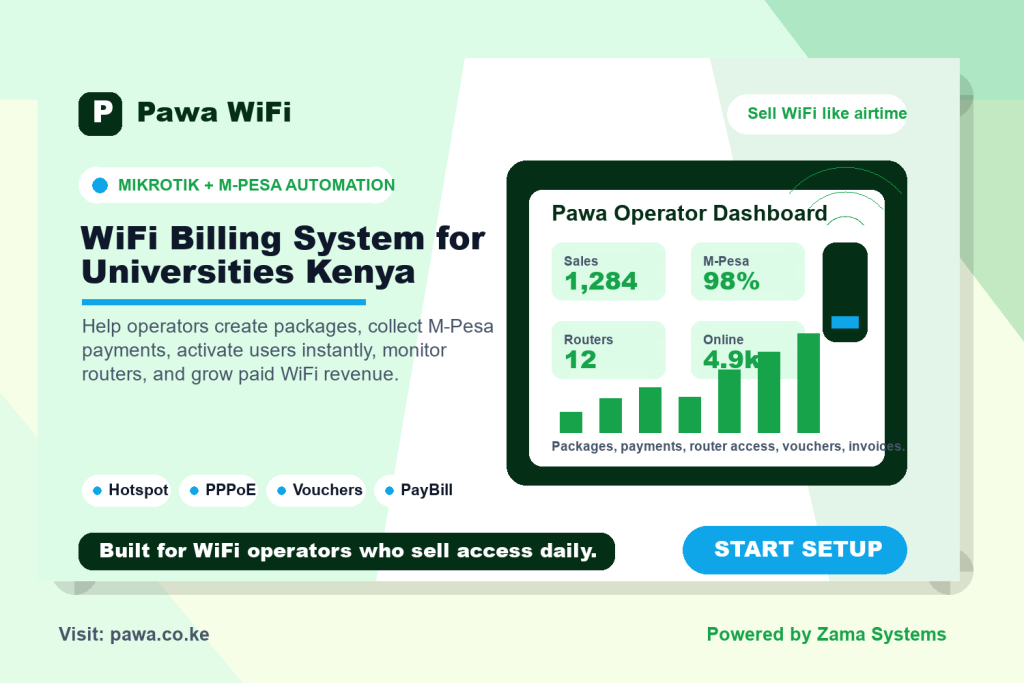
WiFi Billing System for Universities Kenya is a high-intent search made by universities, colleges, campuses, hostels, libraries, innovation hubs, ICT departments, and student-service teams who are already comparing options, evidence, cost, delivery, implementation, or support. This guide explains how to make that comparison carefully and what to confirm before taking the next step with Pawa WiFi.
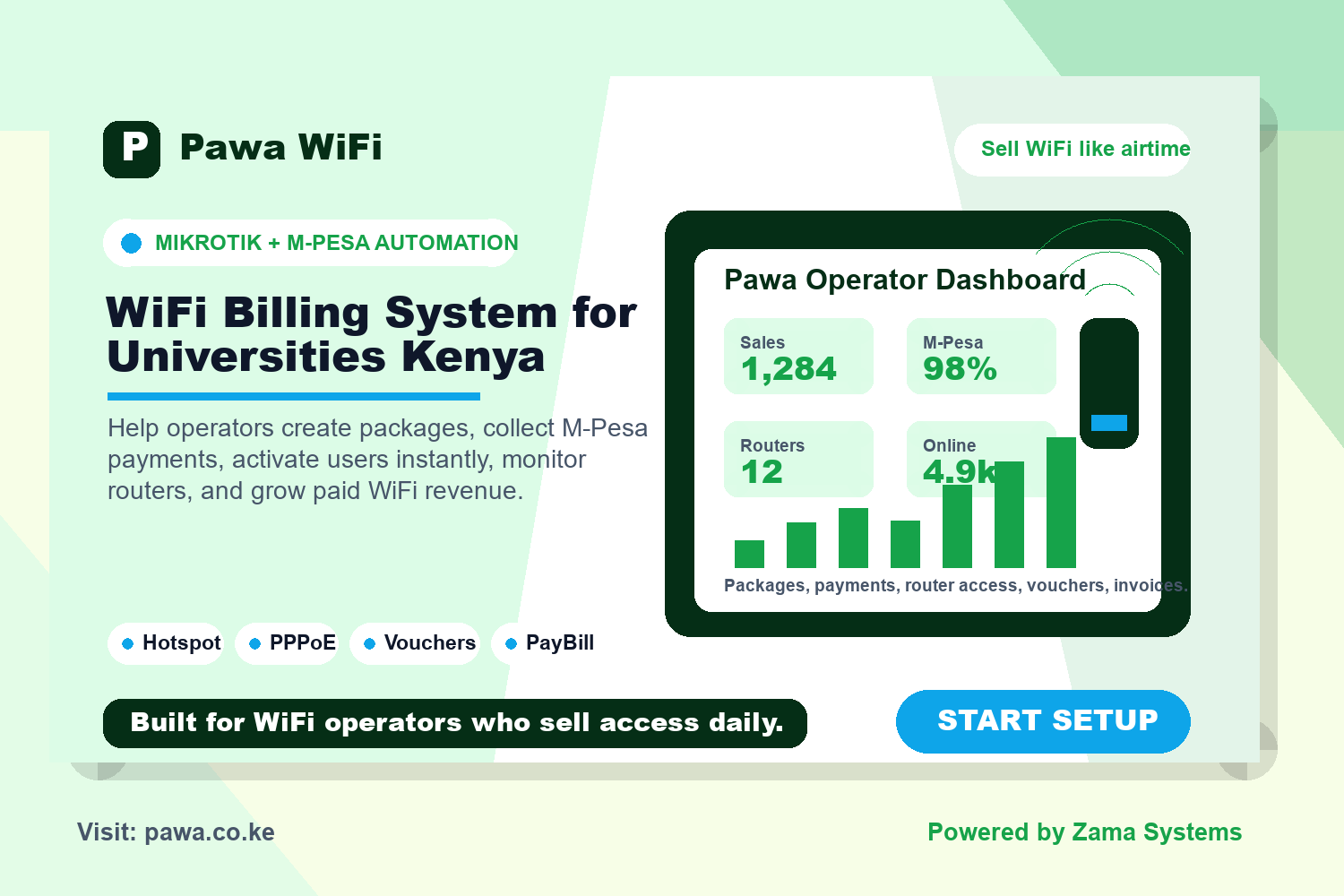
The main buying risk is large campuses serve several user groups and zones, making shared credentials, uncontrolled sessions, weak roaming, and limited usage visibility expensive to manage. A useful article must therefore do more than repeat a focus keyword. It should help the reader define the required result, compare like with like, request evidence, understand exclusions, calculate the complete cost, and preserve a clear record of the decision.
Pawa WiFi helps hotspot and small-ISP operators package internet access, connect payment-ready activation, apply MikroTik-compatible access rules, manage customer sessions, and review usage and revenue from a more controlled workflow.
What the search means and why intent matters
A person searching for WiFi Billing System for Universities Kenya is usually beyond early awareness. They may have a budget, deadline, current problem, shortlist, or internal approval to secure. Some want a product or platform immediately; others need a quotation, demonstration, installation plan, or credible provider comparison. The content should respect that intent by answering commercial questions clearly while avoiding guarantees that depend on live inventory, site conditions, configuration, third parties, user adoption, or changing prices.
Start by writing a one-page requirement. State who will use the purchase, the present problem, the minimum acceptable result, the deadline, the budget range, essential evidence, and the conditions that would make the buyer reject an offer. This prevents attractive but irrelevant features from controlling the decision. It also gives every seller or provider the same basis for a response, making the final comparison fairer and easier to defend.
Six capabilities buyers should compare
1. role and zone-based access
Ask the provider or seller to explain role and zone-based access in the context of the buyer’s real requirement. Request the exact specification, workflow, limitation, responsibility, supporting record, and next action if the expected result is not achieved. A label on a listing or proposal is not enough; the buyer needs to know what is included now, what is optional, what depends on another product or party, and which assumptions affect delivery. The comparison should show how this capability contributes to controlled access across user groups rather than treating every feature as equally valuable.
Use a simple evidence column in the scorecard. Acceptable evidence might include a live listing, written specification, dated quotation, demonstration, sample report, test result, warranty document, implementation plan, support procedure, or clear answer from the responsible party. Record unanswered questions separately and do not convert an assumption into a promise. This discipline is particularly important when two offers use similar marketing language but differ in condition, configuration, limits, service scope, or after-sales responsibility.
2. student, staff, visitor, and event packages
Ask the provider or seller to explain student, staff, visitor, and event packages in the context of the buyer’s real requirement. Request the exact specification, workflow, limitation, responsibility, supporting record, and next action if the expected result is not achieved. A label on a listing or proposal is not enough; the buyer needs to know what is included now, what is optional, what depends on another product or party, and which assumptions affect delivery. The comparison should show how this capability contributes to better planning for busy zones rather than treating every feature as equally valuable.
Use a simple evidence column in the scorecard. Acceptable evidence might include a live listing, written specification, dated quotation, demonstration, sample report, test result, warranty document, implementation plan, support procedure, or clear answer from the responsible party. Record unanswered questions separately and do not convert an assumption into a promise. This discipline is particularly important when two offers use similar marketing language but differ in condition, configuration, limits, service scope, or after-sales responsibility.
3. device, duration, speed, and data rules
Ask the provider or seller to explain device, duration, speed, and data rules in the context of the buyer’s real requirement. Request the exact specification, workflow, limitation, responsibility, supporting record, and next action if the expected result is not achieved. A label on a listing or proposal is not enough; the buyer needs to know what is included now, what is optional, what depends on another product or party, and which assumptions affect delivery. The comparison should show how this capability contributes to less manual account activation rather than treating every feature as equally valuable.
Use a simple evidence column in the scorecard. Acceptable evidence might include a live listing, written specification, dated quotation, demonstration, sample report, test result, warranty document, implementation plan, support procedure, or clear answer from the responsible party. Record unanswered questions separately and do not convert an assumption into a promise. This discipline is particularly important when two offers use similar marketing language but differ in condition, configuration, limits, service scope, or after-sales responsibility.
4. payment, voucher, and sponsored activation
Ask the provider or seller to explain payment, voucher, and sponsored activation in the context of the buyer’s real requirement. Request the exact specification, workflow, limitation, responsibility, supporting record, and next action if the expected result is not achieved. A label on a listing or proposal is not enough; the buyer needs to know what is included now, what is optional, what depends on another product or party, and which assumptions affect delivery. The comparison should show how this capability contributes to clearer multi-site and management reporting rather than treating every feature as equally valuable.
Use a simple evidence column in the scorecard. Acceptable evidence might include a live listing, written specification, dated quotation, demonstration, sample report, test result, warranty document, implementation plan, support procedure, or clear answer from the responsible party. Record unanswered questions separately and do not convert an assumption into a promise. This discipline is particularly important when two offers use similar marketing language but differ in condition, configuration, limits, service scope, or after-sales responsibility.
5. multi-access-point monitoring and session visibility
Ask the provider or seller to explain multi-access-point monitoring and session visibility in the context of the buyer’s real requirement. Request the exact specification, workflow, limitation, responsibility, supporting record, and next action if the expected result is not achieved. A label on a listing or proposal is not enough; the buyer needs to know what is included now, what is optional, what depends on another product or party, and which assumptions affect delivery. The comparison should show how this capability contributes to controlled access across user groups rather than treating every feature as equally valuable.
Use a simple evidence column in the scorecard. Acceptable evidence might include a live listing, written specification, dated quotation, demonstration, sample report, test result, warranty document, implementation plan, support procedure, or clear answer from the responsible party. Record unanswered questions separately and do not convert an assumption into a promise. This discipline is particularly important when two offers use similar marketing language but differ in condition, configuration, limits, service scope, or after-sales responsibility.
6. campus usage, sales, fault, and capacity reporting
Ask the provider or seller to explain campus usage, sales, fault, and capacity reporting in the context of the buyer’s real requirement. Request the exact specification, workflow, limitation, responsibility, supporting record, and next action if the expected result is not achieved. A label on a listing or proposal is not enough; the buyer needs to know what is included now, what is optional, what depends on another product or party, and which assumptions affect delivery. The comparison should show how this capability contributes to better planning for busy zones rather than treating every feature as equally valuable.
Use a simple evidence column in the scorecard. Acceptable evidence might include a live listing, written specification, dated quotation, demonstration, sample report, test result, warranty document, implementation plan, support procedure, or clear answer from the responsible party. Record unanswered questions separately and do not convert an assumption into a promise. This discipline is particularly important when two offers use similar marketing language but differ in condition, configuration, limits, service scope, or after-sales responsibility.
Detailed due-diligence checklist
The following checks turn the broad search into a practical decision. They should be adapted to the buyer’s circumstances, documented before payment or approval, and reviewed again during inspection, pilot testing, implementation, or delivery.
1. site survey and coverage design
For WiFi Billing System for Universities Kenya, site survey and coverage design must be tested against the real site, network, package design, payment flow, and support model. Document the expected number of users, busiest periods, access points, router model, internet capacity, coverage barriers, device behaviour, and the person responsible for daily administration. Ask the provider to show the complete journey from package selection or voucher issue through authentication, session enforcement, payment confirmation, reporting, expiry, reconnection, and failure handling. A practical pilot should use representative devices and load so the operator can identify coverage, capacity, usability, and reconciliation problems before a wider launch.
2. expected users and concurrent sessions
For WiFi Billing System for Universities Kenya, expected users and concurrent sessions must be tested against the real site, network, package design, payment flow, and support model. Document the expected number of users, busiest periods, access points, router model, internet capacity, coverage barriers, device behaviour, and the person responsible for daily administration. Ask the provider to show the complete journey from package selection or voucher issue through authentication, session enforcement, payment confirmation, reporting, expiry, reconnection, and failure handling. A practical pilot should use representative devices and load so the operator can identify coverage, capacity, usability, and reconciliation problems before a wider launch.
3. internet capacity and fair-use planning
For WiFi Billing System for Universities Kenya, internet capacity and fair-use planning must be tested against the real site, network, package design, payment flow, and support model. Document the expected number of users, busiest periods, access points, router model, internet capacity, coverage barriers, device behaviour, and the person responsible for daily administration. Ask the provider to show the complete journey from package selection or voucher issue through authentication, session enforcement, payment confirmation, reporting, expiry, reconnection, and failure handling. A practical pilot should use representative devices and load so the operator can identify coverage, capacity, usability, and reconciliation problems before a wider launch.
4. MikroTik and network compatibility
For WiFi Billing System for Universities Kenya, MikroTik and network compatibility must be tested against the real site, network, package design, payment flow, and support model. Document the expected number of users, busiest periods, access points, router model, internet capacity, coverage barriers, device behaviour, and the person responsible for daily administration. Ask the provider to show the complete journey from package selection or voucher issue through authentication, session enforcement, payment confirmation, reporting, expiry, reconnection, and failure handling. A practical pilot should use representative devices and load so the operator can identify coverage, capacity, usability, and reconciliation problems before a wider launch.
5. access-point placement and roaming
For WiFi Billing System for Universities Kenya, access-point placement and roaming must be tested against the real site, network, package design, payment flow, and support model. Document the expected number of users, busiest periods, access points, router model, internet capacity, coverage barriers, device behaviour, and the person responsible for daily administration. Ask the provider to show the complete journey from package selection or voucher issue through authentication, session enforcement, payment confirmation, reporting, expiry, reconnection, and failure handling. A practical pilot should use representative devices and load so the operator can identify coverage, capacity, usability, and reconciliation problems before a wider launch.
6. package price, speed, and duration rules
For WiFi Billing System for Universities Kenya, package price, speed, and duration rules must be tested against the real site, network, package design, payment flow, and support model. Document the expected number of users, busiest periods, access points, router model, internet capacity, coverage barriers, device behaviour, and the person responsible for daily administration. Ask the provider to show the complete journey from package selection or voucher issue through authentication, session enforcement, payment confirmation, reporting, expiry, reconnection, and failure handling. A practical pilot should use representative devices and load so the operator can identify coverage, capacity, usability, and reconciliation problems before a wider launch.
7. M-Pesa and payment activation
For WiFi Billing System for Universities Kenya, M-Pesa and payment activation must be tested against the real site, network, package design, payment flow, and support model. Document the expected number of users, busiest periods, access points, router model, internet capacity, coverage barriers, device behaviour, and the person responsible for daily administration. Ask the provider to show the complete journey from package selection or voucher issue through authentication, session enforcement, payment confirmation, reporting, expiry, reconnection, and failure handling. A practical pilot should use representative devices and load so the operator can identify coverage, capacity, usability, and reconciliation problems before a wider launch.
8. voucher and sponsored-access options
For WiFi Billing System for Universities Kenya, voucher and sponsored-access options must be tested against the real site, network, package design, payment flow, and support model. Document the expected number of users, busiest periods, access points, router model, internet capacity, coverage barriers, device behaviour, and the person responsible for daily administration. Ask the provider to show the complete journey from package selection or voucher issue through authentication, session enforcement, payment confirmation, reporting, expiry, reconnection, and failure handling. A practical pilot should use representative devices and load so the operator can identify coverage, capacity, usability, and reconciliation problems before a wider launch.
9. device, session, and expiry controls
For WiFi Billing System for Universities Kenya, device, session, and expiry controls must be tested against the real site, network, package design, payment flow, and support model. Document the expected number of users, busiest periods, access points, router model, internet capacity, coverage barriers, device behaviour, and the person responsible for daily administration. Ask the provider to show the complete journey from package selection or voucher issue through authentication, session enforcement, payment confirmation, reporting, expiry, reconnection, and failure handling. A practical pilot should use representative devices and load so the operator can identify coverage, capacity, usability, and reconciliation problems before a wider launch.
10. customer onboarding and captive portal
For WiFi Billing System for Universities Kenya, customer onboarding and captive portal must be tested against the real site, network, package design, payment flow, and support model. Document the expected number of users, busiest periods, access points, router model, internet capacity, coverage barriers, device behaviour, and the person responsible for daily administration. Ask the provider to show the complete journey from package selection or voucher issue through authentication, session enforcement, payment confirmation, reporting, expiry, reconnection, and failure handling. A practical pilot should use representative devices and load so the operator can identify coverage, capacity, usability, and reconciliation problems before a wider launch.
11. support and failed-payment handling
For WiFi Billing System for Universities Kenya, support and failed-payment handling must be tested against the real site, network, package design, payment flow, and support model. Document the expected number of users, busiest periods, access points, router model, internet capacity, coverage barriers, device behaviour, and the person responsible for daily administration. Ask the provider to show the complete journey from package selection or voucher issue through authentication, session enforcement, payment confirmation, reporting, expiry, reconnection, and failure handling. A practical pilot should use representative devices and load so the operator can identify coverage, capacity, usability, and reconciliation problems before a wider launch.
12. sales, usage, and reconciliation reports
For WiFi Billing System for Universities Kenya, sales, usage, and reconciliation reports must be tested against the real site, network, package design, payment flow, and support model. Document the expected number of users, busiest periods, access points, router model, internet capacity, coverage barriers, device behaviour, and the person responsible for daily administration. Ask the provider to show the complete journey from package selection or voucher issue through authentication, session enforcement, payment confirmation, reporting, expiry, reconnection, and failure handling. A practical pilot should use representative devices and load so the operator can identify coverage, capacity, usability, and reconciliation problems before a wider launch.
13. monitoring and fault visibility
For WiFi Billing System for Universities Kenya, monitoring and fault visibility must be tested against the real site, network, package design, payment flow, and support model. Document the expected number of users, busiest periods, access points, router model, internet capacity, coverage barriers, device behaviour, and the person responsible for daily administration. Ask the provider to show the complete journey from package selection or voucher issue through authentication, session enforcement, payment confirmation, reporting, expiry, reconnection, and failure handling. A practical pilot should use representative devices and load so the operator can identify coverage, capacity, usability, and reconciliation problems before a wider launch.
14. power backup and service continuity
For WiFi Billing System for Universities Kenya, power backup and service continuity must be tested against the real site, network, package design, payment flow, and support model. Document the expected number of users, busiest periods, access points, router model, internet capacity, coverage barriers, device behaviour, and the person responsible for daily administration. Ask the provider to show the complete journey from package selection or voucher issue through authentication, session enforcement, payment confirmation, reporting, expiry, reconnection, and failure handling. A practical pilot should use representative devices and load so the operator can identify coverage, capacity, usability, and reconciliation problems before a wider launch.
15. privacy and acceptable-use controls
For WiFi Billing System for Universities Kenya, privacy and acceptable-use controls must be tested against the real site, network, package design, payment flow, and support model. Document the expected number of users, busiest periods, access points, router model, internet capacity, coverage barriers, device behaviour, and the person responsible for daily administration. Ask the provider to show the complete journey from package selection or voucher issue through authentication, session enforcement, payment confirmation, reporting, expiry, reconnection, and failure handling. A practical pilot should use representative devices and load so the operator can identify coverage, capacity, usability, and reconciliation problems before a wider launch.
16. one-time and recurring costs
For WiFi Billing System for Universities Kenya, one-time and recurring costs must be tested against the real site, network, package design, payment flow, and support model. Document the expected number of users, busiest periods, access points, router model, internet capacity, coverage barriers, device behaviour, and the person responsible for daily administration. Ask the provider to show the complete journey from package selection or voucher issue through authentication, session enforcement, payment confirmation, reporting, expiry, reconnection, and failure handling. A practical pilot should use representative devices and load so the operator can identify coverage, capacity, usability, and reconciliation problems before a wider launch.
17. pilot testing under real load
For WiFi Billing System for Universities Kenya, pilot testing under real load must be tested against the real site, network, package design, payment flow, and support model. Document the expected number of users, busiest periods, access points, router model, internet capacity, coverage barriers, device behaviour, and the person responsible for daily administration. Ask the provider to show the complete journey from package selection or voucher issue through authentication, session enforcement, payment confirmation, reporting, expiry, reconnection, and failure handling. A practical pilot should use representative devices and load so the operator can identify coverage, capacity, usability, and reconciliation problems before a wider launch.
18. multi-site growth and operator ownership
For WiFi Billing System for Universities Kenya, multi-site growth and operator ownership must be tested against the real site, network, package design, payment flow, and support model. Document the expected number of users, busiest periods, access points, router model, internet capacity, coverage barriers, device behaviour, and the person responsible for daily administration. Ask the provider to show the complete journey from package selection or voucher issue through authentication, session enforcement, payment confirmation, reporting, expiry, reconnection, and failure handling. A practical pilot should use representative devices and load so the operator can identify coverage, capacity, usability, and reconciliation problems before a wider launch.
A step-by-step buying and implementation process
Step 1: Define the outcome
Describe the result in plain language, identify primary users, and distinguish mandatory requirements from preferences. Add the deadline, budget boundary, and the evidence needed for approval. For WiFi Billing System for Universities Kenya, the responsible buyer should write down the result of this step and any unresolved issue. Decisions become safer when another manager, family member, administrator, or technical reviewer can follow the evidence without relying on memory or private conversations.
Step 2: Document the current situation
Capture current tools, records, devices, suppliers, pain points, transaction volumes, exceptions, costs, and support responsibilities. A provider cannot plan a reliable transition from an undocumented starting point. For WiFi Billing System for Universities Kenya, the responsible buyer should write down the result of this step and any unresolved issue. Decisions become safer when another manager, family member, administrator, or technical reviewer can follow the evidence without relying on memory or private conversations.
Step 3: Create one comparison brief
Send every shortlisted seller or provider the same questions. Require clear inclusions, exclusions, assumptions, dependencies, validity period, delivery steps, support terms, and complete pricing. For WiFi Billing System for Universities Kenya, the responsible buyer should write down the result of this step and any unresolved issue. Decisions become safer when another manager, family member, administrator, or technical reviewer can follow the evidence without relying on memory or private conversations.
Step 4: Check identity and authority
Confirm who owns the listing or proposal, who may accept payment, who provides warranty or implementation, who holds the relevant account, and who can resolve a dispute or failure. For WiFi Billing System for Universities Kenya, the responsible buyer should write down the result of this step and any unresolved issue. Decisions become safer when another manager, family member, administrator, or technical reviewer can follow the evidence without relying on memory or private conversations.
Step 5: Test the most important journey
Use a realistic product inspection, service scenario, data sample, network pilot, or workflow demonstration. Test normal use plus at least one exception, failure, cancellation, correction, or support request. For WiFi Billing System for Universities Kenya, the responsible buyer should write down the result of this step and any unresolved issue. Decisions become safer when another manager, family member, administrator, or technical reviewer can follow the evidence without relying on memory or private conversations.
Step 6: Calculate total cost
Include delivery, setup, equipment, accessories, migration, integrations, training, payment or messaging charges, taxes, maintenance, support, renewal, and likely growth costs instead of comparing one headline figure. For WiFi Billing System for Universities Kenya, the responsible buyer should write down the result of this step and any unresolved issue. Decisions become safer when another manager, family member, administrator, or technical reviewer can follow the evidence without relying on memory or private conversations.
Step 7: Approve with written conditions
Record scope, milestones, acceptance tests, payment stages, access, responsibilities, change control, data ownership, handover, warranty, support, and escalation before the final commitment. For WiFi Billing System for Universities Kenya, the responsible buyer should write down the result of this step and any unresolved issue. Decisions become safer when another manager, family member, administrator, or technical reviewer can follow the evidence without relying on memory or private conversations.
Step 8: Review after delivery or launch
Inspect the result promptly, reconcile the agreed evidence, train users, monitor early failures, retain records, and schedule a review against the outcomes the buyer intended to achieve. For WiFi Billing System for Universities Kenya, the responsible buyer should write down the result of this step and any unresolved issue. Decisions become safer when another manager, family member, administrator, or technical reviewer can follow the evidence without relying on memory or private conversations.
How to compare quotations and total value
Put each offer into the same table. Suggested columns are exact scope, quantity or user volume, required equipment, standard features, configuration, integrations, delivery or implementation, data or content work, training, support, warranty, recurring charges, third-party fees, taxes, exclusions, validity date, and total expected cost for the first year. Add a confidence rating for each claim based on the evidence supplied.
The lowest figure is not automatically the best value. A cheap option may exclude essential equipment, accessories, migration, repairs, support, payment charges, or delivery. An expensive option may include features the buyer does not need. Compare the complete result and the cost of failure: lost time, unusable purchases, service disruption, weak records, repeated manual work, customer complaints, or the difficulty of replacing the supplier later.
Ask how pricing changes if the buyer adds users, units, sites, devices, packages, storage, transactions, support hours, or another location. Confirm whether renewal pricing, warranty, maintenance, software updates, licences, payment integrations, and essential accessories are included. A dated written quotation should identify optional items clearly so that an attractive headline price cannot conceal a necessary second purchase.
Security, privacy, safety, and record ownership
Security and privacy should match the type of purchase. Use authorised payment channels, strong account controls, role-based access where available, secure connections, appropriate backups, and a documented way to revoke access. Do not share one-time codes, passwords, mobile-money PINs, or unnecessary personal data with a seller, installer, or support agent. Confirm who can view, change, export, retain, or delete records and what happens when the relationship ends.
Physical products and on-site services require an additional safety check. Confirm electrical compatibility, safe installation, property access, supervision, protective equipment, damage responsibility, and an inspection process. Software and connectivity projects require test accounts, least-privilege access, controlled credentials, change records, backups, and a recovery procedure. Obtain specialised legal, tax, safety, health, privacy, or engineering advice where the buyer’s situation requires it.
Common mistakes to avoid
Avoid choosing from a headline price without calculating the complete cost
This mistake weakens the buyer’s ability to compare offers and resolve problems. Replace it with a written checkpoint, named owner, supporting evidence, and a clear stop condition. For WiFi Billing System for Universities Kenya, the checkpoint should be completed before the next payment, approval, delivery, rollout, or expansion milestone. If the supplier cannot answer a material question, record the gap and decide whether a smaller pilot, different term, independent check, or alternative provider is necessary.
Avoid assuming a category name or feature label proves the exact specification
This mistake weakens the buyer’s ability to compare offers and resolve problems. Replace it with a written checkpoint, named owner, supporting evidence, and a clear stop condition. For WiFi Billing System for Universities Kenya, the checkpoint should be completed before the next payment, approval, delivery, rollout, or expansion milestone. If the supplier cannot answer a material question, record the gap and decide whether a smaller pilot, different term, independent check, or alternative provider is necessary.
Avoid paying before identity, authority, scope, condition, or delivery is clear
This mistake weakens the buyer’s ability to compare offers and resolve problems. Replace it with a written checkpoint, named owner, supporting evidence, and a clear stop condition. For WiFi Billing System for Universities Kenya, the checkpoint should be completed before the next payment, approval, delivery, rollout, or expansion milestone. If the supplier cannot answer a material question, record the gap and decide whether a smaller pilot, different term, independent check, or alternative provider is necessary.
Avoid moving important agreements into undocumented calls or disappearing messages
This mistake weakens the buyer’s ability to compare offers and resolve problems. Replace it with a written checkpoint, named owner, supporting evidence, and a clear stop condition. For WiFi Billing System for Universities Kenya, the checkpoint should be completed before the next payment, approval, delivery, rollout, or expansion milestone. If the supplier cannot answer a material question, record the gap and decide whether a smaller pilot, different term, independent check, or alternative provider is necessary.
Avoid skipping inspection, demonstration, pilot testing, or an acceptance checklist
This mistake weakens the buyer’s ability to compare offers and resolve problems. Replace it with a written checkpoint, named owner, supporting evidence, and a clear stop condition. For WiFi Billing System for Universities Kenya, the checkpoint should be completed before the next payment, approval, delivery, rollout, or expansion milestone. If the supplier cannot answer a material question, record the gap and decide whether a smaller pilot, different term, independent check, or alternative provider is necessary.
Avoid ignoring support, warranty, repair, renewal, training, or exit requirements
This mistake weakens the buyer’s ability to compare offers and resolve problems. Replace it with a written checkpoint, named owner, supporting evidence, and a clear stop condition. For WiFi Billing System for Universities Kenya, the checkpoint should be completed before the next payment, approval, delivery, rollout, or expansion milestone. If the supplier cannot answer a material question, record the gap and decide whether a smaller pilot, different term, independent check, or alternative provider is necessary.
Avoid collecting more personal data or granting more access than the task requires
This mistake weakens the buyer’s ability to compare offers and resolve problems. Replace it with a written checkpoint, named owner, supporting evidence, and a clear stop condition. For WiFi Billing System for Universities Kenya, the checkpoint should be completed before the next payment, approval, delivery, rollout, or expansion milestone. If the supplier cannot answer a material question, record the gap and decide whether a smaller pilot, different term, independent check, or alternative provider is necessary.
Avoid publishing or relying on stale prices, stock, models, packages, or regulations
This mistake weakens the buyer’s ability to compare offers and resolve problems. Replace it with a written checkpoint, named owner, supporting evidence, and a clear stop condition. For WiFi Billing System for Universities Kenya, the checkpoint should be completed before the next payment, approval, delivery, rollout, or expansion milestone. If the supplier cannot answer a material question, record the gap and decide whether a smaller pilot, different term, independent check, or alternative provider is necessary.
How to measure whether the decision worked
controlled access across user groups
Define a baseline and a review date for controlled access across user groups. Choose a measure that the buyer can actually observe, such as response time, successful activation, inspection defects, payment matching, user adoption, support tickets, delivery accuracy, operating cost, report completion, downtime, return rate, or time saved. Results should be interpreted alongside external factors such as connectivity, inventory, user behaviour, site conditions, staffing, integrations, and accurate configuration. The purpose is not to manufacture a promotional claim; it is to decide whether the purchase is delivering the intended value and what should improve next.
better planning for busy zones
Define a baseline and a review date for better planning for busy zones. Choose a measure that the buyer can actually observe, such as response time, successful activation, inspection defects, payment matching, user adoption, support tickets, delivery accuracy, operating cost, report completion, downtime, return rate, or time saved. Results should be interpreted alongside external factors such as connectivity, inventory, user behaviour, site conditions, staffing, integrations, and accurate configuration. The purpose is not to manufacture a promotional claim; it is to decide whether the purchase is delivering the intended value and what should improve next.
less manual account activation
Define a baseline and a review date for less manual account activation. Choose a measure that the buyer can actually observe, such as response time, successful activation, inspection defects, payment matching, user adoption, support tickets, delivery accuracy, operating cost, report completion, downtime, return rate, or time saved. Results should be interpreted alongside external factors such as connectivity, inventory, user behaviour, site conditions, staffing, integrations, and accurate configuration. The purpose is not to manufacture a promotional claim; it is to decide whether the purchase is delivering the intended value and what should improve next.
clearer multi-site and management reporting
Define a baseline and a review date for clearer multi-site and management reporting. Choose a measure that the buyer can actually observe, such as response time, successful activation, inspection defects, payment matching, user adoption, support tickets, delivery accuracy, operating cost, report completion, downtime, return rate, or time saved. Results should be interpreted alongside external factors such as connectivity, inventory, user behaviour, site conditions, staffing, integrations, and accurate configuration. The purpose is not to manufacture a promotional claim; it is to decide whether the purchase is delivering the intended value and what should improve next.
Frequently asked questions
Who should compare
universities, colleges, campuses, hostels, libraries, innovation hubs, ICT departments, and student-service teams should use a structured comparison when the present approach is expensive, risky, unclear, manual, difficult to scale, or no longer produces reliable evidence. The exact answer for WiFi Billing System for Universities Kenya should be confirmed from the current listing, proposal, demonstration, site assessment, contract, or responsible provider because important terms can change.
What should be checked first?
Start with the exact required outcome, users, current problem, live specification or workflow, total budget, deadline, evidence, and the person responsible for accepting the result. The exact answer for WiFi Billing System for Universities Kenya should be confirmed from the current listing, proposal, demonstration, site assessment, contract, or responsible provider because important terms can change.
How should buyers compare price?
Compare the complete first-year or ownership cost, including required products, equipment, delivery, setup, configuration, support, third-party charges, taxes, maintenance, renewals, and expected growth. The exact answer for WiFi Billing System for Universities Kenya should be confirmed from the current listing, proposal, demonstration, site assessment, contract, or responsible provider because important terms can change.
Can the offer be customised?
Some products, services, packages, and platforms can be configured or tailored, but the provider must state what is standard, optional, technically possible, unsupported, or dependent on another party. The exact answer for WiFi Billing System for Universities Kenya should be confirmed from the current listing, proposal, demonstration, site assessment, contract, or responsible provider because important terms can change.
What evidence should a buyer request?
Request current listings, exact specifications, written quotations, demonstrations, sample reports, inspection results, implementation plans, warranty terms, support procedures, and a named escalation path as appropriate. The exact answer for WiFi Billing System for Universities Kenya should be confirmed from the current listing, proposal, demonstration, site assessment, contract, or responsible provider because important terms can change.
How can the buyer reduce risk?
Use approved payment and communication channels, verify identity and authority, limit access and personal data, test a representative journey, approve in stages, preserve records, and inspect promptly. The exact answer for WiFi Billing System for Universities Kenya should be confirmed from the current listing, proposal, demonstration, site assessment, contract, or responsible provider because important terms can change.
How quickly can delivery or implementation happen?
Timing depends on availability, scope, site readiness, data, equipment, integrations, decisions, access, testing, and training. Ask for milestones and dependencies instead of relying on an unsupported date. The exact answer for WiFi Billing System for Universities Kenya should be confirmed from the current listing, proposal, demonstration, site assessment, contract, or responsible provider because important terms can change.
What should happen after purchase or launch?
Complete acceptance checks, reconcile records, train users, monitor early problems, use the agreed support route, measure intended outcomes, and keep warranty, configuration, or handover information accessible. The exact answer for WiFi Billing System for Universities Kenya should be confirmed from the current listing, proposal, demonstration, site assessment, contract, or responsible provider because important terms can change.
Useful links and next step
Ask Pawa for a site-specific assessment covering expected users, concurrent sessions, packages, payment flow, existing routers, access points, coverage, bandwidth, power resilience, support, and the complete one-time and recurring cost.
Conclusion
WiFi Billing System for Universities Kenya deserves a careful buyer guide because the search connects directly to money, time, access, service quality, operational control, and trust. Define the outcome, compare current evidence, calculate full cost, test the important journey, document responsibilities, and preserve a clear route for support or correction. That approach helps the buyer choose an option that fits the real requirement instead of reacting only to a headline price or marketing label.