
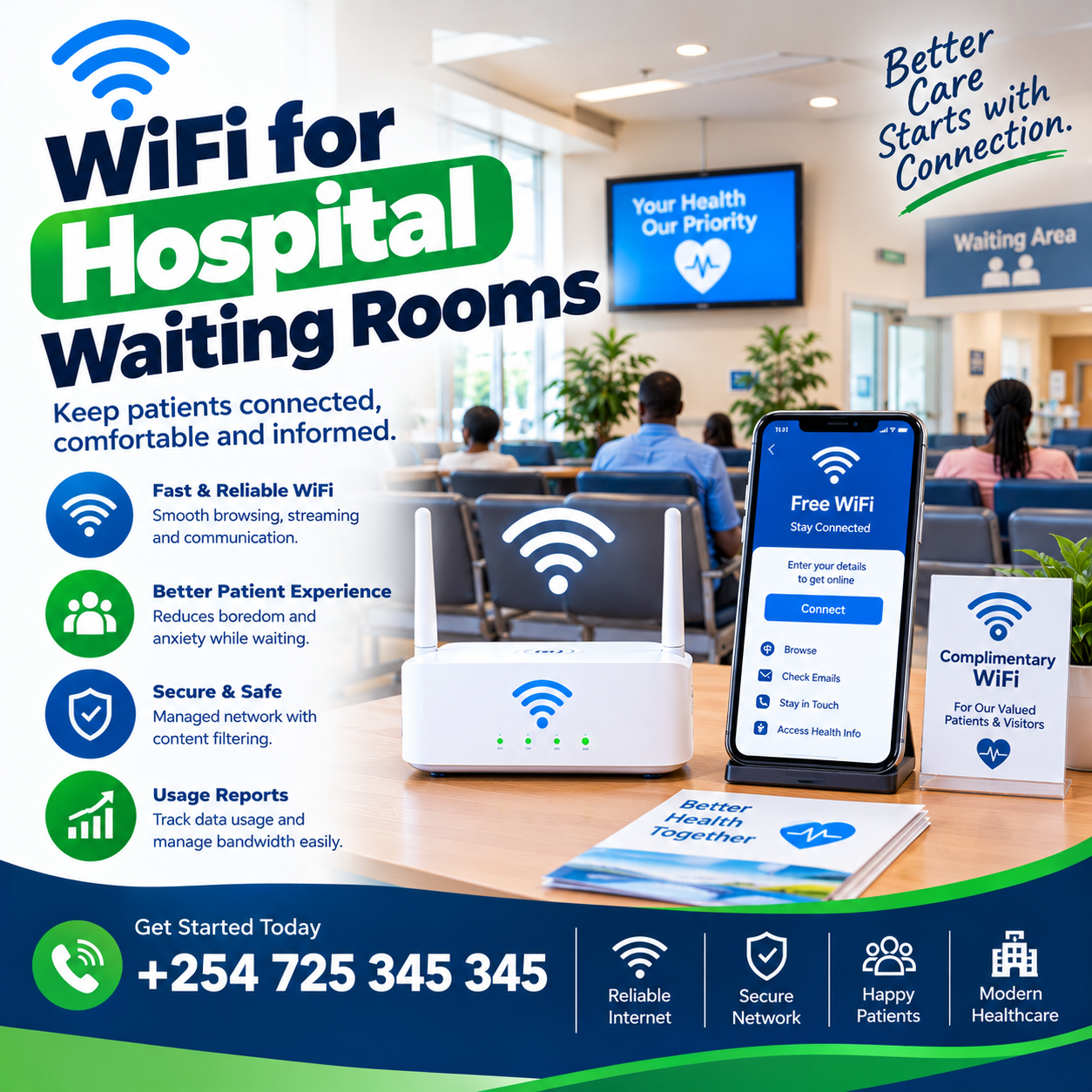
WiFi for hospital waiting rooms is quietly becoming one of the most humane upgrades in healthcare — a service that transforms the most stressful, most repetitive, and longest waits in public life into hours that feel shorter, pass easier, and leave patients and families genuinely grateful.
Anyone who has sat in a waiting room knows the texture of that time: the anxiety before a diagnosis, the boredom of a five-hour queue, the child climbing the chairs, the relative pacing for news from the wards.
The clocks in waiting rooms seem to run slower than everywhere else, and the queue numbers move at their own patient pace.
Yet the crowd sitting in those rows carries the most connected generation of phones in history — devices capable of filling every waiting hour with video calls home, series, study, work, and comfort.
The gap between what those phones could do and what the room allows is exactly where WiFi for hospital waiting rooms changes the experience.
This article walks through the complete picture: what this service involves, why waiting rooms are the most deserving venues in the connectivity trade, how hospitals and patients both gain, and the disciplines that make it work with the care a medical setting deserves.
Because the waiting will always be part of healthcare — and WiFi for hospital waiting rooms is simply the way to make that waiting kinder.
Table of Contents
ToggleWhat WiFi for Hospital Waiting Rooms Actually Is
Strip away the jargon and the concept is refreshingly simple.
WiFi for hospital waiting rooms is a managed connectivity service covering the spaces where patients, families, and companions spend their waiting hours — outpatient queues, results lobbies, admission corridors, and the seating outside wards.
The service delivers what every modern visitor now expects: a connection that appears on their phone the moment they sit down, opens a clear portal, and offers access that fits their visit
The structure behind it mirrors the standard of the best-run venues: a strong connection, access points placed for full coverage of every seating row, and a billing or courtesy layer that serves each visitor appropriately.
What makes the medical setting distinct is the audience’s profile — people under stress, people far from home, and people whose visit was never planned for leisure.
That profile shapes every design choice in WiFi for hospital waiting rooms: the courtesy that matters more than the pricing, the simplicity that matters more than the features, and the reliability that matters more than everything.
The service typically layers three experiences: a short complimentary session for every visitor, extended access for those whose wait runs long, and all-day passes for the relatives who camp at a loved one’s bedside corridor.
The hospital’s side of the system is a dashboard: visitor numbers, session activity, and the usage patterns of the crowd it hosts daily.
That combination — humane service for visitors, clear management for the institution — is the complete shape of WiFi for hospital waiting rooms.
Why Waiting Rooms Are the Most Deserving Venues in the Trade
Every venue type in the connectivity trade serves a crowd — but none serves a crowd with the same needs as a waiting room, and understanding that is the heart of designing WiFi for hospital waiting rooms.
The first distinction is duration: no café visit, no matatu ride, no salon appointment compares to a referral hospital queue that consumes an entre day.
Visitors arrive at seven in the morning for a specialist they may see after lunch — and the hours between belong entirely to the waiting room.
The second distinction is the crowd’s geography: families travel from distant villages to county and national referral hospitals, arriving with phones full of relatives waiting for news and bundles too small to last the day.
For these visitors, connectivity is not entertainment — it is the lifeline home, the video call that reassures a worried grandmother, the message that says “we are still waiting, we are okay.”
The third distinction is the emotional load: waiting rooms concentrate worry, and worry makes every frustration heavier.
A network that stumbles in a mall annoys; a network that fails while a family waits for news feels like one more burden in a heavy day.
The fourth distinction is the regularity: hospitals receive the same flow every single day, seven days a week, without seasons or slowdowns — the most permanent audience any connectivity service will ever find.
Put these four together and the conclusion is unavoidable: the waiting room is the venue where connectivity does the most good per session anywhere in the trade.
That is the moral and commercial foundation of WiFi for hospital waiting rooms — a service whose value is measured in comfort as much as in collections.
The Patient Experience: How Connectivity Transforms the Wait
The most immediate impact of WiFi for hospital waiting rooms is felt in the patient’s own experience of time — and the psychology behind it is well understood.
Occupied time passes faster than empty time; this is the oldest truth in queue psychology, and connectivity is the most powerful occupier ever invented.
A patient absorbed in a video call with their family, a downloaded series, or their children’s school group experiences a wait entirely differently from one staring at the same four walls for the fourth hour.
The queue number still moves at its own pace — but the person waiting for it stops counting.
The second transformation is practical: the modern hospital visit involves digital errands of its own.
Insurance verifications, patient portal logins, referral documents on WhatsApp, lab results sent by email, prescription screenshots shown to the pharmacist — every one of these tasks needs a connection the visitor’s bundle may not survive.
A WiFi for hospital waiting rooms service turns those small digital hurdles from data-budget anxieties into moments of ordinary browsing.
The third transformation is the companions’ experience: the mother with a restless child, the son accompanying an elderly father, the friend holding a place in the queue — all of them are visitors whose comfort the hospital never asked about, until now.
The fourth transformation is reputational, and it compounds: hospitals are compared constantly, and the comparison runs through WhatsApp groups, community forums, and casual conversations where experiences are exchanged.
The facility where “the waiting is easier because you can be on your phone” acquires a distinction no billboard can purchase.
Visitors who felt cared for during the wait carry that feeling into every judgment they make about the institution — which is the quiet, compounding return on WiFi for hospital waiting rooms.
The Family Lifeline: The Emotional Layer of Connectivity
The deepest value of WiFi for hospital waiting rooms sits in a place revenue reports cannot reach: the emotional work that families do through their phones.
Consider the family geography of a serious hospital visit.
A patient admitted to a referral hospital is rarely alone — they carry a companion, and behind that companion stands a household: relatives in the village, siblings in the city, a spouse managing the home front, all waiting for updates.
Under thin connectivity, that household waits in the dark, and every unanswered call breeds its own anxiety a hundred kilometers away.
With proper WiFi for hospital waiting rooms, the companion in the corridor becomes the family’s news channel: the video call showing the patient resting, the photo of the prescription, the voice note reporting what the doctor said.
That simple flow of reassurance is worth more to those families than any amenity the hospital could name — and it costs the network almost nothing to deliver.
The second emotional layer is the long-admission vigil: the relatives who remain for days, sleeping in corridors and seating areas, maintaining a patient’s spirits through their phone.
For them, all-day access is not a convenience but a survival tool — entertainment through the long afternoons, coordination for the family’s logistics, and the constant thread of connection home.
The third layer is the quiet one: the comfort of ordinary life inside an extraordinary day.
A patient’s child watching cartoons in the corner is a calmer child; a companion laughing at a video is a steadier companion; and calm, steady families are easier to care for in every department.
Hospitals that observed their waiting rooms after deploying WiFi for hospital waiting rooms consistently report the same observation: the rooms got calmer.
The tension that used to concentrate at the reception desk — where boredom and worry met every hour — distributed itself into a thousand quiet, connected moments instead.
That calm is the service’s invisible product, and everyone in the building benefits from it.
The Hospital’s Side: What the Institution Gains
While the visitors feel the comfort, the institution behind WiFi for hospital waiting rooms collects gains of its own — operational, reputational, and financial.
The first gain is the complaint reduction: across hospitality and healthcare alike, waiting is the most common grievance visitors raise, and occupied waiting is the most effective remedy known.
Facilities that connected their queues report fewer complaints reaching the desk, and the tone of the ones that remain shifts from frustration to logistics.
The second gain is the visitor-flow intelligence: the platform’s dashboard shows the daily crowd in numbers — peak hours, dwell times, session volumes — the same waiting-room data the hospital has always estimated by eye.
Those numbers inform staffing, seating decisions, and even department scheduling with an honesty that observation never matched.
The third gain is the communication channel: the portal every visitor faces becomes the facility’s direct line to its public — notices, department directories, health education, and clinic schedules delivered at the exact moment of attention.
The fourth gain is the sponsorship economy: the hospital’s crowd is the most precisely targeted audience a local pharmacy, laboratory, insurance provider, or health brand could ever want.
A sponsor funding visitors’ courtesy sessions puts its name on every connection — a placement that reads as care rather than advertising.
The fifth gain is the modest direct revenue: extended sessions and all-day passes, priced gently and collected automatically, cover the service’s costs and often produce a surplus.
And the sixth gain is the deepest one: the hospital’s reputation as an institution that understands its visitors’ whole experience — not just the clinical half.
In a competitive healthcare market, that reputation is the difference institutions fight for, and WiFi for hospital waiting rooms earns it one connected waiting hour at a time.
The Service Models: Courtesy, Sponsorship, and Gentle Pricing
The design question behind every WiFi for hospital waiting rooms deployment is the access model — and the settings that serve patients best are built on generosity first.
The foundation is the courtesy session: every visitor receives free access for a meaningful window — thirty to sixty minutes — no payment, no registration burden, no conditions.
This courtesy is the model’s ethical core: a family rushing to a casualty ward should never meet a paywall before they meet a nurse.
The second layer is the sponsored extension: the courtesy window’s expiry invites the visitor into extended access — free again, because a pharmacy, lab, insurer, or the hospital itself has sponsored the day’s connectivity.
The sponsor’s name on that extension reads as a gift, and the gratitude it earns attaches to the sponsor’s brand with unusual strength.
The third layer is the gently priced option: all-day passes for the long-vigil families, priced at a fraction of what their bundles would charge for the same hours.
This layer serves the visitors whose stays run longest — the ones who need the service most — and its modest collections keep the system sustainable without ever feeling like a toll.
The fourth layer is the staff and student provision: medical trainees, nursing students, and junior staff working within the facility receive their own managed access, separated from the public flow.
The balance across the layers is the craft: the WiFi for hospital waiting rooms deployment that gets it right serves the distressed freely, the long-staying affordably, and the institution transparently — and every visitor experiences generosity at the door.
The Digital Patient Journey: Connectivity as Part of Care
The modern hospital visit has quietly become a digital journey, and WiFi for hospital waiting rooms has become part of its infrastructure.
The journey begins before the queue: the referral letter on WhatsApp, the appointment confirmation by SMS, the insurance pre-authorization running through an app.
It continues through the visit: the patient portal login for records, the digital queue displays, the lab results that arrive by email while the family waits, the e-prescription forwarded to the pharmacy.
And it concludes after discharge: the follow-up booking made online, the report downloaded for the family doctor back home, the telemedicine consult scheduled instead of a second journey.
Every stage of that journey assumes connectivity the visitor may not have — bundles run out, hospital basements block signals, and long stays outlast any data purchase.
A WiFi for hospital waiting rooms service closes that gap: the visitor’s digital journey proceeds on the facility’s connection, smoothly, without their budget deciding how far they get.
The telemedicine layer deserves its own note: follow-up consultations conducted by video from the waiting room save rural families an entire second journey — and they only function when the connection holds.
The insurance layer matters equally: claim verifications, pre-approvals, and member portals all run online, and a stalled verification stalls the care behind it.
Hospitals that wired connectivity into the visitor journey describe the effect as removing friction from their own processes — because the hospital’s digital systems were only as accessible as the visitor’s data bundle allowed.
That alignment between institutional digitization and visitor connectivity is what makes WiFi for hospital waiting rooms part of modern care rather than an amenity beside it.
The Portal: The Hospital’s Most-Read Page
The captive portal is the single screen every visitor faces before their session begins — and in a hospital, WiFi for hospital waiting rooms turns that screen into the facility’s most-read page.
The portal’s first job is orientation: the visitor landing on a page that carries the hospital’s name, a warm welcome, and the courtesy session offered clearly.
That first impression sets the tone for the visit — a facility that connects its visitors effortlessly signals an institution that manages details.
The second job is wayfinding: department locations, consultation hours, laboratory procedures, and pharmacy timings — the questions every visitor asks the reception desk, answered on the screen in their hand.
Every question the portal answers is a queue at the information desk that never forms.
The third job is education: health notices, screening campaigns, maternal health reminders, and seasonal advisories delivered to a captive, relevant audience.
No health communication in the facility reaches its audience with the guarantee the portal does — every connected visitor passes through it.
The fourth job is service: the emergency numbers, the lost-and-found contact, the feedback channel — the small links between the institution and the people it serves.
The fifth job is the sponsor’s: the supporting pharmacy, lab, or insurer presented as the reason the visitor’s session is free.
Hospitals that managed their portals deliberately describe them as their highest-performing communication surface — read by every visitor, on every visit, at the moment of maximum attention.
That page, always current and always on-brand, is one of the most valuable assets a WiFi for hospital waiting rooms deployment creates.
Bandwidth Governance: Fairness in a Crowded Room
A waiting room concentrates devices the way few venues ever will — hundreds of phones in a few hundred square meters — and the engineering discipline that keeps WiFi for hospital waiting rooms performing is governed sharing.
The governing principle is the trade’s standard: every connected visitor receives their floor, and no single device consumes the room.
Per-user speed profiles guarantee each visitor comfortable browsing, calling, and streaming quality — enforced automatically through the morning surge and the afternoon peak.
Speed ceilings cap the extremes: the visitor backing up an entire photo library no longer starves the forty people around them.
Traffic prioritization protects the uses that matter most in a medical setting: video calls home, telemedicine sessions, and the portal itself stay responsive even at full occupancy.
Session management adds the fairness layer: courtesy windows run their course, extensions follow their purchases, and every visitor’s access behaves exactly as the portal promised.
The capacity planning underneath follows the same concurrency math that governs every serious deployment: expected peak occupancy, times realistic per-device needs, plus headroom for the moment every phone connects at once.
Hospitals that planned capacity this way discovered the evening peak is gentler in waiting rooms than in cafés — the crowds thin by late afternoon — but the mid-morning surge, when outpatient queues fill, is the design target.
That surge, engineered for rather than survived, is what separates a waiting room where connectivity simply works from one where it works until it doesn’t.
Governed sharing, sized honestly, is the technical heart of every WiFi for hospital waiting rooms deployment that earns its visitors’ trust.
Security and Privacy: The Non-Negotiable Layer
No venue demands more care with security than a hospital, and any WiFi for hospital waiting rooms deployment must treat the subject as foundational rather than optional.
The first principle is segmentation: visitor traffic lives entirely on its own network layer — isolated from the hospital’s clinical systems, patient records, and administrative machines by architecture, not by password.
That separation is the assurance that a visitor’s device and the hospital’s patient database share nothing but the building.
The second principle is payment hygiene: visitors enter their M-Pesa PIN only on their own phones, inside the payment provider’s own environment, never on any portal form.
A service serving people at their most vulnerable must be beyond reproach at the moment money moves.
The third principle is data minimization: the portal collects only what the session requires — and where consent is sought for follow-up communication, it is stated plainly and honored exactly.
The fourth principle is the honest portal: the page served is genuinely the hospital’s, over secure HTTPS, with no imitation possible — because visitors in distress are precisely the audience fraudsters target with fake networks.
The fifth principle is monitoring with restraint: the network’s health is watched, while visitors’ personal activity is not — a distinction the deployment’s design makes structural.
Hospitals that documented these principles and shared them with their visitors discovered something valuable: security, explained simply, becomes part of the institution’s trustworthiness.
In a building where people entrust their health and their data, the connectivity service must meet the same standard as everything else the facility does — and a properly built WiFi for hospital waiting rooms system does exactly that.
The Ecosystem Around the Hospital: Pharmacies, Vendors, and Partners
A hospital’s waiting room sits at the center of a small economy — the pharmacies, labs, canteens, and vendors that serve the daily crowd — and WiFi for hospital waiting rooms naturally becomes that ecosystem’s shared infrastructure.
The pharmaceutical layer is the most natural partnership: the chemist across the road sponsors visitors’ sessions, and its name appears on every portal as the reason access is free.
The sponsorship works because the audience is perfect — every visitor in a hospital queue is, by definition, a healthcare consumer with immediate needs.
The laboratory and imaging centers follow the same logic: results delivered digitally, consultations scheduled by phone, and follow-ups arranged online all flow better when the facility’s visitors are connected.
The insurance providers join with their own interest: member verification, claim submissions, and pre-approvals served digitally to a crowd that is literally standing in their market.
The canteen and vendor layer participates too: the portal can carry the canteen’s menu, the vendor stalls’ offerings, and the small commerce that keeps the waiting crowd fed.
And the transport layer completes it: the boda riders, taxis, and shuttle services that move families to and from the facility, reachable through the portal’s directory.
Each partnership follows the same pattern: a local business serving the hospital’s crowd funds the connectivity that reaches them, and the gratitude earned is worth more than any advertising the business could buy.
The hospital coordinates, the platform manages, and the ecosystem’s businesses pay for the privilege of serving the best-targeted audience in their market.
That triple win — visitors connected, businesses reached, institution honored — is the signature structure of a mature WiFi for hospital waiting rooms deployment.
The Mistakes That Undermine Waiting-Room Connectivity
The predictable failures repeat across deployments, and naming them is the cheapest protection for any institution planning WiFi for hospital waiting rooms.
The first is the paywall-first mistake: launching with paid access and no courtesy window, so the family rushing to casualty meets a purchase screen before a nurse — a first impression no facility can afford.
The second is the coverage gap: access points placed for the main lobby while the annex, the stairs, and the ward corridors sit dark, and the visitors in those corners discover the service’s absence at the worst moments.
The third is the undersized backbone: bandwidth planned for the morning trickle that folds under the mid-morning surge, and the service’s reputation dying in its first crowded week.
The fourth is the complicated portal: registration forms demanding details visitors will not share in a hospital corridor, and adoption collapsing at the first screen.
The portal that serves waiting rooms asks almost nothing — one tap to the courtesy session, because simplicity is respect.
The fifth is the neglected portal: welcome pages frozen from the launch month, carrying outdated notices and departed sponsors — the digital equivalent of a faded sign in the lobby.
The sixth is the security shortcut: any arrangement that lets visitor traffic touch clinical systems, or payment flows that collect credentials directly — failures that no medical setting can survive.
The seventh is the silent launch: connectivity switched on without telling the crowd, and weeks of underuse misread as indifference.
Each mistake is avoidable with the same discipline: lead with courtesy, cover every seat, size for the surge, simplify the portal, keep it current, secure it structurally, and announce it warmly.
The institutions that kept those habits watch their WiFi for hospital waiting rooms service become the quiet pride of the facility.
Scaling: One Waiting Room Becomes a Network of Care
The connectivity discipline that transforms one waiting room extends naturally across a healthcare network — and WiFi for hospital waiting rooms architecture scales from a single facility to a whole institution.
The template transfers completely: the courtesy structure, the portal design, the governance rules, and the sponsorship model — replicated to the next facility as configuration rather than reinvention.
The buildings differ, the crowds differ, but the discipline is identical: cover every waiting seat, simplify every portal, and serve every visitor generously.
The dashboard extends across the facilities: every site’s visitor numbers, session activity, and portal engagement visible to the administration in one view.
That portfolio view turns visitor experience into a managed standard — measured, compared, and improved across the network rather than left to chance at each site.
The sponsorship portfolio scales with it: the pharmacy that sponsored one waiting room extends across the network’s facilities, and the value of the audience multiplies with every location.
The health communication reach compounds the same way: a screening campaign or vaccination notice published across the network’s portals reaches every connected visitor in every facility simultaneously.
And the reputation scales beyond any single site: the health network known for connected, considerate waiting rooms carries that name into every new community it serves.
That is how the model grows from one room’s kindness into an institution-wide standard — one facility, one portal, and one considered deployment at a time, through the WiFi for hospital waiting rooms architecture that made it repeatable.
The Payoff, Counted Honestly
Ask the institutions and operators a year after deploying WiFi for hospital waiting rooms what changed, and the answers gather into four themes.
Calm: the waiting rooms that once concentrated boredom and tension now hum with quiet, connected activity — and the complaints that used to open at the reception desk simply diminished.
Reputation: the facility where “you can even be on your phone while you wait” becoming the institution people recommend — a distinction earned through comfort, not advertising.
Reach: the portal’s daily audience — every connected visitor, every day — becoming the most reliable communication channel the facility has ever operated.
And value: the sponsorships covering the costs, the modest collections adding a surplus, and the entire service running as a self-sustaining act of care.
None of it required new buildings, new staff, or clinical budgets.
It required seeing the waiting room as the most deserving venue in the connectivity trade — and serving it with the design it deserved.
That is the complete case for WiFi for hospital waiting rooms: the crowds were always going to sit and wait, the phones were always going to be in their hands, and the only thing the room was ever missing was the connection that turned their hardest hours into their easiest.
Frequently Asked Questions
Should hospital WiFi be free for patients?
A courtesy window — free access for every visitor — is the ethical and practical foundation, with extended sessions either sponsored or gently priced for the longest stays.
The deployments that earn the most goodwill through WiFi for hospital waiting rooms all lead with generosity at the door.
How much bandwidth does a waiting room need?
The concurrency math gives the honest answer: peak occupancy times realistic per-device needs, plus headroom — and waiting-room surges concentrate mid-morning when the queues fill.
Institutions that sized their WiFi for hospital waiting rooms backbones this way never met the congestion that embarrasses unplanned networks.
Can visitor WiFi be separated from hospital systems?
Absolutely — and it must be: visitor traffic lives on an isolated network layer that shares nothing with clinical records or administrative systems.
That architectural separation is a non-negotiable standard in every professional WiFi for hospital waiting rooms deployment.
What should the portal show visitors?
A warm welcome, the courtesy offer, department locations, consultation hours, emergency contacts, and current health notices — everything a visitor would otherwise queue at the desk to ask.
The institutions that kept their WiFi for hospital waiting rooms portals current turned them into their most-read page.
How do sponsors fit into the model?
Naturally: pharmacies, labs, and insurers fund visitors’ sessions in exchange for their name on every portal — reaching the most precisely targeted healthcare audience available.
That sponsorship structure is what keeps WiFi for hospital waiting rooms free for visitors and sustainable for the facility.
What about patients without smartphones?
They remain fully served by the hospital’s ordinary processes — and the courtesy model ensures the service never becomes a barrier for anyone.
The connectivity layer of WiFi for hospital waiting rooms adds comfort for those who have phones without ever subtracting care from those who don’t.
How long does deployment take?
A straightforward rollout takes days: the connection verified, access points placed across every waiting area, the portal configured, and the service announced.
The teams behind established WiFi for hospital waiting rooms deployments treat launch week as routine.
Will video calls and streaming overwhelm the network?
Not when governed: per-user floors and ceilings, priority for calls and telemedicine, and capacity sized to the real peak keep the room smooth under full occupancy.
That governed sharing is the core machinery of every WiFi for hospital waiting rooms deployment that performs.
Is collecting any payment appropriate in a hospital?
Modestly priced all-day passes for long-vigil families are appropriate when they sit on top of free courtesy access — a choice, never a toll.
The facilities that structured WiFi for hospital waiting rooms that way served their longest-staying visitors without ever charging for the first hour of care.
Can the system support telemedicine follow-ups?
Yes — video consultations run comfortably on governed visitor access, saving rural families entire return journeys.
That capability is among the most meaningful outcomes reported from WiFi for hospital waiting rooms deployments in referral facilities.
How do we announce the service to visitors?
Warmly and simply: signage in the waiting areas, the portal’s own welcome doing the introduction, and staff mentioning it at the desk.
The facilities that launched their WiFi for hospital waiting rooms with that courtesy saw adoption fill the rooms within the first week.
What happens when the network goes down?
Well-built systems restore cleanly and keep records intact, and the facility’s ordinary processes continue unaffected — because visitor connectivity is a layer beside care, never in front of it.
Choosing a platform with proven reliability is the standard behind every trusted WiFi for hospital waiting rooms service.
How does this compare to what large private hospitals offer?
The same fundamentals scale: courtesy access, governed sharing, branded portals, and sponsorship — all available at any facility’s size.
The difference between a county hospital and a corporate one, in this regard, is no longer budget but the decision to deploy WiFi for hospital waiting rooms properly.
What is the smartest first step this week?
Sit in your own waiting room at its busiest hour, count the phones and the boredom, and sketch what a courtesy session, a current portal, and full-row coverage would change.
That one hour of honest observation is how every thoughtful deployment of WiFi for hospital waiting rooms began — and the institutions that ran it discovered the same truth every time: the waiting was never going to disappear from healthcare, but with WiFi for hospital waiting rooms, it finally stopped feeling like waiting — one connected hour, one reassured family, and one calmer room at a time.