
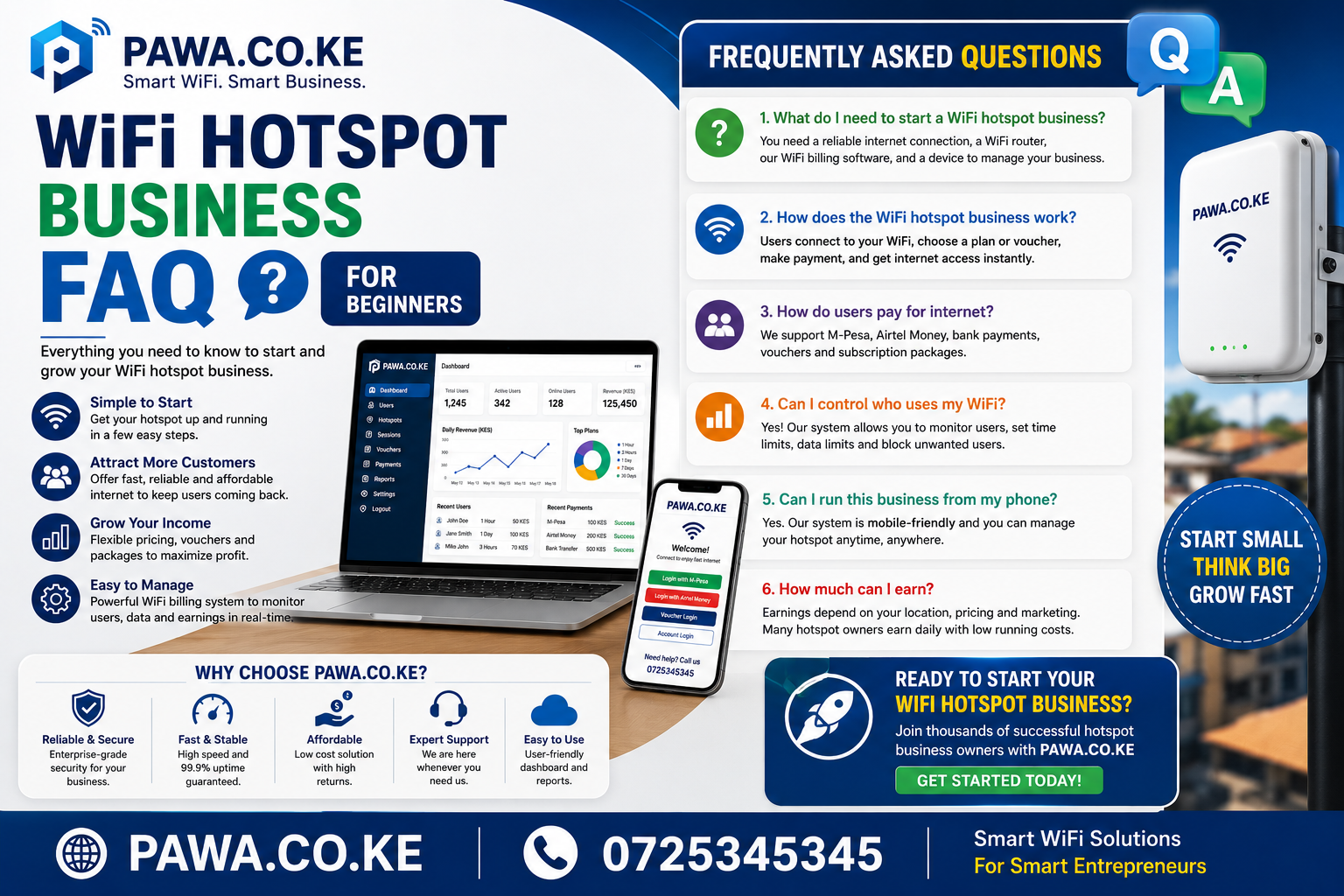
Starting a paid internet service can be an attractive opportunity for entrepreneurs who want to provide affordable connectivity in residential areas, shops, estates, market centres, offices, and other locations. This WiFi hotspot business FAQ for beginners answers common questions people have before setting up a hotspot business.
A successful hotspot business requires more than an internet connection. You need suitable networking equipment, a reliable internet source, customer management tools, a payment system, appropriate packages, and a location with sufficient demand.
Using a structured approach can help a new operator understand the business before investing heavily.
WiFi hotspot business FAQ for beginners – What Is a WiFi Hotspot Business?
A WiFi hotspot business FAQ for beginners starts with understanding what a hotspot business actually does.
A WiFi hotspot business provides internet access to customers within a defined coverage area. Customers can pay for access based on time, data, speed, or subscription packages.
The operator provides the infrastructure while customers use their phones, laptops, tablets, or other compatible devices to connect.
Hotspots can be established in locations such as:
- Residential estates
- Shopping centres
- Restaurants
- Hotels
- Hostels
- Offices
- Market centres
- Boda boda stages
- Public gathering areas
- Entertainment venues
The business model can be adapted according to the needs of the target customers.
WiFi hotspot business FAQ for beginners – How Does a Paid WiFi Hotspot Work?
A WiFi hotspot business FAQ for beginners should explain the basic customer journey.
A typical setup works like this:
Customer connects → Captive portal appears → Customer selects package → Payment is made → Account is activated → Internet access is granted.
A hotspot management platform can automate much of this process.
The operator can create different packages and configure the system to control access according to the customer’s purchase.
This reduces the need for manually giving passwords to every customer.
WiFi hotspot business FAQ for beginners – What Do I Need to Start?
One of the most important questions in a WiFi hotspot business FAQ for beginners concerns the equipment and services required.
A basic hotspot may require:
- Internet connection
- Router
- WiFi access points
- Network cables
- Power supply
- Customer authentication system
- Billing software
- Payment integration
- Suitable installation location
The exact equipment depends on the number of customers and the size of the area you want to cover.
A small hotspot can start with simpler equipment, while a larger network requires more powerful infrastructure.
WiFi hotspot business FAQ for beginners – How Much Does It Cost to Start?
The startup cost depends on the size and complexity of the network.
Important expenses may include:
- Internet installation
- Router
- Access points
- Cabling
- Mounting equipment
- Power backup
- Billing software
- Installation labour
- Marketing
- Maintenance
Instead of purchasing the most expensive equipment immediately, beginners should estimate expected demand and build infrastructure that can grow as the customer base increases.
For connectivity and networking requirements, SpaceKits is another Kenyan technology resource that can be explored.
WiFi hotspot business FAQ for beginners – Where Should I Set Up a Hotspot?
Location is one of the most important factors in determining whether a hotspot can attract customers.
Look for areas where people regularly need affordable internet access.
Potential locations include busy residential estates, transport stages, market centres, student accommodation, restaurants, and commercial areas.
Before installing equipment, assess:
- Number of potential customers
- Existing competitors
- Internet availability
- Power reliability
- Physical security
- Coverage requirements
- Customer purchasing behaviour
A strong location can be more valuable than expensive equipment installed where there is little demand.
WiFi hotspot business FAQ for beginners – Can I Sell WiFi by Time?
Yes. Operators can structure packages around different access periods.
For example, a business may create:
- One-hour packages
- Daily packages
- Weekly packages
- Monthly packages
Time-based packages are useful when customers want predictable access without committing to large subscriptions.
The billing system should automatically determine when a package starts and when it expires.
This reduces manual administration and makes customer access easier to manage.
WiFi hotspot business FAQ for beginners – Can I Sell WiFi by Data?
Data-based packages are another possible pricing model.
Customers can purchase a defined amount of data and use it until the allocation is exhausted or the package expires.
For example, an operator may offer different packages based on customer usage patterns.
A billing platform can help monitor data consumption and apply the relevant access limits.
The best pricing model depends on customer demand and the type of location being served.
WiFi hotspot business FAQ for beginners – Do I Need WiFi Billing Software?
A professional billing system becomes increasingly useful as the number of customers grows.
Instead of manually recording payments and activating accounts, software can automate customer authentication, package management, payment processing, and access control.
Pawa provides a platform to explore when considering WiFi management and billing requirements.
Automation can save time and reduce errors caused by manual activation.
WiFi hotspot business FAQ for beginners – How Do Customers Pay?
A hotspot can support different payment methods depending on the target market and available technology.
Mobile payments are particularly useful where customers already use their phones for everyday transactions.
The payment workflow should be simple:
- Select a package.
- Enter the required customer details.
- Make payment.
- Receive confirmation.
- Get internet access.
A well-integrated payment system can reduce delays between payment and activation.
WiFi hotspot business FAQ for beginners – How Do I Control Customer Access?
Access control determines who can use the network and under what conditions.
A hotspot management system can control:
- User accounts
- Passwords
- Vouchers
- Session duration
- Data limits
- Speed limits
- Number of devices
- Package expiry
This makes it easier to manage a network with many users.
It can also prevent customers from continuing to use paid services after their package expires.
WiFi hotspot business FAQ for beginners – What Is a Captive Portal?
A captive portal is a webpage that customers encounter before receiving internet access.
Instead of simply connecting to WiFi and immediately browsing, users may be directed to a login or payment page.
The portal can display:
- Available packages
- Prices
- Login fields
- Payment instructions
- Terms of service
- Customer support information
This creates a more organized customer experience and can help automate the purchasing process.
WiFi hotspot business FAQ for beginners – How Can I Make My Hotspot Profitable?
Profitability depends on several factors.
You need to balance:
Revenue: Money collected from customers.
Costs: Internet, equipment, electricity, maintenance, installation, and software.
Customer volume: Number of paying users.
Pricing: Amount charged for each package.
Retention: Number of customers who continue purchasing.
A profitable hotspot does not necessarily need very high prices. Affordable packages combined with strong customer demand can create sustainable recurring revenue.
WiFi hotspot business FAQ for beginners – How Should I Price My Packages?
Pricing should reflect the local market.
Research what competing providers charge and determine what customers are willing to pay.
Consider offering several package levels instead of one universal package.
For example:
Basic: Short-duration access for occasional users.
Standard: Longer access for regular customers.
Premium: Higher-speed or longer-duration access.
Testing different packages can help identify which options customers prefer.
WiFi hotspot business FAQ for beginners – How Important Is Internet Speed?
Internet speed affects customer experience significantly.
However, speed alone does not determine network quality.
The operator should also consider:
- Number of connected users
- Bandwidth allocation
- Router capacity
- Access point performance
- Network interference
- Internet service reliability
A network with too many customers sharing insufficient bandwidth may become slow during busy periods.
Proper bandwidth management is therefore important.
WiFi hotspot business FAQ for beginners – How Many Customers Can One Router Support?
There is no universal number because capacity depends on the router, access point, customer devices, applications, bandwidth, and network configuration.
A small residential router may not be appropriate for a busy commercial hotspot.
As the customer base grows, operators may need multiple access points and better network architecture.
The goal should be to distribute users effectively rather than expecting one device to handle an entire large area.
WiFi hotspot business FAQ for beginners – How Can I Extend WiFi Coverage?
Coverage can be improved using strategically positioned access points.
Factors affecting coverage include:
- Building materials
- Walls
- Distance
- Interference
- Antenna positioning
- Access point placement
- Number of users
Outdoor hotspots may require equipment designed specifically for outdoor environments.
Before installation, conduct a site assessment to determine where access points should be placed.
WiFi hotspot business FAQ for beginners – What Happens When Customers Share Passwords?
Password sharing can reduce revenue if customers give their credentials to people who have not paid.
A hotspot billing system can reduce this problem by using individual accounts, vouchers, device restrictions, session controls, or other authentication methods.
The appropriate method depends on the network architecture and business model.
Access control should be designed around the way customers actually use the service.
WiFi hotspot business FAQ for beginners – How Do I Monitor My Business?
Monitoring allows an operator to understand what is happening across the network.
Useful information may include:
- Number of active users
- Payments
- Package sales
- Data consumption
- Session duration
- Expired accounts
- Failed logins
- Network availability
These records can help identify the most popular packages and the busiest periods.
Data can then support better business decisions.
WiFi hotspot business FAQ for beginners – How Can I Reduce Downtime?
Reliable service is important for customer retention.
Operators can reduce downtime by maintaining network equipment, monitoring internet connectivity, having backup power where appropriate, and responding quickly to technical problems.
It is also useful to document common troubleshooting procedures.
If customers experience repeated interruptions, investigate whether the problem comes from the internet provider, router, access points, power supply, or billing platform.
WiFi hotspot business FAQ for beginners – Can WiFi Be Monetized in Market Centres?
Yes. Market centres can provide opportunities for paid connectivity where there is sufficient customer demand.
Traders, customers, riders, visitors, and nearby businesses may need affordable internet.
A hotspot can provide short-term packages suitable for people who do not need a full monthly internet subscription.
For businesses operating around transport and delivery services, Dexa and Dereva provide related digital resources.
WiFi hotspot business FAQ for beginners – Can a Boda Boda Stage Use Paid WiFi?
Busy transport stages can potentially support hotspot services when there is adequate demand and suitable infrastructure.
Customers may purchase short-duration packages while waiting for transport or carrying out business activities.
The operator should consider coverage, security, power, equipment placement, and expected traffic before installation.
Other digital business solutions can be explored through Zama and Wito.
WiFi hotspot business FAQ for beginners – Can Hotels and Restaurants Sell WiFi?
Hotels, restaurants, cafés, and similar businesses can use managed WiFi to provide controlled customer internet access.
Businesses can choose whether connectivity is:
- Free
- Included with a purchase
- Available through vouchers
- Sold as a separate service
Managed access can also help businesses create separate networks for customers and staff.
For accommodation and rental-related digital operations, RentalDesk provides another technology resource.
WiFi hotspot business FAQ for beginners – What Are the Common Beginner Mistakes?
New operators can make avoidable mistakes when starting a hotspot.
Common examples include:
- Choosing a location without checking demand
- Buying unsuitable equipment
- Underestimating bandwidth requirements
- Ignoring power backup
- Using manual payment processes
- Failing to monitor usage
- Setting prices without researching the market
- Providing poor customer support
Planning before installation can reduce these risks.
WiFi hotspot business FAQ for beginners – How Can I Promote My Hotspot?
Promotion can be simple at the beginning.
Consider:
- Posters
- Signage
- Social media
- WhatsApp communication
- Referral offers
- Customer discounts
- Partnerships with nearby businesses
Make sure customers can easily understand the available packages and how to connect.
A visible sign showing the network name and purchasing process can increase awareness.
WiFi hotspot business FAQ for beginners – What Records Should I Keep?
Business records help you understand whether the hotspot is performing well.
Keep track of:
- Daily sales
- Monthly revenue
- Internet expenses
- Equipment costs
- Maintenance
- Number of customers
- Package sales
- Customer complaints
Comparing revenue against operating costs provides a clearer picture of profitability.
Other digital business resources include Fama for agricultural technology and ZamaCore for broader technology solutions.
WiFi hotspot business FAQ for beginners – Is a Hotspot Suitable for a Small Business?
A hotspot can be started at a relatively small scale and expanded as demand grows.
A beginner can start by serving a limited area and learning how customers behave.
As revenue increases, the operator can reinvest in additional access points, stronger networking equipment, better power backup, and improved management tools.
This gradual approach can reduce the financial risk associated with launching a large network immediately.
WiFi hotspot business FAQ for beginners – How Can Technology Help a Growing Hotspot?
Technology can automate many repetitive activities.
Instead of manually activating users, recording payments, monitoring sessions, and calculating expiry dates, software can handle many of these functions automatically.
This allows the operator to concentrate on network quality, customer acquisition, and business expansion.
Businesses looking for additional technology and digital services can also explore KayaPro360, Zivo, ZES, and Kenya Website Experts.
WiFi hotspot business FAQ for beginners – Scaling Your Hotspot as Demand Grows
As more customers begin using your service, the network may need to grow with them. A beginner should monitor the number of active users and identify busy periods before adding more equipment. This helps prevent unnecessary spending while ensuring that customers continue receiving reliable connectivity.
Expansion may involve installing additional access points, improving network coverage, increasing available bandwidth, or upgrading the router. The billing platform should also be capable of handling more customers and transactions without creating additional manual work.
Customer feedback can provide valuable information during expansion. Ask users whether the connection is fast enough, whether packages are affordable, and whether they experience difficulty when making payments or logging in.
Operators should also review their most popular packages regularly. If customers consistently choose short-duration plans, the business can optimize those packages while introducing longer options for regular users.
Security should remain a priority as the network grows. Separate customer access from private administrative systems, use appropriate authentication, and regularly review connected devices.
A scalable approach allows a hotspot operator to expand gradually while maintaining service quality and controlling operating costs. With proper planning, monitoring, and reliable management technology, a small connectivity project can develop into a more organized digital service business.
WiFi hotspot business FAQ for beginners – What Should Beginners Do First?
A new operator should avoid rushing into equipment purchases.
Start by answering these questions:
- Who are my target customers?
- Where will I provide the service?
- How many users could potentially connect?
- What internet connection is available?
- What packages will I sell?
- What will customers pay?
- What equipment is required?
- How will payments be processed?
- How will access be controlled?
- How will I monitor the business?
Once these questions are answered, you can create a practical implementation plan.
WiFi hotspot business FAQ for beginners – Final Conclusion
Starting a WiFi hotspot business requires planning, suitable equipment, reliable connectivity, effective payment processing, and customer management.
Beginners should focus on identifying a strong location, understanding customer demand, selecting suitable packages, and using technology that can automate access and billing.
A well-managed hotspot can serve customers in estates, market centres, restaurants, hotels, offices, hostels, and other busy locations.
The most important objective is to create a simple customer journey where users can connect, select a package, pay conveniently, and receive access without unnecessary delays.
For businesses interested in managed WiFi, billing, hotspot monetization, and customer access control, Pawa provides a useful starting point.
WiFi hotspot business FAQ for beginners – Start Building Your Hotspot Business
Research your location, understand your target customers, calculate your expected costs, and select technology that can grow with your business.
Additional Kenyan digital resources include Prim, Vega, Dexa, Dereva, Zama, SpaceKits, ZamaCore, KayaPro360, Wito, Fama, RentalDesk, Pawa, Zivo, ZES, and Kenya Website Experts.