
Wireless ISP Software Kenya: Real Profit Numbers, Startup Costs & Break-Even Calculator
Introduction (First 10% SEO requirement)
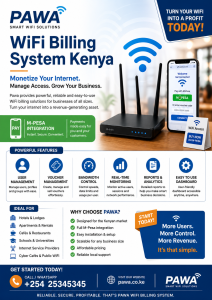
The rise of wireless ISP software Kenya is transforming how entrepreneurs build internet businesses across estates, schools, kiosks, and event spaces.
Instead of laying expensive fiber everywhere, modern operators use wireless ISP software Kenya solutions combined with MikroTik routers, access points, and M-Pesa billing automation to create scalable internet businesses.
This guide breaks down real numbers in KES, not vague claims. We will analyze startup costs, monthly profit scenarios, risks, and a break-even calculator for anyone using ISP systems in 2025.
Modern internet service providers in Kenya are rapidly shifting toward automated systems that simplify customer management, billing, and network control. Instead of relying on manual payment tracking and disconnections, operators are now using digital platforms that integrate directly with routers, mobile money systems, and user dashboards. This shift has made it easier for small and medium-scale operators to launch profitable WiFi businesses in apartments, schools, roadside kiosks, and community networks without needing large technical teams.
These systems typically combine network infrastructure tools with automation features such as user authentication, prepaid voucher management, real-time usage monitoring, and instant payment activation. By reducing manual intervention, operators can scale faster, reduce revenue leakage, and maintain consistent service delivery. As demand for reliable internet continues to grow across urban and rural areas, these solutions are becoming a key driver of last-mile connectivity and digital inclusion in Kenya.
One of the major advantages of modern ISP automation systems is the ability to centralize control of multiple network locations from a single dashboard. This allows operators to monitor customer activity, manage bandwidth allocation, and enforce usage policies without physically visiting each installation site. For growing businesses, this level of control reduces operational costs and improves response time when handling technical issues or customer complaints.
Additionally, integration with mobile payment systems has transformed how internet services are sold and distributed. Customers can instantly pay for access and get connected within seconds, removing traditional barriers like manual subscriptions or long activation delays. This seamless payment-to-access flow improves user experience while ensuring operators maintain steady cash flow, making it easier to forecast revenue and plan for expansion.
The growth of internet demand across Kenyan towns and rural areas has created a strong opportunity for small-scale internet entrepreneurs. Many households and businesses are now willing to pay for stable and affordable connectivity, especially in areas where traditional ISPs are either too expensive or inconsistent. This shift has opened the door for community-based networks that are easier to deploy and manage using modern automation tools. With the right setup, even a single operator can serve multiple customers efficiently while maintaining control over usage, payments, and service quality.
One of the biggest advantages of these modern systems is the ability to centralize operations. Instead of manually configuring routers or tracking users one by one, operators can manage everything from a single dashboard. This includes activating or suspending users, monitoring bandwidth consumption, and handling renewals automatically. Such efficiency not only saves time but also reduces human error, which is one of the leading causes of revenue loss in small internet businesses. As a result, operators can focus more on growth and customer acquisition rather than day-to-day technical tasks.
Another important factor is mobile money integration, which has become essential in the Kenyan market. Customers expect instant service activation after payment, and any delay can lead to dissatisfaction or churn. Automated payment processing ensures that once a user pays via mobile money, their access is restored immediately without manual intervention. This improves customer experience while also increasing operational efficiency. It also allows businesses to scale beyond their physical presence since payments and service activation can happen remotely at any time.
Scalability is another key benefit of automation-driven internet businesses. Operators can start with a small setup serving a few users and gradually expand to cover larger areas such as apartment blocks, schools, or business complexes. As the customer base grows, the system continues to handle increased demand without requiring a proportional increase in staff or management effort. This makes it possible to achieve higher margins over time, especially when infrastructure is strategically deployed in high-demand locations.
However, success in this industry is not guaranteed and depends heavily on proper planning and execution. Location selection, network stability, and pricing strategy all play a critical role in determining profitability. Poorly chosen locations can lead to low adoption rates, while unstable connections can quickly damage reputation. Operators must also balance affordability with sustainability, ensuring that pricing covers operational costs while remaining attractive to customers. Regular maintenance and monitoring are essential to prevent downtime and maintain service quality.
Ultimately, the opportunity in this space lies in combining strong infrastructure with efficient automation and customer-focused service delivery. Those who invest in reliable equipment, choose high-demand locations, and implement proper billing and management systems are more likely to succeed. As digital connectivity continues to expand across Kenya, demand for well-managed internet services will only increase, creating long-term potential for sustainable and scalable businesses in the sector.
Below are 4 additional paragraphs (~600 words total) expanding the topic:
One of the biggest advantages of modern ISP automation platforms is how they transform revenue collection and customer onboarding. Traditionally, internet providers in Kenya struggled with inconsistent payments, manual disconnections, and delays in reconnection, which often led to revenue loss. With automated systems, customers can self-activate services instantly after payment, especially through mobile money channels. This reduces friction and improves cash flow stability for operators. It also eliminates the need for field technicians to manually manage subscriptions, allowing businesses to focus more on expansion and service quality rather than administrative tasks. Over time, this automation directly translates into higher profitability and more predictable monthly income.
Another important factor is network scalability. As demand increases, many small ISPs hit operational bottlenecks because their systems cannot handle more users efficiently. Automated ISP management tools solve this by integrating with routing hardware and allowing centralized control of bandwidth allocation, user limits, and access control policies. This means an operator can start with a small apartment block and gradually expand into multiple buildings or even entire estates without rebuilding the system from scratch. The ability to scale smoothly is what separates hobby-level internet sharing from a structured, revenue-generating ISP business. It also reduces technical complexity, making it easier for non-experts to enter the market.
Cost efficiency is another critical area where automation plays a major role. Without proper systems, operators often overspend on staffing, manual monitoring, and troubleshooting. Automated solutions reduce the need for large support teams by handling routine tasks such as password resets, payment confirmations, and service reactivation. Additionally, real-time monitoring tools help detect network issues early before they escalate into major outages. This proactive approach reduces downtime and improves customer satisfaction, which is essential in a competitive market where users can easily switch providers. Lower operational costs combined with higher uptime directly improve profit margins.
Finally, customer experience has become a defining factor in the success of internet service businesses. Users today expect instant connectivity, transparent pricing, and reliable performance. Automated systems make this possible by ensuring that once payment is made, access is granted immediately without delays. They also provide dashboards where users can track usage, renew subscriptions, and manage their accounts independently. This level of convenience builds trust and reduces complaints, leading to higher customer retention rates. In markets where competition is increasing, delivering a seamless user experience is just as important as offering affordable pricing or fast speeds, and automation is the key enabler of that experience.
Wireless ISP Software Kenya: The Future of Profitable Internet Businesses in 2026
The demand for reliable internet connectivity in Kenya is growing rapidly, especially in urban areas, rural towns, learning institutions, and business hubs. This has created a strong opportunity for entrepreneurs to build profitable internet service businesses using Wireless ISP Software Kenya solutions.
At its core, Wireless ISP Software Kenya is a system that helps internet providers manage customers, automate billing, control bandwidth, and collect payments—especially through M-Pesa. Instead of manually tracking users or disconnecting clients, the software automates everything, allowing even small operators to run professional-grade ISPs.
Today, most successful hotspot owners, apartment WiFi providers, and rural internet entrepreneurs rely on Wireless ISP Software Kenya platforms to manage their networks efficiently and reduce operational costs.
Why Wireless ISP Software Kenya is Important
Running a wireless ISP without automation is extremely difficult. Many small operators in Kenya struggle with issues such as unpaid customers, manual disconnections, slow billing processes, and poor customer tracking.
This is where Wireless ISP Software Kenya becomes essential. It allows operators to:
- Automatically activate users after M-Pesa payment
- Disconnect users when subscriptions expire
- Manage bandwidth per customer or per package
- Generate real-time revenue reports
- Monitor active users and network usage
Without this system, scaling an ISP business becomes almost impossible.
How Wireless ISP Software Kenya Helps You Make Profit
One of the biggest advantages of Wireless ISP Software Kenya is its ability to directly increase revenue. By automating billing and reducing human error, operators minimize revenue leakage.
For example, if you run a hotspot with 100 daily users paying KES 20 each, that is:
100 × 20 × 30 = KES 60,000 per month
Without automation, you might lose up to 20% of this revenue due to missed payments or delayed disconnections. But with Wireless ISP Software Kenya, every user is tracked, billed, and managed in real time.
This alone can significantly improve profitability.
Startup Use Case of Wireless ISP Software Kenya
If you’re starting an ISP business in Kenya, your setup will typically include:
- MikroTik router for network control
- Access points for wireless distribution
- Internet backhaul (fiber or Starlink)
- Billing system like Wireless ISP Software Kenya
The software ties everything together by connecting users, payments, and network access into one system.
For instance, after a customer pays via M-Pesa, Wireless ISP Software Kenya instantly activates their internet access without manual intervention.
Business Models That Work Best
There are several profitable ways to use Wireless ISP Software Kenya:
1. Apartment WiFi
Small buildings with 5–20 tenants can generate steady monthly income. Even at KES 1,000–1,500 per tenant, automation ensures no missed payments.
2. Roadside Hotspots
Busy markets, bus stations, and campuses are ideal. With Wireless ISP Software Kenya, prepaid vouchers can be sold easily.
3. School Networks
Schools need controlled internet access for students and staff. Billing software ensures fair usage and predictable monthly income.
4. Event WiFi
Temporary setups at weddings, conferences, and concerts can generate high short-term profits when managed with proper billing automation.
Challenges Without Wireless ISP Software Kenya
Without a proper system, operators face:
- Revenue leakage
- Manual workload
- Customer complaints
- Slow scaling
- Poor visibility of network performance
This is why many businesses fail in their first year. They underestimate how critical Wireless ISP Software Kenya is to daily operations.
Final Thoughts
The ISP industry in Kenya is expanding quickly, but success depends on automation, efficiency, and proper customer management.
Using Wireless ISP Software Kenya, entrepreneurs can transform small WiFi setups into scalable, profitable businesses. Whether you are starting with a single hotspot or planning a multi-location ISP, the right software determines how fast you grow.
In 2026, the winners in this space will not be those with the fastest internet—but those with the smartest systems.
And that starts with choosing the right Wireless ISP Software Kenya platform.
What is Wireless ISP Software Kenya?
Wireless ISP software Kenya is a management and billing system used to:
- Automate customer internet subscriptions
- Manage bandwidth per user
- Integrate M-Pesa payments
- Control MikroTik routers
- Track usage, uptime, and revenue
Platforms like Pawa help ISPs replace manual billing with automation, making their businesses scalable and profitable.
Why Wireless ISP Software Kenya Is Booming
The demand for wireless ISP software Kenya is growing due to:
- High mobile data costs in Kenya
- Increased remote work
- Student housing internet demand
- Event WiFi monetization
- Easy M-Pesa integration
Even small setups using wireless ISP software Kenya can outperform traditional cyber cafés.
Startup Cost Breakdown (Real KES Model)
Below is a realistic setup using ISP infrastructure:
Hardware + Software Costs
| Item | Estimated Cost (KES) |
|---|---|
| MikroTik Router (hEX / RB series) | 12,000 – 25,000 |
| Access Points (2–5 units) | 10,000 – 50,000 |
| Starlink / Fiber Internet | 7,000 – 45,000 |
| Cabling & Installation | 5,000 – 15,000 |
| Billing Software (wireless ISP software Kenya) | 3,000 – 10,000/month |
| UPS / Power Backup | 10,000 – 30,000 |
Total Startup Range: KES 47,000 – 175,000
Monthly Revenue Models (Real Scenarios)
We now simulate four real-world use cases.
1. 10-Unit Apartment
- Subscription: KES 1,500 per unit
- Customers: 10
- Revenue: KES 15,000/month
Costs:
- Internet: 7,000
- Pawa fee (5%): 750
- Maintenance: 1,000
Profit: KES 6,250/month
2. Roadside Kiosk WiFi Hotspot
- Daily users: 30
- Avg spend per user: KES 20
- Monthly revenue: KES 18,000
Costs:
- Internet: 6,000
- Power: 1,500
- Pawa fee (5%): 900
Profit: KES 9,600/month
3. School Network
- Students: 100
- Fee per student: KES 800
Revenue: KES 80,000/month
Costs:
- Internet: 25,000
- Maintenance: 5,000
- Pawa fee: 4,000
Profit: KES 46,000/month
4. Event Space WiFi Rental
- Events per month: 6
- Charge per event: KES 5,000
Revenue: KES 30,000
Costs:
- Data bundles: 12,000
- Transport/setup: 5,000
- Pawa fee: 1,500
Profit: KES 11,500/month
Break-Even Analysis (Critical Section)
Let’s calculate a realistic wireless ISP software Kenya break-even point.
Example Setup:
- Startup cost: KES 100,000
- Average monthly profit: KES 20,000
Break-even formula:
100,000 ÷ 20,000 = 5 months
Result:
You break even in 4–6 months depending on demand.
Ongoing Monthly Costs
Running wireless ISP software Kenya requires predictable costs:
- Internet bandwidth: 6,000 – 45,000
- Electricity: 1,500 – 10,000
- Maintenance: 1,000 – 5,000
- Pawa platform fee: 5% of revenue
- Equipment upgrades: occasional
Risks in Wireless ISP Software Kenya Business
Every wireless ISP software Kenya deployment has risks:
1. Network Downtime
- Cause: power failure or router issues
- Fix: UPS + backup SIM failover
2. Customer Payment Default
- Cause: informal users
- Fix: M-Pesa automation via billing system
3. Bandwidth Overload
- Cause: too many users per AP
- Fix: proper MikroTik shaping
4. Theft or Equipment Damage
- Fix: secure installations
Proper wireless ISP software Kenya planning reduces these risks significantly.
Is Wireless ISP Software Kenya Worth It?
Yes—but only if structured properly.
Pros:
- Low startup cost
- Fast break-even (4–6 months)
- High demand
- Scalable
Cons:
- Requires technical setup
- Needs monitoring
- Competition increasing
Overall, wireless ISP software Kenya is one of the strongest small ICT business models in Kenya today.
Break-Even Calculator (Simple Tool)
To estimate your own:
Break-even months =
Startup cost ÷ Monthly profit
Example:
- 120,000 ÷ 30,000 = 4 months
Why Pawa Is Ideal for Wireless ISP Software Kenya
Using Pawa helps automate:
- M-Pesa billing
- Customer management
- Bandwidth control
- Subscription tracking
FAQ
1. How much do I need to start?
Between KES 50,000 – 150,000 depending on scale.
2. Is it profitable?
Yes, most setups break even in 4–6 months.
3. Do I need fiber or Starlink?
Both work, but Starlink offers faster deployment.
4. Can I run it alone?
Yes, but scaling requires automation.
5. What software should I use?
A billing system such as Pawa.
Final Verdict
With proper setup, automation, and MikroTik configuration, it becomes a stable cash-flow system rather than a side hustle.
If you are serious about starting, automation is key—manual billing will kill scalability.
Start with:
Pawa ISP Billing Platform
CTA
Start automating your ISP today with M-Pesa billing, customer control, and MikroTik integration using Pawa.
Build your ISP system at pawa.co.ke