
selling WiFi to tenants automatically is the question bringing landlords, caretakers, and property owners to the Zama system every single day.
It usually starts the same way. A landlord invests in a good internet connection for their rental property — maybe fiber for the plot, maybe a powerful router serving a row of bedsitters.
The intention is good: WiFi attracts tenants, justifies higher rent, and keeps vacancies low.
Then reality arrives. Every month becomes a collection exercise.
“Mwenyewe, WiFi ya this month.” Knocking on doors. Chasing the tenant who paid rent but “forgot” the WiFi. The one who says they’ll pay on Friday. The one who always pays on Friday and never does.
The landlord who went online asking selling WiFi to tenants automatically is almost always a landlord who is tired — tired of being a debt collector, tired of forgotten payments, and tired of subsidizing internet for people who consume it without ever paying.
This article answers that question completely: why manual WiFi selling fails, how the Zama system automates the entire process, and what life looks like after the switch.
The Manual Routine That Is Breaking Landlords
Every landlord selling WiFi manually runs the same exhausting routine.
The internet subscription leaves the account on the 1st of the month — automatically, without fail.
The payments come back — eventually, partially, sometimes.
Some tenants pay promptly. Some pay when reminded. Some pay half. Some pay nothing and still stream every evening.
The landlord becomes the billing department: tracking who has paid, who owes, and who is “about to pay” for the third week running.
Notebooks fill up with marks and dashes that nobody can fully reconstruct a month later.
The arithmetic turns sour quietly. If ten tenants should pay for WiFi and three routinely don’t, the landlord is gifting a third of the subscription cost every single month.
Multiply that across a year and the “free WiFi bonus” has become a genuine business loss.
Every landlord who searches selling WiFi to tenants automatically has already done this math in their head, usually at night, usually after a frustrating collection round.
There is also the fairness problem. The tenant who pays on time watches the neighbor who never pays enjoy the same connection.
That resentment poisons the whole plot — and the paying tenants are the ones the landlord can least afford to lose. Manual selling cannot fix this, because its only tool is the landlord’s memory and persistence.
Automation fixes it structurally, which is why the search for selling WiFi to tenants automatically always ends in the same place: a proper billing system.
Enter Zama: The System Built for This Exact Question
Zama was designed for landlords asking precisely this question.
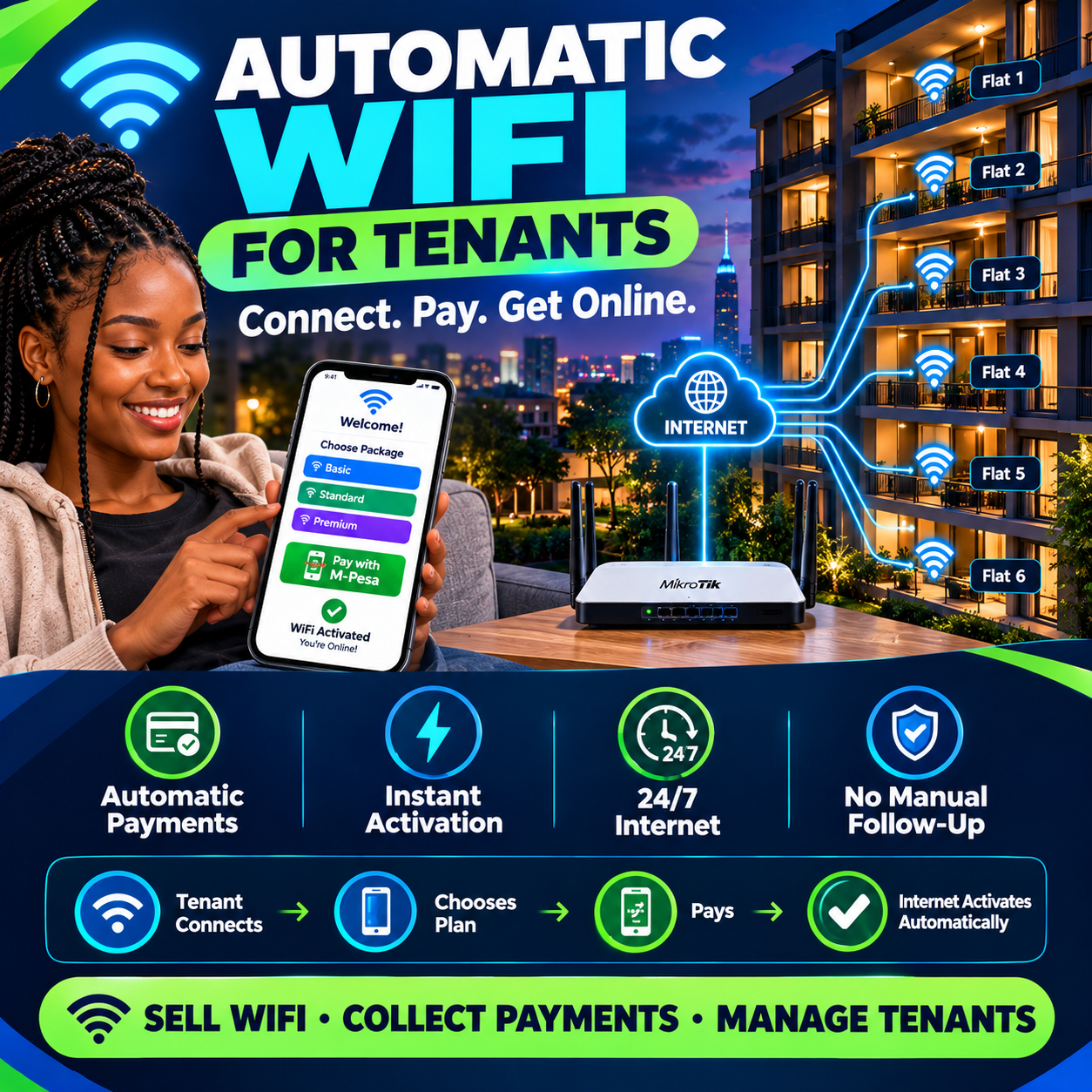
The platform takes the internet connection a landlord already pays for and turns it into a self-service product tenants buy themselves — on their phones, at any hour, without the landlord lifting a finger.
No more door knocking. No more reminder texts. No more notebook. The landlord configures packages once, and the Zama system runs the collection forever.
Understanding selling WiFi to tenants automatically through Zama means understanding one core idea: access becomes tied to payment, automatically.
When a tenant pays, the system connects them. When their package expires, the system disconnects them — politely, instantly, and without any awkward conversation.
The landlord never has to be the bad guy. The system handles enforcement the way a prepaid electricity meter does: neutral, automatic, and understood by everyone.
That neutrality changes the entire relationship. Nobody argues with a meter, and nobody argues with a countdown on their screen.
Landlords who adopted the Zama approach describe the same relief in the same words: “I stopped being a bill collector and went back to being a landlord.”
That is the promise hiding inside the question selling WiFi to tenants automatically — and unlike most promises in property management, this one is delivered by software that never forgets, never gets embarrassed, and never takes a day off.
How the System Actually Works
The mechanics answer the question selling WiFi to tenants automatically in four clean steps.
Step one: the connection. The landlord’s existing internet — fiber, wireless, or any broadband — connects to the Zama-managed network.
No exotic hardware, no server room, no IT contractor on retainer.
Step two: the packages. The landlord defines what tenants can buy: a daily pass, a weekly bundle, a monthly package — each with its own price and speed.
Pricing is entirely the landlord’s decision, adjusted anytime from a dashboard.
Step three: the portal. Every tenant who connects to the WiFi lands on a clean login page showing the packages and prices.
The tenant taps a package, an M-Pesa prompt appears on their phone, they enter their PIN, and the connection opens instantly.
Step four: automation. From that moment, everything runs itself.
Payments confirm automatically. Connections activate automatically. Expiries disconnect automatically.
Records, receipts, and reports generate automatically.
This is the complete, practical answer to selling WiFi to tenants automatically: the landlord sets the rules once, and the system enforces them thousands of times without supervision.
There is no step five where the landlord intervenes.
The best proof of the system is what it does when the landlord is asleep, away, or simply unwilling to have another money conversation — which is exactly when the old manual system failed every time.
The Tenant Experience: Why They Actually Prefer It
Landlords worry that automation will annoy tenants, but the opposite happens — and understanding why is central to selling WiFi to tenants automatically successfully.
Tenants already live in a pay-as-you-go world.
They buy airtime in small amounts. They buy electricity tokens from their phones. They buy data bundles on demand.
Buying WiFi the same way — small, instant, from the phone — is not a new behavior for them.
It is their native language. Under the manual system, the tenant had to find the landlord, have cash ready, and time the payment to the landlord’s availability.
Under the Zama model, the tenant pays at midnight in their room, on payday from the office, or on Sunday from their village — and the WiFi opens the moment the PIN is entered.
Convenience converts faster than any discount ever could. There is a dignity element too, and it matters more than landlords expect.
Under door-knock collection, paying for WiFi feels like being chased.
Under the portal, paying for WiFi feels like topping up — the same neutral, private, self-service motion as buying tokens.
No tenant ever has to explain a late payment to a human being again. Tenants on Zama-managed networks also see their own balance, expiry, and history on the portal, which ends the “when did my package end?” confusion entirely.
Every landlord who truly understands selling WiFi to tenants automatically eventually realizes the automation is not for the landlord’s convenience alone — it is a better experience for the tenant too, and that is why it sticks.
The First Month: What Actually Changes in Numbers
Stories are nice; landlords run on numbers. So here is what the first month after switching to automated WiFi selling typically looks like, measured on the dashboard.
The first number is the collection rate. Under manual collection, the gap between who should pay and who does pay is the landlord’s silent monthly loss.
Once payment and access are locked together, that gap collapses — tenants pay because paying is the only path to the WiFi, and the system never forgets to ask.
The second number is the landlord’s hours. Door knocking, reminder texts, receipt writing, ledger updating — all of it drops to zero.
The owner who spent evenings managing WiFi money now glances at a dashboard for two minutes and knows everything: who paid, who is active, what expired, what was collected.
The third number is the one nobody predicts: recovery of previously “impossible” tenants. Every plot has one or two tenants nobody ever managed to collect from.
Within days of access being tied to payment, they appear on the portal, phone in hand, paying like everyone else.
It is not a miracle. It is structure. This is the quiet financial engine behind selling WiFi to tenants automatically: the landlord does not find new money — the landlord stops losing money that was already theirs.
Owners who track a full quarter on the Zama dashboard describe the pattern identically: the WiFi subscription stops being a cost they subsidize and becomes a service that pays for itself, with a surplus.
That surplus, month after month, is the real answer to the question the landlord started with.
Packages and Pricing: Designing What Tenants Buy
A big part of sellingWiFi to tenants automatically is deciding what the tenants can actually buy — and the Zama system gives landlords full control here.
The classic mistake is offering only one monthly package. It sounds simple, but it excludes reality: the tenant who is broke until the 15th, the tenant staying for two weeks, the tenant who wants premium speed.
The landlords who earn best from automated WiFi offer a small ladder of options. A daily or three-day pass for short stays and tight weeks.
A weekly package for the flexible middle. A monthly package priced as the obvious best value — so most tenants land there naturally.
Speed tiers add another dimension: standard speed at the base price, faster speed at a premium. Some tenants genuinely need more bandwidth for work or gaming, and they will happily pay for it — but only if the option exists.
Zama lets every one of these packages be created, renamed, repriced, or retired from the dashboard in minutes. No technician visit, no reconfiguration fee, no waiting.
The pricing philosophy that works: make the monthly option clearly the smartest choice, let the shorter options catch everyone else, and let the automation do the selling.
Landlords who master this piece of selling WiFi to tenants automatically discover their WiFi income becomes predictable — a known figure arriving at known times, the way rent does.
Predictability, every landlord agrees, is worth more than an occasional higher number.
The Mistakes Landlords Make — and How to Avoid Them
The path to automated WiFi selling has a few predictable potholes, and naming them is cheaper than hitting them.
The first mistake is launching silently. The system goes live, but tenants were never told how it works — so they sit disconnected, confused, and frustrated.
The fix costs one afternoon: tell every tenant before the switch, explain the portal in one message, and maybe give a small free first session so everyone experiences the flow without risk.
The second mistake is overpricing.
A landlord who prices the WiFi above what mobile data costs will watch tenants quietly walk away from the portal — and then blame the system.
The portal doesn’t set the market; it reveals it.
The landlords who win at selling WiFi to tenants automatically price against the data bundle: noticeably cheaper per hour, noticeably better experience.
The third mistake is ignoring the dashboard.
The system reports everything — who pays late, which packages sell, what the busy hours are — and the landlord who never looks is flying blind with perfect instruments on the panel.
A weekly glance is enough to catch problems while they are small.
The fourth mistake is bad connection hygiene: one overloaded router, weak coverage in the back rooms, no protection for the equipment.
Automation manages the money, but the landlord still owns the physics. A tenant who pays and gets a weak signal becomes a refund conversation.
The fifth mistake is treating automation as a tax rather than a product. The landlords who thrive describe their WiFi the way a business describes a service: priced fairly, delivered reliably, supported quickly.
That mindset — plus the Zama system running the mechanics — is the complete formula behind selling WiFi to tenants automatically done properly.
Beyond the Main House: Bedsitters, Extensions, and Shared Plots
The question selling WiFi to tenants automatically comes from every shape of property, and the answer flexes to fit all of them.
The bedsitter row is the classic case: many small units, one connection, and a caretaker who is tired of collecting coins for WiFi.
Automation turns the entire row into self-service — each unit buys its own package, and the caretaker stops being the middleman.
The landlord with a main house and rental extensions uses it to separate the family connection from the paid one cleanly.
No more “the tenants are using our bandwidth” tension — everyone’s usage is tied to their own purchase.
The plot with shared common areas handles the same way: the landlord can sell tenant packages on the portal while keeping the parking lights and gate camera on an unmetered internal line.
The system distinguishes the two automatically.
Even single-room rentals and student hostels run on the same logic — any property where one connection serves many payers is a candidate.
The consistent result across every property type: the landlord’s role in WiFi shrinks to setting prices and reading reports.
Everything else — selling, collecting, connecting, disconnecting — the system does alone.
That is the scalable answer to selling WiFi to tenants automatically: it works the same for five tenants or fifty, which means the landlord’s WiFi income can grow with the property instead of growing the landlord’s workload.
Trust, Records, and Ending the Arguments
Money between landlords and tenants is where relationships go to die — unless there are records.
This is one of the least advertised but most valuable answers to selling WiFi to tenants automatically: the system replaces memory with evidence.
Every payment generates a timestamped receipt, visible to both sides.
“Did you receive my money?” becomes a question the portal answers in two seconds, without tone, without friction, without anyone feeling accused.
The tenant who claims their package should still be active sees their own expiry on screen.
The landlord who wonders who paid this month sees the full list on the dashboard.
Disputes that once consumed an evening of raised voices now end with a scroll.
The payment flow itself protects both sides too.
Tenants pay through their own M-Pesa prompt — their PIN stays on their own phone, never on any landlord-owned screen or paper list
The landlord never handles cash for WiFi, which means no missing float, no “I gave it to the caretaker,” no unexplained gaps.
Every shilling travels phone-to-system, recorded at both ends.
And because Zama keeps history, patterns become visible: the tenant who always pays on the 3rd, the package that sells best, the month collections dipped.
Over a year, that record becomes a quiet asset — useful for pricing decisions, useful in any disagreement, and occasionally useful in court.
Landlords who sell WiFi manually rarely think about records until the day they desperately need one.
Landlords who automated never think about records because they always have them.
That difference alone justifies the switch for many owners who came looking for selling WiFi to tenants automatically and left with something bigger: a property where money conversations simply stopped happening.
What the Landlord’s Life Looks Like After
The most honest way to evaluate any answer to selling WiFi to tenants automatically is to look at the landlord’s ordinary week afterward.
The 1st of the month arrives — the day the internet subscription renews.
Under the old system, it arrived with anxiety: would collections cover it?
Under the automated system, the dashboard already knows the answer, because collections have been flowing all month, tenant by tenant, phone by phone.
There is no collection round to schedule.
No reminders to compose.
No awkward conversation at the gate with the tenant who is “about to pay.”
The landlord’s involvement with WiFi shrinks to two moments: a few minutes setting or adjusting packages, and a glance at the reports — usually with a cup of tea.
The relationship with tenants improves in ways landlords don’t anticipate.
Paying tenants stop subsidizing non-paying ones, which removes the plot’s quietest source of resentment.
New tenants ask about WiFi the way they ask about water — as a service that just works — and sign up on the portal the day they move in.
Vacancy conversations change too: ” WiFi na instant” has become a genuine marketing line for automated plots, and tenants increasingly expect it.
The landlord who started with the question selling WiFi to tenants automatically ends up with something larger than automated income.
They end up with a property that runs a little more like a business and a little less like a favor — and with their evenings, their patience, and their tenant relationships fully intact.
Frequently Asked Questions
Do tenants need smartphones for this to work?
A basic phone with M-Pesa is enough to pay, and any device with a browser can open the portal.
In practice, nearly every tenant paying for WiFi already owns exactly the phone this requires.
What happens if a tenant pays and the WiFi doesn’t connect?
Every payment carries a timestamped record on the Zama dashboard, so the case is traced in seconds — and activation follows confirmation automatically.
The rare exception gets fixed far faster than a manual dispute ever did, with evidence instead of argument.
Can the landlord still give free WiFi to someone?
Yes — the system can grant complimentary packages or time from the dashboard, on the landlord’s terms.
Automation controls the default; the landlord keeps the exceptions.
What if a tenant prefers paying rent and WiFi together?
The landlord can bundle WiFi into rent if they choose — but automation lets them stop doing so, which most landlords prefer.
Separate packages mean a tenant leaving mid-month doesn’t complicate either payment.
Does one connection slow down when many tenants use it?
The system manages this with per-user speed limits, so one heavy streamer cannot degrade everyone else.
Package tiers let heavier users pay for faster speeds, keeping the base experience smooth.
What does the system cost the landlord?
Zama runs on transparent platform pricing, and the honest comparison is against the manual cost: unpaid subscriptions, collection hours, and lost surplus.
Landlords who run the numbers almost always find the system pays for itself from the leakage it recovers.
How long does setup take?
Most properties go live within a day or two: connect the network, create packages, and brief the tenants.
The landlord’s main job on setup day is communication, not configuration.
Can I use this across several properties?
Yes — multiple properties run from one dashboard, with revenue reporting per plot.
Landlords scaling from one property to several find their WiFi income scales without their workload scaling alongside it.
Will tenants share one package across units?
Device binding ties each purchase to specific devices, and simultaneous-login limits stop one package from serving a whole corridor.
Sharing attempts fail quietly, and at portal prices, most tenants simply buy their own.
What is the first step for a landlord still on the fence?
List what manual WiFi selling actually costs: the unpaid share of the subscription, the hours spent collecting, and the tenant friction it creates.
Then watch one live payment flow — portal to M-Pesa to connection — and see exactly how selling WiFi to tenants automatically stops being a question and becomes the way the property simply works.