
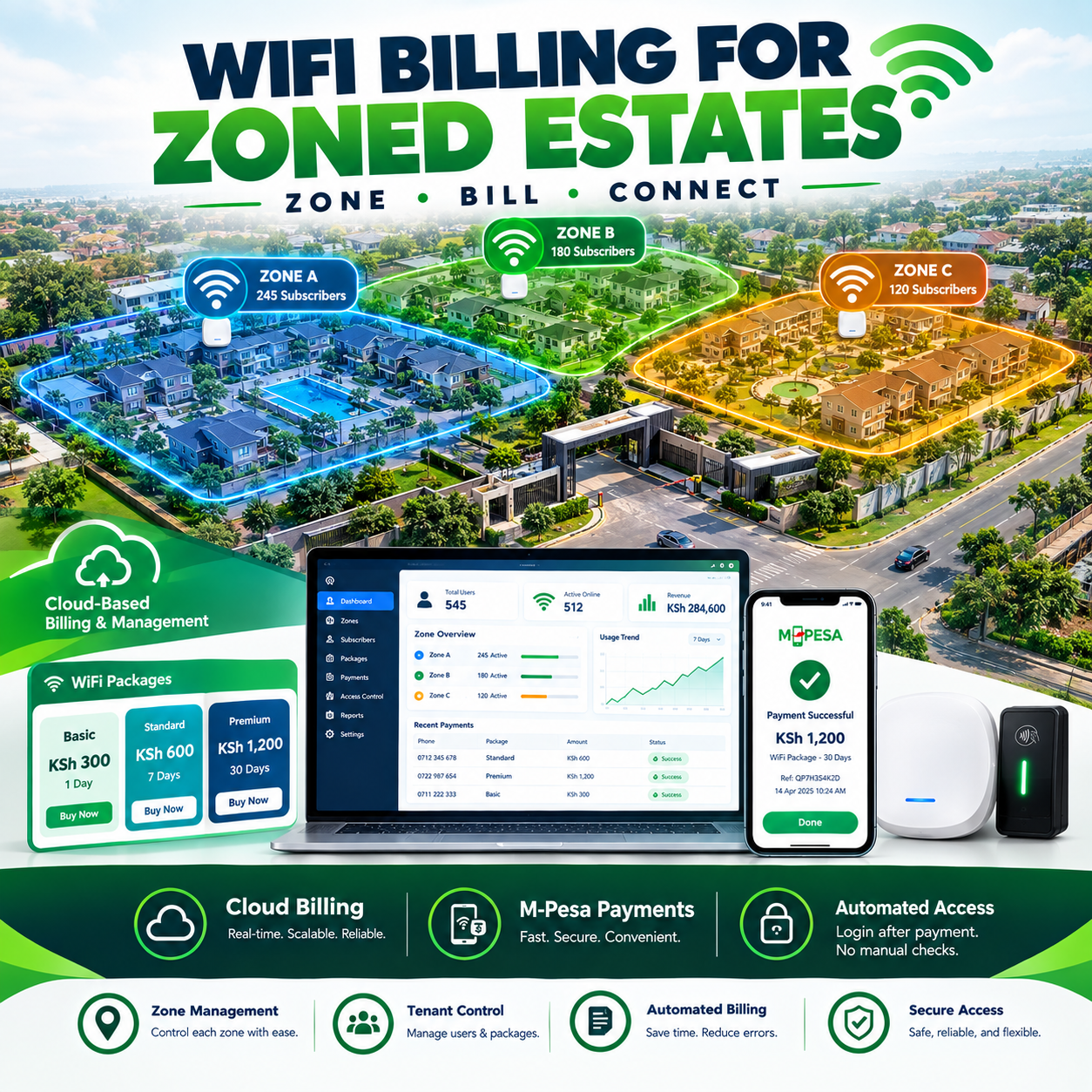
WiFi billing for zoned estates is the missing piece in every large residential property that grew faster than its internet management. Walk into any big estate — two hundred units split across Blocks A, B, and C, or a gated community spread across five phases — and you will find the same quiet chaos.
One internet connection serves everyone. One bill arrives monthly. And one caretaker holds a notebook that decides who gets connected and who gets cut off. The zones made the estate manageable. But the internet was never zoned along with it — until structured WiFi billing for zoned estates changed what was possible.
This article walks through why zoned estates struggle with internet more than any other property type, how zoned billing resolves it, and what changes on the ground once the system goes live.
Because the estates that solved this problem discovered something bigger than tidy accounts: the internet became a revenue line, a selling point, and a source of peace — all at once.
Table of Contents
ToggleWhy Zoned Estates Struggle More Than Any Other Property
A zoned estate is not one property; it is many small properties wearing one fence. Each zone has its own character: the bedsitter block with young tenants and high turnover, the family phase with steady payers, the newer wing still filling with occupants.
And each zone consumes the internet differently — in volume, in hours, in willingness to pay. Sound WiFi billing for zoned estates recognizes this reality instead of pretending one flat arrangement can serve all of it.
The problem starts with the shared connection. One fiber line, one bill, one cost — split informally across zones that never agreed on anything. Zone B pays late, so the caretaker disconnects Zone B — except the disconnection tool is a ladder and a pair of pliers, and the wrong cable gets pulled.
Now Zone A, which paid on time, is offline too, and the argument starts at the gate. Every estate manager who has lived this knows the sequence by heart — and every one of them eventually starts searching for proper WiFi billing for zoned estates that treats zones as zones.
There is also the distance problem. Zones built later sit farther from the router, and their coverage is weaker through no fault of their tenants.
Those tenants pay the same as everyone else and receive half the experience — a quiet unfairness that festers into open resentment by the second month. Zoned billing makes this visible and fixable, because it measures each zone separately instead of averaging them into one blurry whole.
That visibility is the first gift of structured WiFi billing for zoned estates, and it is the foundation everything else stands on.
The Manual Routine: Where Zoned Estates Lose Money
Under manual management, internet money in a zoned estate moves through human hands and human memory — and both leak. The caretaker collects from Zone A on the 3rd, Zone B whenever he sees them, and Zone C when they answer the door.
Receipts are handwritten or nonexistent. The notebook records who paid, in whatever shorthand the caretaker uses, and the owner cannot verify any of it without driving over.
Owners researching WiFi billing for zoned estates options are almost always owners who have tried to audit that notebook and failed.
Then the arrears begin.
Zone C owes for two months, but cutting them off means climbing the mast — and cutting off the wrong zone means a scene.
So the owner absorbs it, month after month, and the estate’s internet becomes a subsidy wearing a service uniform.
The paying zones notice, because paying tenants always notice.
The second leak is sharing.
One tenant buys the connection’s password from the caretaker’s cousin and shares it across three doors.
Under flat, unmanaged access, the estate cannot even see it happening — which is why proper WiFi billing for zoned estates systems bind every purchase to devices and records instead of whispered codes.
The third leak is invisible usage.
Without per-zone data, nobody knows which zone actually consumes the bandwidth — so capacity decisions, upgrade decisions, and pricing decisions all happen blind.
The estate guesses, overbuys bandwidth to compensate, and pays for the guessing every month.
Ending that blindness is the core promise of professional WiFi billing for zoned estates systems, and it arrives in the very first month of operation.
How Zoned Billing Actually Works
Strip the technology down and WiFi billing for zoned estates rests on one clean idea: the network mirrors the estate’s geography.
Each zone gets its own managed segment — its own access points, its own user group, its own rules — all reporting into one central dashboard.
The estate map becomes the billing map.
A tenant in Block A buys through the portal, pays by mobile money, and their connection opens within seconds.
A tenant in Phase 2 lets their package expire, and their segment disconnects automatically — their zone, their unit, nobody else.
That precision is the entire promise of WiFi billing for zoned estates: enforcement lands exactly where the money stopped, and nowhere else.
The owner’s role shrinks to three things: setting packages, glancing at reports, and collecting a revenue line that now runs itself.
No ladders. No pliers. No scenes at the gate.
The caretaker stops being a debt collector and goes back to being a caretaker.
Every party in the estate — owner, caretaker, tenant — ends up dealing only with the system, which never forgets, never favors, and never pulls the wrong cable.
That neutrality is why estates that adopt WiFi billing for zoned estates structures almost never go back to manual arrangements, no matter how attached they were to the old ways.
Per-Zone Packages: Pricing That Matches Reality
The most powerful feature inside WiFi billing for zoned estates platforms is the freedom to price each zone as its own market.
The bedsitter block, with its modest budgets, gets a daily and weekly ladder at accessible prices.
The family phase, with its stable tenants, gets a monthly package positioned as the obvious value.
The premium wing, with its larger units, gets a premium tier with faster speeds.
One estate, three markets, three pricing strategies — all under WiFi billing for zoned estates management that treats each zone’s economics independently.
This flexibility ends the oldest argument in shared-property internet: what is fair.
Under one flat price, someone always overpays — usually the small-unit tenants subsidizing the heavy users in the big ones.
Under zoned pricing, each segment pays for the product it actually receives, and the fairness debate dissolves into a price list.
Operators who implemented tiered WiFi billing for zoned estates structures report the same outcome everywhere: collections rose in every zone simultaneously, because every zone finally felt its price was its own.
Package design per zone also becomes an experiment lab.
A new weekly offer can launch in one zone, prove itself, and roll out to the rest — without touching the pricing the other zones already trust.
That test-then-expand rhythm is impossible under flat arrangements and routine under zoned ones.
It is the difference between guessing what tenants want and watching them show you, one zone at a time, through WiFi billing for zoned estates dashboards that record every choice.
The Isolation Principle: One Zone’s Problem Stays in Its Zone
Here is the feature that sells zoned billing to every estate owner who hears it: isolation.
When one zone stops paying, only that zone goes offline — automatically, precisely, without anyone climbing anything.
Zone C’s arrears become Zone C’s offline status, visible to them on their own portal, resolvable by them with a tap.
The estate’s other zones never flicker.
Under manual management, non-payment anywhere threatened connectivity everywhere, because enforcement was physical and imprecise.
Under structured WiFi billing for zoned estates, enforcement is digital and exact — which converts the estate’s most volatile money conversations into quiet, self-service events.
Isolation works in the other direction too.
When Zone B’s access point fails or its cabling corrodes, the fault confines itself to Zone B’s segment, and the dashboard names the zone explicitly.
Diagnosis that once took a day of walking the estate now takes a glance.
The estate’s total downtime drops because its problems stop being communal.
Engineers who deploy WiFi billing for zoned estates systems describe the isolation principle as the estate equivalent of circuit breakers — one zone tripping no longer blacks out the house.
And the isolation extends to reputation.
Under shared arrangements, one zone’s complaints on the neighborhood WhatsApp group stained the whole estate’s name.
Under zoned systems, the complaint threads shrink to the actual zone, and the actual fixes arrive within hours — restoring both the service and the estate’s standing.
That boundary-keeping is one of the most underrated returns on WiFi billing for zoned estates adoption, and it compounds every month the system runs.
Phased Rollouts: Growing the System Zone by Zone
Large estates rarely adopt big changes all at once, and WiFi billing for zoned estates deployments respect that reality.
The smart rollout starts with one zone — usually the smallest or the most frustrated
The system goes live there, tenants learn the portal, collections begin, and the results become visible within weeks.
The other zones watch from the sidelines, and the pitch for zone two writes itself: “Look at Block A — nobody knocks on their door about WiFi anymore.”
Property veterans who rolled out WiFi billing for zoned estates this way report zero resistance by the third zone, because the pilot zone’s tenants became the system’s advocates.
Phased rollout also spreads the cost.
Instead of one large capital outlay across the whole estate, each phase’s equipment pays for itself from its own zone’s collections before the next phase begins.
The estate finances its own upgrade, zone by zone, without a single loan.
That self-funding sequence is the quiet financial genius of staged WiFi billing for zoned estates adoption — and it works for estates of every size.
Phasing also allows learning without exposure.
The mistakes of zone one — a mispriced package, a portal that confused a few tenants — get corrected before zone two ever sees them.
By the final zone, the rollout is routine, the messaging is polished, and the whole transition feels inevitable rather than disruptive.
Owners who rushed all zones at once, by contrast, report the classic pattern: one confused estate, one overwhelmed caretaker, and a week of goodwill spent repairing what a phased WiFi billing for zoned estates launch would have preserved.
Per-Zone Reporting: The Dashboard That Ends Guesswork
The reporting layer is where WiFi billing for zoned estates platforms reveal their full value to ownership.
One dashboard, one estate, every zone visible: who paid in Block A, what expired in Phase 2, what collected from the bedsitter block this week.
Arrears stop being rumors and become lists — zone by zone, unit by unit, with timestamps.
The owner who once drove to the estate to find out what happened now reads it over morning tea.
Revenue reporting per zone changes ownership strategy too.
The zone that consistently collects best becomes the template; the zone that lags gets examined — pricing, coverage, tenant mix — against data instead of anecdotes.
Owners running WiFi billing for zoned estates dashboards describe the first month of data as the first time they ever truly saw their own estate.
Usage reporting adds the capacity dimension.
Which zones consume the most, at which hours, and whether the shared bandwidth chokes at 8 p.m. because of one zone’s evening streaming — every answer arrives in the reports.
Capacity upgrades stop being defensive guesses and become targeted investments in the specific zones that need them.
That precision, multiplied across a large estate, is worth thousands monthly in avoided overspending — one of the least advertised returns on WiFi billing for zoned estates systems.
The Tenant Experience: Why Zones Prefer It
The success of any estate system lives or dies with the tenants, and WiFi billing for zoned estates platforms win them over faster than owners expect.
Tenants already buy connectivity by phone — airtime, tokens, bundles — so portal purchases feel native rather than novel.
The tenant pays at midnight from their room, on payday from work, or on Sunday from upcountry, and the connection opens the moment the PIN is entered.
Nobody waits for the caretaker’s shift to end.
Nobody explains a late payment to a human being.
There is a dignity layer here that tenants articulate in their own words: paying feels like topping up, not being chased.
That reframing alone ends most of the friction the old routine produced.
Tenants on properly deployed WiFi billing for zoned estates systems also see their own status — package, expiry, history — on the portal, which ends the “when did my internet end?” confusion permanently.
The fair-price effect reaches tenants too.
Zoned pricing means the bedsitter tenant is no longer subsidizing the three-bedroom unit’s streaming habits.
Each tenant pays for their zone’s product at their zone’s price, and the quiet resentment that poisoned flat-rate estates simply has nowhere to grow.
When estates surveyed tenants after switching to structured WiFi billing for zoned estates arrangements, the most common response was not about the internet at all — it was about fairness finally being visible.
Life After: The Estate Manager’s New Week
Ask estate managers what changed after adopting WiFi billing for zoned estates systems, and their weekly routine tells the story
The month no longer opens with a collection schedule — because collection is continuous, happening tenant by tenant, phone by phone, across all zones at once.
The caretaker’s notebook closes for good.
The gate conversations about WiFi stop entirely.
Month-end becomes a report instead of an audit: zones ranked by collection, arrears named explicitly, revenue trending visibly.
The manager who spent years reconstructing who paid what now spends minutes confirming what the dashboard already knows.
That recovered time flows back into the actual job — maintenance, occupancy, tenant welfare — and estates consistently run better for it.
The financial rhythm changes just as much.
Internet revenue arrives in known patterns, per zone, which makes the estate’s income predictable enough to plan against.
The subscription that once threatened to swallow the estate’s margins now sits covered by collections with a surplus on top.
Owners describe the surplus in a phrase that needs no explanation: the mast now pays its own salary.
And the deepest change is structural — the estate finally has a growth path for internet that does not run through the manager’s personal labor, because WiFi billing for zoned estates automation scales with units, not with hours.
The Mistakes Zoned Estates Make — and the Fixes
The predictable rollout errors repeat across every large property, and naming them is cheaper than making them.
The first is the silent launch — switching zones online without telling tenants, then reading the confusion as resistance.
Every smooth adoption of WiFi billing for zoned estates was preceded by an honest announcement: what changes, what it costs, how to pay, and what current tenants get as a grace gesture.
The second mistake is one price for all zones, which recreates the flat-rate unfairness the zoned system was meant to end.
Pricing per zone is not complexity; it is honesty, and the collections data proves it within a quarter.
The third mistake is neglecting the weak-coverage zone — automating billing while the far block still suffers dead corners.
A tenant who pays and receives half a signal becomes a refund conversation; fix the coverage before or alongside the billing, and the WiFi billing for zoned estates rollout inherits goodwill instead of grievances.
The fourth mistake is ignoring the dashboard after go-live.
The system’s reports are the estate’s new eyes, and the owner who reads them monthly keeps finding money — an underpriced zone, a leaking segment, an upgrade need spotted before it became complaints.
The fifth is keeping the old back door — letting the caretaker sell “special” codes outside the system for favorite tenants.
Every exception outside the platform is a leak inside it, and the estates that closed those doors completely are the ones whose WiFi billing for zoned estates numbers tell the truth.
Fairness Between Zones: The Peace Dividend
Money between neighbors is where communities fray, and shared internet has always been the sharpest edge.
Structured WiFi billing for zoned estates removes the edge by making every zone’s deal explicit: this zone, this price, this speed, this record.
Zone A’s payment history is Zone A’s business, visible to its tenants and its owner, and no longer entangled with Zone C’s arrears.
The neighborhood WhatsApp group’s longest-running argument — who is riding on whose payment — simply ends, because the answer lives in a system rather than a suspicion.
Estate committees that adopted WiFi billing for zoned estates structures report the same social effect: the estate’s mood lightened, because fairness stopped being a debate and became a feature.
The peace dividend compounds.
Tenants who trust the system pay faster, stay longer, and recommend units to friends — and every one of those behaviors is worth real money to occupancy rates.
The estate that feels fair rents faster than the estate that feels murky, at identical prices.
That is the quiet marketing power inside WiFi billing for zoned estates systems: not a slogan, but a lived experience tenants describe to the next tenant at the gate.
Infrastructure Reality: What Each Zone Actually Needs
Billing software manages the money; physics still manages the signal — and zoned estates ignore this at their peril.
Each zone’s access points, cabling, and mounting matter, and the dashboard will honestly report which zones carry weak links.
The professional pattern is a per-zone audit before automation: signal strength unit by unit, dead corners marked, corroded connectors replaced.
The estates that paired infrastructure cleanup with their WiFi billing for zoned estates rollout reported smooth adoption; the ones that skipped it inherited the old complaints with a new price list.
Power protection belongs to the same chapter
A blackout that kills the mast kills every zone at once, and tenants judge the whole system by that night.
Surge protection and backup power for the core equipment are not luxuries — they are the difference between a network that rides out the grid and one that refunds its reputation during every storm.
Maintenance routines complete the picture: monthly checks per zone, recorded, with failing parts replaced before they fail.
The owners who treat their WiFi billing for zoned estates deployment as infrastructure rather than an app are the ones whose systems still run cleanly in year three.
Security: Zones as Natural Firewalls
Zoned architecture carries a security bonus that most estates discover only after adoption.
Each zone’s segment isolates its traffic from the others, so a compromised device in one block cannot wander the whole estate’s network.
Estate offices, CCTV, and any business systems can sit on their own managed layer, invisible to every tenant segment.
This separation neutralizes the most common shared-network risks — a visitor’s laptop probing the estate, a tenant’s infected phone scanning neighbors — by simply giving every device a smaller world.
Estate managers who field questions about safety now answer with architecture instead of assurances, which is the stronger answer by far.
Credential hygiene completes the picture: per-tenant accounts, automatic expiry for departed tenants, admin access limited to named people
The estate that once had no answer to “who is on this network?” now has a complete, current list per zone — one of the quietest but most valuable exports of WiFi billing for zoned estates systems
And because every account is tied to a payment and a device, the anonymous crowd that once shared one password becomes a known, accountable population.
Security, it turns out, was hiding inside the billing structure all along — another reason disciplined WiFi billing for zoned estates adoption pays beyond the revenue column.
From Three Zones to Thirteen: How It Scales
The test of any estate system arrives at the fourth, fifth, and tenth zone — and WiFi billing for zoned estates platforms are built for exactly that test.
Adding a zone is configuration, not construction: new segment, new access points, packages assigned, and the zone appears on the same dashboard as the rest.
The owner who manages three zones today manages thirteen tomorrow with barely more effort.
Multi-property portfolios work the same way.
An owner with two estates runs both from one login, with each zone of each property reporting separately — the portfolio view that manual management could never produce.
This is the scaling secret behind the largest WiFi billing for zoned estates deployments in the market: centralization at the top, precision at the zone level, and nothing lost in between.
Consistency survives scaling too.
Packages, portal branding, and enforcement rules replicate across zones automatically, so the estate feels like one professional service everywhere while billing like many distinct markets.
New tenants moving between zones become a settings change rather than a renegotiation.
Growth, in other words, stops being a fresh start and becomes an extension — which is the difference between an estate business and an estate struggle, and the reason seasoned owners insist on WiFi billing for zoned estates platforms designed for the thirteenth zone on day one.
The Payoff, Counted Honestly
Ask zoned estates a year after adopting structured WiFi billing for zoned estates systems what changed, and the answers cluster into four themes.
Money: collections rose in every zone, arrears collapsed to named lists, and the internet shifted from subsidized cost to profitable service line.
Time: the caretaker’s collection rounds vanished, the owner’s audits became dashboard glances, and both got their hours back.
Calm: the gate arguments, the WhatsApp disputes, the wrong-cable incidents — gone, replaced by a system that enforces identically in every zone.
And reputation: an estate where the internet simply works, is fairly priced, and resolves its own disputes becomes the address people recommend.
None of it required new tenants, higher rents, or bigger bandwidth — only management that finally matched the estate’s own shape.
That is the argument for WiFi billing for zoned estates in one sentence: the property was already divided into zones for good reasons, and the internet was the last system still pretending it was not.
The estates that made the change describe the feeling identically: the internet stopped being a monthly negotiation and became a utility that pays its own way — which is what every zone, every tenant, and every owner wanted from the start.
Frequently Asked Questions
Can different zones really have different prices?
Yes — per-zone packages and pricing are core to WiFi billing for zoned estates systems, and it is the feature that ends flat-rate unfairness.
Each zone pays for the product its segment actually receives, and collections rise everywhere as a result.
What happens when one zone doesn’t pay?
Only that zone disconnects — automatically and precisely — while every other zone continues untouched.
This isolation is the defining feature of WiFi billing for zoned estates enforcement, and it converts arrears from estate crises into tenant-level events.
Do tenants need smartphones to use the portal?
A basic phone with mobile money can pay, and any browser can open the portal.
In practice, nearly every tenant buying WiFi already carries exactly the device this requires.
Can we start with just one zone?
Yes — phased rollout is the recommended path: automate one zone, prove it, then expand using that zone’s results as the pitch.
Most successful WiFi billing for zoned estates deployments grew zone by zone rather than all at once.
What if a zone has weak coverage in some corners?
Fix the coverage before or alongside the billing rollout, because a paying tenant with a weak signal becomes a refund conversation.
The per-zone visibility inside WiFi billing for zoned estates dashboards makes weak zones easy to identify and target.
How does the caretaker’s role change?
Collection disappears from the job, and the caretaker returns to maintenance and tenant service — usually a promotion on both sides.
Records inside WiFi billing for zoned estates systems also protect honest caretakers from suspicion, since every transaction carries a receipt.
Can one owner manage several estates with this?
Yes — multiple properties run from one dashboard, with every zone of every estate reporting separately.
Portfolio owners find WiFi billing for zoned estates centralization scales cleanly as they add properties.
What stops one tenant from sharing a package across units?
Device binding ties each purchase to specific devices, and simultaneous-login limits block one package from serving a corridor.
This enforcement is standard in WiFi billing for zoned estates systems and recovers revenue that shared passwords silently drained.
What happens during a power cut?
With proper protection, sessions persist and service restores automatically when power returns; without it, every zone judges the system by that night.
Surge protection and backup power for core equipment are the recommended standard for any WiFi billing for zoned estates deployment.
How do we handle a tenant who claims they paid?
Their payment carries a timestamped receipt visible on both the portal and the dashboard — the dispute ends with a scroll instead of an argument.
This evidence trail is one of the most valued features of WiFi billing for zoned estates platforms.
Can the estate still give free or discounted access?
Yes — complimentary packages and grace periods can be granted per zone from the dashboard, on the estate’s terms.
Automation controls the default; the owner keeps the exceptions, which is how WiFi billing for zoned estates systems balance rules with humanity.
What is the smartest first step for an estate still deciding?
Map the zones honestly: who pays now, who doesn’t, what coverage each block actually delivers, and what the current arrangement costs in arrears and caretaker hours.
That one page, set against what WiFi billing for zoned estates automates from day one, has decided more estates than any sales pitch — and the owners who make the switch discover the same closing truth every time: the estate was already zoned for good reasons, and WiFi billing for zoned estates simply brought the internet into line with everything else the property had already figured out.