
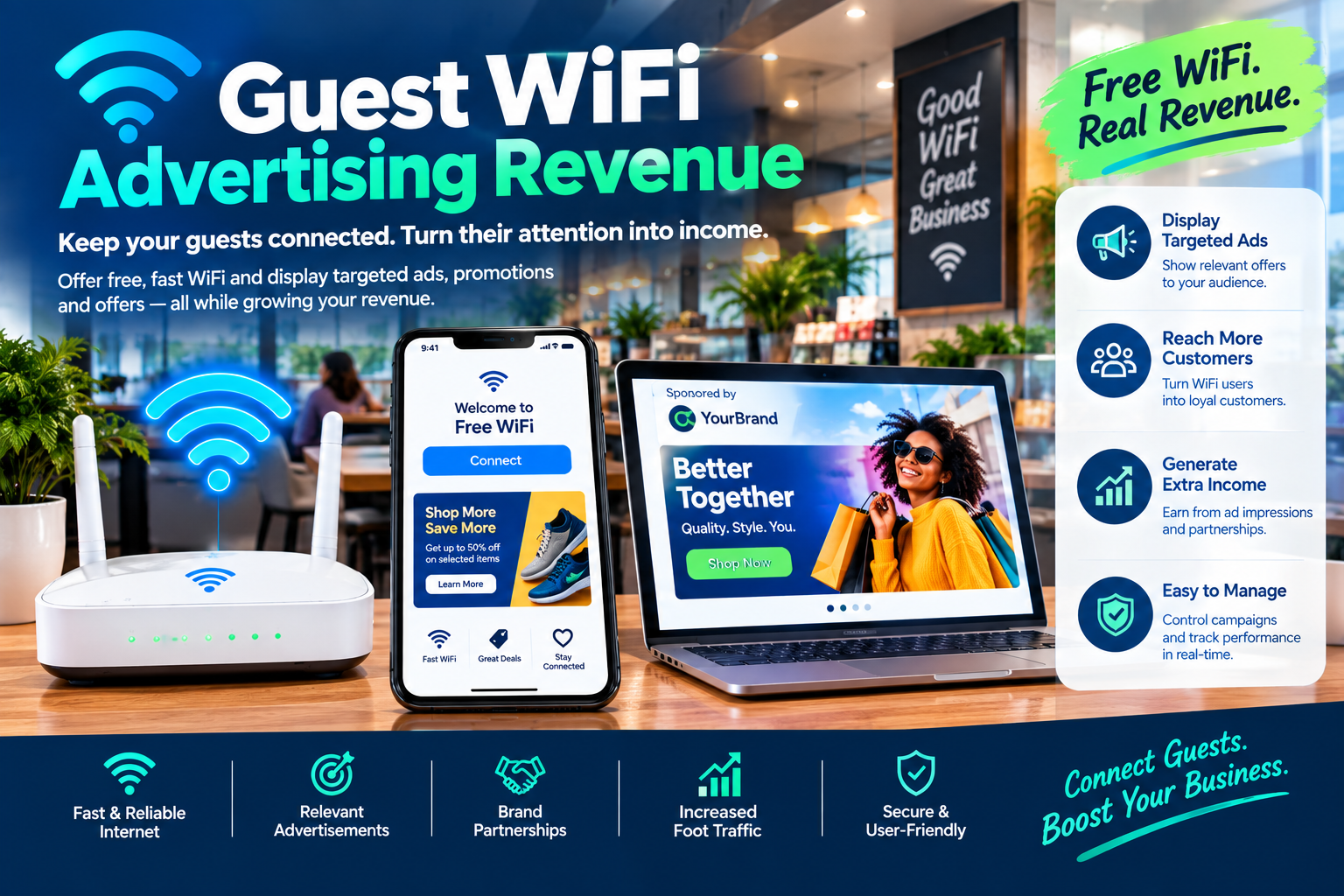
Guest WiFi advertising revenue is the income stream hiding in plain sight in thousands of businesses across the country — a screen every customer already looks at, monetized the way billboards and radio spots have been monetized for decades.
Every café, hotel, salon, clinic, and waiting room that offers WiFi owns something no advertising agency can sell them: a page their customers must face before a single byte of internet flows.
Most owners treat that page as a technical necessity — a login form, a password field, a thing to get past.
The operators who discovered guest WiFi advertising revenue treat it as what it actually is: guaranteed, undivided attention from a captive local audience, delivered daily, at zero media cost.
That attention is worth money, and businesses everywhere are learning to collect it.
This article walks through the entire economics of guest WiFi advertising revenue — what it is, who pays for it, what it realistically earns, and why the login page has quietly become the most valuable advertising space a small business owns.
Table of Contents
ToggleWhat Guest WiFi Advertising Revenue Actually Is
Strip away the jargon and the concept is simple.
When customers connect to a business WiFi network, they land on a captive portal — the login page that stands between them and the internet.
Guest WiFi advertising revenue is the money earned by placing paid messages on that page: banners, sponsor lines, promotional tiles, and video clips shown to every connecting device
The business sells access to its audience the way a newspaper sells access to its readers — except this audience is physically present, local, and already engaged.
A matatu sacco advertises its new route to commuters logging into the stage WiFi.
A gym promotes its January offer to everyone logging into the café next door.
A pharmacy reminds the clinic’s waiting room that it sits fifty meters away.
This is the everyday texture of guest WiFi advertising revenue — hyper-local advertising delivered to people who are, at that exact moment, looking at the screen.
The model borrows nothing exotic from digital marketing.
It simply applies the oldest truth in the industry — attention sells — to the one screen a small business controls completely.
Why the Login Page Outperforms Every Other Ad Space
Every business owner has tried advertising somewhere: a poster on the wall, a flyer at the till, a boosted social media post.
The results are famously disappointing, because all of those media compete for attention against a hundred other things.
The captive portal competes with nothing.
A customer cannot scroll past it, mute it, or walk by it — the page simply will not release the internet until it has been faced.
That is the structural advantage behind guest WiFi advertising revenue: the impressions are not bought, chased, or estimated.
Theyare guaranteed by architecture.
Media planners have a name for this: captive audience advertising, the same category as airport screens and fuel-station pumps — the formats with the highest measured attention in the entire industry.
The login page belongs to that family, and it carries one extra advantage none of the others have: it appears at the precise moment the customer is reaching for their phone anyway.
Operators measuring the effect consistently find the same thing: banner views on a portal are not impressions in the technical sense — they are moments of complete, verified attention.
No poster in the building can make that claim, which is why the economics of guest WiFi advertising revenue hold up even at small scale.
The Audience Advertisers Actually Want
The second pillar supporting guest WiFi advertising revenue is the quality of the audience itself.
Consider who connects to guest WiFi and where.
The café near campus serves students — the exact demographic every brand chases and rarely reaches affordably.
The clinic’s waiting room serves patients from a five-kilometer radius — the precise catchment a nearby pharmacy, lab, or chemist wants.
The salon serves its neighborhood’s spenders; the hotel serves travelers with money and needs; the hardware store serves builders mid-project.
Guest WiFi audiences are not anonymous traffic — they are pre-filtered by location, context, and often by time of day.
A business selling that audience is not selling “impressions.”
It is selling qualified local reach — the thing small advertisers have always wanted and rarely found at prices they could pay.
This is why guest WiFi advertising revenue works at neighborhood scale while most digital advertising struggles there.
The corner shop cannot afford a billboard, and the billboard cannot promise the corner shop’s neighbors anyway.
The WiFi portal does both — it is the local paper, the community noticeboard, and the storefront poster rebuilt as a screen that reports its own views.
Who Can Sell It: The Venues Where This Works
The honest answer about guest WiFi advertising revenue potential is that it scales with footfall and dwell time.
High-traffic, waiting-heavy venues sit at the top of the list.
Hospitals and clinics, where patients wait with nothing to do and phones in hand
Transport stages and lounges, where every departure begins with a connection.
Universities, salons, barbershops, car service centers, banks, government offices, restaurants, gyms — anywhere bodies gather and time passes.
Each of these venues hosts hundreds to thousands of portal views weekly, and every view is a sellable impression.
But the quieter discovery is that even modest venues earn from guest WiFi advertising revenue — because their advertisers are not national brands.
They are the pharmacy across the street, the driving school down the road, the sacco with a new product, the church announcing an event, the landlord with units to let.
Local advertisers do not need a million impressions.
They need the right three hundred — the people who can actually walk through their door this week.
That is the market guest WiFi advertising revenue serves, and it is enormous precisely because it is local.
The Formats: Ways a Portal Earns
The mechanics of guest WiFi advertising revenue are flexible, and the main formats each suit different advertisers.
The portal banner is the workhorse: a rotating image slot on the login page, seen by every connecting device.
Sponsorships are the premium format: “This WiFi is brought to you by [Business]” — a permanent line that reads as endorsement rather than interruption.
The confirmation page — shown after payment or login — carries a second impression at the moment of maximum engagement.
Sponsored sessions flip the model entirely: an advertiser pays for customers’ internet time in exchange for a view, so the customer browses free and the advertiser’s message delivered them.
Splash intertitials — a full-screen ad shown briefly before the portal — command the highest rates for high-traffic venues.
Video slots, coupon delivery, and tap-through offers to the advertiser’s own page complete the toolkit.
Venues running guest WiFi advertising revenue programs typically stack two or three formats rather than choosing one — a rotation banner plus a sponsor line plus a confirmation-page slot is a common and effective combination.
The format decision follows the advertiser’s goal: awareness favors banners and sponsorships, action favors coupons and tap-throughs, and budget favors the rotation slot.
Who the Advertisers Are
Every venue discovering guest WiFi advertising revenue eventually asks the same question: who actually pays for this?
The answer, consistently, is five categories.
First, neighboring businesses — the pharmacy, the gym, the driving school, the electronics shop — for whom the venue’s audience is walking distance away.
Second, suppliers and distributors — the beverage company, the flour brand, the gas supplier — who already serve the venue and will pay to appear where their product is consumed.
Third, service providers: insurers, banks, SACCOs, telcos, and real estate agents hunting for local leads.
Fourth, event promoters — concerts, church conferences, trade days, political campaigns — who need concentrated neighborhood reach for short bursts and pay premiums for it.
Fifth, the venue’s own promotions, which earn no cash but displace advertising the business would otherwise buy elsewhere.
The most successful guest WiFi advertising revenue programs start with category one — the neighbors — because they are already in relationship with the venue and can see the screen themselves.
A venue owner who shows the pharmacy owner the login page on their own phone closes the first deal in ten minutes.
The pharmacy tells the hardware store; the hardware store tells the SACCO.
In this market, guest WiFi advertising revenue grows the way everything local grows — by referral, one advertiser at a time.
Pricing It: What the Space Is Worth
Pricing is where guest WiFi advertising revenue either becomes real income or stays a hobby, and the successful venues share a practical approach.
The simplest model is flat monthly sponsorship: a fixed fee for a permanent slot, priced like a poster rental — modest, predictable, easy for a local advertiser to approve.
The rotation banner prices by share of voice: an advertiser buying half the weekly impressions pays half the slot’s rate.
High-traffic venues graduate to impression-based pricing, charging per thousand views the way digital media does.
Sponsored sessions price per session delivered, letting the advertiser directly buy reach.
The reference points that make these numbers land are offline comparisons.
A poster printed monthly costs money, fades, and reaches whoever walks past it.
A portal slot costs nothing to produce, updates instantly, and reports exactly how many people saw it.
When venues pitch guest WiFi advertising revenue slots against the poster budget their advertisers already spend, the comparison usually closes the sale by itself.
The honest expectation: a single neighborhood venue earns a meaningful supplementary income from two to five local advertisers — enough to cover the internet bill with room to spare.
Venue networks — one operator aggregating many locations — multiply that into a genuine media business.
The Reporting Advantage: Ads That Prove Themselves
Every advertiser who has bought a poster knows its flaw: no one can say how many people saw it.
The portal’s answer is the reason guest WiFi advertising revenue closes renewals that print advertising never could.
Modern platforms track every impression — which banner, which day, which hour, how many devices.
The venue sends the pharmacy a monthly report: your banner was seen 2,340 times this month, mostly between 7 and 9 a.m.
No poster in history has made that statement.
Better still, tap-through campaigns report actions: how many viewers tapped the ad, claimed the coupon, or visited the advertiser’s page.
Advertisers who receive those reports renew, because renewal stops being faith and becomes arithmetic.
This evidence layer is the structural edge of guest WiFi advertising revenue over every offline format the local advertiser has ever bought.
It also disciplines the venue: underperforming slots get redesigned, rotations get rebalanced, and pricing gets justified — all from the same dashboard.
The venues that treat reporting as part of the product keep advertisers for years.
The ones that sell the slot and disappear lose them at the first slow month — a pattern visible across every guest WiFi advertising revenue program in the market.
Consent, Data, and the Line That Must Not Be Crossed
The data layer is where guest WiFi advertising revenue becomes powerful — and where discipline matters most.
With consent, the login flow can capture a phone number or email, letting advertisers follow up with people who actually engaged.
That consent must be genuine: clearly stated, separately ticked, and honest about purpose.
Audiences forgive advertising; they do not forgive ambush.
The venues that last keep three rules.
First, sell attention, not identities — banners reach everyone, data follows only the willing.
Second, keep the ads relevant and few: a rotation of three to five local messages feels like a community noticeboard, while a cluttered wall of fifteen feels like a scam page.
Third, never let advertising delay the login — the moment the portal becomes slow is the moment the venue’s own service degrades to pay for its side income.
Platforms built for guest WiFi advertising revenue enforce these lines by design: fast-loading ad slots, impression tracking, consent checkboxes, and privacy notices that satisfy data protection requirements without a lawyer on retainer.
The venues that respect the audience keep the audience — and the audience is the entire asset being sold.
Dual Revenue: Ads and Paid WiFi Together
The most profitable deployments of guest WiFi advertising revenue do not choose between ads and paid access — they stack them.
The structure is simple: a short free session funded by the advertiser, with paid extensions beyond it.
The customer connects, sees the sponsor’s banner, enjoys the complimentary fifteen minutes, and taps into a paid package when they want more.
The advertiser buys reach; the venue earns twice from the same connection; the customer gets a freestart and honest pricing beyond it.
Every party in the triangle receives value, which is why this hybrid dominates wherever guest WiFi advertising revenue has matured.
For venues already running paid WiFi, adding the advertising layer costs nothing — the portal is live, the audience is flowing, and the banner slot is empty inventory waiting for a tenant.
For venues giving WiFi away free, the advertising layer converts a pure cost into a break-even line before a single shilling is charged to a customer.
The free session itself becomes sellable: “your brand delivers the free fifteen minutes” is among the strongest sponsorship propositions in guest WiFi advertising revenue, because the customer’s gratitude attaches directly to the advertiser’s name.
That emotional placement — generosity wearing the sponsor’s logo — outperforms any banner the same budget could buy.
The Mistakes That Kill Programs Early
Every veteran of guest WiFi advertising revenue can name the failures that sink programs in their first quarter.
The first is overstuffing: selling eight banners to eight eager advertisers and watching the portal become a classifieds page customers resent.
Four well-paying slots outearn twelve resented ones, every time.
The second is selling to the wrong advertisers — businesses whose messages clash with the venue or its clientele.
The clinic’s portal carrying a betting ad destroys more trust than the income replaces.
The third is no reporting: the venue sells the slot, goes silent, and the advertiser’s renewal dies of uncertainty.
The fourth is slow creative — heavy images that stretch login times on cheap phones, taxing the venue’s own service to serve its side income.
The fifth is treating it as passive: the slot sold once and never revisited, while prices, rotations, and creative went stale.
The operators whose guest WiFi advertising revenue programs survive year two all share one habit: they manage the portal like a media property — reviewed monthly, refreshed seasonally, and pruned honestly.
What the Platform Contributes
None of this functions on a hand-built login page, and the platform layer is what turns the concept of guest WiFi advertising revenue into an operational income line.
A capable captive portal carries the rotating banner slots, the impression counters, the sponsor lines, and the confirmation-page placements as built-in features.
It logs every view by advertiser and day, generating the reports that renew sponsors automatically.
It serves ads fast enough to protect the login experience on the cheapest devices on the network.
And it runs the dual-revenue stack — free sponsored sessions on top of paid packages — from the same dashboard that manages the venue’s connectivity.
When venues evaluate platforms for guest WiFi advertising revenue purposes, the questions are practical: how many ad slots, what reporting exists, how fast does it load, and who updates the creative?
The platforms that answer well turn the portal into what it should have been all along — the venue’s best-performing billboard, with a meter attached.
Realistic Numbers, Stated Honestly
So what does guest WiFi advertising revenue actually pay?
A single neighborhood venue with steady footfall, running three local advertisers on rotation plus one sponsor line, typically earns enough monthly to cover its entire internet cost with a surplus — from a page that was previously blank.
A high-traffic venue — a clinic, a stage, a campus corner — prices its slots several multiples higher and often carries a waiting list.
An operator aggregating ten to twenty venues becomes, functionally, a local media company: selling neighborhood reach across a network no single advertiser could assemble alone.
None of these figures arrive without work — the slots must be sold, the creative refreshed, the reports delivered.
But the underlying asset requires no investment beyond the portal the venue already runs.
That asymmetry — an existing audience, monetized by attention rather than inventory — is the entire economics of guest WiFi advertising revenue, and it is why the model keeps spreading one login page at a time.
Selling the First Slot: How It Actually Happens
The practical start of every guest WiFi advertising revenue program is a single conversation, and the venues that succeed run it the same way.
They pick the most natural advertiser first — the neighbor whose customers already overlap with the venue’s.
They show the portal live, on a phone, standing in the venue — the demo that no pitch deck matches.
They price against what the advertiser already spends on posters and radio spots, positioning the slot as the same budget with proof attached.
They offer the first month at a trial rate, because the advertiser’s own experience of the report closes the second month.
And they deliver the first monthly report personally, turning a transaction into a relationship.
Every mature guest WiFi advertising revenue program traces back to one such conversation, repeated.
The second advertiser is easier than the first, the fifth easier than the second — because the early reports become the sales material.
The slot that sat empty for years fills, the rotation builds, and the venue’s blank page becomes its quietest-earning asset.
The Trajectory: Where This Is Heading
The direction of guest WiFi advertising revenue follows the direction of captive-audit media everywhere: more precision, more formats, more self-serve.
Targeting will sharpen — ads by hour, by package type, by venue zone — as platforms expose richer controls.
Programmatic-style marketplaces will emerge, letting local advertisers book neighborhood portal slots the way they book social ads today.
Venue networks will aggregate into genuine hyper-local media companies, selling reach across dozens of portals from one interface.
And the analytics will deepen from impressions toward engagement — taps, claims, and footfall following exposure.
The venues building their programs now — with clean consent, honest reporting, and disciplined slot management — are assembling the audience assets those future systems will run on.
The login page has already won its argument on attention.
What remains for owners is the decision every media owner eventually makes: whether the screen in front of their customers is a wall — or guest WiFi advertising revenue waiting for its first tenant.
Frequently Asked Questions
How many ads can a portal carry before it hurts the experience?
Three to five rotating messages plus one sponsor line is the proven ceiling.
Venues running guest WiFi advertising revenue programs beyond that see login abandonment rise — and every abandoned login is a lost impression for every advertiser on the page.
What should I charge a local business for a portal slot?
Anchor against what the advertiser already spends on posters, flyers, or radio, then let your verified impression numbers justify the price.
The reporting built into guest WiFi advertising revenue platforms is the strongest pricing tool you have — evidence beats estimation in every negotiation.
Do I need permission from customers to show ads?
No consent is needed to display banners — consent is needed only for collecting personal data.
Platforms supporting guest WiFi advertising revenue include proper consent flows for any data capture, keeping the venue compliant while the banners run to everyone.
Can I run ads and still charge for WiFi?
Yes — and the combination outperforms either model alone: sponsors fund a short free session, paid packages serve heavier users, and the venue earns from both sides of the same connection.
This hybrid is the standard structure in mature guest WiFi advertising revenue deployments.
What happens when an advertiser underperforms or complains?
The reporting answers before the complaint forms: impressions by day and hour show exactly what the slot delivered.
Venues managing guest WiFi advertising revenue programs well refresh creative, adjust rotations, and occasionally refund a month — because a renewed advertiser is worth more than a defended invoice.
Which venues earn the most from this model?
Waiting-heavy, high-footfall venues: clinics, transport stages, campuses, salons, and service centers.
The formula behind guest WiFi advertising revenue is always the same — attention multiplied by time on hand.
Do I need a designer for the ad creative?
Simple, bold, phone-sized banners work best, and most advertisers supply their own logos and offers.
The venues winning at guest WiFi advertising revenue keep creative templates ready so a new advertiser can go live the same day they say yes.
Can one operator run ads across many venues?
Yes — and it is the model’s highest-earning form: aggregated reach sold to advertisers who want the whole neighborhood rather than one doorway.
Multi-venue guest WiFi advertising revenue networks operate from one dashboard, with impressions and revenue reported per location.
How do I measure whether the program is working?
Two numbers: advertiser renewal rate and revenue per thousand impressions.
Programs with healthy guest WiFi advertising revenue fundamentals show renewals above eighty percent — advertisers stay because the reports prove the reach.
What is the smartest first step this week?
Open your own portal on your own phone, look at the empty space with a media owner’s eyes, and list the five neighboring businesses whose customers are standing in your room right now.
That list, shown live on the login screen, has launched more guest WiFi advertising revenue programs than any advertising theory — and the venues that make those first five calls discover the same thing every time: the blank page was never blank, it was guest WiFi advertising revenue waiting for the first advertiser to see it.