
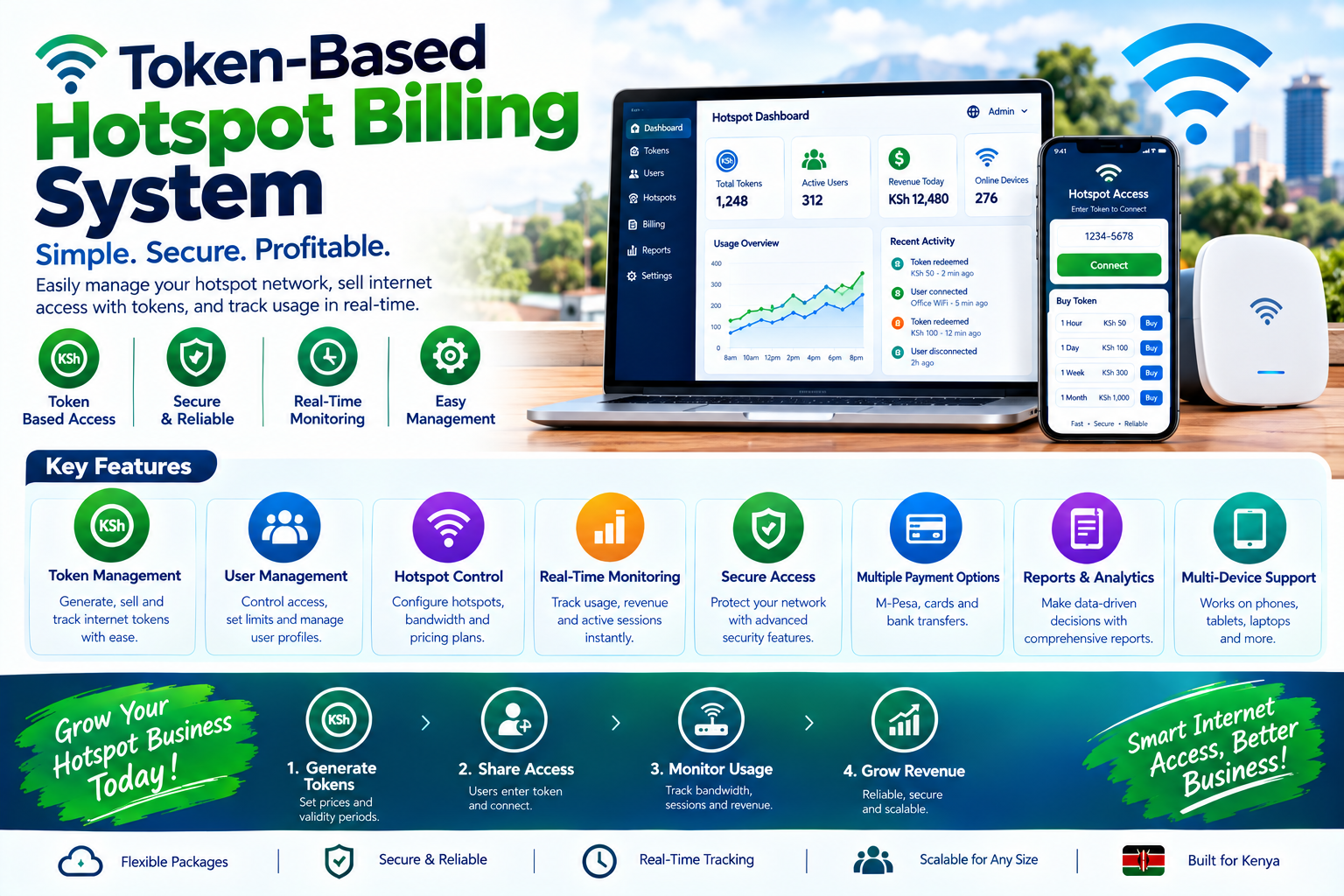
Token-based hotspot billing system technology is the quiet engine behind more internet businesses in this country than any other model — a simple, brilliant arrangement where a customer pays, receives a unique code, and types that code to unlock the internet.
It is the system behind the scratch cards sold at kiosks, the codes printed for events, the session keys delivered by M-Pesa at midnight.
Before sophisticated portals and accounts existed, the token-based hotspot billing system model is what made selling internet person-by-person possible at all.
And far from being outdated, it remains the most universally understood payment language in the connectivity business.
Every customer in the market already knows how a token works — because they use the same logic daily with airtime cards and electricity units.
This article explores the complete anatomy of a token-based hotspot billing system: how it works, why it won, where it shines, and how modern platforms have made it stronger than ever.
What a Token-Based Hotspot Billing System Actually Is
Strip away the jargon and the concept is beautifully concrete.
A token is a unique code — usually a string of characters or digits — that represents a purchased amount of internet: two hours of access, a gigabyte of data, a day of browsing.
A token-based hotspot billing system generates these codes, attaches rules to each one, and enforces those rules automatically when a customer redeems.
The customer’s journey takes three steps: pay for the token, receive the code, enter it on the login page.
From that moment, the system tracks the purchase — counting down the time or data — and cuts access cleanly when the allocation ends.
No account creation, no passwords to remember, no personal details required.
This simplicity is the strategic genius of the token-based hotspot billing system: it matches the customer’s mental model perfectly, because buying internet by code feels exactly like buying airtime by card.
The operator’s side is equally clean.
Every token is a discrete product — generated, sold, redeemed, and recorded — which makes the entire revenue operation countable, auditable, and reportable.
That dual simplicity, on both sides of the counter, is why the token-based hotspot billing system became the default architecture for paid WiFi across the continent.
Why Tokens Won the Market
The token model did not win by accident; it won because it solved the market’s hardest problems with the simplest possible tool.
The first problem it solved was trust.
In a market where customers hesitate to create accounts or share personal details, a token-based hotspot billing system asks for nothing — pay, receive a code, get online.
The anonymity lowers the barrier to purchase dramatically, and first-time buyers convert without hesitation.
The second problem was cash handling.
Tokens created a clean product for counter sales: the customer hands over fifty shillings, the attendant hands over a printed code, and both parties can see exactly what was exchanged.
The third problem was enforcement.
Before tokens, controlling who used a network meant chasing people physically.
After tokens, the token-based hotspot billing system enforced access automatically — a code without remaining time simply stopped working, and no argument could extend it.
The fourth problem was scale.
An operator could sell tokens through any number of intermediaries — attendants, shops, resellers — because each code was self-contained and pre-paid.
Distribution became as easy as selling airtime scratch cards, which is exactly the model the token-based hotspot billing system borrowed and perfected.
How the System Actually Works
The mechanics of a token-based hotspot billing system unfold in a clean sequence that repeats thousands of times daily across the market.
Step one: generation.
The operator defines their packages — one hour, three hours, one day, one week — and the system generates unique codes for each, in any quantity, instantly.
Step two: distribution.
Codes reach customers through printed cards, SMS delivery, reseller networks, or automated mobile money flows.
Step three: redemption.
The customer connects to the network, lands on the login page, and enters their code.
Step four: activation.
The token-based hotspot billing system validates the code, checks it has not been used, and opens the session with the purchased limits attached.
Step five: enforcement.
The system counts down the allocation in real time — minutes, megabytes, or both — and ends access precisely when the purchase is consumed.
Step six: the record.
Every token’s life cycle — generated, sold, redeemed, exhausted — is logged with timestamps, giving the operator a complete audit trail.
This six-step loop is the complete architecture of a token-based hotspot billing system, and its beauty lies in requiring no human judgment at any point.
The system never forgets a code, never miscounts a balance, and never extends a session out of sympathy.
The Types of Tokens
A flexible token-based hotspot billing system offers several token types, each suited to different customers and business models.
Time tokens are the classic: two hours, twelve hours, three days — the customer buys duration and the clock runs whenever they are connected.
Data tokens flip the logic: the customer buys megabytes or gigabytes, and the allocation drains with usage rather than with the clock.
Combined tokens carry both limits together — two hours and one gigabyte — ending when either runs out.
Speed-tiered tokens add the premium dimension: same duration, different velocity, letting the token-based hotspot billing system sell a fast lane to customers who need it.
Single-use tokens bind to one device and die after one session — the standard for walk-in traffic and events.
Multi-use tokens survive logout and login, serving regulars across days — the format behind weekly and monthly passes.
The operators who master their token-based hotspot billing system menu match each token type to a real customer segment, building a product line as varied as the street it serves.
Generating and Managing Tokens at Scale
Modern token-based hotspot billing system platforms have turned token generation from a chore into a two-minute task.
The operator selects a package, enters a quantity, and the system produces codes in bulk — a thousand ready to sell before the tea goes cold.
Batch management keeps the operation organized: every batch carries its package, price, creation date, and status, so the operator always knows what exists and what has sold.
Batch tracking also powers the reseller model.
Codes assigned to a reseller are tracked separately, letting the operator see exactly which agent sold what — and settle commissions from records rather than memory.
Expiry controls add another management layer: tokens can carry validity windows, so unsold stock from a promotion does not linger forever.
The strongest token-based hotspot billing system platforms also support token profiles — saved templates that make regenerating a favorite package a single click.
For operators running multiple locations, centralized generation means codes minted once work across the whole network.
That centralization turns a token-based hotspot billing system from a single-shop tool into a distribution platform — one code library serving every site the business grows into.
Printed Cards Versus Digital Delivery
Every token-based hotspot billing system operator eventually chooses between two delivery worlds: physical cards and digital codes — and the strongest businesses run both.
Printed cards are the tangible classic.
Codes printed on scratch cards, receipts, or simple paper slips — sold at counters, stocked in shops, handed to friends.
Their power is physicality: a customer holding a card holds something real, and printed token-based hotspot billing system stock can sit in a dozen retail points around the neighborhood, selling while the operator sleeps.
Digital delivery is the modern evolution.
Codes sent by SMS after an M-Pesa payment, displayed instantly on the payment page, or delivered automatically the moment a purchase confirms.
No printing, no stock, no physical loss — the token-based hotspot billing system supply chain becomes pure software.
The hybrid model captures everything.
Walk-in customers buy printed cards; phone-first customers buy digital codes; the same token library serves both.
Operators who tracked their sales across both channels consistently report the same finding: digital grows fastest, but printed token-based hotspot billing system stock keeps selling in corners digital alone never reaches.
M-Pesa and the Automated Token
The single biggest leap in the token model’s history was wiring it directly to mobile money — turning the token-based hotspot billing system from a counter business into an always-on one.
The automated flow is elegantly simple.
The customer selects a package, an M-Pesa prompt lands on their phone, they enter their PIN, and their unique token arrives by SMS or on-screen within seconds.
No attendant, no card, no counter hours — the token-based hotspot billing system sells at 6 a.m., at midnight, and through every Sunday in between.
Reconciliation completes the automation: every payment matches to a generated token automatically, so no money ever arrives without its code.
For the operator, this changes the shape of the business entirely.
Collections stop depending on presence — which is why operators who automated their token-based hotspot billing system flows report immediate revenue jumps from hours they never used to sell.
The data confirms what the sales do: every automated purchase is timestamped, matched, and reported — turning the token operation into a self-documenting business.
That is the modern standard: a token-based hotspot billing system where the oldest model in the market runs on the newest rails it can get.
Enforcement: Where Tokens Earn Their Keep
The enforcement layer is where a token-based hotspot billing system proves its worth daily — because a token is only as valuable as the system’s refusal to honor anything else.
Single-device binding is the first discipline: each token locks to the first device that redeems it, ending the era of one card serving a hostel corridor.
Session expiry is the second: when the allocation runs out, access ends precisely — no grace leak, no manual cutoff, no argument.
Concurrent-login blocks form the third: a token cannot log in on two devices at once, no matter how it is shared.
Speed and priority enforcement adds the fourth: tokens carrying premium tiers receive their promised performance, enforced at network level rather than promised on the card.
Together, these rules make the token-based hotspot billing system airtight — every purchase serves exactly one customer for exactly what was paid.
The revenue impact is immediate and measurable.
Operators who tightened enforcement on their token-based hotspot billing system deployments routinely recover double-digit percentages that sharing and leakage had quietly drained.
And enforcement protects fairness too: the honest customer stops subsidizing the sharer, which is why tightened rules consistently improve customer satisfaction rather than damaging it.
Designing the Token Menu
The token menu is the token-based hotspot billing system storefront, and its design decides who buys what.
The proven pattern is a ladder, not a list.
A short, cheap token at the bottom catches first-timers and quick checkers.
A middle token — priced as the obvious value — serves the daily mainstream.
A long token at the top converts regulars into committed revenue.
Speed tiers weave through the ladder where the network can deliver them honestly.
The pricing reference is always the customer’s alternative: the data bundle on their own SIM.
Tokens priced visibly below bundle value win by default — the structural advantage every token-based hotspot billing system operator holds over the carriers.
Off-peak tokens are the ladder’s secret rung: discounted codes valid only in quiet hours, turning idle capacity into revenue.
The operators who read their token-based hotspot billing system sales reports monthly refine the ladder against evidence — and a well-tuned menu can double revenue without a single new customer.
The Mistakes That Undermine Token Operations
The recurring failures are well known, and naming them is cheaper than making them.
The first is the shared-code leak: running a token-based hotspot billing system without device binding, then wondering why three customers share every purchase.
The second is stock chaos — printed codes scattered across shops and pockets with no batch tracking, so reconciliation becomes guesswork.
The third is the stale menu: tokens priced in last year’s market, untouched since launch.
The fourth is ignoring redemption data: every unused and expired token in the token-based hotspot billing system records tells the operator which packages missed — a free consulting report most never open.
The fifth is the security lapse: default passwords on the system itself, inviting anyone who guesses them to mint their own tokens.
The sixth is no backups — the token library and its records living on one fragile device.
The seventh is treating resellers as informal: codes handed out on trust, settled on memory, and disputed every month-end.
Each mistake is fixable in an afternoon, and the operators who fixed them watch their token-based hotspot billing system numbers straighten out within the first quarter.
Scaling: Tokens as a Distribution Business
The token model scales differently from every other billing architecture — and that difference is its greatest growth advantage.
Because tokens are self-contained products, they travel through any distribution channel: attendants, kiosks, shopkeepers, and agents can all sell without training or equipment.
This turns the token-based hotspot billing system into a network effect: every new retail point becomes a selling location for the same inventory.
The reseller layer runs on clean mechanics: batches assigned to agents, sales tracked per code, commissions settled from records.
Agents can check stock and sales on their phones, and the operator sees the whole distribution map from one dashboard.
Multi-site operators gain the same leverage internally: one token-based hotspot billing system library serving every mast, with per-location reporting intact.
The growth story of the market’s largest operators is, at its core, a distribution story — and the token-based hotspot billing system is the architecture that made distribution possible.
The Payoff: What the Model Delivers
Ask veteran operators what their token-based hotspot billing system ultimately gave them, and the answers converge.
Simplicity that sells: a product every customer understands instantly, requiring no explanation, no onboarding, and no trust-building.
Control that holds: enforcement so precise that revenue leaks became visible, measurable, and fixable.
Distribution that scales: sales through every counter in the neighborhood, settled from records rather than relationships.
And an operation that audits itself: every token tracked from mint to expiry, giving the owner numbers they can actually trust.
The model’s longevity is the final proof.
Every newer billing fashion has eventually borrowed the token’s logic — codes, allocations, prepaid units — because the token-based hotspot billing system captured something permanent about how this market buys.
Frequently Asked Questions
Do tokens still make sense in the era of portals and accounts?
Yes — and modern platforms blend them: accounts for regulars, tokens for walk-ins and resale.
The flexibility of a token-based hotspot billing system that supports both is the current best practice.
How do I stop one token from being shared?
Device binding and concurrent-login blocks tie each code to one device at a time.
This enforcement is standard in any professional token-based hotspot billing system and recovers the revenue sharing quietly drains.
Can tokens be delivered automatically after M-Pesa payment?
Yes — payment confirmation triggers instant SMS or on-screen delivery of the code.
This automation is the defining upgrade of the modern token-based hotspot billing system, expanding selling hours to all twenty-four.
What happens to unused tokens?
They sit until redeemed or until their validity window closes — and their expiry patterns show up in reports, telling the operator which packages overstocked.
That visibility is one of the quiet advantages of running a token-based hotspot billing system with proper tracking.
Can different locations use the same tokens?
On centralized platforms, yes — codes minted once redeem across the whole network, with per-site reporting preserved.
Multi-location operators standardize on this token-based hotspot billing system architecture to keep inventory simple.
How many tokens can a system generate?
Practically unlimited — modern platforms mint codes in thousands per batch without strain.
The generation ceiling of a token-based hotspot billing system is rarely the constraint; distribution is where the real work lives.
Can tokens carry both time and data limits?
Yes — combined tokens end when either allocation runs out, matching real customer usage patterns.
This flexibility is a core feature of any capable token-based hotspot billing system.
What protects the system from code fraud?
Strong admin credentials, encrypted code generation, and single-use validation — a code cannot redeem twice, and nobody outside the platform can mint one.
Security discipline is what keeps a token-based hotspot billing system trustworthy year after year.
Can resellers sell my tokens?
That is one of the model’s superpowers: batches assigned to agents, sales tracked per code, commissions settled from records.
The reseller network is how the biggest token-based hotspot billing system operations grew beyond their own counters.
What is the smartest first step for a new operator?
Design a three-rung ladder against local bundle prices, generate a small first batch, and place it in two real selling points with full tracking on.
That modest launch — measured, adjusted, and expanded — is exactly how every thriving token-based hotspot billing system business in the market began, and the operators who kept reading their token-based hotspot billing system reports as they grew are the ones still collecting today — one simple code at a time, through the token-based hotspot billing system that never stopped being the market’s favorite way to buy.