
How to Monetize WiFi Kenya: Real Profit Numbers, Startup Costs & Break-Even Calculator
The phrase how to monetize WiFi Kenya is becoming one of the most searched business opportunities among young entrepreneurs, campus investors, and small business owners in Kenya. The reason is simple: internet demand is exploding, but most explanations on the internet are vague, unrealistic, and lack actual numbers.
This guide changes that.
Instead of saying you “can earn good money,” we will break down exactly how to monetize WiFi Kenya using real Kenyan Shilling (KES) calculations, real hardware costs, real monthly expenses, and real break-even timelines.
If you are serious about understanding how to monetize WiFi Kenya, this is the most practical breakdown you will find.
Why People Are Searching How to Monetize WiFi Kenya
The demand for how to monetize WiFi Kenya is growing because:
- Mobile data is expensive
- Students need stable internet
- Apartments want shared WiFi
- Businesses need backup connectivity
- Events require temporary networks
But most importantly, people realize WiFi is no longer a luxury—it is a utility.
So learning how to monetize WiFi Kenya is becoming a serious income opportunity, not just a side hustle.
How to Build a Profitable WiFi Internet Business in Kenya: Real Costs, Revenue Models & Break-Even Analysis (2026 Guide)
Kenya is experiencing one of the fastest-growing demands for wireless internet services in Africa. From urban apartments to rural trading centers, from schools to events, connectivity is no longer optional—it is essential. This shift has created a powerful opportunity for entrepreneurs to build sustainable internet businesses using wireless infrastructure, proper billing systems, and structured customer management.
However, most online guides about WiFi businesses are overly optimistic and rarely provide real financial breakdowns. They often mention earnings without showing actual cost structures or break-even timelines. This guide corrects that by focusing strictly on real Kenyan Shilling (KES) figures, practical deployment scenarios, and realistic business outcomes.
Understanding the WiFi Internet Business Model in Kenya
A WiFi-based internet business works by purchasing bandwidth from upstream providers (fiber or satellite), distributing it wirelessly through routers and access points, and charging end users for access. Revenue is generated either through:
- Daily or hourly vouchers
- Monthly subscriptions
- Bulk institutional contracts
- Event-based internet provisioning
To operate efficiently, most providers rely on automated billing systems that integrate with M-Pesa for payments, manage user authentication, and control access.
Without automation, revenue leakage is common due to unpaid users, manual disconnections, and poor tracking.
Startup Costs Breakdown for a WiFi Business
Before starting, it is important to understand the capital required. Below is a realistic breakdown for a small to medium deployment.
| Item | Estimated Cost (KES) |
|---|---|
| MikroTik Router (Core Gateway) | 15,000 |
| Wireless Access Points (2–4 units) | 20,000 – 40,000 |
| Cabling & Installation | 10,000 |
| UPS Backup Power System | 12,000 |
| Site Setup & Configuration | 5,000 |
| Internet Activation Fees | 5,000 |
| Satellite Internet Kit (optional) | 50,000 |
| Branding & Signage | 5,000 |
| Contingency Costs | 8,000 |
Total Estimated Investment:
- Fiber-based setup: KES 75,000 – 90,000
- Satellite-based setup: KES 120,000+
This capital determines the scale and speed of return on investment.
Monthly Operating Costs
Running a WiFi business involves recurring expenses that directly impact profitability.
| Expense | Monthly Cost (KES) |
|---|---|
| Internet Bandwidth | 5,000 – 20,000 |
| Electricity | 1,500 – 3,000 |
| Maintenance & Repairs | 1,000 – 2,000 |
| Customer Support | 2,000 – 5,000 |
| Miscellaneous Costs | 1,500 |
| Payment Processing Fees (5%) | Variable |
The key variable expense is transaction fees, especially when using mobile money payments at scale. Automation systems help reduce operational inefficiencies and ensure accurate billing.
Revenue Model 1: Residential Apartment Deployment
One of the simplest entry points is serving apartment blocks.
Assumptions:
- 10 units available
- 80% occupancy rate
- Monthly fee per user: KES 1,500
Revenue:
8 users × 1,500 = KES 12,000/month
Expenses:
- Internet: 5,000
- Electricity: 1,500
- Maintenance: 1,000
- Transaction fees (5%): 600
Total Costs:
KES 8,100
Monthly Profit:
KES 3,900
Break-even Period:
Initial investment (KES 75,000 ÷ 3,900) = 19 months
This model is stable but slow in return. It is ideal for beginners testing the market.
Revenue Model 2: High-Traffic Roadside Hotspot
This is one of the most common setups in Kenya, especially in towns, bus stations, and markets.
Assumptions:
- 50 daily users
- Average spend per user: KES 20
- 30 operational days
Revenue:
50 × 20 × 30 = KES 30,000/month
Expenses:
- Internet: 5,000
- Electricity: 1,500
- Maintenance: 1,000
- Transaction fees (5%): 1,500
Total Costs:
KES 9,000
Monthly Profit:
KES 21,000
Break-even Period:
75,000 ÷ 21,000 = 3.6 months
This model scales quickly due to high user volume and low entry pricing.
Revenue Model 3: School Internet Deployment
Educational institutions are among the most profitable long-term clients.
Assumptions:
- 300 students
- Monthly fee per student: KES 300
Revenue:
300 × 300 = KES 90,000/month
Expenses:
- Dedicated bandwidth: 20,000
- Electricity: 2,000
- Support: 5,000
- Transaction fees (5%): 4,500
Total Costs:
KES 31,500
Monthly Profit:
KES 58,500
Break-even Period:
75,000 ÷ 58,500 = 1.3 months
This is one of the fastest ROI models due to predictable payments and large user base.
Revenue Model 4: Event-Based Internet Provisioning
Temporary internet setups for weddings, conferences, and exhibitions are highly profitable.
Assumptions:
- 4 events per month
- Revenue per event: KES 20,000
Revenue:
4 × 20,000 = KES 80,000/month
Expenses:
- Bandwidth allocation: 15,000
- Transport & logistics: 5,000
- Electricity: 2,000
- Transaction fees: 4,000
Total Costs:
KES 26,000
Monthly Profit:
KES 54,000
Break-even Period:
75,000 ÷ 54,000 = 1.4 months
This model is highly scalable with proper marketing and partnerships.
Comparative Profit Summary
| Model | Monthly Profit | Break-even |
|---|---|---|
| Apartment WiFi | 3,900 | 19 months |
| Roadside Hotspot | 21,000 | 3.6 months |
| School Deployment | 58,500 | 1.3 months |
| Event WiFi | 54,000 | 1.4 months |
The results clearly show that location and customer density determine profitability more than technical setup.
Risks in WiFi Internet Businesses
Every internet distribution business has risks that must be managed.
1. Poor Location Selection
Low traffic areas lead to weak revenue.
2. Internet Downtime
Frequent outages lead to customer churn.
3. Revenue Leakage
Manual billing systems often lose money.
4. Equipment Theft or Damage
Outdoor hardware is vulnerable.
5. Underpricing Services
Competing solely on price reduces profitability.
Proper planning and automation significantly reduce these risks.
Importance of Billing Automation
Modern WiFi businesses rely heavily on automated systems to manage users, payments, and access control.
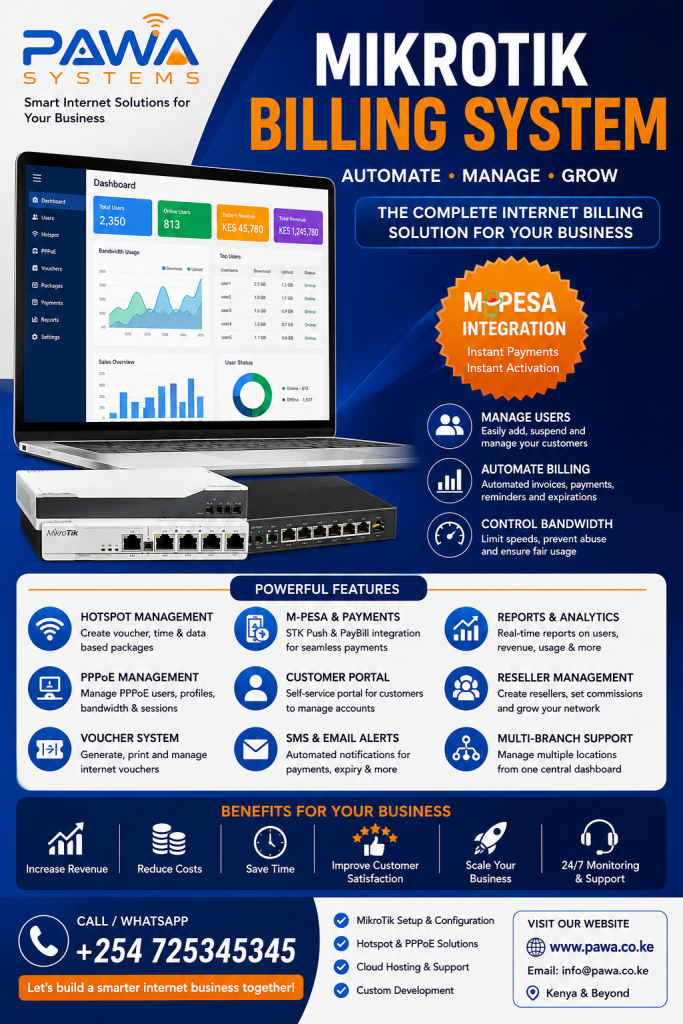
Platforms like https://pawa.co.ke allow operators to:
- Automate M-Pesa payments
- Activate and deactivate users instantly
- Monitor revenue in real time
- Reduce manual workload
- Scale operations across multiple locations
Without automation, scaling becomes difficult and revenue losses increase.
Start Building Your Internet Business
To streamline operations, manage customers, and automate billing from day one, use a professional system built for African ISPs.
Visit:
https://pawa.co.ke
and start building a scalable internet business today.
Startup Costs for WiFi Monetization in Kenya
Before you understand how to monetize WiFi Kenya, you must understand the startup cost structure.
Startup Cost Table
| Item | Estimated Cost (KES) |
|---|---|
| MikroTik Router | 15,000 |
| Access Points (2 units) | 20,000 |
| Installation & Cabling | 10,000 |
| UPS Backup Power | 12,000 |
| Internet Setup Fees | 5,000 |
| Starlink Kit (optional) | 50,000 |
| Billing System (Pawa) | 0–5,000 |
| Branding & Marketing | 5,000 |
| Miscellaneous | 8,000 |
| Total (Fiber Setup) | 75,000 |
| Total (Starlink Setup) | 120,000+ |
You cannot properly understand how to monetize WiFi Kenya without knowing these baseline costs.
For Starlink hardware reference:
SpaceKit Starlink Kenya
Monthly Operating Costs
To successfully implement how to monetize WiFi Kenya, you must account for monthly expenses.
| Expense | Cost (KES) |
| Internet Backhaul | 5,000 |
| Electricity | 1,500 |
| Maintenance | 1,000 |
| Customer Support | 2,000 |
| Miscellaneous | 1,500 |
| Pawa Fee (5%) | Variable |
Understanding these costs is critical when learning how to monetize WiFi Kenya because profit is not revenue—it is revenue minus expenses.
Revenue Models: How to Monetize WiFi Kenya in 4 Scenarios
Below are realistic models showing how to monetize WiFi Kenya in different environments.
1. 10-Unit Apartment Model
A simple way to start how to monetize WiFi Kenya is apartment WiFi.
- 10 tenants
- KES 1,500 per month
- 80% occupancy
Revenue:
8 × 1,500 = KES 12,000
Costs: KES 8,100
Profit: KES 3,900
Break-even: 19 months
This shows that how to monetize WiFi Kenya in apartments is stable but slow.
2. Roadside WiFi Kiosk
A faster way to implement how to monetize WiFi Kenya.
- 50 users daily
- KES 20 per session
- 30 days
Revenue: KES 30,000
Costs: KES 9,000
Profit: KES 21,000
Break-even: 3.6 months
This is one of the most popular ways of how to monetize WiFi Kenya in urban areas.
3. School WiFi Network
Schools are high-value clients in how to monetize WiFi Kenya strategies.
- 300 students
- KES 300 monthly fee
Revenue: KES 90,000
Costs: KES 31,500
Profit: KES 58,500
Break-even: 1.3 months
Schools are the fastest route in how to monetize WiFi Kenya.
4. Event WiFi Model
Temporary WiFi is highly profitable.
- 4 events monthly
- KES 20,000 per event
Revenue: KES 80,000
Costs: KES 26,000
Profit: KES 54,000
Break-even: 1.4 months
Event WiFi is one of the most aggressive strategies in how to monetize WiFi Kenya.
Break-Even Summary
| Model | Profit | Break-Even |
| Apartment | 3,900 | 19 months |
| Kiosk | 21,000 | 4 months |
| School | 58,500 | 1–2 months |
| Events | 54,000 | 1–2 months |
The conclusion is simple: how to monetize WiFi Kenya depends heavily on location and user density.
Ongoing Risks When Learning How to Monetize WiFi Kenya
Even though how to monetize WiFi Kenya is profitable, there are risks:
1. Poor Location
Low traffic kills revenue.
2. Internet Downtime
Users leave immediately when service is unstable.
3. Manual Billing Losses
Without automation, money is lost daily.
4. Theft & Hardware Damage
Outdoor equipment is vulnerable.
5. Pricing Mistakes
Too cheap = no profit.
Proper planning is essential when learning how to monetize WiFi Kenya.
Billing Automation Advantage
A major part of how to monetize WiFi Kenya is automation.
Using systems like Pawa ISP Billing System allows you to:
- Auto-activate users via M-Pesa
- Disconnect expired accounts
- Track revenue in real time
- Reduce manual errors
- Scale faster
Without automation, how to monetize WiFi Kenya becomes inefficient and unscalable.
Is It Worth Learning How to Monetize WiFi Kenya?
Yes—but only if done correctly.
Here is the truth:
- Apartments = slow returns
- Kiosks = medium returns
- Schools = fast returns
- Events = very fast returns
The success of how to monetize WiFi Kenya depends on:
- Customer density
- Automation system
- Internet reliability
- Pricing strategy
If these align, how to monetize WiFi Kenya becomes a strong income business.
Hidden Costs People Ignore
When learning how to monetize WiFi Kenya, most beginners ignore:
- Equipment replacement every 12–18 months
- Power fluctuations
- Customer churn
- Support calls
- Seasonal demand drops
These reduce profitability if not planned for.
Advanced Profit Insight
One key insight in how to monetize WiFi Kenya is this:
Profit does NOT come from internet speed—it comes from user management efficiency.
That is why systems like Pawa are central to how to monetize WiFi Kenya effectively.
FAQ: How to Monetize WiFi Kenya
1. How much do I need to start?
Around KES 75,000–130,000 depending on setup.
2. Do I need a billing system?
Yes. It is essential for how to monetize WiFi Kenya successfully.
3. Is Starlink good for WiFi businesses?
Yes, especially in rural areas.
4. How fast is ROI?
Between 1 month and 19 months depending on model.
5. What is the best model?
Schools and kiosks are the fastest ways of how to monetize WiFi Kenya.
Is a WiFi Business Worth It?
Yes, but only under the right conditions.
The most successful operators typically:
- Choose high-density environments
- Use automated billing systems
- Maintain stable internet connections
- Focus on customer experience rather than just pricing
The reality is that this business is not passive. It requires monitoring, maintenance, and strategic expansion.
However, when executed correctly, it becomes one of the most scalable small infrastructure businesses in Kenya.
Key Success Factors
- Location selection is critical
- Automation improves profitability
- Customer density drives revenue
- Reliability builds retention
- Cost control ensures sustainability
Final Thoughts
The WiFi internet business model in Kenya is evolving rapidly. With increasing digital demand, entrepreneurs who adopt structured systems and proper financial planning can build highly profitable operations.
However, success depends on execution—not assumptions.
Those who invest in automation, understand their numbers, and choose the right deployment model will scale faster and more efficiently than those relying on manual systems.
Understanding how to monetize WiFi Kenya is not just about installing routers or buying internet.
It is about building a structured, automated, and scalable business.
If you want to succeed in how to monetize WiFi Kenya:
- Choose high-traffic areas
- Use automation tools
- Control costs
- Track revenue
- Scale smartly
Start Your WiFi Business Today
If you’re serious about learning how to monetize WiFi Kenya, the fastest way to start is using a complete billing and automation system.
Start now with:
Turn your WiFi idea into a real business today.