What a Wifi Billing Platform Actually Does (No Guesswork)
Every Kenyan operator searching for a Wifi Billing Platform wants the same thing: a clear answer on cost, profit, and risk before spending a single shilling. Search “Wifi Billing Platform” in Kenya and you will find the same five promises repeated on almost every site: “turn your internet into a powerful business tool,” “start earning instantly,” “revenue grows exponentially,” and “your salary is a function of foot traffic.”
None of those lines tell you what a voucher actually sells for, how many routers you need, or how long it takes to recover your capital. This article does the opposite. Every number below is a real shilling figure you can check on a calculator, because a Wifi Billing Platform is only worth building around if the math behind it survives contact with an actual Kenyan estate, shop, or trading centre.
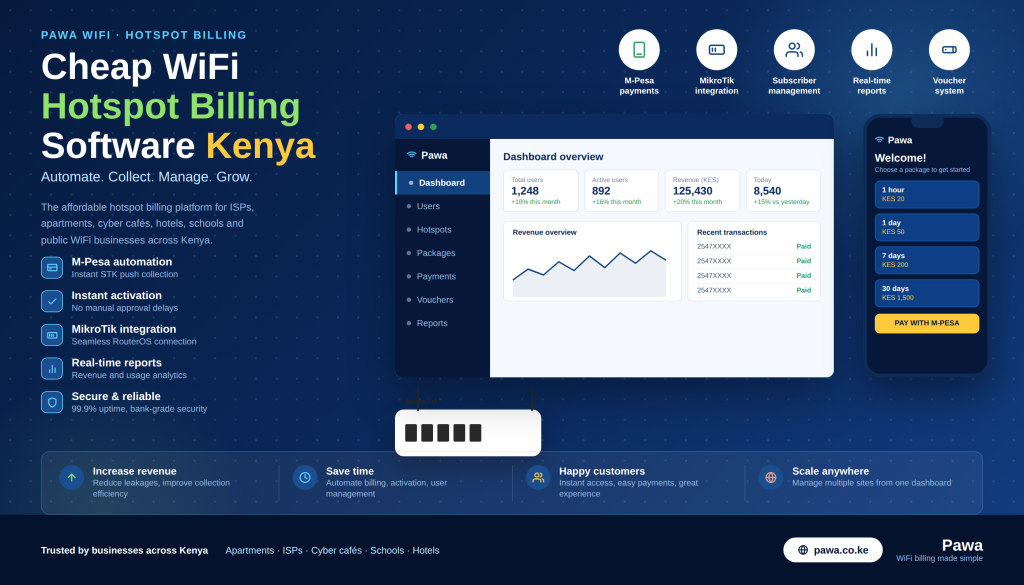
A Wifi Billing Platform is the software layer that sits between your router and your customer’s phone. It generates vouchers, meters data or time, accepts M-Pesa payments through STK Push or Paybill, disconnects users automatically when their package expires, and gives you a dashboard showing exactly how much money moved through your network on any given day. Without it, you are running a free WiFi spot with a password taped to the wall. With it, you are running a metered, billed, auditable internet business — which is the entire difference between a hobby and a business that survives past month three. Understand more how Wifi Billing Platform works on pawa.co.ke
The Real Startup Cost of a Wifi Billing Platform Setup
Most blog posts quote a “start for as little as KES 500” figure and stop there, which is technically true but practically misleading, because KES 500 buys you a software licence fee, not a working hotspot.
A realistic first deployment for one location — say a 40-unit apartment block in Kahawa Wendani or a shopping arcade in Nakuru — needs a MikroTik hRB951 or hAP ac2 router (roughly KES 8,500 to KES 14,000), an indoor or outdoor access point to cover the full compound (KES 3,500 to KES 9,000 depending on range), a weatherproof cable run and connectors (about KES 2,000), and the upstream internet connection itself, which in most Kenyan towns now runs KES 4,000 to KES 8,000 per month for a dedicated 10 Mbps to 20 Mbps fibre or wireless link from a local ISP.
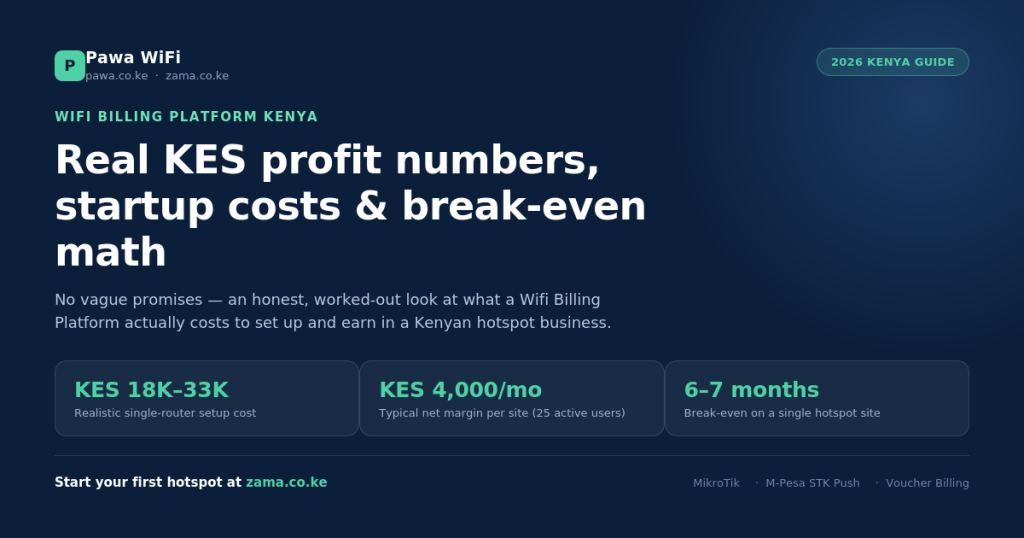
Add the Wifi Billing Platform software itself. Pawa’s managed onboarding for a single-router site typically lands between KES 3,000 and KES 6,000 as a one-time configuration fee, covering MikroTik hotspot setup, M-Pesa Paybill or Till linkage, and your branded login page. Stack all of that together and a single-site, single-router rollout costs roughly KES 18,000 to KES 33,000 in hardware and setup, plus your first month of upstream bandwidth. That is the number worth budgeting against — not the KES 500 headline that ignores everything except the software licence.
If you are scaling to three or four routers across one estate, expect total hardware and setup costs of roughly KES 55,000 to KES 95,000, since you are buying multiple access points but only one upstream bandwidth contract and one billing dashboard. This is where a proper Wifi Billing Platform earns its keep: one dashboard controlling four routers is dramatically cheaper to run than four separate logins, four separate M-Pesa reconciliations, and four sets of vouchers printed by hand.
Voucher Pricing: What Kenyan Hotspot Customers Actually Pay
Pricing on most competitor sites is described only in adjectives — “affordable,” “competitive,” “attractive packages.” In practice, Kenyan hotspot operators running a Wifi Billing Platform in residential estates or trading centres tend to converge on a narrow band of prices because customers compare them against mobile data bundles. A common structure looks like this: KES 10 for 30 minutes, KES 20 for 2 hours, KES 50 for a full day (24 hours), and KES 300 to KES 500 for a 7-day unlimited or capped package. In student-heavy areas near Meru, Eldoret, or Egerton, the KES 20 two-hour voucher and the KES 50 day pass are typically the two best sellers, often making up 60% to 70% of total voucher volume.
Take a single MikroTik router serving a 40-unit residential block. If 25 of those 40 units actively buy vouchers (a realistic adoption rate for year one, not the unrealistic “100% of tenants” assumption some sites imply), and each active household spends an average of KES 400 per month split between day passes and the 7-day package, your gross monthly voucher revenue from that single site is 25 × KES 400 = KES 10,000. Subtract your upstream bandwidth cost of roughly KES 6,000 and you are left with about KES 4,000 in monthly margin from one router, before accounting for any reseller commission your Wifi Billing Platform provider charges.
That single-router number looks unglamorous next to claims of “exponential growth,” but it is the honest base case. The real opportunity in a Wifi Billing Platform business is not one router — it is replication. An operator running six similar sites across Ruiru, Thika Road, and Kahawa West, each generating that same KES 4,000 net margin, is looking at roughly KES 24,000 per month in combined profit, with one shared dashboard, one support number, and centrally managed vouchers rather than six disconnected operations.
Break-Even Math: How Long Until a Wifi Billing Platform Pays for Itself
Using the single-site numbers above — an initial outlay of roughly KES 25,000 (mid-range of the 18,000 to 33,000 band) and a net monthly margin of about KES 4,000 — simple division gives a break-even point of 25,000 ÷ 4,000, which is 6.25 months. Round upward for safety and a realistic single-router Wifi Billing Platform deployment in a mid-density estate pays back its hardware and setup cost in about 6 to 7 months, assuming steady 25-household adoption and no major equipment failure.
If adoption is slower — say only 15 of 40 units buying vouchers in the first quarter, which is common while you are still building trust and word-of-mouth — monthly margin drops to roughly 15 × 400 minus 6,000, or KES 0, meaning you are at breakeven on operating costs but not yet recovering hardware. That scenario typically resolves within two to three months as referrals kick in, since WiFi adoption in Kenyan estates tends to follow a slow-start, then word-of-mouth curve rather than instant uptake. Anyone telling you a Wifi Billing Platform guarantees full adoption from week one is skipping this ramp-up period entirely.
On the upside, a high-density site — a 100-unit apartment complex or a busy market arcade — can flip those numbers considerably. At 50 active buyers spending the same KES 400 average, gross revenue rises to KES 20,000 per month, and after roughly KES 8,000 in bandwidth for the higher load, net margin reaches about KES 12,000 monthly. Against a similar KES 28,000 setup cost for the heavier-duty access point such a site needs, that is a break-even of just over two months. This is why location selection matters more than almost any other variable in a Wifi Billing Platform rollout — the software cost barely changes between a 40-unit and 100-unit site, but the revenue ceiling roughly doubles.
What Makes One Wifi Billing Platform Different From Another
Once the hardware and pricing are sorted, the actual software differences between providers come down to five practical things, and they rarely get spelled out clearly in marketing copy. First is payment reliability: an M-Pesa STK Push that fails silently during peak evening hours costs you real shillings in abandoned purchases, so ask any Wifi Billing Platform vendor for their STK Push success rate, not just whether they “support M-Pesa.” Second is auto-disconnection accuracy — a platform that lets expired users linger online for an extra hour is quietly giving away free internet, which on a KES 20 two-hour voucher product can erode 10% or more of revenue if disconnection lag is consistent.
Third is multi-router management. If you plan to scale past one site, confirm the dashboard genuinely supports centralized control across locations rather than requiring you to log into each MikroTik router separately — this single feature is often the difference between managing four sites in twenty minutes a day versus two hours. Fourth is reporting depth: daily revenue, voucher redemption rate, and peak usage hours let you adjust pricing intelligently, for example raising the 2-hour voucher from KES 20 to KES 25 if redemption data shows demand holding steady at the lower price — a five-shilling increase across 600 monthly vouchers is an extra KES 3,000 a year you would otherwise leave unclaimed.
Fifth is support responsiveness, since a router outage at 7 PM on a Friday in a 100-unit complex can cost you the KES 700 to KES 1,000 in voucher sales that evening alone if nobody answers the phone.
Pawa WiFi (operating at pawa.co.ke) and its sister platform zama.co.ke are built around exactly these five points: MikroTik configuration handled for you, M-Pesa STK Push and Paybill collection wired directly into the billing engine, multi-site dashboards for operators running more than one router, and Kenyan-based support reachable on WhatsApp rather than an offshore ticketing queue. If you are comparing options, it is worth reading independent overviews such as TechTarget’s explanation of captive portal billing and the Communications Authority of Kenya’s guidance on internet service provision to understand the regulatory and technical baseline any billing platform should meet.
Risk Section: What Can Go Wrong With a Wifi Billing Platform, and How to Mitigate It
No honest article skips the downside, and a Wifi Billing Platform carries five risks worth budgeting for before you sign anything.
Bandwidth oversubscription: Selling more vouchers than your upstream link can handle causes buffering complaints and refund requests. Mitigation: cap concurrent users per router using the platform’s bandwidth management tools, and budget for an upstream upgrade once you cross roughly 30 simultaneous active users on a 10 Mbps line.
Equipment theft or weather damage: Outdoor access points in Kenya are exposed to lightning, rain, and theft, particularly in semi-secured compounds. Mitigation: budget an extra KES 1,500 to KES 2,500 for surge protection and mount hardware in a locked, elevated enclosure; most insurers will not cover unsecured rooftop equipment.
M-Pesa downtime or STK failures: Safaricom’s payment rails occasionally experience peak-hour congestion, and a failed STK push at the wrong moment loses a sale. Mitigation: choose a platform that offers a fallback Paybill/Till manual-entry option alongside STK Push, so customers are never left with zero payment path.
Slow adoption in low-trust areas: New estates sometimes resist paying for WiFi after years of expecting free landlord-provided internet. Mitigation: run a 3-day free trial voucher for new residents in month one; the conversion-to-paid rate this generates typically offsets the trial cost within the first two weeks.
Underpricing relative to operating cost: Setting day-pass prices too low to compete on price alone can mean you are selling vouchers below your true cost per gigabyte once bandwidth, router depreciation, and support time are included. Mitigation: recalculate your cost-per-GB quarterly as bandwidth prices shift, rather than setting prices once and never revisiting them.
None of these risks are unique to any one vendor — they are structural to the WiFi resale business itself. A well-built Wifi Billing Platform reduces their impact through automation and reporting, but it cannot eliminate the underlying economics of bandwidth, hardware, and customer trust.
Is a Wifi Billing Platform Worth It? An Honest Verdict
Based on the numbers above, a single-site Wifi Billing Platform deployment is worth it if you have access to a location with at least 30 to 40 potential paying households or stalls, and if you can commit roughly KES 25,000 to KES 30,000 in upfront capital you are prepared not to touch for six to seven months. At that scale, the realistic outcome is modest but genuine: KES 4,000 to KES 8,000 in monthly net margin per site, growing meaningfully once you replicate the model across two or three more locations rather than expecting one router to make you wealthy.
It is not worth it as a get-rich-quick scheme, and any “quick profits” framing should be treated with suspicion. It is also not worth it in low-density, low-income areas where fewer than 15 households can realistically afford even a KES 50 day pass, since fixed bandwidth costs will outpace voucher revenue regardless of how good the software is. Where it consistently makes sense is for landlords with existing rental properties who already pay for internet infrastructure informally, for shop owners in busy trading centres with high foot traffic, and for small entrepreneurs willing to manage two or three sites as a genuine side business rather than a single experimental router.
The honest verdict: realistic, profitable, but gradual — not instant, and not exponential.
Getting Started the Right Way
If the math above makes sense for your location, the practical next step in choosing a Wifi Billing Platform is to start with a single, well-chosen site rather than overcommitting to four routers on day one. zama.co.ke offers an entry point for setting up your first metered hotspot with M-Pesa collection built in, letting you test real voucher demand in your specific estate or trading centre before scaling hardware spend. Pair that with Pawa’s MikroTik configuration support at pawa.co.ke once you are ready to add a second or third router, and you avoid the most common first-time mistake: buying hardware for four sites before confirming even one site converts.
Pawa is part of a wider family of Kenyan-built business systems under the Dexa/KayaPro umbrella, so if your operation grows beyond WiFi resale, the same group runs complementary tools worth knowing about: RentalDesk for property and rental management if you are billing WiFi inside apartments you also manage, Vega POS if your hotspot sits inside a retail shop needing point-of-sale alongside internet billing, and Dexa for broader HR, accounts, and workflow needs as your hotspot business formalizes into a registered company with staff and payroll to manage.
Frequently Asked Questions About Wifi Billing Platforms
1. How much does it cost to start a Wifi Billing Platform business in Kenya?
A single-router setup realistically costs KES 18,000 to KES 33,000 in hardware, installation, and software configuration, plus a recurring KES 4,000 to KES 8,000 monthly upstream bandwidth bill. Multi-router sites scale roughly linearly on hardware but share one bandwidth and dashboard cost, which is why a Wifi Billing Platform becomes more cost-efficient per router as you add sites.
2. How long does it take to break even on a hotspot billing setup?
Using realistic adoption of 25 paying households out of 40 units and KES 400 average monthly spend per household, break-even on a typical KES 25,000 setup lands at roughly 6 to 7 months. High-density sites with 50 or more active buyers can break even in as little as 2 months.
3. Can I run a Wifi Billing Platform without an ISP licence?
If you are reselling internet you already purchase from a licensed ISP within your own premises or compound, you generally operate as a reseller rather than a full ISP, but requirements vary by scale and location. Check current guidance directly from the Communications Authority of Kenya before scaling beyond a single site, since regulatory thresholds can change.
4. What is the most reliable payment method for a Wifi Billing Platform in Kenya?
M-Pesa STK Push is the standard for convenience since customers do not need to leave the login page, but pairing it with a Paybill or Till fallback for manual entry protects against the occasional STK failure during peak network congestion, preventing lost sales during your busiest evening hours.
5. Is it better to buy a Wifi Billing Platform outright or use a managed service?
For a first site, a managed Wifi Billing Platform service such as the one offered through zama.co.ke removes the need to configure MikroTik RouterOS, RADIUS authentication, and M-Pesa API integration yourself, which collectively can take a beginner two to three weeks of trial and error to get right. Once you are running three or more sites and have technical staff, self-managing becomes more cost-effective, but most operators are better served starting managed and graduating later.
Start Your Wifi Billing Platform With zama.co.ke
The numbers in this article are deliberately conservative, because a Wifi Billing Platform business that survives past its first year is built on realistic math, not inflated promises. If your estate, shop, or trading centre fits the adoption assumptions above, the fastest way to find out is to test it in the real world rather than keep reading projections. Start your first metered hotspot at zama.co.ke and get your M-Pesa billing, voucher system, and MikroTik configuration handled in one onboarding session, or reach the Pawa WiFi team directly through pawa.co.ke for a walkthrough of which router and package size matches the location you have in mind.