
How to Sell WiFi Like Airtime in Kenya: Intro
If you’ve searched “how to sell wifi like airtime,” you’ve probably noticed something: almost every article promises you “can earn up to” some impressive figure, but rarely shows the math behind it. This guide does the opposite. We’ll walk through exactly how to sell WiFi like airtime in Kenya, what it actually costs to start, and what you can realistically keep after expenses, using real KES figures instead of vague promises.
The idea itself is simple and already proven in the Kenyan market. Just as airtime resellers buy bulk credit and sell it in small denominations to walk-in customers, a WiFi hotspot operator buys one bulk internet connection and resells it in small, prepaid chunks — an hour, a day, a week — to people who need to get online. The model has worked in markets, estates, hostels, and matatu stages across the country for years, mainly because it solves a real problem: many Kenyans want internet access but can’t or won’t commit to a full monthly subscription. This pattern is the foundation of how to sell wifi like airtime profitably in almost any high-foot-traffic location.
What “Selling WiFi Like Airtime” Actually Means
When people talk about learning how to sell wifi like airtime, they’re describing a pay-as-you-go hotspot business. You set up one internet connection (fibre, Starlink, or a 4G/5G router), broadcast it through a router with hotspot software, and gate access behind a captive portal — the login page a customer sees before they can browse. Customers then pay for a voucher or M-Pesa code that unlocks a set amount of time or data, exactly the way they’d buy a paper airtime scratch card years ago, except now it’s usually handled over M-Pesa STK push or a paybill number rather than a physical card.
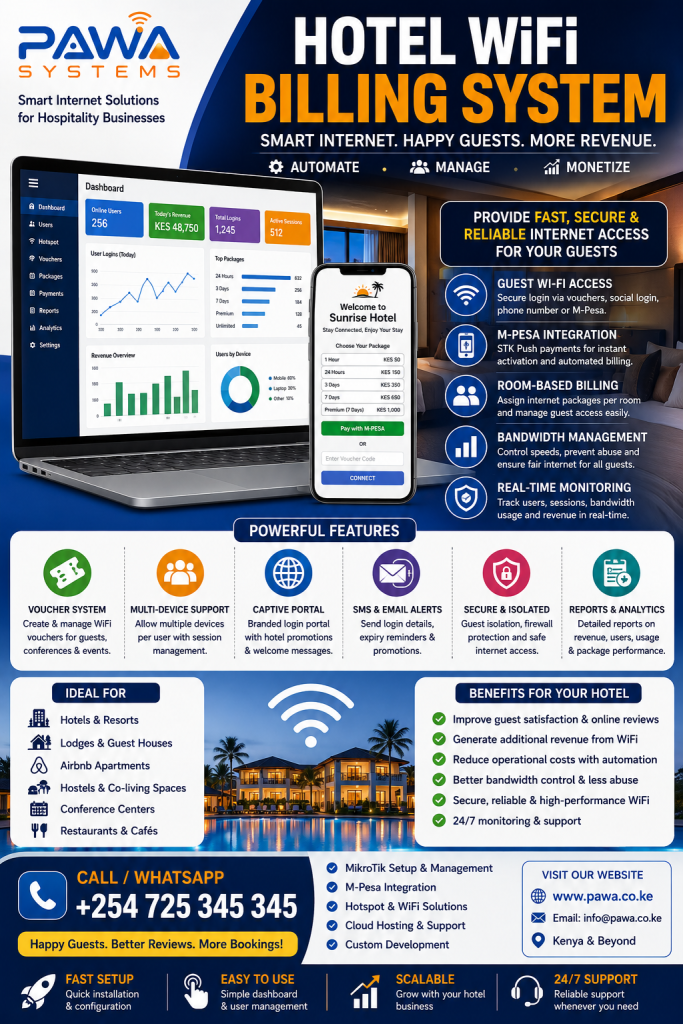
This is different from running a full Internet Service Provider. You’re not laying fibre or managing thousands of subscribers across a city; you’re monetizing one good connection at one or a few physical locations — a shop front, an estate gate, a market, or a building lobby — and letting your billing software, such as Pawa, handle authentication, time limits, and M-Pesa reconciliation automatically. It’s also why beginners ask how to sell wifi like airtime instead of building a full network from scratch.
How to Sell WiFi Like Airtime in Kenya: The 7-Step Process
1. Get Licensed Before You Get Paid
Selling internet access commercially in Kenya falls under the regulatory remit of the Communications Authority of Kenya, which issues the Application Service Provider (ASP) license needed to legally resell internet access to the public. Skipping this step is one of the most common mistakes new operators make, because it feels optional when you’re just testing the idea on one router — but it stops being optional the moment you’re collecting M-Pesa payments from strangers at scale.
2. Choose Your Bulk Connection
Your bandwidth source is the foundation of the business. Most small operators in Kenya choose between business-grade fibre, a 4G/5G router, or Starlink, depending on location. Rural areas often lean on Starlink since it doesn’t depend on fibre infrastructure, while urban estates frequently use fibre because it’s cheaper per megabit at scale. Whichever you pick, confirm with your provider that commercial resale is actually permitted on your plan — residential and even some “unlimited” plans prohibit reselling access, and getting flagged for breaching terms of service can shut your hotspot down overnight. Getting this choice right is half the work of learning how to sell wifi like airtime sustainably.
3. Set Up the Hotspot Hardware
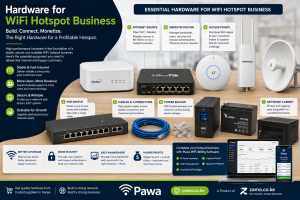
A basic setup needs a hotspot-capable router, with MikroTik devices such as the hAP ac2 or hAP ac3 being common, generally priced from roughly KES 9,000 to KES 25,000 depending on the model and coverage area, plus one or more outdoor access points for wider reach. Without the right hardware, you simply can’t sell wifi like airtime at any meaningful volume.
4. Connect a Billing System That Talks to M-Pesa
This is the step that actually turns “I have WiFi” into “I sell WiFi like airtime.” Without billing software, you would have to manually create login codes, track who has paid, and disconnect people when their time runs out, which becomes unworkable beyond a handful of customers. A system like Pawa automates the loop: a customer connects, sees your branded splash page, pays via M-Pesa STK push or paybill using infrastructure similar to Safaricom’s Daraja API, and gets instant access for exactly what they paid for. Read more in Pawa’s breakdown of a hotspot billing system.
5. Price Your Vouchers Like Airtime Denominations
Successful operators mirror airtime pricing psychology: small, affordable denominations that feel like an impulse buy rather than a commitment. A common structure in Kenyan estates and markets looks roughly like KES 10 for one hour, KES 20 for three hours, KES 50 for a full day, KES 250 for a week, and KES 1,000 to KES 1,500 for unlimited monthly access. Your exact prices should reflect local competition, your connection’s actual speed, and what nearby M-Pesa shops and cyber cafés already charge. Pricing this way is central to how to sell wifi like airtime in a way that feels natural to customers.
6. Add Backup Power
Power cuts are one of the fastest ways to lose customer trust in this business, because a hotspot that goes offline during peak evening hours stops earning at the exact moment people want it most.
7. Promote It Like a Local Shop, Not a Tech Startup
The customers walking past your hotspot don’t care about your router model; they care whether the WiFi is fast and the price feels fair. Simple, low-cost local promotion — a printed sign at the gate showing your prices, word of mouth from satisfied customers, a WhatsApp status update, or a small banner — tends to outperform paid digital ads for this kind of hyperlocal, walk-up business.
Real KES Numbers: How Much You Actually Earn When You Sell WiFi Like Airtime
Now that you understand how to sell wifi like airtime step by step, here’s the part most articles skip entirely: the actual math, using realistic Kenyan figures rather than a vague “earn up to” headline.
Picture a single hotspot location in a busy estate or market trading centre. On a reasonably good day, suppose 35 customers buy the KES 50 day-voucher and another 20 buy the KES 10 hour-voucher. Thirty-five vouchers at KES 50 each bring in KES 1,750, and twenty vouchers at KES 10 each add another KES 200, giving you a daily gross of roughly KES 1,950. Carry that across a thirty-day month and you land at approximately KES 58,500 in gross voucher sales for that single hotspot, and that figure, not some unexplained “earn up to” number, is your actual starting point.
From that KES 58,500, real costs come out before you see a shilling of profit. A business-grade Starlink or fibre connection suitable for legal resale commonly runs between KES 9,000 and KES 15,000 a month in Kenya. Running your router and access points twenty-four hours a day typically adds another KES 1,500 to KES 3,000 to your electricity bill, depending on your tariff and access points. M-Pesa transaction costs will shave off a small percentage of every sale, and a modest billing software fee plus occasional maintenance round out your expenses.
Once deducted, a realistic monthly net profit on a single, moderately busy hotspot lands somewhere in the KES 30,000 to KES 40,000 range, not the unverified six-figure numbers in some marketing copy. This is the real, unglamorous math behind how to sell wifi like airtime profitably, not a marketing headline.
Scale changes this picture meaningfully. An operator running three hotspots across an estate, a nearby market, and a hostel gate, each generating a similar daily gross around KES 1,950, is looking at combined monthly gross sales of roughly KES 175,000 before costs. Because the internet connection, your biggest fixed cost, doesn’t triple as cleanly as revenue once you negotiate bulk or business-tier plans, margins per location tend to improve slightly with scale, often pushing combined monthly profit for three well-run sites into the KES 100,000 to KES 130,000 range.
That’s why most people who take this seriously start with one location, prove the unit economics for a full month, and only then add a second or third site. It also shows that how to sell wifi like airtime scales fairly predictably once the first site’s numbers are proven.
What Can Go Wrong When You Sell WiFi Like Airtime (And How to Avoid It)
Every realistic guide to how to sell wifi like airtime should include what can actually go wrong, because the failures here are predictable and mostly preventable.
The most common early mistake is operating without the right license, or on a plan that doesn’t actually permit commercial resale. Either issue can get your connection suspended with no warning, wiping out a month of sales overnight. The fix: confirm your ASP licensing status with the Communications Authority of Kenya and ask your ISP directly, in writing, whether your plan allows reselling before you launch. This mistake can undo everything else you’ve done right while learning how to sell wifi like airtime.
Power outages are the second major risk, since a hotspot that’s down during evening peak hours, when most people actually want to browse, quietly bleeds revenue you’ll never recover. A modest UPS or solar backup, treated as a non-negotiable startup cost rather than an optional extra, solves this for most small operators who sell wifi like airtime as a serious, daily business rather than a side experiment.
Bandwidth congestion during peak hours, where too many simultaneous users slow everyone down and trigger refund requests, is usually a billing-software configuration problem rather than a hardware one. Setting sensible per-user speed caps and fair-usage limits inside your billing system, rather than leaving the connection open to whoever logs in first, keeps the experience consistent enough that customers keep coming back. Getting this balance right matters just as much when you sell wifi like airtime without losing customers to frustration.
Finally, underestimating how long it takes to recover your starting capital is a quiet killer of motivation. Between hardware, licensing, and your first month or two of below-capacity sales while word spreads locally, most single-location operators should expect a break-even period of two to four months rather than instant profit. Anyone serious about how to sell wifi like airtime should plan for this runway from day one.
Is Selling WiFi Like Airtime Worth It in Kenya? The Honest Verdict
Based on the real numbers above, selling WiFi like airtime is genuinely worth pursuing for the right location and operator, but it’s not the passive, low-effort income stream some marketing makes it sound like. A single hotspot generating roughly KES 30,000 to KES 40,000 in monthly net profit, against a startup cost of perhaps KES 30,000 to KES 90,000 depending on whether you choose Starlink or fibre, typically pays back its initial investment within two to four months and then keeps producing income with relatively light involvement once it’s running smoothly.
Where it stops being worth it is in saturated, low-footfall locations, on connections that aren’t actually licensed or permitted for resale, or for operators unwilling to handle the basic maintenance — checking power backup, restocking vouchers, responding to the occasional complaint — that keeps a hotspot reliable. If you have decent foot traffic, a connection you can legally resell, and you’re willing to treat this as a small operational business rather than a one-time setup-and-forget project, the unit economics behind how to sell wifi like airtime are sound and repeatable across multiple sites.
Getting Started the Right Way
The fastest path from wanting to learn how to sell wifi like airtime to actually collecting your first M-Pesa payment is pairing a properly licensed, resale-permitted internet connection with billing software built specifically for this model. Pawa handles the captive portal, voucher generation, M-Pesa STK push and paybill collection, and multi-site dashboard reporting, so you’re not stitching together separate tools for billing, access control, and payment reconciliation.
Pawa is part of a wider family of Kenyan-built business tools from the same team at Zama, including RentalDesk for property management, Prim for salons, Vega POS for retail point-of-sale, Dereva for hiring verified drivers, Vota for campaign management, Zivo for shared WhatsApp inboxes, Ratibu for school management, ChurchesAdmin for church administration, and core platforms like Fama serving other industries across the region. If you’re already running a shop, estate, or campus and want a WiFi revenue stream alongside what you manage day to day, it’s worth checking whether any of these fit your operation, especially if you’re serious about how to sell wifi like airtime as a real income stream.
Every week, more small business owners across Kenya type the same question into Google: how to sell wifi like airtime. The phrase keeps trending because the model behind it is simple and proven, and it doesn’t require a telecom license or millions in capital to test. If you’ve been wondering how to sell wifi like airtime in your own estate, shop, or market stall, the short answer is that you’re really learning to resell one bulk internet connection in small, prepaid chunks, the same way an airtime kiosk sells small denominations of credit.
What makes how to sell wifi like airtime such a popular search term right now is timing. Data costs in Kenya remain high relative to income for many households, and not everyone wants or can afford a full monthly subscription. A hotspot voucher solves that gap instantly: a customer pays KES 10 or KES 50, gets online for an hour or a day, and walks away satisfied. That’s the entire appeal behind how to sell wifi like airtime, and it’s why the model keeps spreading from Nairobi estates to rural trading centres.
But knowing how to sell wifi like airtime in theory and running a profitable hotspot are two different things. The people who succeed treat it like a real micro-business. They license their connection properly, choose a bulk plan that permits resale, install a hotspot router, and connect billing software that talks to M-Pesa automatically. Skip any one step, and learning how to sell wifi like airtime becomes a frustrating exercise instead of a steady income stream.
The other reason how to sell wifi like airtime keeps coming up in searches is that most existing guides answer it vaguely, throwing around lines like “earn up to KES 100,000 a month” without showing where that number comes from. A proper answer to how to sell wifi like airtime should always include real KES numbers: router cost, monthly connection cost, a realistic daily voucher count, and what’s actually left over after expenses.
If you’re serious about how to sell wifi like airtime as more than a passing idea, the fastest way to start is pairing a licensed, resale-permitted connection with billing software built for hotspot vouchers, M-Pesa STK push, and access control. That’s the gap Pawa was built to close for operators across Kenya.
Most beginners researching how to sell wifi like airtime also underestimate how location-dependent results are. A hotspot near a busy matatu stage or market will outsell one tucked into a quiet corner, no matter how good the router is. Foot traffic decides more about how to sell wifi like airtime profitably than almost anything else, so evaluate it honestly before buying equipment, and once the basics are running, refine pricing and uptime steadily rather than chasing a second site too soon. Master that single location first, and how to sell wifi like airtime becomes a repeatable playbook instead of a one-off experiment.
Frequently Asked Questions
How much capital do I need to start selling WiFi like airtime in Kenya? A realistic single-location startup budget, covering a hotspot router, an outdoor access point, basic power backup, and your first month of connectivity, typically falls between KES 30,000 and KES 90,000, depending heavily on whether you choose a cheaper fibre connection or a pricier Starlink kit. This is the real budget range to plan for once you’ve decided to sell wifi like airtime rather than just test the idea casually.
Do I need a license from the Communications Authority of Kenya? Yes. Commercially reselling internet access in Kenya requires an Application Service Provider license from the Communications Authority of Kenya, and operating without one puts your entire setup at risk of being shut down regardless of how good your sales numbers look on paper. Confirm this before you sell wifi like airtime to a single paying customer.
Can I sell WiFi like airtime using my home fibre or residential Starlink connection? Technically you can set up the hardware, but most residential and even some “unlimited” home plans explicitly prohibit commercial resale in their terms of service, so you should confirm with your provider and move to a business-tier plan before charging customers, to avoid having your connection cut off mid-month. This is one of the most overlooked steps in how to sell wifi like airtime safely and legally.
What’s the real difference between learning how to sell wifi like airtime and starting a full ISP? Selling WiFi like airtime means monetizing one bulk connection at one or a few physical locations using prepaid vouchers, while running a full ISP means laying or leasing infrastructure to serve potentially thousands of subscribers across a wider area. The hotspot model has a far lower barrier to entry, and it’s where almost every serious operator in Kenya starts.
Final Word
If you’ve read this far, you now understand how to sell wifi like airtime with real KES numbers behind every claim, not just an optimistic headline. The model works in Kenya because it solves a genuine affordability problem, and the unit economics, done honestly, are solid for the right location. The next step is pairing a licensed, resale-permitted connection with billing software that handles M-Pesa, voucher limits, and access control automatically. Start by exploring Pawa and the wider Zama suite of business tools to get your hotspot set up properly from day one.