Mobile Hotspot Business: 12 Powerful Steps to Build a Profitable WiFi Business in Kenya (2026)
Mobile Hotspot Business: Why It Is Growing Rapidly in Kenya A mobile hotspot business is one of the fastest-growing digital businesses in Kenya because internet connectivity has become an everyday necessity. Students...
Mobile Hotspot Business: Why It Is Growing Rapidly in Kenya
A mobile hotspot business is one of the fastest-growing digital businesses in Kenya because internet connectivity has become an everyday necessity. Students require affordable internet for online learning, freelancers depend on stable connections for remote work, businesses rely on cloud software, and customers expect reliable WiFi wherever they go.
Instead of purchasing expensive mobile bundles every day, many people now prefer buying affordable hotspot packages from nearby WiFi providers.
This demand has created opportunities for entrepreneurs to build profitable hotspot businesses in estates, hostels, shopping centres, apartment complexes, restaurants, cafés, schools, churches, hospitals, and transport terminals.
Unlike traditional cyber cafés, modern hotspot businesses require fewer employees because customer registration, payments, and internet access can all be automated using hotspot management software. Automated billing platforms integrate with routers and mobile payments, allowing customers to pay and receive internet access instantly without manual intervention.
The result is a business that can operate throughout the day while requiring relatively little day-to-day administration.
What Is a Mobile Hotspot Business?
Many beginners confuse a portable hotspot device with a commercial hotspot business.
A portable hotspot simply shares one SIM card’s internet connection among a few devices.
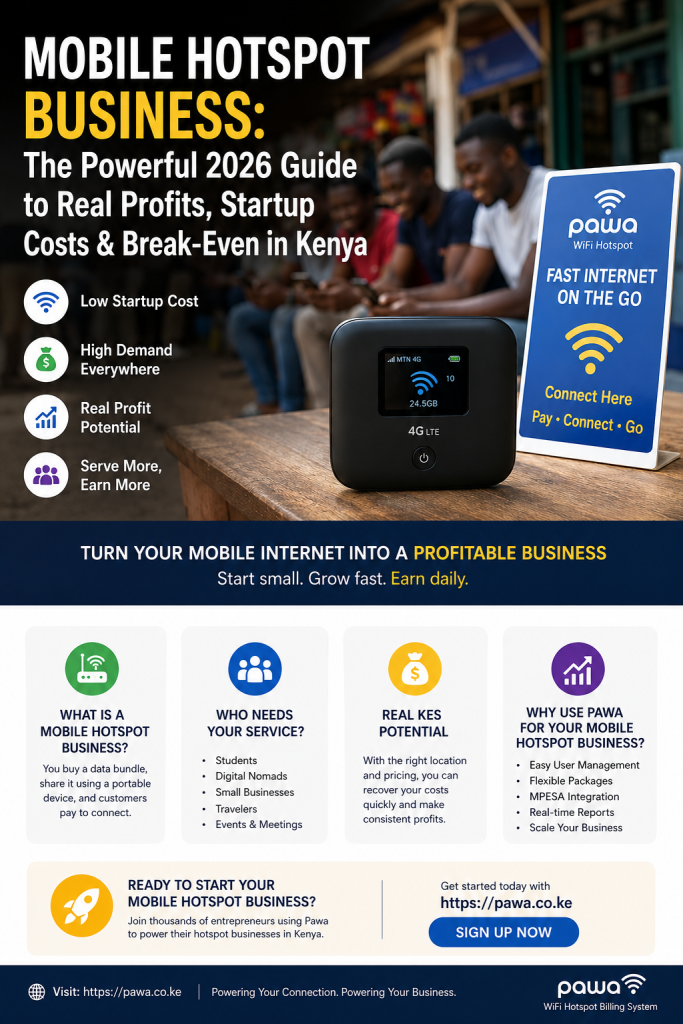
A mobile hotspot business, however, is a commercial operation where internet access is sold to multiple paying customers through managed WiFi infrastructure. The business owner controls access, pricing, bandwidth allocation, user authentication, and payments using specialized hotspot software.
Customers connect to the WiFi network, complete payment through a supported payment method such as M-Pesa, and automatically receive internet access.
The owner monitors users, revenue, bandwidth usage, active sessions, and multiple hotspot locations from a centralized dashboard rather than managing each customer manually.
Why Demand Continues to Increase
Kenya continues experiencing rapid digital transformation.
Several trends are driving demand for commercial hotspot services:
Online education.
Remote employment.
Digital banking.
Video streaming.
Online gaming.
Social media.
Small business digitization.
Cloud applications.
Artificial intelligence tools.
Government digital services.
Although mobile data bundles remain popular, many users seek more affordable, stable, and faster internet connections.
This creates an opportunity for entrepreneurs willing to provide reliable public WiFi services.
A properly planned mobile hotspot business benefits from recurring customers who purchase internet daily, weekly, or monthly depending on their usage.
Choosing the Right Business Model
Not every hotspot business serves the same market.
Your target customers determine the equipment, pricing, internet package, and coverage required.
Some entrepreneurs focus on apartment buildings.
Others specialize in hostels.
Some target shopping centres.
Others install hotspots inside cafés or restaurants.
Schools, hospitals, churches, bus stations, and markets also present strong opportunities because hundreds of people pass through these locations every day.
Rather than trying to serve everyone, define one primary customer segment during your first year.
This makes marketing easier and improves customer retention.
Location Determines Success
One of the biggest factors influencing profitability is location.
Many online articles suggest that “any busy place” works.
That advice is too vague.
A better approach is evaluating places where people remain for extended periods while requiring internet connectivity.
Examples include:
University hostels.
Apartment estates.
Residential neighbourhoods.
Business centres.
Hotels.
Waiting lounges.
Clinics.
Restaurants.
Shared workspaces.
Locations with stable electricity and fibre internet usually perform better than areas experiencing frequent outages.
Even the best equipment cannot compensate for poor internet infrastructure.
Build Around Reliable Internet
The internet connection is the foundation of every mobile hotspot business.
Many beginners purchase expensive networking equipment before confirming whether reliable internet is available.
Instead, evaluate internet providers first.
Look for:
Consistent uptime.
Low latency.
Business-grade support.
Scalability.
Reliable customer service.
Service-level agreements where possible.
Avoid selecting providers based solely on the lowest monthly price.
Frequent downtime quickly damages customer confidence and reduces repeat purchases.
Plan Before Purchasing Equipment
A common mistake among first-time entrepreneurs is buying networking hardware without understanding customer demand.
Start by estimating:
Expected daily users.
Peak usage hours.
Coverage area.
Internet speed requirements.
Expected monthly growth.
Number of simultaneous connections.
Planning first prevents overspending while allowing future expansion.
Your mobile hotspot business should be designed to grow rather than requiring complete replacement after several months.
Why Automation Matters
Some entrepreneurs still activate internet manually after receiving payments.
This approach works for only a handful of customers.
As user numbers increase, manual administration becomes inefficient.
Modern hotspot software automates:
User authentication.
Voucher generation.
Session management.
M-Pesa payment verification.
Customer notifications.
Bandwidth allocation.
Internet expiry.
Reporting.
Automation improves customer experience while allowing one administrator to manage multiple hotspot locations remotely. Businesses increasingly adopt centralized hotspot billing systems because they simplify operations and reduce human error.
For Kenyan entrepreneurs planning a mobile hotspot business, choosing the right billing and management platform is just as important as selecting quality networking hardware.
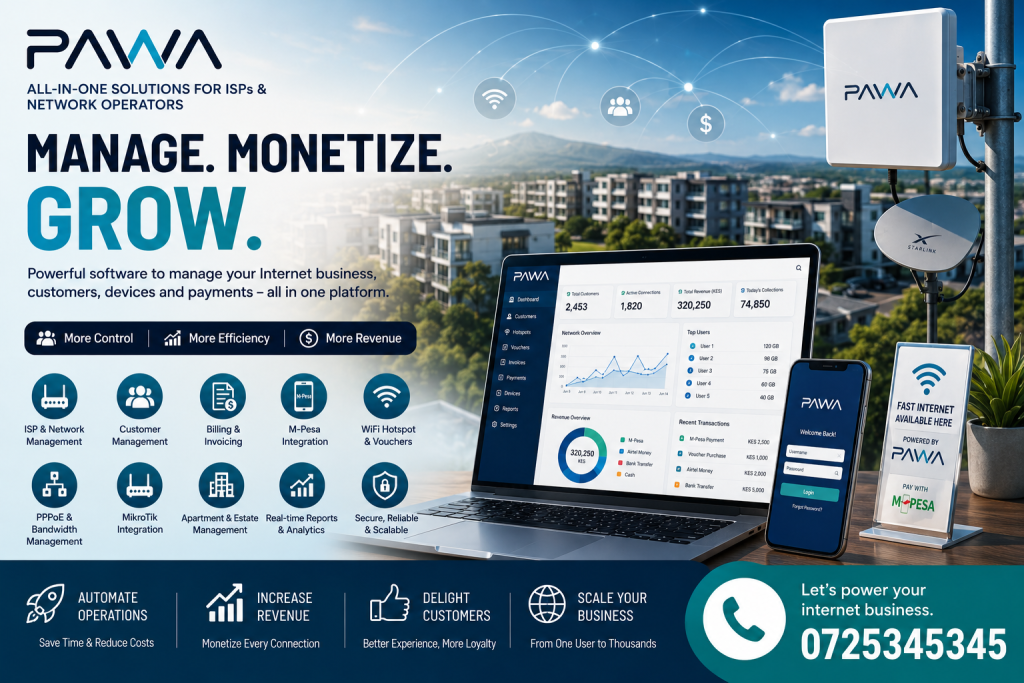
Pawa is designed to simplify commercial hotspot operations by providing centralized hotspot management, automated user authentication, flexible pricing plans, M-Pesa integration, voucher management, customer monitoring, and remote administration.
Instead of juggling multiple systems, operators can manage customers, payments, and hotspot performance from one platform, making expansion to additional locations much easier.
In addition, businesses can integrate complementary solutions across the wider SaaS ecosystem, including RentalDesk for property management, Prim for salon operations, Vega POS for retail businesses, Dereva for driver services, Vota for campaign management, Zivo for customer communication, Dexa for HR and workflow automation, Ratibu for school management, ChurchesAdmin for church administration, Jaat, Fama, KayaPro360, Musa Music AI, and Awasam depending on their operational needs.Equipment Needed for a Successful Mobile Hotspot Business
One of the biggest misconceptions about starting a mobile hotspot business is that buying an expensive router automatically guarantees success. In reality, networking equipment is only one part of the business. The real objective is delivering reliable internet, maintaining excellent uptime, and making it easy for customers to pay and connect.
Your equipment choices should be based on the number of expected users, the size of your coverage area, and how quickly you plan to expand. A hotspot serving a small café has different requirements from one covering an apartment block or university hostel.
A professional setup generally includes a business internet connection, enterprise-grade router, managed access points, network switches where necessary, backup power, structured cabling, and hotspot billing software. Each component contributes to overall network stability.
Many beginners focus almost entirely on WiFi speed while ignoring reliability. Customers are often more satisfied with a stable connection that consistently works than with extremely high speeds that disconnect regularly.
Your mobile hotspot business should therefore prioritize quality infrastructure over unnecessary hardware upgrades.
mobile hotspot business
Selecting the Right Router
The router acts as the brain of your hotspot network.
It manages internet traffic, authenticates users, controls bandwidth, and connects with hotspot billing software.
Business-grade routers generally provide:
Better stability
Higher user capacity
Advanced security
Better traffic management
Remote administration
Bandwidth control
VPN support
Multiple internet connections
Network monitoring
Choosing equipment that supports future expansion prevents costly upgrades later.
Many successful hotspot operators standardize equipment across every location to simplify maintenance and troubleshooting.
Coverage Planning Matters
Excellent internet service depends on more than bandwidth.
Coverage determines whether customers can actually use your network comfortably.
Poor access point placement creates:
Dead zones
Slow speeds
Frequent disconnections
Poor customer experience
Negative online reviews
A proper site survey helps identify the best locations for access points while minimizing signal interference from walls, metal structures, and neighbouring WiFi networks.
When planning your mobile hotspot business, invest time in network design before installation begins.
Internet Speed Expectations
One mistake many entrepreneurs make is advertising unrealistic speeds.
Instead of promising “unlimited super-fast internet,” explain what customers can realistically expect.
Different users have different requirements.
Students browsing educational websites require less bandwidth than customers streaming high-definition videos.
A professionally managed hotspot balances available bandwidth among active users instead of allowing a few customers to consume all available capacity.
Bandwidth management becomes especially important as customer numbers increase.
Setting Competitive Prices
Pricing is one of the most important decisions in every mobile hotspot business.
Many operators simply copy competitors without understanding their own operating costs.
A better approach is understanding your target market first.
Students generally prefer affordable daily packages.
Families may prefer weekly or monthly subscriptions.
Businesses often require dedicated internet packages with higher reliability.
Hotels may bundle WiFi into accommodation pricing.
Restaurants frequently offer complimentary internet while recovering costs through food sales.
Rather than competing solely on the lowest price, compete on reliability, customer support, and convenience.
Customers frequently remain loyal to providers who consistently deliver quality service.
Offering Flexible Packages
Successful hotspot businesses rarely rely on one package.
Instead, they provide options matching different customer needs.
Popular package types include:
Hourly access
Daily packages
Weekend access
Weekly subscriptions
Monthly subscriptions
Business packages
Student packages
Night packages
Promotional bundles
The objective is giving customers flexibility without creating unnecessary complexity.
Your mobile hotspot business should keep pricing simple enough for first-time users to understand immediately.
Marketing Your Mobile Hotspot Business
Excellent internet alone does not attract customers.
People must first know your hotspot exists.
Many first-time operators underestimate marketing because they assume customers will automatically discover the network.
Effective marketing begins before installation.
Useful strategies include:
Large outdoor signage
Window branding
Directional posters
Estate notice boards
WhatsApp community groups
Facebook neighbourhood groups
Google Business Profile
Referral incentives
Free trial vouchers
Partnerships with nearby businesses
If your hotspot serves apartment residents, collaborate with landlords and caretakers.
If your hotspot targets students, work with hostel managers and student organizations.
Building trust within the community often produces better results than expensive advertising campaigns.
Customer Service Creates Repeat Business
Customer acquisition is important.
Customer retention is even more important.
Every returning customer increases lifetime business value.
Simple improvements that strengthen customer loyalty include:
Fast technical support
Easy payment process
Stable internet
Friendly communication
Quick issue resolution
Reliable uptime
Clear instructions
Fair pricing
Negative experiences spread quickly through local communities.
Positive experiences generate referrals.
A successful mobile hotspot business treats customer support as an investment rather than an expense.
Using Analytics to Improve Performance
Modern hotspot platforms collect valuable information about customer behaviour.
Instead of relying on assumptions, operators can analyse:
Peak usage periods
Most popular packages
Returning customers
Device types
Session duration
Payment trends
Daily traffic
Monthly growth
Network performance
These insights help improve pricing, staffing, promotions, and future expansion plans.
Businesses that make decisions using data generally outperform businesses relying on guesswork.
Security Should Always Be a Priority
Public WiFi networks attract hundreds or even thousands of users.
Without proper security, customer information and business systems become vulnerable.
Every mobile hotspot business should implement:
Strong administrator passwords
Secure payment integrations
Firewall protection
User authentication
Updated firmware
Encrypted management access
Regular backups
Activity monitoring
Security also protects your reputation.
Customers trust businesses that provide reliable and secure internet services.
Managing Multiple Hotspot Locations
Many entrepreneurs eventually expand beyond one location.
Managing several hotspots manually quickly becomes difficult.
Centralized hotspot management allows operators to:
Monitor every location remotely
Create pricing packages
View revenue reports
Track active users
Restart equipment
Generate vouchers
Control bandwidth
Update configurations
Platforms such as Pawa simplify multi-location management by allowing businesses to administer several hotspot installations from a single dashboard instead of visiting each site individually.
This centralized approach reduces operational costs while making expansion significantly easier.
Growing Beyond Internet Sales
An established mobile hotspot business creates additional business opportunities.
Once customers regularly connect to your WiFi network, you can introduce complementary services such as:
Digital advertising
Local business promotions
Event internet services
Managed WiFi installations
Network maintenance
Corporate hotspot solutions
Property WiFi management
Educational internet packages
Diversifying income reduces dependence on one revenue source.
Many successful operators eventually transition into complete managed networking companies.
Preparing for Long-Term Expansion
Growth should be planned rather than rushed.
Expand only after the first location consistently delivers excellent customer satisfaction.
Document your installation standards.
Use consistent equipment.
Train staff using standardized procedures.
Automate as many processes as possible.
Your mobile hotspot business becomes easier to scale when every location follows the same operational model.
Businesses that standardize operations usually experience fewer technical problems while maintaining consistent service quality across all branches.
In Kenya’s rapidly expanding digital economy, demand for affordable and reliable internet continues to grow. Entrepreneurs who invest in quality infrastructure, excellent customer support, automated billing, and centralized hotspot management are well positioned to build sustainable businesses that continue generating recurring revenue for years.Risks Every Mobile Hotspot Business Should Prepare For
Every business has risks, and a mobile hotspot business is no exception. Many online articles focus only on the opportunities while ignoring the challenges entrepreneurs face after installation. Understanding these risks before investing allows you to prepare practical solutions instead of reacting after problems occur.
The most common risk is internet downtime. Even the best networking equipment cannot provide service if your internet service provider experiences an outage. Customers paying for internet expect continuous connectivity, and repeated downtime may push them to competitors. Mitigate this by choosing a reputable business-grade ISP, maintaining a backup internet connection where possible, and communicating with customers whenever maintenance is required.
Power interruptions are another challenge, especially in areas with unstable electricity. Installing an Uninterruptible Power Supply (UPS) and, for larger deployments, backup power solutions can keep your hotspot online during short outages. If your target market depends on internet for work or study, backup power quickly becomes a worthwhile investment.
Equipment theft and vandalism can also affect profitability. Install networking equipment in secure locations, use lockable cabinets, restrict physical access, and keep an inventory of all devices. Where appropriate, install CCTV to protect infrastructure.
Security threats should not be ignored. Weak administrator passwords, outdated router firmware, and poor network configuration expose your hotspot to unauthorized access. Update devices regularly, enforce strong passwords, and monitor unusual activity through your hotspot management platform.
Finally, competition continues to increase. New internet providers and hotspot operators enter the market every year. The best way to stay competitive is not by offering the cheapest prices but by providing reliable service, responsive support, and consistent uptime. A trusted provider retains customers far longer than one competing only on discounts.
Common Mistakes That Cause Hotspot Businesses to Fail
A profitable mobile hotspot business depends on careful planning and disciplined execution. Several common mistakes repeatedly appear among operators who struggle to grow.
One mistake is purchasing expensive networking hardware before confirming demand. Conduct a simple survey within your target area to understand whether potential customers actually need commercial WiFi.
Another mistake is relying entirely on manual administration. Manually activating users, confirming payments, and issuing vouchers may work initially but quickly becomes inefficient as customer numbers increase. Automation through hotspot billing software saves time and improves customer experience.
Poor customer support also damages growth. Slow responses to internet problems create frustration and reduce repeat purchases. Clear communication, reliable service, and quick technical support build long-term customer loyalty.
Many operators also fail to monitor network performance. Analytics reveal peak usage hours, popular packages, and recurring technical issues. Reviewing this data regularly helps improve both customer satisfaction and profitability.
Scaling Your Mobile Hotspot Business
Once your first location operates consistently, expansion becomes the next logical step. However, growth should be systematic rather than rushed.
Instead of opening several hotspots at once, replicate a successful model one location at a time. Standardize your equipment, installation methods, pricing structure, and customer support procedures. This reduces maintenance complexity and makes staff training easier.
Centralized hotspot management software becomes increasingly valuable as your network expands. You can monitor multiple locations, generate reports, manage customers, update pricing, and troubleshoot equipment from one dashboard.
Potential expansion locations include:
Apartment complexes
Universities and hostels
Hotels and guest houses
Restaurants and cafés
Shopping centres
Hospitals and clinics
Churches and conference venues
Bus terminals
Co-working spaces
Residential estates
Each successful installation strengthens your brand while creating recurring revenue from a growing customer base.
Integrating with Other Digital Business Solutions
As your mobile hotspot business grows, you may require software beyond hotspot billing. Businesses often benefit from integrating complementary platforms that simplify daily operations.
For example, RentalDesk supports property and estate management, Prim assists salon operations, Vega POS helps retail businesses process sales, Dereva connects businesses with professional drivers, Vota manages campaign activities, Zivo improves customer communication through shared messaging, Dexa streamlines HR and workflow management, Ratibu simplifies school administration, ChurchesAdmin supports church management, while Jaat, Fama, KayaPro360, Musa Music AI, and Awasam provide additional specialized SaaS solutions for different industries.
Choosing software that grows with your business reduces future operational challenges.
For many Kenyan entrepreneurs, the answer is yes—but only if the business is approached professionally.
A mobile hotspot business is not a “get-rich-quick” opportunity. Success depends on choosing the right location, installing reliable infrastructure, providing consistent customer support, and automating operations wherever possible.
Businesses that treat hotspot services as a long-term investment often build recurring revenue through repeat customers. Those expecting immediate profits without proper planning frequently become discouraged.
If you focus on service quality rather than short-term price competition, a hotspot business can become a stable digital enterprise with room for expansion across multiple locations.
Frequently Asked Questions on mobile hotspot business
1. How much capital do I need to start a mobile hotspot business in Kenya?
Startup costs vary depending on the size of your deployment, internet provider, networking equipment, and coverage area. Begin with a clear business plan rather than purchasing equipment first.
2. Can I start with one hotspot and expand later?
Yes. Many successful operators begin with a single location, refine their operations, and expand after establishing consistent customer demand.
3. Do I need hotspot billing software?
If you expect more than a few customers, automated hotspot billing software is highly recommended. It simplifies user authentication, payment processing, bandwidth management, and reporting.
4. Which customers should I target first?
Apartment residents, university students, hostels, cafés, shopping centres, and business parks often provide consistent demand because users require affordable internet every day.
5. How can I increase customer retention?
Provide reliable internet, fair pricing, responsive customer support, and a simple payment process. Customers who enjoy a positive experience are more likely to renew their packages and recommend your service.
Why Choose Pawa for mobile hotspot business?
Running a successful mobile hotspot business requires more than networking hardware. You need a platform that simplifies customer management, automates payments, controls bandwidth, and supports future expansion.
Pawa provides a complete WiFi hotspot billing solution designed for Kenyan businesses. Features include:
Automated hotspot billing
M-Pesa integration
Voucher management
User authentication
Centralized hotspot management
Remote administration
Flexible pricing packages
Usage reporting
Multi-location support
Business analytics
Whether you are launching your first hotspot or expanding across multiple locations, Pawa helps reduce manual work while improving customer experience.