
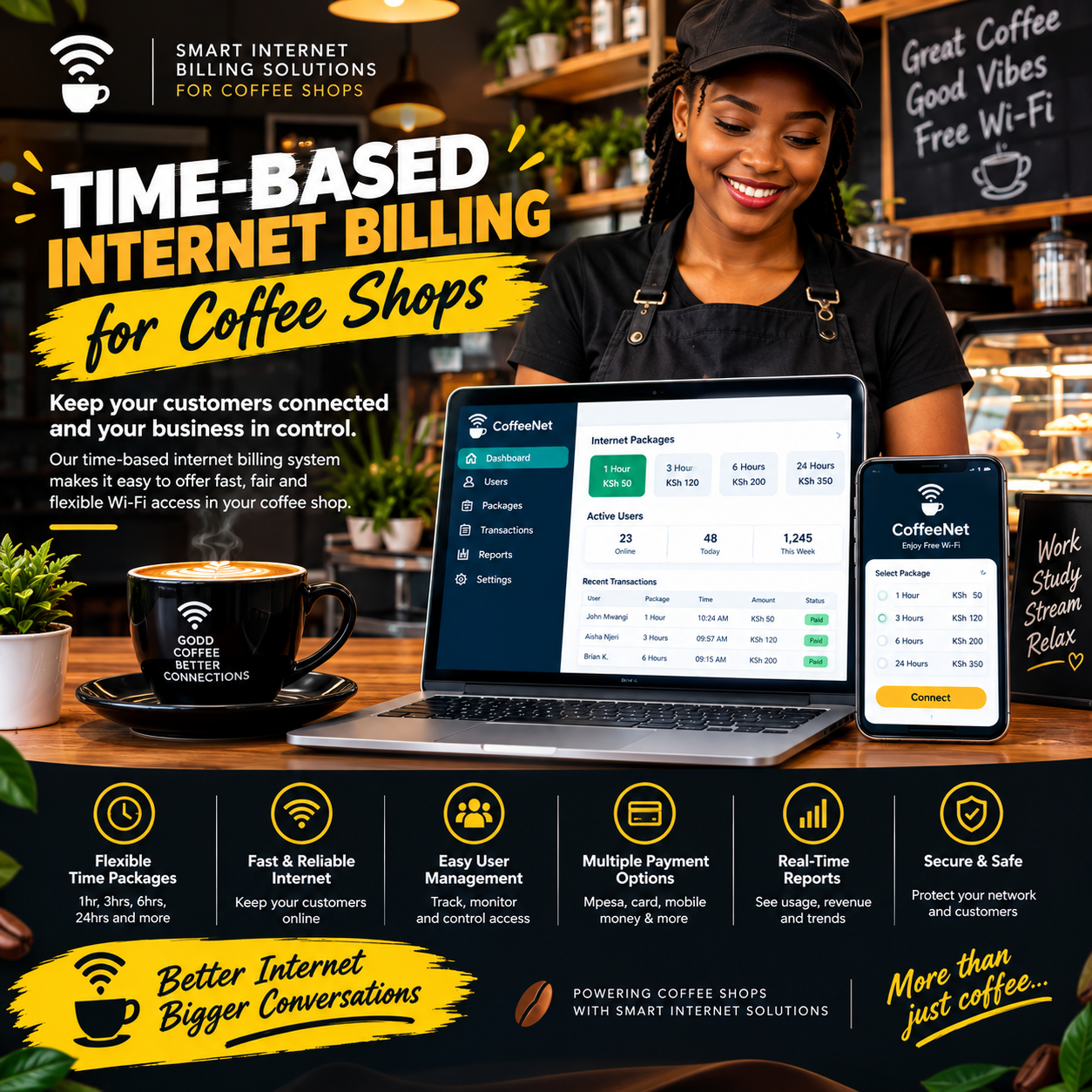
 Time-based internet billing for coffee shops is the decision that rescued one café from a slow financial leak its owner had stopped noticing — and the story is fast becoming one of the most retold business lessons in hospitality circles.
Three years ago, the owner opened a modest twenty-eight-seat café in a busy commercial neighborhood: good coffee, honest prices, and, like every café around it, free unlimited WiFi advertised on a chalkboard by the door. For two years they ran the business the way everyone said it should be run.
Then one quiet Sunday evening, preparing quarterly accounts, the owner noticed something that would not leave them alone: internet and technology costs had quietly grown into one of the largest recurring expenses, while the customers consuming the most of it were spending the least on the menu.
The window tables — the café’s most valuable real estate — were occupied from opening to closing by laptop users nursing single americanos. Bandwidth, purchased at business-grade prices, was choking every afternoon under streams the café never asked to host.
That night marked the beginning of the owner’s conversion to time-based internet billing for coffee shops, and the twelve months that followed transformed the café’s finances, its atmosphere, and the owner’s understanding of what the business actually sells.
What follows is that story, told month by month and decision by decision — not as a theoretical argument, but as a documented journey that any café owner can trace, measure, and repeat.
Because the truth this owner discovered, and the truth this story will show, is that the change made possible by time-based internet billing for coffee shops was never really about WiFi at all. It was about finally being paid for something that had been given away for two years.
The Month the Numbers Stopped Making Sense
Every struggling business has a moment when the fog lifts, and this owner’s arrived during a routine review of the profit-and-loss statement. Food and beverage margins were healthy.
Foot traffic was strong — arguably stronger than ever. Yet the bank balance at the end of each month seemed no better than the year before.
Digging into the expense lines, the owner found the culprits hiding in plain sight: a business internet subscription that had doubled in price after an upgrade meant to “support the customers,” a new mesh router system installed after complaints about dead zones, a technician’s visit after the network collapsed during exam season, and electricity costs running equipment all day to serve connections that generated no income whatsoever.
Then came the exercise that changed everything: three days spent informally tracking who actually used the WiFi and what each user spent. The results read like a parody.
The most connected customer — a friendly young man who arrived at 8 a.m. and left at 6 p.m. — had spent four hundred shillings across ten hours of occupancy at the best window table. Meanwhile, a lunch party of four, disconnected and ordering freely, spent more in forty minutes than the camper spent all day.
The arithmetic was brutal. The owner realized that under the current arrangement, there was no version of time-based internet billing for coffee shops that could leave them worse off — because the current arrangement was simply time-based internet billing for coffee shops with the price set to zero and the meter removed. They were not choosing free WiFi. They had simply never chosen anything.
The Discovery: Learning That the Machinery Already Existed
The first assumption was that charging for internet would require complicated technology, awkward cash handling, or a laminated sheet of voucher codes taped to the counter. A week of research demolished that assumption.
The captive-portal systems powering airport lounges and hotel business centers — where customers had cheerfully paid for connectivity for decades — had evolved into lightweight, affordable platforms designed for small operators. No server room. No IT department. A login page, a payment flow, automatic session countdowns, and a dashboard readable from a phone.
What convinced the owner was the payment experience. Operating in a market where pay-as-you-go is the native language of every utility — airtime, electricity tokens, data bundles — they realized customers already understood purchased units of connectivity better than any customers on earth.
Nobody in the café would need the concept explained. Buying an hour of internet through time-based internet billing for coffee shops would feel exactly like buying tokens: small, familiar, transactional, fair.
The more the owner read about deployments of time-based internet billing for coffee shops in other cities — the recovered tables, the session revenue, the customer data — the more the real question shifted from “can I afford to do this?” to “how have I afforded not to?”
Week One: Holding Their Breath
The owner gave themselves two weeks to prepare, and did the single thing that most deployments skip: talking to customers before changing anything. A handwritten sign appeared by the till and the door: “Big changes coming to our WiFi — ask us about it”.
When regulars asked, they heard the truth plainly — that the café was upgrading the network to guarantee real speeds, that internet time would carry a small charge like every other thing the café sold, and that every customer would still receive a free fifteen-minute window each day as the house’s guest.
The response surprised the owner. The professionals nodded as if the café had finally said something sensible. A university student joked that the network had been “carrying half the semester’s coursework for free.” Nobody stormed out. Nobody posted an angry review. The dread that had built up for weeks dissolved into anticlimax.
On launch day, the portal switched on at opening time, and the owner watched. The first purchase happened at 7:40 a.m. — a commuter who bought a fifteen-minute express session to clear overnight email, tapping through payment on a phone in under a minute, never once approaching the counter.
The second was a freelance designer who purchased a three-hour package, settled at the window seat, and worked in focused silence. By close of the first day, the dashboard showed nineteen paid sessions alongside dozens of courtesy windows used.
The owner sat with an evening tea and scrolled the session log on time-based internet billing for coffee shops infrastructure they did not fully understand yet but had, that morning, watched pay for itself.
The era of time-based internet billing for coffee shops in that café had begun not with resistance, but with a shrug and a queue of customers who simply paid.
The Customers: Who Stayed, Who Left, and Who Paid
The first month sorted the clientele into vivid categories, and watching the sorting was the most educational experience of the owner’s business life.
The Commuters — morning customers who checked email for ten minutes over an espresso — barely registered the change. Their courtesy window covered most of their visits; when it didn’t, they paid the small express price without a flicker of hesitation.
Nothing about their behavior changed except that the owner could finally see them in the session logs: dozens of quick, low-cost connections that had been invisible for two years.
The Professionals — the laptop crowd — split in a way that delivered the deepest lesson. Some, it turned out, had been productive workers who valued the space and spent reasonably; those customers bought half-day packages immediately and, crucially, began telling the owner how much they appreciated the guaranteed speed.
Video calls that used to drop now held. Uploads that crawled now flew, because the network’s congestion had evaporated. The other portion of the laptop crowd — the true campers — had a harder choice.
Faced with a meter, most scaled down to reasonable two-hour sessions and, unexpectedly, started ordering food while they worked, as if the purchased session had legitimized their presence and eased some quiet guilt.
A few migrated elsewhere in search of unlimited free access. The owner watched them go without grief; the records from time-based internet billing for coffee shops reporting showed precisely what each of them had spent during two years of daily occupation, and it was less than the monthly bandwidth bill.
The final category — the heavy streamers, the account-sharing dormitory crowd — simply evaporated. And under time-based internet billing for coffee shops policies with per-session device binding, the days of one purchased session serving an entire study group ended quietly, with each friend tapping their own payment and the café earning its due.
The overall pattern confirmed what operators of time-based internet billing for coffee shops deployments everywhere report: the customers worth keeping stay, spend more than before, and thank you for it.
The First Month in Numbers
Stories persuade, but numbers convince, so the owner tracked everything. Month one under the new model delivered figures that stunned even the most optimistic projections — modest individually, transformative together.
Direct session revenue was the headline: paid sessions across express, hourly, and half-day packages, nearly all delivered with zero marginal cost on infrastructure that was already being funded.
The total was not enormous — it would not pay the rent — but it was pure-margin income arriving daily, and trending upward as word spread.
The second number mattered more: table turnover during peak hours. The lunch service, freed from window-seat colonization, hosted its first genuinely full rotations since opening.
Two additional lunch sittings per table per week, across the prime seating, translated into food-and-beverage revenue that dwarfed the session income — revenue that had been leaking away for two years under an arrangement that had never once been evaluated.
The third number was operational: the support burden dropped to near zero, because the system running time-based internet billing for coffee shops sessions handled authentication, payments, countdowns, and disconnections without a single minute of staff time.
No codes to manage, no disputes to referee — every question answered by a timestamped log, the kind of clean record-keeping that only time-based internet billing for coffee shops platforms provide.
When the three numbers were laid side by side at the end of the month — session revenue, recovered peak-hour sales, and staff hours saved — the combined figure exceeded the entire monthly internet cost by a factor the owner initially double-checked twice.
The leap they had feared for weeks had, measured honestly, printed money in its first thirty days.
The Surprises Nobody Warned About
If the financial results were expected — the projections had, after all, pointed this way — the side effects caught the owner completely off guard.
The first surprise was the portal. Every connected customer, before a single byte of internet flowed, now looked at a page under the café’s control: its logo, its branding, and a rotating banner updated weekly.
In the first month alone that screen launched a new pastry line that sold out twice in a week, filled the first cupping evening to capacity, and drove signups for a loyalty card that had languished unnoticed on the counter for a year.
The owner had adopted a billing system and accidentally acquired the highest-attention advertising space in the building — a benefit of time-based internet billing for coffee shops portals that no projection had captured, because its power only becomes visible once you own the screen.
The second surprise was the data. For two years, the café had been a black box: hundreds of weekly visits, zero retained information.
Now the login flow — with consent checkboxes handled properly by the chosen platform — was quietly assembling a contact list of customers who had agreed to hear from the café, alongside session patterns revealing the true demand curves: the 7 a.m. commuter spike, the 2 p.m. freelancer wave, the exam-season surges.
Within weeks the owner was scheduling discounts and staffing around evidence instead of instinct. The third surprise was reputational.
Word began moving through the neighborhood’s remote-work community that the café had “the serious WiFi” — fast, guaranteed, fairly priced — and a new customer species appeared: people who came because of the network, stayed for hours of productive purchased time, ordered food and refills freely, and returned three and four times a week.
Two years of free unlimited access had never once attracted that customer, because time-based internet billing for coffee shops reliability, not free access, is what serious users are shopping for.
Competitor research had already shown that free WiFi no longer differentiated a café. The first quarter taught the corollary: excellent, guaranteed, honestly-priced connectivity differentiated it more than anything else the owner had tried in years.
The Two Mistakes Owners Make — and How to Fix Them
Honesty demands the record show that this rollout was not flawless, and its two stumbles carry lessons worth more than any success story. The first mistake was pricing the flagship package wrongly.
The launch included a three-hour session priced for the professional crowd — and it outsold everything, to a degree that revealed it had been underpriced.
The half-day package became so popular that afternoons filled with single-session occupants again, softer versions of the camping problem that had just been solved. The fix, drawn from the flexibility of time-based internet billing for coffee shops dashboards, took one evening: the owner raised the three-hour price meaningfully and introduced a mid-length package between it and the hour option, letting the market sort itself into tiers.
Revenue rose the following week. The lesson stuck: pricing under time-based internet billing for coffee shops is not a one-time decision but a living adjustment, and the dashboard will tell you within weeks when a tier is mispriced — if you are willing to look and willing to change.
The second mistake was training. The owner had trained themselves thoroughly and the two staff members barely at all.
When a customer’s phone refused to open the portal on day four — a captive-portal detection quirk on an older device — the barista froze, the customer grew frustrated, and the moment nearly undid two weeks of goodwill.
That evening the owner ran the team through every common scenario: portal not loading, session expiring early, courtesy window exhausted, payment confirmation delays.
A one-page cheat sheet was written and taped inside the counter. The result was transformative in a small way that matters: staff stopped treating connectivity questions as emergencies and started resolving them in under a minute, the way operators of mature time-based internet billing for coffee shops deployments eventually learn to.
Neither mistake was fatal; both were expensive only until confronted. The summary of the rollout, delivered with an accountant’s shrug: the system was never the hard part. The habits around it were.
The Regulars Who Became Evangelists
Somewhere in month two, something happened that no projection had predicted: customers began selling the model on the café’s behalf. It started with the freelancers.
A graphic designer who had worked from the café three days a week under the old free regime mentioned, unprompted, to a table of strangers that “this is the only place around here where the video calls actually hold.”
A university lecturer began recommending the café to colleagues as a weekday workspace. The professionals who purchased time-based internet billing for coffee shops half-day packages became, functionally, an unpaid sales team — because people who pay for a service and receive its full value defend it publicly.
The psychology, once thought through, made perfect sense. Under the free model, connectivity was an entitlement, and entitlements generate no loyalty — only expectations that stretch.
Under the paid model, customers had made a purchase and received exactly what was promised, and that completed transaction created something the free model never had: a relationship with terms.
The paying internet customers returned more frequently than any customer segment the café had ever tracked.
They ordered more per visit. They brought colleagues. They mentioned the café in neighborhood online groups, where — the owner noted with quiet satisfaction — the lone complaint about paid WiFi came from an account belonging to a customer whose two-year spending history in the time-based internet billing for coffee shops records showed to be one samosa and four refills of hot water.
The community’s verdict, rendered through behavior rather than words, was unambiguous: the regulars who mattered had stayed, deepened, and recruited — and the voice of the departed was one hot-water refiller on a neighborhood forum.
Six Months Later: The Café That Breathes
Six months into the new model, the café operates with a rhythm it never had before, and the transformation is visible from the doorway. Mornings belong to the commuters and their express sessions — quick, high-volume, invisible in the best sense.
Late mornings and afternoons belong to the professionals, a stable population of recognizable regulars on half-day packages, occupying prime seats at rates that respect the seats’ value and ordering lunch as a matter of course.
Exam seasons surge now instead of suffocating, because the meter smooths demand and the students who genuinely need three focused hours pay a price they consider fair, while the network stays fast enough for everyone.
The window tables — those colonial outposts of the old regime — turn over three and four times daily, and their revenue reflects it.
The financial statement tells the quieter half of the story. Six months of time-based internet billing for coffee shops session income has fully absorbed the internet and equipment costs since month one, with a growing surplus the owner now thinks of as “the router’s salary” — except the router, unlike the staff, earns it without leave days.
The recovered table turnover, tracked separately, has settled at roughly double the session revenue — meaning the true monthly gain from the switch runs at a multiple of what was projected the night the owner first got angry at their own accounts.
The contact list, assembled consent by consent through the portal, has crossed four hundred opted-in customers and driven two of the best promotional weeks on record. And the deepest change is not on any statement: the owner has stopped thinking of the café as a place that sells coffee and merely tolerates laptops, and started thinking of it as a workspace business that happens to serve excellent coffee.
That reframing — from time-based internet billing for coffee shops as a cost-recovery hack to connectivity as a core product line — is, by the owner’s account, worth more than every figure in the ledger, because it opened a customer category they didn’t know the café was qualified to serve.
What the Competition Did Next
A story about one café is incomplete without the street’s reaction, and the street’s reaction was divided in a revealing way.
The nearest competitor — a larger café two doors down — publicly doubled down on free unlimited WiFi, updating their chalkboard within a week of the switch, as if free access were a counterattack. For a month, the owner watched a handful of the departed campers migrate there, and confesses to a moment of doubt.
Then the month’s numbers arrived: the paying professional segment had not budged, session revenue had grown, and peak-hour turnover was intact.
The competitor had purchased, at bandwidth prices, precisely the customers the model was designed to release — and acquired, in exchange, the congestion, the occupancy, and the unpriced costs the owner had just escaped.
The two cafés now serve visibly different crowds, and the differentiation, time-based internet billing for coffee shops data suggests, favors the metered side: the network is faster because it is governed, the best seats produce revenue because they are priced, and the reputation among the highest-spending connectivity users in the neighborhood has no local rival.
The second reaction came from an unexpected quarter: imitation. By month five, the guesthouse across the road — facing the same all-night streaming drain on its shared connection that cafés know too well — asked the owner for an hour of their time and left with a deployment plan.
A boutique gym followed. A small co-working corner inside a bookshop inquired through a mutual friend. Without intending it, the café had become the neighborhood’s case study, and each new adopter of time-based internet billing for coffee shops logic — whether in a café, a lounge, or a shared office — made the pioneer’s position stronger, normalizing the model the first customers had once raised an eyebrow at.
That is how a local edge compounds into a market norm: one operator proves it, the neighborhood watches the numbers, and the window in which the early decision felt daring quietly closes. That street, by the owner’s estimate, has five years of free-WiFi nostalgia left at most.
The Lessons Worth Borrowing
Strip this story to its transferable lessons and five principles survive, each earned in monthly installments.
First, audit before you act. The entire transformation began with three days of honest observation — who used the WiFi, for how long, spending what — and that audit alone made the decision self-evident.
Any owner can run it this week, and the owners who skip it are not choosing free WiFi; they are choosing not to look, which is the same arrangement many café owners have with time-based internet billing for coffee shops economics for years before they finally count.
Second, communicate before you switch. This rollout succeeded where others stumble because regulars heard the rationale — better speeds, fair access, sustainable costs — before the paywall existed, and received a courtesy window that honored their habit.
Third, treat pricing as a living variable. The mispriced flagship package was corrected in one evening because the dashboard told the truth within weeks; the flexibility that time-based internet billing for coffee shops platforms provide means no pricing decision is ever final, and refusing to adjust is the only fatal choice.
Fourth, train the counter. The system ran itself; the humans needed an hour of scenario practice, and the difference between a flustered barista on day four and an unflappable team by month two cost one page of notes.
Fifth, sell the outcome, not the restriction. Every message that worked — to customers, to staff, to the neighborhood — framed the change as an upgrade: guaranteed speeds, fair pricing, a serious network for serious users.
That framing is not spin; it is the literal truth of what time-based internet billing for coffee shops deployments deliver, and it is the difference between a paywall story and a quality story.
Seasoned operators give every visiting owner the same closing summary: the technology was the easy part, the customers were more reasonable than feared, and the only genuinely expensive mistake in this business is the years spent not looking at the numbers.
Is the Story Repeatable?
The fair question about any single success story is whether it generalizes, and the honest answer requires looking at which parts of this result were luck and which were structure.
Location helped — a commercial district with real professional foot traffic supplies exactly the task-driven customers who pay gladly for guaranteed connectivity.
But the structural drivers of the outcome were not location-dependent. The cost recovery runs on arithmetic that holds anywhere a business pays for bandwidth it gives away: existing expense converted to income at near-zero marginal cost.
The turnover effect operates wherever seats are finite and hours are peak-constrained. The courtesy tier, the portal marketing, the consented contact list, the session data — these are features of time-based internet billing for coffee shops platforms, not of the address, and they perform identically in a suburb, a university quarter, or a small town’s main road.
The genuinely variable factor is customer mix, and even there the model flexes rather than breaks. In lower-income or student-heavy areas, deployments of time-based internet billing for coffee shops adjust through smaller denominations — shorter sessions, cheaper express tiers, courtesy windows — and the pay-as-you-go fluency of customers raised on tokens and airtime does the rest of the work.
What the story does not survive is only the extremes: a venue with no demand for connectivity at all, or an owner unwilling to communicate, adjust pricing, or glance at a dashboard.
Everywhere between those poles, the mechanics repeat — as they have repeated in lounges, hotels, and co-working spaces for decades. One café’s results are not evidence of exceptional circumstances. They are evidence of ordinary arithmetic, finally applied.
Frequently Asked Questions
Doesn’t charging for WiFi scare customers away?
The measurable answer: customer counts dip barely at all, paying segments grow, and the only meaningful departures are all-day occupiers spending less than the cost of the seats they use.
Session logs — the same records every operator gets from time-based internet billing for coffee shops platforms — show paying customers returning more often than any segment under the free model, because a completed transaction with delivered value builds loyalty in a way an entitlement never does.
How much can an owner actually earn from it?
Directly, the first month typically produces a session-revenue stream covering the entire internet cost, growing steadily as word spreads.
Indirectly, recovered peak-hour table turnover often generates roughly double the session income — and that combined figure, tracked cleanly through time-based internet billing for coffee shops reporting, is what convinces owners the switch is structural rather than cosmetic.
Owners evaluating the model should price both lines: the sessions they will sell and the tables they will get back.
What hardware is needed?
Less than most owners fear: the existing business-grade connection, a compatible router or gateway supporting portal authentication and session control, and adequate coverage across the seating area — one added access point after a quick survey.
The platform running time-based internet billing for coffee shops sessions handles everything else in the cloud, with no server, no special equipment beyond that, and no technical staff at any point in the operation.
How should the announcement to regulars be handled?
Directly and in advance. Signs go up two weeks early, the reasoning is stated honestly, and every customer is promised a free daily courtesy window.
Operators of time-based internet billing for coffee shops deployments consistently identify this communication as the difference between smooth adoption and a difficult month — regulars who are told become defenders, while regulars who are surprised become critics.
What about customers who only want a few minutes?
They are served by design. A short, cheap express session exists precisely for the ten-minute email checker, and the fifteen-minute courtesy window covers most of them entirely.
The pricing ladder inside time-based internet billing for coffee shops systems exists exactly for this: light users pay little or nothing, heavy users pay in proportion to use, and nobody subsidizes anybody.
Can a café still give free internet after switching?
Constantly — but on the owner’s terms. Free time bundled with lunch purchases, complimentary hours gifted to loyal regulars, open access during private events: all granted deliberately through the same infrastructure that meters paid sessions.
Under time-based internet billing for coffee shops platforms, time is inventory the owner controls, so generosity becomes a strategy instead of a leak.
What stops one purchased session from being shared around a table?
Session credentials bind to individual devices, and simultaneous logins are blocked automatically — one purchase serves one customer at a time.
This device-level enforcement is standard in time-based internet billing for coffee shops systems, and at typical session prices, most groups simply have each member tap their own payment without discussion.
What happens when a session expires mid-task?
The customer sees a live countdown, receives a low-time warning, and extends with one tap in seconds.
Rather than a failure point, expiry becomes the model’s most natural purchase moment — the built-in rhythm of time-based internet billing for coffee shops sessions that converts genuine need into incremental revenue without friction or complaint.
Do the portal marketing and customer data actually matter?
They become, by most operators’ accounts, the most underrated part of the entire switch.
The login page fills events and launches best-selling menu lines; the consented contact list crosses hundreds of names and drives the strongest promotional weeks.
Neither asset exists under anonymous free WiFi — both accrue automatically under time-based internet billing for coffee shops infrastructure, passively, every day the network runs.
Is existing bandwidth enough for paying customers?
Often one upgrade covers it, and the metering itself does most of the work: purchased sessions replace the unconstrained streaming that chokes connections, and per-user speed profiles keep any single customer from degrading the room.
Paying customers on time-based internet billing for coffee shops networks receive the performance they purchased — which is why under-purchasing bandwidth is the one technical mistake the model punishes hardest.
What happens to the all-day campers?
They get priced into honesty. Faced with a meter, most campers scale down to reasonable two-hour sessions and begin ordering food during their stays; a minority leave for free-WiFi competitors, taking their minimal daily spending habits with them.
The time-based internet billing for coffee shops records show their long-run contribution to the business, and the departure registers — as operators say — as an improvement.
Would this work in a lower-income or student-heavy neighborhood?
With adjusted denominations, yes: shorter sessions, cheaper express tiers, and courtesy windows preserve access while metering the heavy use that drives costs.
Markets raised on pay-as-you-go utilities adapt to time-based internet billing for coffee shops sessions with essentially zero learning curve, because buying an hour of internet is the same mental motion as buying tokens or airtime.
What is the biggest regret most owners report?
Waiting too long. They calculate the foregone session revenue, the unrecovered table turnover, and years of uncollected customer contacts — every element traceable in first-month time-based internet billing for coffee shops reports — and describe the delay, not the rollout, as the only expensive phase of the entire story.
How long before the change pays for itself?
Within the first weeks: session income typically covers the monthly internet cost before the first billing cycle closes, and hardware pays back inside the quarter.
Owners tracking time-based internet billing for coffee shops dashboards through a single month consistently report the same pattern — the model’s payback arrives faster than any other equipment or marketing investment the café has made.
What would experienced operators tell an owner still on the fence?
Count first, decide second: three days tracking who uses the network, how long, and spending what — the same audit that made this decision for the owner in the story.
Then watch a live demonstration of time-based internet billing for coffee shops infrastructure completing one real purchase, from portal to payment to expiry.
Every hesitating owner walked through those two steps reaches the same conclusion: the model was never the risk — the unexamined status quo was, and time-based internet billing for coffee shops simply ends it.