
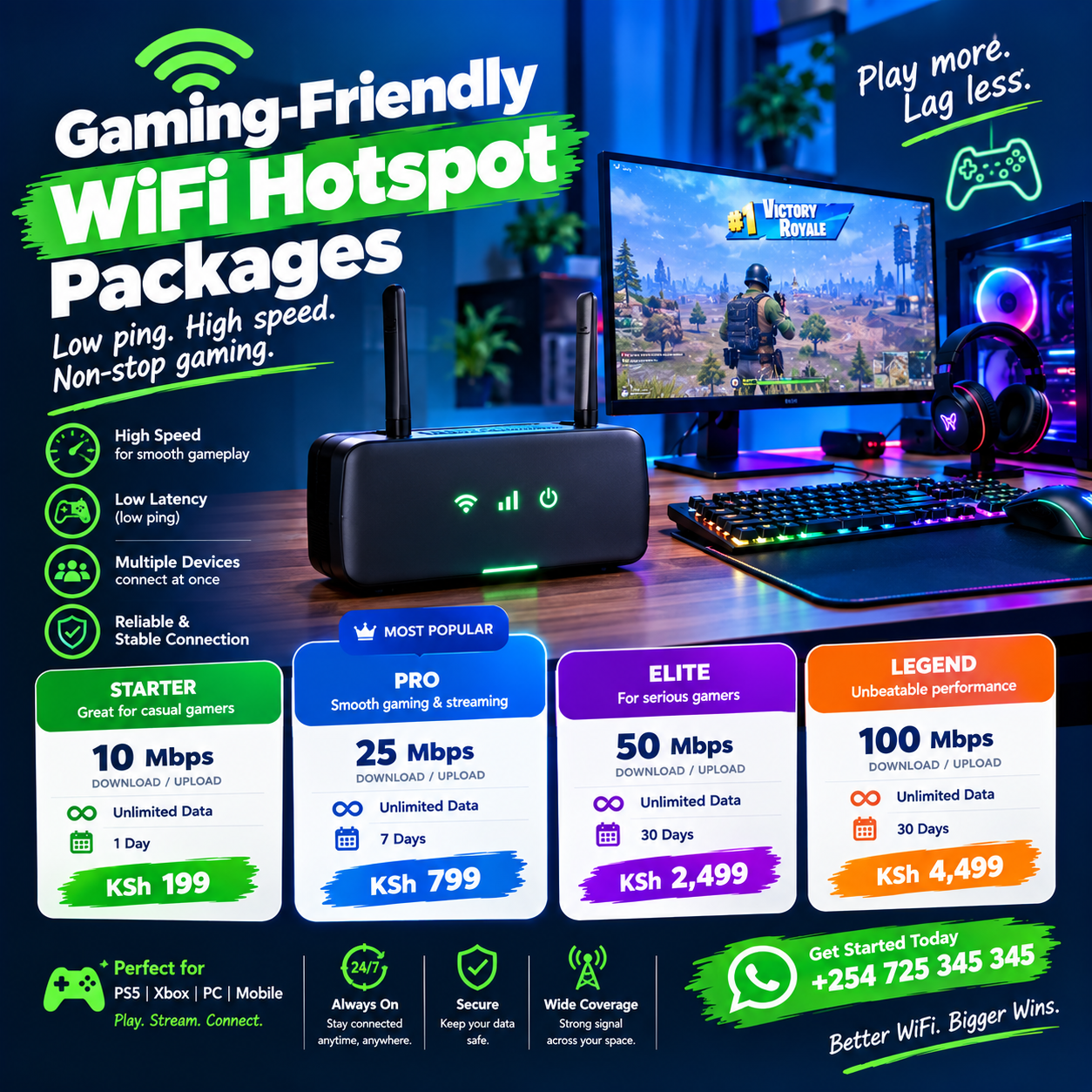
Gaming-friendly WiFi hotspot packages are quietly becoming the most profitable product line in the entire hotspot trade — purpose-built internet offers that turn the most passionate, most loyal, and most demanding customer group in the market into a steady, predictable income stream.
Walk past any hotspot after sunset and you will see them: young people hunched over phones and controllers, consoles glowing in dim corners, FIFA tournaments drawing spectators who stay for hours. Gamers are everywhere in this market — in estates, trading centers, university neighborhoods, and shops with a TV and a console — and they are already spending on data.
The only question is whether they are spending it on your network or struggling through on congested bundles that drop their matches at the worst moment. A gaming-friendly WiFi hotspot packages offering answers that question in your favor: latency engineered for competition, hours built for marathon sessions, and pricing built for the way gamers actually buy.
This article walks through the complete opportunity: what makes a package genuinely gaming-friendly, why gamers out-earn every other customer type, how to price and structure the offers, and how operators turn a few consoles in the corner into the busiest corner of their business.
Because the gaming crowd is not a niche — it is a movement, and gaming-friendly WiFi hotspot packages are how operators claim their share of it.
Table of Contents
ToggleWhat Gaming-Friendly WiFi Hotspot Packages Actually Are
Strip away the jargon and the concept is refreshingly concrete. Gaming-friendly WiFi hotspot packages are internet offers engineered around the one thing games cannot tolerate: interruption.
A standard hotspot package sells browsing time, and browsing forgives everything — a two-second stall while a page loads goes unnoticed. A game forgives nothing: a two-second stall ends a match, loses a rank, and sends the player looking for a better network.
That difference in tolerance is why gaming demands its own product line rather than a rebranded browsing package. A true gaming-friendly WiFi hotspot packages offering addresses four things at once: consistent latency, sustained speed, generous session lengths, and pricing matched to marathon play.
Consistent latency means the connection responds predictably — no spikes when someone in the room starts streaming. Sustained speed means downloads and updates complete in minutes, not the hours that turn a gaming evening into a waiting evening.
Generous sessions mean the package outlasts the tournament, the ranked climb, and the rematch cycle. And the right pricing means the player never hesitates at the portal mid-competition — because hesitation at that moment means the sale is lost to whoever’s network feels faster.
Operators who built around these four pillars describe the same discovery: gamers do not compare prices the way browsers do. They compare feel — and the network that feels alive wins their loyalty permanently. That loyalty, renewed night after night, is the entire commercial promise of gaming-friendly WiFi hotspot packages.
Why Gamers Are the Best Customers in the Market
Every operator who has served both crowds reaches the same conclusion: the gaming customer out-earns the casual browser in every measurable way.
The first reason is frequency. A casual customer buys a session when they need to check something; a gamer buys every time they play — which, for the committed ones, is every single evening. One gamer on gaming-friendly WiFi hotspot packages can out-purchase ten casual browsers across a month.
The second reason is session length. Browsing sessions average minutes; gaming sessions run for hours, and the all-nighter crowd stretches the model even further. Longer sessions mean steadier revenue and fuller seats during the exact hours most networks sit quiet.
The third reason is social gravity. Gamers arrive in packs — squads, rivals, spectators — and one satisfied player recruits their whole circle.A single tournament night can introduce twenty new customers to gaming-friendly WiFi hotspot packages without the operator spending a shilling on marketing.
The fourth reason is tolerance for premium pricing.Gamers pay for performance the way professionals pay for tools — because a dropped match costs them rank, pride, and wagers among friends. The operator whose network actually delivers can price the gaming tier above every other package and watch it sell anyway.
And the fifth reason is the quiet one: gamers are the most forgiving customers about everything except the network itself. Keep their connection alive and they will forgive a plastic chair, a crowded room, and a slow printer. That single condition — an honest connection — is what gaming-friendly WiFi hotspot packages are engineered to meet, and meeting it converts a passing crowd into a resident community.
Latency: The Currency Gamers Actually Pay For
If there is one technical word every operator selling gaming-friendly WiFi hotspot packages must understand, it is latency — because latency is what gamers feel and what they pay for.
Latency is the delay between a player’s action and the game’s response — measured in milliseconds, invisible on a speed test, and unmistakable in a match. A player with high latency shoots after the enemy has already moved; a player with low latency plays in the present tense.
Speed tests can mislead badly here: a connection can post impressive megabits and still lose every match, because raw speed and responsive latency are different qualities.
The sources of latency are knowable and fixable: congestion on the backbone, wireless interference, overloaded equipment, and queueing caused by one heavy user saturating the link.
This is why gaming-friendly WiFi hotspot packages deployments treat latency management as a design feature rather than an accident. Per-user bandwidth caps stop one streamer from ballooning everyone’s ping during the evening match.
Traffic prioritization lets the small, urgent packets of game data jump ahead of bulky downloads. Wired connections for the console corner remove the wireless lottery entirely — the single biggest latency upgrade available to any operator.
And backbone selection matters more than headline speed: a connection that holds steady under load beats a faster one that spikes every time the neighborhood wakes.
Operators who engineered for latency describe the moment the gaming crowd noticed: the room went quiet, the matches got serious, and the same players started arriving every night with friends. That is the sound of gaming-friendly WiFi hotspot packages doing exactly what they were built to do.
The Anatomy of a Gaming-Friendly Package
A gaming-friendly WiFi hotspot packages offering is assembled from a handful of deliberate ingredients, each mapped to how gamers actually behave.
The first ingredient is the session structure.
Gamers think in matches, not minutes — and a match cycle runs thirty minutes to an hour, with rematches stacking behind it. Packages built in two-hour and all-night blocks match that rhythm, so nobody’s session dies mid-tournament.
The second ingredient is the off-peak window.
Gaming’s golden hours are exactly when browsing demand fades — evenings and late nights — which makes gaming the perfect product for the capacity other customers leave idle.
The third ingredient is data generosity.
Modern games download updates measured in gigabytes, and a player whose package throttles mid-update spends the evening watching a progress bar. Gaming tiers built on gaming-friendly WiFi hotspot packages platforms carry fair data allowances — or honest unlimited structures — so updates finish and play begins.
The fourth ingredient is priority treatment.
QoS rules that protect game traffic from bulk downloads keep the latency flat even in a full room, which is the difference between a gaming network and a guessing game.
The fifth ingredient is the social layer: seating, power outlets, and a screen or two — the physical comforts that turn connectivity into a destination.
None of these ingredients is exotic; all of them are deliberate. That deliberateness is what separates an operator selling gaming-friendly WiFi hotspot packages from one who simply has a fast router and hope.
Designing the Package Ladder: Pricing for How Gamers Buy
The package menu is where gaming-friendly WiFi hotspot packages either capture the crowd or confuse it — and the winning ladders follow the gamer’s clock.
The entry rung is the match session: two or three hours priced for the after-school or after-work player. This is the volume seller — the package that converts first-timers who came to watch a friend play and decided to join.
The middle rung is the evening block: five to six hours covering the prime gaming window from supper until midnight. This is where the regulars live, and pricing it as the obvious value pulls players up from the short sessions.
The top rung is the all-nighter pass: unlimited-duration access through the night hours at a premium price. Weekends, tournaments, and holiday marathons all sell this tier — and it monetizes the hours when the network’s other seats sit empty.
Speed tiers cut across the ladder on gaming-friendly WiFi hotspot packages platforms: standard play for the mainstream, and a competitive tier with priority latency for the ranked crowd. The competitive tier is the upsell that sells itself — every player who has lost a match to lag understands its value instantly.
Group and squad pricing adds another layer: bundles sized for a full squad connecting together, priced to reward the pack behavior that gamers naturally exhibit. And event pricing rounds out the menu: tournament-day passes that bundle the whole evening’s play at a single figure.
Operators who built their ladders this way report the same pattern: the evening block becomes the heartbeat of the business, renewed nightly by the same faces — the recurring revenue engine that gaming-friendly WiFi hotspot packages were designed to create.
The Night Economy: Filling the Hours Nobody Else Sells
The deepest strategic value of gaming-friendly WiFi hotspot packages is temporal: gamers monetize the exact hours when every other product line goes quiet.
Study the revenue chart of a typical hotspot and the shape is familiar — a morning trickle, a lunch bump, and a long empty evening after the browsers go home. The gaming crowd reverses that curve entirely.
Their hours begin when the browsers end: after supper, after the chores, after the last matatu of the night. An operator running gaming-friendly WiFi hotspot packages watches the evening transform from the deadest window of the day into the busiest one.
The economics compound beautifully. The bandwidth was already paid for whether anyone used it or not — every gaming session sold at 10 p.m. is nearly pure margin on infrastructure that was idling.
The electricity, the rent, the staff — all fixed, all already spent — suddenly earn a second shift. Operators who did this arithmetic describe the gaming tier as their most profitable line, not despite the off-peak timing but because of it.
Weekends extend the effect: Friday and Saturday nights run at full capacity while competitors’ networks sit dark. School holidays turn the pattern into a season, with daytime sessions filling the gaps the school-year schedule used to leave.
And the late-night crowd brings its own spending: snacks, drinks, and the food-and-drink side revenue that long sessions naturally generate. That transformation — dead hours becoming the best hours — is the quiet revolution gaming-friendly WiFi hotspot packages deliver to any operator willing to stay open for it.
Hardware and Network: Building the Gaming Corner
The technical foundation beneath gaming-friendly WiFi hotspot packages is modest by enterprise standards, and the shopping list is short.
The backbone comes first: a connection chosen for stability under load rather than headline speed — verified with real gaming tests at the actual evening hours, not a quiet afternoon. Operators sizing a backbone for gaming provision for the full room playing simultaneously, plus the streamers and downloaders sharing the link.
The router comes next: a business-class unit with proper traffic control, sufficient session capacity, and the headroom to shape bandwidth intelligently under load. QoS capability is non-negotiable, because gaming-friendly WiFi hotspot packages live or die on how intelligently the router shares the pipe.
Wired access points form the third pillar: Ethernet runs to the console corner, because a cable removes the wireless interference that no configuration can fully fix. A handful of ports and a small switch transform the gaming corner from a wireless lottery into a guaranteed experience.
Power protection completes the infrastructure: backup batteries that carry the network through the evening blackouts that always seem to arrive mid-tournament.
The gaming crowd judges harshly, and a network that folds during a ranked match loses the whole room’s trust at once — which is why the gaming-friendly WiFi hotspot packages professionals never skip the power layer. Cooling and ventilation matter too: a room full of consoles and players heats up, and overheated equipment throttles exactly when the evening peaks.
Finally, the platform underneath must enforce fairly: per-user caps, session limits, and priority queues — the machinery that lets a gaming-friendly WiFi hotspot packages tier deliver what its name promises. None of this requires enterprise budgets; it requires the discipline to build for the worst moment of the busiest night.
QoS and Bandwidth Governance: The Invisible Referee
If latency is the currency, then quality of service is the referee — and gaming-friendly WiFi hotspot packages succeed or fail on how well that referee works.The governing principle is simple: game traffic is small but urgent, while downloads and streams are large but patient.
QoS rules encode that difference — tiny game packets jump the queue, bulk transfers wait their turn, and nobody experiences a stall they can feel. Per-user speed profiles add the second layer: every connected device receives a comfortable baseline, and no single streamer can suffocate the room.
The beauty of this arrangement on modern platforms is that it configures once and enforces forever — gaming-friendly WiFi hotspot packages policies applied identically at midnight and midday, with no human policing required.
Priority tiers refine the system further: the competitive package’s traffic ranks above the standard tier’s, delivering the premium difference that justifies the premium price.
Download scheduling adds cleverness: updates and big downloads can be shaped to yield automatically whenever live matches are running. And the monitoring dashboard closes the loop: latency trends, per-user consumption, and peak-hour patterns visible at a glance.
Operators who read those reports weekly tune their networks the way coaches tune teams — adjusting queues, rebalancing tiers, and spotting congestion before players complain.
The players never see any of this machinery. They simply notice that their matches hold, their pings stay low, and the network feels theirs — which is the entire experience gaming-friendly WiFi hotspot packages are engineered to deliver.
Marketing to the Gaming Community: Where the Crowd Already Gathers
The promotional playbook for gaming-friendly WiFi hotspot packages is unusually effective because the gaming community is already organized — it just needs an invitation.
The first channel is the squad network itself: every gamer belongs to WhatsApp groups, in-person circles, and rival friendships that carry recommendations further than any poster.One satisfied player posting a screenshot of their low ping recruits more customers than a month of flyers.
The second channel is the tournament.
A weekend FIFA or mobile-games competition, run at the operator’s venue with brackets and small prizes, fills the room and introduces the network to every participant at once. Operators who hosted regular tournaments describe them as their single most effective marketing event — the gaming-friendly WiFi hotspot packages trial that converts an entire crowd in one evening.
The third channel is the content creators: local streamers and gaming pages with audiences precisely matching the target market. A sponsored stream from the operator’s venue — showing the low latency live — doubles as a demonstration and an advertisement.
The fourth channel is the physical signal: a small “gaming zone” sign, a visible console corner, and the sound of competition drawing curiosity from the street. Word travels fast in gaming circles precisely because players share networks the way they share tactics.
And the referral mechanics can be formalized: bring-a-squad discounts and group bundles that reward the pack behavior the community already runs on.
The operators who marketed this way all observed the same flywheel: tournaments bring crowds, crowds bring regulars, regulars bring squads, and the gaming-friendly WiFi hotspot packages customer base compounds without a single paid advertisement.
Tournaments and Events: The Gaming Crowd’s Payday
Nothing showcases gaming-friendly WiFi hotspot packages like a tournament night — the single highest-revenue evening the gaming model produces.
The structure is proven and repeatable: an announced bracket, an entry fee bundled with the evening’s play, prizes that cost less than the revenue they generate, and a room packed from dusk to midnight.
The economics work on three layers simultaneously.
Entry fees fill the direct revenue line; every participant purchases the tournament package through the gaming-friendly WiFi hotspot packages portal in one flow. Spectators buy shorter sessions to watch and wait, converting the audience into a second income layer.
And sponsors — mobile shops, beverage brands, phone dealers — pay to put their names on the bracket, adding a third stream the operator brokers once and renews forever.
The reputational payoff outlasts the evening: every player who competed on a stable network carries that experience back to their squad.
Operators who ran monthly tournaments describe the pattern: the first event draws the curious, the second draws the committed, and by the third, the calendar fills itself.
The tournament also stress-tests the network in the best possible way — a full room competing simultaneously proves the gaming-friendly WiFi hotspot packages engineering in public.
And the content generated is free marketing: photos, clips, and results posted across the community’s channels, advertising the next event before it is even announced.
The operator who treats tournaments as a monthly institution rather than an experiment builds the strongest possible moat: a venue that is not just a network but the community’s stage.
That stage — repeated, reliable, and theirs — is what transforms gaming-friendly WiFi hotspot packages from a product into a gathering place.
The Mistakes That Lose the Gaming Crowd
The gaming market punishes mistakes faster than any other segment, and the recurring failures deserve their own list.
The first is overselling the room: more simultaneous players than the backbone carries, until every match lags and the whole crowd leaves together.
Gamers do not complain quietly — they leave loudly, and they take their squads with them.
The second is skipping QoS: one late-night downloader throttling every match in the building, and the gaming-friendly WiFi hotspot packages reputation dying in a single evening.
The third is the hard cutoff: a session expiring during the final match of a ranked climb, converting a loyal customer into a critic with one poorly timed logout.
Grace periods and one-tap extensions exist precisely to prevent that moment — the operators who configured them kept their regulars through every near-expiry.
The fourth is the wireless-only corner: consoles fighting interference while a wired port sat unbuilt, and latency staying a lottery the players eventually stop playing.
The fifth is neglecting the power layer: a blackout ending the tournament mid-bracket, and the crowd remembering which network folded.
The sixth is stale pricing: gaming tiers frozen since launch while the crowd’s habits, games, and expectations evolved.
The seventh is ignoring the dashboard — the gaming-friendly WiFi hotspot packages reports showing congestion patterns and churn warnings that nobody read.
Each mistake is avoidable with the same discipline: size honestly, prioritize game traffic, extend before expiry, wire the corner, protect the power, and read the numbers. The operators who kept those habits watch the gaming crowd become their most stable revenue — while competitors wonder why the players stopped coming.
The Hybrid: Hotspot by Day, Gaming Lounge by Night
The most successful implementations of gaming-friendly WiFi hotspot packages evolve into something bigger: a hybrid space that serves browsers by day and gamers by night, from the same connection and the same platform. The daytime identity is familiar — a hotspot serving students, remote workers, and the passing crowd through the standard portal.
The evening identity transforms the room: consoles in the corner, the gaming packages taking over the menu, and the crowd that arrives as the browsers leave. The transformation requires almost nothing new: the same bandwidth, the same billing platform, the same seating — plus a console or two, a screen, and the wired corner built once.
Operators who made this shift describe the economics as two businesses sharing one cost base. The gaming tier fills the hours the hotspot cannot sell; the hotspot fills the hours the gamers sleep.
And the crowds cross-pollinate: browsers become curious spectators, spectators become players, and players buy daytime sessions for their coursework between matches. The platform manages both identities seamlessly — gaming-friendly WiFi hotspot packages tiers appearing alongside standard packages on the same portal, each priced for its audience.
Space planning matters: a corner that reads as a gaming zone after sunset without disrupting the daytime layout. And the community layer completes it: regulars with their usual seats, tournament nights on the calendar, and a venue that has become the neighborhood’s third place.
That evolution — from access point to destination — is the highest form of the model, and it begins with the same first step every operator took: gaming-friendly WiFi hotspot packages built properly, priced fairly, and delivered night after night.
The Payoff, Counted Honestly
Ask operators a year after building their gaming tier what it delivered, and the answers converge with striking consistency. Revenue in dead hours: the evenings and late nights that once sat empty becoming the busiest, highest-margin windows of the entire week.
The most loyal customers in the market: players who renew nightly, forgive everything except lag, and recruit their squads faster than any campaign could. A venue with a name: the shop or mast that hosts the tournaments becomes the gaming spot in its area — a title competitors cannot buy and players do not surrender.
And a business with a community: regulars, routines, and a calendar that fills itself — the difference between selling access and hosting a gathering. None of it required unusual capital or exotic technology. It required treating latency as the product, pricing around the gamer’s clock, and keeping the connection honest on the nights that mattered.
That is the complete case for gaming-friendly WiFi hotspot packages: the players were always there, the consoles were already glowing, and the only thing the neighborhood’s gamers were ever missing was a network built for the way they play.
The operators who built it describe the shift the same way: they stopped selling internet and started hosting the game. And the game, unlike browsing, never ends — it just queues up for tomorrow night.
Frequently Asked Questions
Do gaming packages really need to be separate from normal packages?
Yes — because gamers buy responsiveness, not just data, and the tier’s engineering (priority, latency protection, session lengths) only exists if it is built deliberately. Separating the tiers on gaming-friendly WiFi hotspot packages platforms is also what lets the premium pricing hold.
What internet speed do I need for a gaming-friendly hotspot?
Stability matters more than headline speed — provision for your full evening room playing simultaneously, with headroom for streamers and downloads. The operators behind successful gaming-friendly WiFi hotspot packages all verified their backbone with real matches at peak hours before selling the first tier.
How do I keep one heavy user from ruining everyone’s ping?
Through QoS: per-user caps, game-traffic priority, and download shaping — configured once on the platform and enforced automatically. That governance is the core machinery of every gaming-friendly WiFi hotspot packages deployment that holds under load.
Should consoles be wired or can WiFi work?
Wired wherever possible — a cable removes the interference lottery and delivers the most consistent latency a player can feel. The wired console corner is the signature upgrade behind every serious gaming-friendly WiFi hotspot packages venue.
What packages should I start with?
A simple three-rung ladder: a two-hour match session, an evening block, and an all-nighter pass — priced against how long gamers actually play. Operators who launched lean with gaming-friendly WiFi hotspot packages refined faster than those who launched with a dozen confusing tiers.
What happens if a session expires mid-tournament?
A countdown, a low-time warning, and a one-tap extension prevent it — and a grace period covers the moment entirely. Operators who configured that safety net on their gaming-friendly WiFi hotspot packages never lost a regular to a mid-match logout.
Can I run tournaments as a business?
Profoundly — entry fees, spectator sessions, and sponsorships stack into the highest-revenue evenings the model produces. Monthly tournaments are the growth engine behind the most established gaming-friendly WiFi hotspot packages venues in the market.
How do I market to gamers without a budget?
Through the community itself: squad WhatsApp groups, one satisfied player’s screenshot, a local streamer’s visit, and a visible gaming corner. Word of mouth inside the gaming crowd is faster and cheaper than any campaign — which is how every gaming-friendly WiFi hotspot packages success story actually spread.
What about power cuts during gaming hours?
Backup batteries are non-negotiable — a blackout mid-tournament costs the whole room’s trust at once. Power protection is listed as core infrastructure in every gaming-friendly WiFi hotspot packages deployment guide for exactly that reason.
Do gamers really pay premium prices?
They pay for performance the way professionals pay for tools — and a network that holds its latency in a full room justifies its tier effortlessly. Pricing power is one of the defining rewards of gaming-friendly WiFi hotspot packages done honestly.
Can I serve gamers and regular browsers on the same network?
Yes — both run on the same connection and portal, with the gaming tier’s priority applied only to its own sessions. That coexistence is standard on platforms built for gaming-friendly WiFi hotspot packages and needs no separate infrastructure.
How much can the gaming tier add to monthly revenue?
Operators consistently report evenings becoming their busiest window — with gaming sessions filling hours that previously earned nothing at all. The night-economy effect is the headline number behind every gaming-friendly WiFi hotspot packages success story.
What is the single biggest mistake to avoid?
Overselling the room past what the backbone carries — because gamers leave loudly, together, and they take their squads with them. Honest capacity is the first commandment of gaming-friendly WiFi hotspot packages.
How do I know my network is genuinely gaming-friendly?
Watch the players: low, steady ping in a full room, matches that hold through the evening peak, and regulars who stop asking about alternatives.
That observable calm — confirmed on the gaming-friendly WiFi hotspot packages dashboard — is the only certification that matters.
What is the smartest first step this week?
Find the gamers already near your network, ask what they play and when, and test your connection with a real match at their real hours.
That one evening of fieldwork — plus a two-tier ladder priced from what you learn — is exactly how every thriving gaming-friendly WiFi hotspot packages business began, and the operators who ran it discovered the same truth every time: the players were already there, spending on lag, waiting for someone to build the network their games deserved — and the gaming-friendly WiFi hotspot packages that answered them turned the neighborhood’s most passionate crowd into its most loyal customers, one match, one squad, and one tournament night at a time.