
Table of Contents
ToggleHardware for WiFi Hotspot Business: Why Choosing the Right Equipment Matters
If you are planning to start a hotspot network, one of the most important decisions you will make is selecting the right hardware for wifi hotspot business operations. Many beginners focus only on internet bandwidth and forget that network equipment determines stability, coverage, customer experience, and long-term profitability.
Across Kenya, hotspot businesses continue growing in estates, apartments, shopping centres, universities, hostels, markets, hotels, and public spaces. The increasing demand for affordable internet access creates opportunities for entrepreneurs willing to invest in quality hardware for wifi hotspot business deployments.
Get quality hardware devices for wifi hotspot from Pawa hardware product catalog.
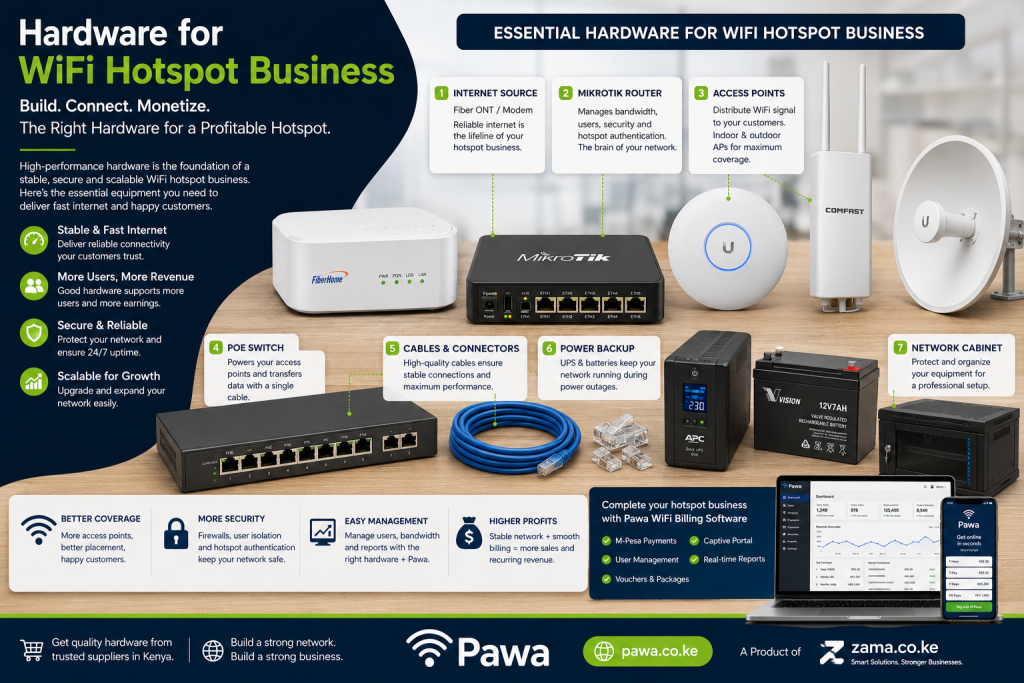
One mistake commonly seen in online guides is the use of vague statements such as “you can make thousands per day” without explaining the infrastructure required to achieve those results. Some hotspot operators on community forums report making between KES 1,500 and KES 2,000 daily in smaller deployments, while larger networks generate significantly more revenue because they have invested in stronger infrastructure, better coverage, and reliable billing systems.
The truth is simple. Your hotspot business can only be as good as the equipment supporting it.
Why Cheap Equipment Often Becomes Expensive
Many first-time operators purchase ordinary home routers because they appear affordable.
Unfortunately, consumer-grade routers were designed for homes with a handful of users, not commercial hotspots serving dozens or hundreds of customers.
Business hotspot networks require equipment capable of handling authentication, bandwidth management, traffic prioritization, user sessions, and payment integrations. Enterprise-grade routers and hotspot systems provide these capabilities while remaining affordable enough for startups. MikroTik routers are widely recommended because they support hotspot management, traffic control, user authentication, and business-grade reliability.
When selecting hardware for wifi hotspot business operations, focus on reliability rather than the cheapest upfront cost.
Understanding the Core Components of Hardware for WiFi Hotspot Business Networks
Every hotspot business relies on several hardware categories working together.
You need internet connectivity, routing equipment, wireless coverage devices, power systems, cabling, and billing software.
Removing any one component weakens the entire network.
The best hardware for wifi hotspot business setup balances performance, scalability, and affordability.
1. MikroTik Router: The Brain of Your Hotspot
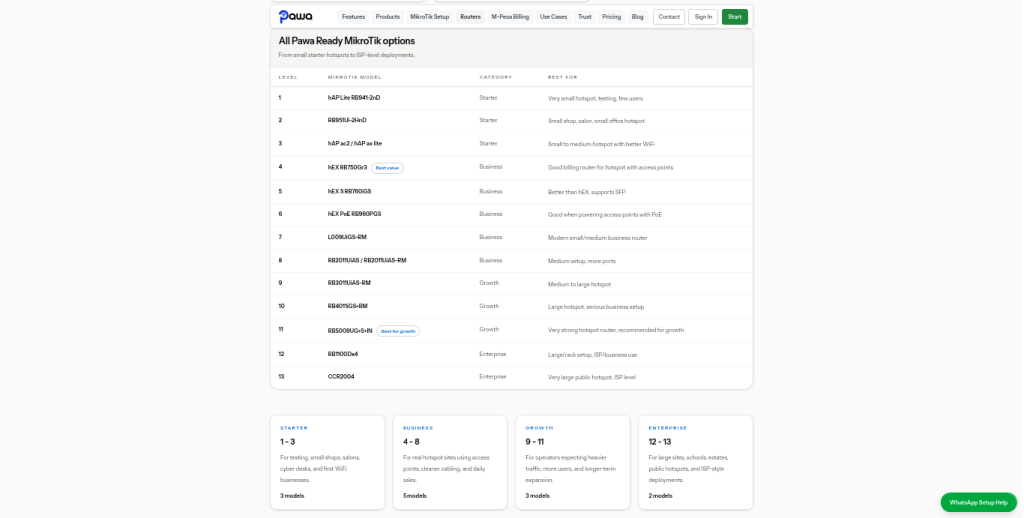
The most important hardware for wifi hotspot business deployments is the router.
A router manages internet traffic, user authentication, hotspot access, bandwidth control, and network security.
MikroTik remains the preferred choice among hotspot operators because of its flexibility and affordability. Industry guides consistently recommend MikroTik for hotspot businesses due to its advanced routing and hotspot management features.
Popular options include:
The appropriate model depends on the number of concurrent users you expect to serve.
For smaller estate deployments, entry-level models may be sufficient. Larger apartment complexes, schools, and market centres often require more powerful devices.
2. Access Points: The Equipment Customers Actually Connect To
While routers control the network, access points distribute the WiFi signal.
Without proper access points, even the best internet connection becomes unusable.
Access points are among the most important hardware for wifi hotspot business investments because they directly influence user experience.
Enterprise-grade access points typically support more simultaneous users, stronger signal quality, and better stability than ordinary home WiFi devices. Modern business WiFi deployments increasingly rely on managed access points with centralized control and monitoring capabilities.
Popular options include:
- Ubiquiti UniFi
- TP-Link Omada
- MikroTik Access Points
- Comfast Outdoor APs
3. Outdoor Access Points for Wider Coverage
Many hotspot businesses serve outdoor locations.
Markets, estates, bus stages, campuses, and shopping centres require outdoor coverage.
Outdoor access points are specialized hardware for wifi hotspot business networks designed to withstand weather while providing long-range connectivity.
Several deployment guides recommend outdoor access points when covering large open areas where ordinary indoor devices would struggle.
A properly positioned outdoor access point can dramatically increase customer reach and revenue potential.
4. Network Switches
As your network grows, connecting multiple access points directly to the router becomes impractical.
A network switch allows multiple devices to communicate efficiently.
Switches are often overlooked when discussing hardware for wifi hotspot business requirements, yet they play a crucial role in scalability.
Managed switches provide additional capabilities such as VLAN segmentation, monitoring, and traffic management.
5. PoE Equipment
Power over Ethernet (PoE) technology allows access points to receive both power and network connectivity through a single cable.
This simplifies installation significantly.
Many enterprise WiFi deployments rely on PoE because it reduces wiring complexity and installation costs. Professional hotspot implementation guides commonly recommend PoE-capable infrastructure for larger deployments.
PoE equipment should be considered essential hardware for wifi hotspot business projects involving multiple access points.
6. Quality Ethernet Cabling
Cables may seem insignificant, but poor-quality cabling causes countless network problems.
Reliable hardware for wifi hotspot business deployments use quality Cat6 or Cat6a cabling whenever possible.
Good cabling reduces signal loss and improves overall network stability.
Professional installers understand that weak cabling can create performance issues even when every other component is functioning correctly.
7. Reliable Internet Source
No hotspot business can operate without internet connectivity.
Fiber remains the preferred option because it provides consistent performance and lower latency.
However, many startups begin with:
- Fiber internet
- Fixed wireless internet
- 4G LTE routers
- 5G routers
The choice depends on location, budget, and customer demand.
8. Backup Power Systems
Power outages remain a challenge in many locations.
A hotspot that goes offline during peak hours loses revenue immediately.
UPS systems and backup power solutions are critical hardware for wifi hotspot business operators who value uptime.
Even a short outage can damage customer trust.
Backup power ensures uninterrupted service during electrical disruptions.
9. Network Cabinets and Protection
As networks expand, equipment organization becomes important.
Network cabinets help secure routers, switches, patch panels, and power systems.
Proper equipment housing protects your hardware for wifi hotspot business investment from dust, theft, accidental damage, and environmental factors.
Professional installations almost always include structured equipment storage.
10. Billing System Hardware and Software
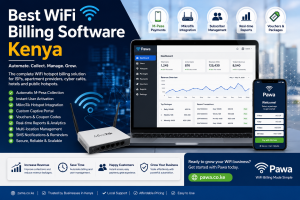
Hardware alone cannot run a hotspot business.
You also need a billing system.
Many operators report that understanding billing systems is one of the most challenging aspects of launching a hotspot business.
This is where Pawa becomes valuable.
Pawa.co.ke provides WiFi hotspot billing automation that integrates with MikroTik routers, M-Pesa payments, user management, voucher systems, and captive portals.
Combining quality hardware for wifi hotspot business infrastructure with automated billing creates a scalable business model.
How to Choose the Right Hardware for WiFi Hotspot Business Growth
One of the biggest mistakes entrepreneurs make when buying hardware for wifi hotspot business operations is purchasing equipment based solely on price. While saving money is important, choosing the cheapest equipment often results in network instability, customer complaints, and costly replacements later.
A better approach is to think about where your hotspot business will be in the next two to three years. If you expect to serve 50 users today but plan to expand to 500 users within a year, investing in scalable hardware for wifi hotspot business infrastructure from the beginning can save significant money and downtime.
Scalability means selecting routers, switches, and access points that can accommodate future growth without requiring a complete network redesign. A hotspot business that expands successfully often experiences increasing demand from neighboring buildings, nearby businesses, and surrounding residential areas. When expansion opportunities arise, having scalable infrastructure allows operators to grow quickly and efficiently.
The most successful hotspot operators understand that hardware should be viewed as a long-term investment rather than a short-term expense. Quality equipment often delivers better reliability, longer lifespan, improved security, and reduced maintenance costs.
Why Network Coverage Determines Customer Satisfaction
Coverage quality is one of the most overlooked aspects of hardware for wifi hotspot business planning. Customers rarely care about router specifications, processor speeds, or networking terminology. They care about one thing: whether the internet works reliably wherever they need it.
Poor coverage creates dead zones where customers experience slow speeds, frequent disconnections, or complete loss of service. These issues quickly lead to negative word-of-mouth and reduced customer retention.
Professional hotspot deployments begin with coverage planning. Operators evaluate building layouts, wall materials, user density, and expected traffic levels before installing equipment. Strategic placement of access points ensures consistent signal strength throughout the coverage area.
For apartment complexes, signal propagation through walls and floors becomes particularly important. In shopping centres, user density may fluctuate dramatically throughout the day. Outdoor deployments must account for distance, weather conditions, and physical obstacles.
The right hardware for wifi hotspot business deployment addresses these challenges through proper design rather than simply adding more equipment.
Security Considerations for Hotspot Operators
Security is another critical factor when investing in hardware for wifi hotspot business infrastructure. Public internet networks face unique security challenges because multiple users access the same network environment.
Without proper security measures, hotspot operators may encounter unauthorized access, bandwidth abuse, account sharing, and malicious activity. These issues can impact both profitability and network performance.
Modern hotspot hardware includes features such as firewall protection, user isolation, traffic monitoring, access control policies, and authentication systems. Combined with a professional billing platform like Pawa, these tools help protect both the operator and customers.
Many business owners underestimate the importance of security until problems occur. Proactive investment in secure hardware for wifi hotspot business infrastructure reduces operational risks and improves long-term sustainability.
The Role of Antennas in Hardware for WiFi Hotspot Business Networks
Antennas are often overlooked when discussing hardware for wifi hotspot business requirements. However, antenna selection can dramatically influence network coverage and performance.
Different environments require different antenna designs. Omnidirectional antennas distribute signals in all directions and are commonly used in estates, public spaces, and indoor environments. Directional antennas focus signals toward specific locations and are useful for long-distance connections between buildings or targeted coverage areas.
In larger hotspot deployments, antenna optimization can improve coverage without requiring additional access points. Proper antenna placement also helps reduce interference and improve signal quality.
Understanding antenna requirements is particularly important for operators serving markets, campuses, hotels, and large outdoor areas.
How Billing Software Complements Hardware Investments
No matter how advanced your hardware for wifi hotspot business setup becomes, the network still requires an efficient way to manage users and collect payments.
Many operators discover that manual customer management becomes increasingly difficult as subscriber numbers grow. Tasks such as activating users, verifying M-Pesa transactions, tracking package expirations, and generating reports consume valuable time.
This is why professional hotspot businesses combine quality infrastructure with automated billing platforms such as Pawa.
Pawa integrates with MikroTik routers and other hotspot systems to automate customer onboarding, M-Pesa payments, package management, vouchers, captive portals, and reporting. The combination of strong hardware for wifi hotspot business infrastructure and automated billing creates a foundation for sustainable growth.
Instead of spending hours performing repetitive administrative tasks, operators can focus on expanding coverage, acquiring new customers, and improving service quality.
Future Trends in Hardware for WiFi Hotspot Business Networks
Technology continues evolving rapidly, and hotspot businesses must adapt to changing customer expectations. The future of hardware for wifi hotspot business deployments will likely be shaped by faster wireless standards, improved network automation, and greater integration between hardware and cloud-based management platforms.
WiFi 6 and newer wireless technologies already offer significant performance improvements compared to older standards. These technologies support more simultaneous users, lower latency, and improved efficiency in crowded environments.
Cloud-managed networking is another growing trend. Operators increasingly prefer centralized dashboards that allow remote monitoring and management of equipment across multiple locations. This capability is particularly valuable for businesses operating networks in different estates, towns, or commercial centres.
Artificial intelligence may also play a role in future hotspot management. Advanced analytics could help operators identify congestion patterns, predict equipment failures, and optimize network performance automatically.
Businesses investing in modern hardware for wifi hotspot business infrastructure today position themselves to take advantage of these future developments.
Building a Competitive Advantage Through Better Infrastructure
Competition in the internet access industry continues increasing. Customers have more choices than ever before, and service quality often determines which provider succeeds.
The strongest competitive advantage frequently comes from reliability. Customers are willing to remain loyal to providers who consistently deliver stable connections, convenient payment options, and responsive support.
Investing in professional hardware for wifi hotspot business infrastructure helps create this reliability. Strong routers, properly designed coverage, backup power systems, quality cabling, and automated billing platforms all contribute to a superior customer experience.
Businesses that prioritize infrastructure often experience lower churn rates, higher customer satisfaction, and stronger referral growth. Existing customers become advocates who recommend the service to friends, family members, neighbors, and colleagues.
This organic growth can significantly reduce marketing costs while increasing revenue over time.
Common Hardware Mistakes Beginners Make
Many new operators purchase equipment without planning for future growth.
They often underestimate customer numbers.
Some buy cheap home routers that fail when user demand increases.
Others install too few access points, creating coverage gaps and customer complaints.
A successful hardware for wifi hotspot business deployment requires planning beyond the first few months.
Think about future expansion before purchasing equipment.
Hardware for WiFi Hotspot Business in Apartments
Apartment internet businesses are among the fastest-growing hotspot models in Kenya.
Residents expect stable internet for streaming, work, online learning, and communication.
Apartment deployments typically require:
- Enterprise router
- Multiple access points
- Structured cabling
- Centralized billing
- Backup power
The best hardware for wifi hotspot business installations in apartments prioritize reliability and consistent coverage throughout the building.
Hardware for WiFi Hotspot Business in Markets and Public Spaces
Markets create different challenges.
Large numbers of users connect simultaneously.
Outdoor conditions affect signal quality.
Coverage areas are often larger than apartment buildings.
The ideal hardware for wifi hotspot business deployment in these environments includes outdoor access points, weather-resistant equipment, elevated mounting positions, and scalable routing infrastructure.
Location quality remains one of the biggest factors influencing hotspot success. Operators frequently note that strategic placement matters as much as technology itself.
Risks and Challenges
Every hotspot business faces risks.
Equipment theft can occur in poorly secured installations.
Power outages may interrupt service.
Internet providers occasionally experience downtime.
Network congestion can reduce user satisfaction.
Hardware failures can impact revenue.
The solution is proactive planning.
Use secure enclosures, backup internet options, quality equipment, and preventative maintenance.
A well-designed hardware for wifi hotspot business deployment minimizes these risks significantly.
Is Investing in Hardware for WiFi Hotspot Business Worth It?
For the right location, yes.
Internet demand continues increasing across Kenya.
Students, tenants, businesses, shoppers, and travelers all require affordable connectivity.
The key is realistic expectations.
Hotspot businesses are not magical money machines.
They require proper planning, quality equipment, customer support, and reliable billing systems.
Community discussions consistently emphasize that infrastructure, location, and operational knowledge matter far more than hype.
If you choose the right hardware for wifi hotspot business setup and combine it with professional billing automation, the business can generate sustainable recurring income.
Final Expansion Strategy for Hotspot Entrepreneurs
The most successful hotspot operators rarely stop at one location. Once a network becomes profitable, expansion opportunities often emerge naturally. Nearby apartment blocks, schools, markets, hostels, and commercial centres may request similar services.
A well-designed hardware for wifi hotspot business setup makes expansion easier because the same infrastructure model can be replicated across multiple locations.
Standardized equipment simplifies maintenance, training, troubleshooting, and inventory management. Operators can deploy new sites more quickly while maintaining consistent service quality.
When combined with centralized billing through Pawa, multiple hotspot locations can be managed from a single dashboard. This allows entrepreneurs to scale efficiently without significantly increasing administrative workload.
Ultimately, quality hardware for wifi hotspot business infrastructure is not simply about connecting people to the internet. It is about building a scalable, sustainable, and profitable digital business capable of serving customers reliably for years to come. By investing in the right equipment, implementing proper planning, and leveraging automation tools such as Pawa, entrepreneurs can create hotspot networks that generate recurring revenue while meeting the growing demand for internet access across Kenya.
Related Software Solutions from the Zama Ecosystem
Businesses expanding beyond hotspot operations often use additional platforms including:
- RentalDesk.co.ke for rental management
- PMS.co.ke for property management
- EstateAdmin.co.ke for estate management
- Prim.co.ke for salon management
- Vega.co.ke for POS systems
- Dereva.co.ke for driver marketplace services
- Vota.co.ke for campaign management
- Zivo.co.ke and ZChat for customer communication
- Dexa.co.ke for workflow management
- Ratibu.co.ke for school management
- ChurchesAdmin.com for church administration
- Fama.co.ke
- Jaat.co.ke
- KayaPro360.com
FAQ About Hardware for WiFi Hotspot Business
1. What is the most important hardware for wifi hotspot business operations?
The router is the most important component because it controls authentication, bandwidth management, and network security.
2. Is MikroTik necessary?
Not mandatory, but MikroTik remains one of the most recommended platforms for hotspot businesses because of its hotspot features and affordability.
3. Can I use a normal home router?
For very small deployments, yes. For commercial operations, enterprise equipment is strongly recommended.
4. How many access points do I need?
The answer depends on coverage area, building structure, user density, and internet demand.
5. Do I need billing software?
Yes. Billing software automates payments, user access, package management, and reporting.
Start Your Hotspot Business with Zama and Pawa
Choosing the right hardware for wifi hotspot business operations is the foundation of a successful hotspot network. Quality routers, access points, switches, power systems, and billing software work together to create a reliable customer experience.
If you are planning to launch or expand a hotspot network, visit Pawa.co.ke
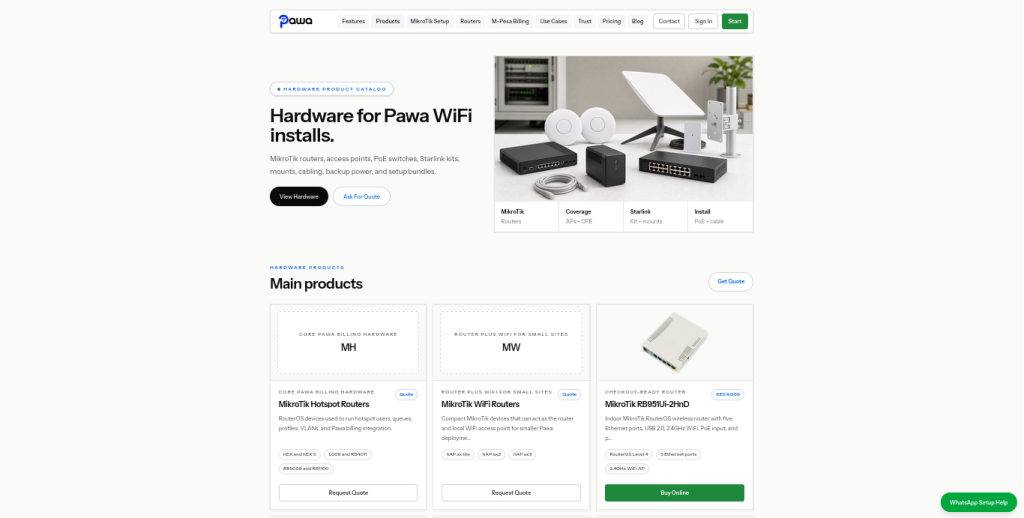
Pawa helps businesses automate hotspot billing, M-Pesa payments, customer management, vouchers, captive portals, and MikroTik integrations, allowing you to focus on growth while delivering reliable internet services to your customers.